
The AI wave is starting to look a bit like the PC era – with some obvious differences. The first similarity is personal productivity. Individuals are taking control of their own work with agents, open tools and repeatable skills, much like power users once did with spreadsheets, word processors, presentation graphics and PCs. The early mandate for AI came from the top – CEOs and boards pushing AI into the enterprise – but the first phase of adoption is increasingly bottom up. People are downloading tools, wiring them into their own workflows and finding ways to get more done without waiting for a formal enterprise transformation program.
But there is a major difference between this wave and the PC era. Agents don’t just create documents, spreadsheets and dashboards. They can act. They can touch data, invoke tools, call applications and, over time, execute work. So if every person, department and vendor builds its own island of intelligence, enterprises will recreate the same silo problem that has plagued software for decades – only faster, with greater operational risk. This may be a necessary step on the journey, but it cannot be the end state.
Our premise in this Breaking Analysis is that personal agents will light the fuse, but sustainable enterprise value will accrue to the platforms that organize business knowledge into a true System of Intelligence (SoI). The system of engagement becomes the new front end – where people interact with agents and get work done. The System of Intelligence becomes the back end – the layer that organizes enterprise data, trust, context, actions and business logic so information becomes human-readable, agent-readable and eventually executable by agents.
This is why Snowflake and Databricks are so relevant right now. Ahead of Snowflake Summit and Databricks Data + AI Summit, we believe these two companies should be viewed in the context of a much larger industry shift. As we said roughly a year ago, both companies have crossed the Rubicon. They are no longer just data platforms serving analytic workloads. They are moving toward the layer where enterprise knowledge, rules, context and eventually business logic become the substrate for intelligent action.
They are not alone. Application vendors, hyperscalers and frontier model companies are all pursuing some version of this control point because whoever helps organizations best model the business will shape how agents reason, decide and act. Frontier models are critical – they are the engine of this era. But owning the model is not the same as owning the enterprise operating context. The System of Intelligence is the world the agent lives in; the model is the engine that reasons inside that world.
This transformation will happen in two motions at the same time, in our view. Bottom up, individuals will build personal agents and skills that immediately improve productivity. Top down, leadership has to guide that energy into an AI-native architecture so those skills become governed assets connected to a shared ontology – not another generation of disconnected tools. The job of the CIO, Chief AI Officer and data leaders is not to slow the movement down. It is to make sure the bottom-up efforts plug into an architecture that prevents new silos from forming.
In this Breaking Analysis, we dig into the emerging AI software stack and unpack how enterprises can move from personal productivity to organizational productivity. We’ll look at how Snowflake and Databricks are pushing beyond their existing data platform swim lanes, how their moves compare with application vendors and model makers, and why the next decade of enterprise AI will be shaped by the battle to organize business knowledge, rules, actions and feedback into a shared System of Intelligence.
The emerging AI software stack
The slide below lays out the emerging AI software stack and gives us a way to describe where the industry is headed. The model builds on concepts from Geoffrey Moore and shows five major pieces: the system of engagement on the left, the system of agency on top, the system of intelligence in the middle, and the data platforms and systems of record underneath. The key idea is that the new stack doesn’t replace all prior enterprise systems in one move. It reorganizes them around intelligence, context and action.
Start with the purple box on the left: the system of engagement. This is not engagement in the social media sense. It is the new front end – the place where humans and agents interact with data, decisions and actions. The right comparison is Windows, the browser or the smartphone. Each of those front ends forced a new backend. Windows ultimately drove client-server computing. The browser drove scalable web backends. Mobile and web drove the cloud. Personal agents and intelligent interfaces are now creating the same kind of pressure. To make the new front end useful, enterprises need a new backend that can organize knowledge, rules, context and business state in a way humans and agents can use.
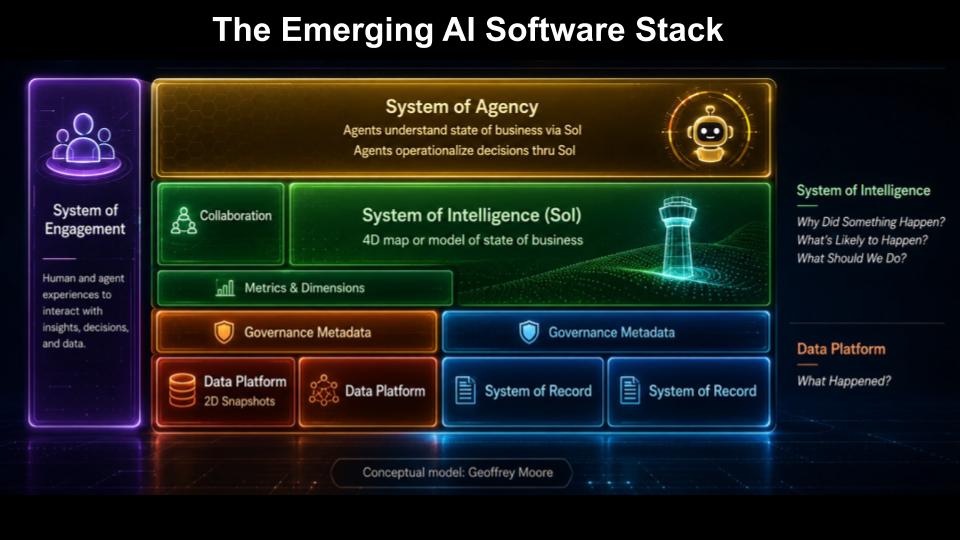
That backend is the system of intelligence – the green layer in the middle of the slide above. This is where the hard work sits. Enterprises have spent decades building islands of operational data and analytic data. Humans bridge those islands today through departments, functional teams, matrix organizations, meetings and tribal knowledge. Agents need something more explicit. They need a harmonized model of the business so they can understand state, apply rules, reason over context and take action with confidence. That means business logic has to become an asset in the same way data became an asset over the past several decades.
The layer on top is the system of agency. That is where agents perceive, reason, decide, act and learn. But those agents are only as useful as the state they can see and the actions they are allowed to take. They understand the business through the system of intelligence and operationalize decisions through it. That’s why the system of intelligence is the high-value layer in this stack. It is the world the agent lives in.
Mapping products to the AI stack
The prior slide gave us the conceptual model. This one below starts putting company names into the architecture, which makes the industry battle lines much easier to see. The point is not to pretend these boxes are fixed or that any vendor fits neatly in only one place. The point is to show where the pressure is building. Snowflake and Databricks started as data platforms, but they’re no longer staying in the bottom layer. They’re moving up into governance with catalogs, into systems of engagement with Snowflake Intelligence and Databricks Genie, and ultimately, toward the system of intelligence. That’s the Rubicon they’ve crossed.
Focusing on the diagram below – on the far left – with the system of engagement. This is where users interact with agents and data. The model makers are pushing hard here. ChatGPT is moving toward Codex. Claude is evolving toward Cowork. When an agent acts on your behalf, it doesn’t just produce text – it emits code, calls tools, manipulates applications and accesses data. In other words, the chat interface is being rebuilt around a coding-agent harness. That’s why Codex and Cowork belong in this engagement layer. They are becoming the new interface for work. This is why Elon is buying Cursor.
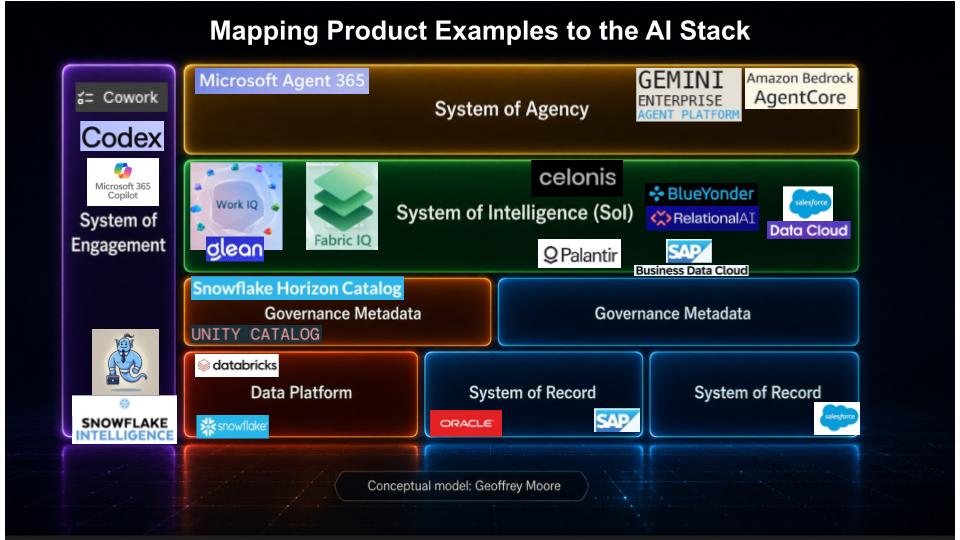
But the model makers have a structural gap. They have powerful models and increasingly capable agent harnesses, but they don’t naturally have the structured enterprise backend. They can generate code, search the web and reason over prompts, but if the goal is to search enterprise knowledge, query governed business data and act inside an organization, that enterprise context has to be organized in a new way. That’s where the data platform vendors, application vendors and ontology players come in.
Snowflake Intelligence and Databricks Genie are early examples of this new front end for enterprise data. They let users talk to data in natural language, but the important part isn’t just the interface. It’s what sits underneath. Snowflake Horizon and Databricks Unity Catalog are attempts to organize governance metadata and definitions so the system knows what the data means, who can access it and how it should be used. That’s still not a full system of intelligence, but it is a starting point.
The green layer – the system of intelligence – is where the bigger race is taking shape. This is where vendors try to organize enterprise data, rules, process context and business meaning into something agents can use. Glean does this around a personal graph of people, documents and interactions. Microsoft has Graph, now expressed through Work IQ and Copilot 365, with Fabric IQ moving toward an ontology layer. Palantir is more mature here with its ontology. RelationalAI, Celonis, Salesforce Data Cloud, SAP Business Data Cloud and others are all trying to own some portion of this enterprise context.
The key distinction is catalog versus intelligence. A catalog gives you definitions. It tells you what a metric means, where data lives, who owns it and what policy applies. That’s necessary, but it’s not enough. A system of intelligence goes further. It begins to model the business process logic itself – not just the nouns, but the verbs. When business rules, relationships and actions become live, governed and eventually executable, the enterprise moves from metadata to intelligence.
That’s why the top layer – the system of agency – gets so much attention, but it depends on what happens below it. Microsoft Agent 365, Gemini Enterprise Agent Platform, Amazon Bedrock AgentCore and others are going after the control and orchestration layer for agents. But agents can only act safely and usefully if they understand the state of the business through the system of intelligence. The hard work isn’t just launching agents. It’s giving those agents a coherent world to operate in.
Our view is that this taxonomy explains the next phase of competition. The model makers will try to bundle model, harness, interface and memory. The application vendors will try to defend their domains. The data platform vendors will move up from storage and analytics into governance, context and intelligence. And the winners will be the platforms that help enterprises model the business with enough richness that humans and agents can ask better questions, get better answers and take safer actions.
Unpacking the system of intelligence
The next slide below moves from the AI stack taxonomy to the long-term architecture we believe enterprises are trying to build – a real-time digital representation of the business, or an enterprise digital twin. This is the North Star. It brings together the reliability of deterministic software – systems of record, BI systems, transaction systems, governed data – with the creativity and generative power of probabilistic systems such as LLMs. The point is not to replace one with the other. The point is to make them work together so agents can coordinate work, assist with judgment and eventually act with increasing confidence.
The reason this is so important, in our view, is that a huge portion of enterprise work today still depends on human judgment. People make exceptions, adjudicate edge cases, apply tribal knowledge, reconcile conflicting signals and decide what to do when the rules aren’t clear. Initially, AI will be strongest in the coordination work – routing, summarizing, reconciling, searching, matching and organizing. Over time, more judgment-oriented work will get incorporated into this digital twin as the system learns from experts and captures the evidence behind decisions. But we do not believe this is here today. This will take years to mature because the enterprise has to model not just data, but rules, context, actions and reasoning.
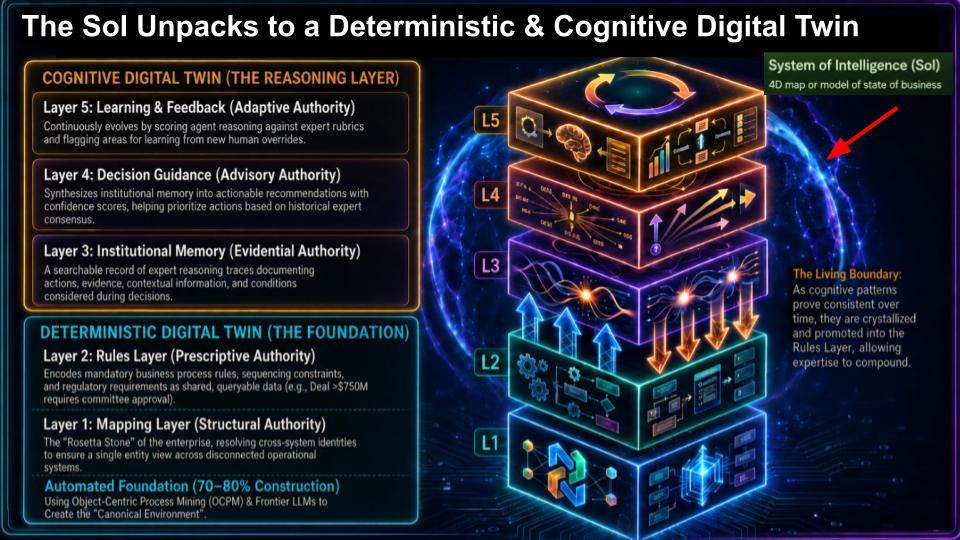
The slide above unpacks the System of Intelligence into five layers. The bottom two layers form the deterministic digital twin – the foundation. Layer 1 is the mapping layer, essentially the “Rosetta Stone” for the enterprise. Large companies have hundreds or thousands of operational applications and islands of analytic data. When the business says “customer,” “order,” “account,” or “asset,” the system has to map that concept across all the different applications and attributes. Without that, you don’t even have a common object model.
Layer 2 is the rules layer. Once the enterprise has common objects, it has to model how those objects interact and how the business must run. These are the deterministic rules that today are embalmed and entombed inside operational applications. Rules such as whether a customer can receive credit, whether an order can ship or whether a workflow is allowed to proceed. Our view is that these rules have to become harmonized assets, just as data became an asset decades ago.
The upper three layers form the cognitive digital twin – the reasoning layer. Layer 3 is institutional memory. This is where the system starts capturing the dark matter of the enterprise – i.e., what happened before, what experts considered, what actions were taken, what evidence supported those actions and what conditions shaped the decision. This is not just a document repository. It is a searchable record of expert reasoning traces.
Layer 4 is decision guidance. This is where institutional memory is synthesized into advice. When a human or agent is about to make a decision, the System of Intelligence can combine the deterministic state of the business with prior expert reasoning and provide a recommendation. Under these conditions, given what happened before and given the current state of the business, what should we do next? That is where AI begins to move from coordination into judgment support.
Layer 5 is learning and feedback, and we believe it is one of the least understood but most important layers. This is the behavioral exhaust of agents. It captures how agents reason, what they do, what evidence they use, when they fail, when humans intervene and how outcomes change as a result. This becomes the new big data. In the 2010s, enterprises collected clickstream data to learn how people interacted with websites. In the agentic era, enterprises will collect agent reasoning and action traces to learn how agents interact with business processes. The volume of this data could be orders of magnitude larger than traditional observability data from cloud-native applications.
The takeaway is that the System of Intelligence is not a single product layer that magically appears in 2026. It is a multi-layer architecture that matures over time. Some pieces already exist. Catalogs, governance metadata, observability tools, process mining, knowledge graphs and agent frameworks all play a role. But the end state is more ambitious and will form a deterministic, cognitive digital twin that understands the state of the business, captures the rules and exceptions, supports human judgment and teaches agents to improve.
That is why the arc of AI initiatives will form over longer periods of time for established firms. CEOs such as Michael Dell, Jamie Dimon, Andy Jassy, Sundar Pichai and others have pushed AI top down. At the same time, individuals are already building agents with tools like NemoClaw, Hermes Agent and other open-source frameworks. The bottom-up movement is real. The challenge is making sure those personal agents and skills eventually plug into this kind of architecture rather than creating another generation of disconnected silos.
Reality: Islands of intelligence will come first
While the North Star is an enterprise digital twin, the real world won’t get there in one clean, unified step. The next slide below shows the more practical and messy path, where systems of intelligence will emerge first around islands of data. Snowflake will try to harmonize and enrich the data it controls. Databricks will do the same around its lakehouse and Unity-centric ecosystem. Salesforce Data Cloud, SAP Business Data Cloud, Microsoft Fabric IQ and others will create domain-specific intelligence layers around the business data they understand best.
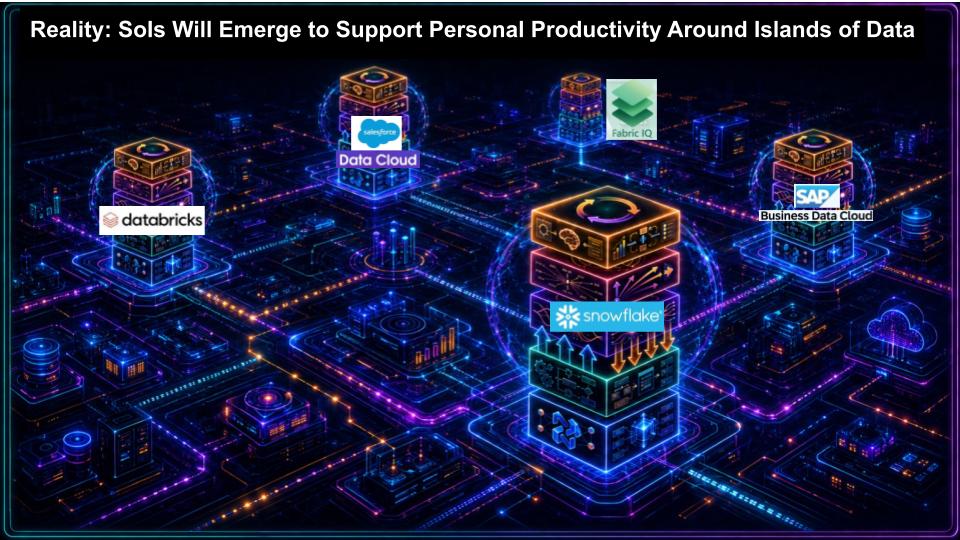
This is not necessarily a bad thing. In fact, it may be the only pragmatic way the market moves forward. Customers already have fragmented estates, and no enterprise is going to wait for a perfect intergalactic digital twin before deploying agents. Salesforce can organize customer-related data. SAP can organize back-office and operational data. Snowflake and Databricks can organize analytic and unstructured data tied to their platforms. These domain-specific layers become early systems of intelligence – not the final enterprise-wide system, but useful overlays that let customers ask better questions and operationalize actions in bounded areas of the business.
The important nuance is that these overlays don’t necessarily extract and replace the customer’s analytic estate. In many cases, they sit above it, synchronize with it, enrich it or cache parts of it so that the vendor can create a more useful model for its domain. Salesforce Data Cloud, for example, is not trying to become the entire enterprise data estate. It is trying to make customer-related data more usable for analytics and agentic actions. SAP Business Data Cloud has a similar ambition for operational and business process data. That means the early market will be full of partial digital twins – each one useful, each one incomplete.
This creates a core strategic tension. SaaS vendors are fighting for relevance in an agentic world. They want to bring their deterministic business logic together with probabilistic AI, partner with the LLM vendors and keep their installed bases inside their own control plane. They don’t want to become passive feeds into Snowflake, Databricks, Palantir or any other horizontal system of intelligence. If they become just another data source, their differentiation and pricing power decline.
That’s why each vendor wants its data layer to be visible to its agents as first-class citizens in high-value workflows. If a vendor owns the operational platform where agents act, it can see the work product, influence the outcome, and potentially price closer to a unit of work or business outcome. If it only feeds data into someone else’s intelligence layer, it gets pushed toward consumption pricing. That is a much less attractive economic position.
Our view is that the next phase will look like a kid’s stacking game. Each vendor will try to put its intelligence layer above the others, make its domain the place where agents operate and attempt to co-opt the workflow. The customer problem is that this can recreate the same fragmented software landscape we already have – only now, with islands of intelligence and agents acting inside each one. That may help personal productivity and domain-specific automation, but it will not deliver the full digital twin vision.
The path forward is to use these islands pragmatically without mistaking them for the destination. Customers should take the productivity gains where they are available, but they should also force vendors toward interoperability, shared governance, common identity, consistent semantics and a broader enterprise ontology. Unfortunately, the history of the tech industry suggests this is a long shot.
Regardless, the greatest value will accrue to the platforms that can model how the business actually works across domains. The scope and fidelity of that model will determine where agents gravitate, what work they can do, and how much of the business they can safely help run.
How the SoI matures: From snapshots to process definitions as data
This graphic below starts to unpack how the foundational layers of the System of Intelligence mature over time. The point is not that enterprises jump from today’s data platforms directly to a full enterprise digital twin. They won’t. The practical path is one that moves through stages, and each stage increases the scope and fidelity of the business model. This is important because the sophistication of the data model determines the sophistication of the analytics, and the sophistication of the analytics determines how much action humans and agents can take with confidence.
This is the key idea behind the following chart. If the data model is shallow, the system can mostly tell you what happened. If the model has harmonized entities and real-time events, the system can begin to diagnose and predict. If the model captures relationships, action spaces, real-time state and process logic, then the system starts moving from analytics into operations. That’s the path from business intelligence to enterprise intelligence.
Snowflake’s recent momentum is a good early example of how this is taking shape. As natural language interfaces make data easier to query, more people query more data. And those queries become more compute-intensive because agents don’t just run static dashboards. They ask follow-up questions, gather context and behave more like a deep research workflow than a precompiled report. That can drive consumption and monetization, which is good for platforms like Snowflake, but it also creates a future cost question for customers. Someone’s budget is going to feel the impact when agentic query becomes mainstream.
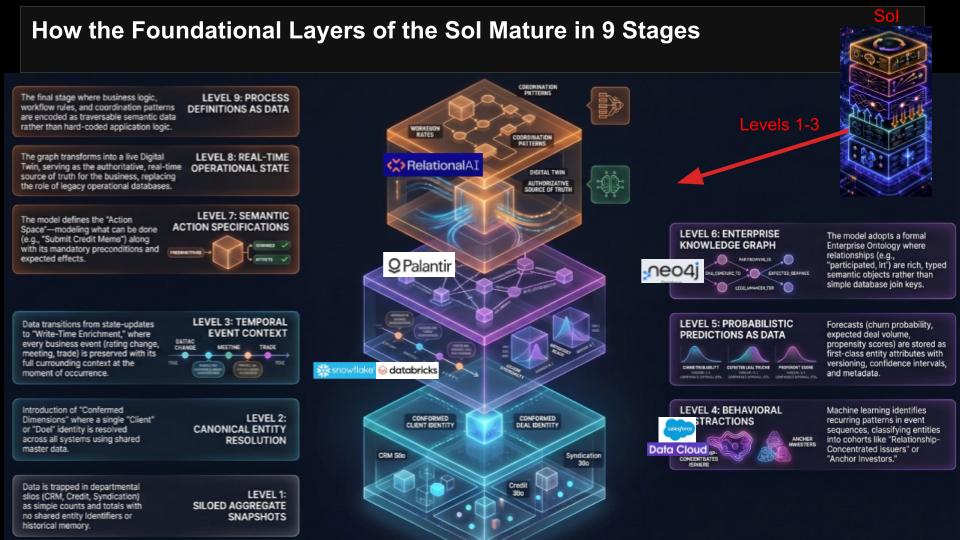
The slide lays out nine levels of maturity as follows:
- Level 1: Siloed aggregate snapshots – departmental reports, metrics and dimensions, with no shared entity identifiers or historical memory. This is the classic BI world.
- Level 2: Canonical entity resolution – the enterprise starts to establish one reference for key entities such as customer, account, product or order.
- Level 3: Temporal event context – real-time updates begin flowing into tables, so every event is preserved with its surrounding context.
- Level 4: Behavioral abstractions – machine learning identifies recurring patterns, such as high-value shoppers, fraud risk, churn signals or concentrated issuer relationships.
- Level 5: Probabilistic predictions as data – predictions themselves become data objects, with confidence intervals and metadata attached.
- Level 6: Enterprise knowledge graph – the model becomes a formal representation of relationships across the business.
- Level 7: Semantic action specifications – the model begins representing what can be done, not just what exists.
- Level 8: Real-time operational state – the graph becomes the live source of truth for the business, replacing the role of older operational databases in some scenarios.
- Level 9: Process definitions as data – business workflows, rules and coordination patterns become data rather than hard-coded application logic.
The lower levels are quite familiar. Most enterprises have been working on versions of levels one through three for years. They have dashboards, reporting cubes, metrics, catalogs, governance metadata and, increasingly, event streams that update data in real time. This is where we expect Snowflake and Databricks to show more progress – especially around natural language query, catalogs, governance and real-time data updates.
The middle levels are where the model becomes more expressive. At level four, the system starts to recognize behavior. At level five, it turns probabilities into usable business signals. At level six, the enterprise starts to represent business relationships as rich objects, not just rows and columns. A sale is no longer just a transaction. It becomes a web of related entities – e.g., customer, order, SKU, promotion, inventory, fulfillment center, carrier, payment, risk and timing. This is where graph thinking becomes important, and why players like Neo4j, Salesforce Data Cloud and SAP Business Data Cloud show up around these middle layers, often in domain-specific ways.
Level seven is where the model starts to become much more interesting. The sale is no longer just a record of what happened. It becomes a set of possible actions – e.g., apply a promotion, reserve inventory, authorize payment, split the shipment, notify the customer, escalate to an agent or pause the transaction. Those actions are not just API calls buried in application code. They become modeled and governed. The system knows what can be done, under what preconditions and with what expected effects. This is why Palantir is shown higher in the stack. Its ontology has pushed further into modeling actions and operational decisions, though often with heavy customer-specific work.
Level eight is the live operational state. The system knows what is happening now, not just what happened last night. It knows the customer’s cart, the current inventory for the product, the payment authorization, the fulfillment center’s load and the carrier pickup window. “Reserved” means reserved now, not a snapshot from yesterday. This is where the System of Intelligence starts to behave more like the operational truth layer.
Level nine is the most ambitious state. Process logic becomes data. Changing how the business runs becomes a data update rather than a code deploy. The system can reason about and improve the process itself. This is still well into the future for most enterprises, but it defines the direction of AI’s enterprise promise. It is why we show RelationalAI near the top of the model. The ambition is to represent business logic, rules, relationships and processes in a way that can be queried, reasoned over and ultimately executed.
The important point for customers is that these levels are not just abstract maturity stages. They determine what questions can be asked, what answers can be trusted and what actions agents can safely take. A level-one system can tell you what happened. A level-three system can update the answer in real time. A level-six system can explain relationships. A level-seven or eight system can recommend and coordinate actions. A level-nine system starts to make the enterprise itself programmable.
Our view is that this is the architecture behind the next decade of enterprise AI. The richness of the data model determines the richness of the intelligence. And the richer the intelligence, the more valuable the agents become. The platforms that help customers move up this maturity curve – without creating yet another set of silos – will be the ones that matter most.
Data foundation maturity: From descriptive analytics to autonomous planning
This section takes the nine-level maturity model and shows why the data foundation determines the analytic ceiling of the enterprise. Said another way, the richer the model of the business, the richer the questions the system can answer. And the richer the answers, the more confidence humans and agents can have in taking action.
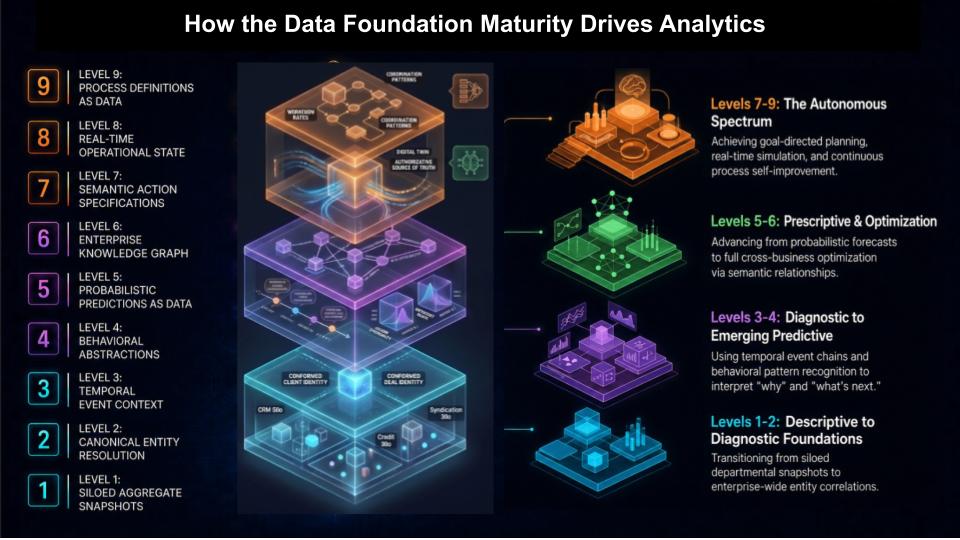
At the bottom of the stack above, levels one and two are again, familiar territory. This is the world of departmental snapshots, metrics, dimensions and entity resolution. A business can ask basic questions such as: do gold-tier customers who bought during the spring promotion spend more per order than bronze customers? That’s useful, but it’s still immature. The individual customer is hidden inside an aggregate dimension. You can see that something happened, but the system can’t really explain why. There’s no sequence, no causality and therefore no grounded recommendation.
Levels three and four start moving the enterprise from descriptive analytics toward diagnosis and early prediction. Events are preserved in temporal order, and behavioral labels get layered on top. Now the system can decompose an outcome into a chain of events. Instead of merely saying a customer purchased a tent, the system can ask: “why did Maria’s tent purchase convert so quickly?” At level four, the pattern gets a name. Maria is a deal-driven replenisher. She responded to a promotion, replenished in a category and moved quickly through the funnel. That’s a different class of analytics because the system is starting to interpret behavior, not just count transactions.
Levels five and six move into prescriptive and optimization territory. Now the system doesn’t just describe Maria’s behavior, it carries continuously updated predictions about her and the entities around her. Maria has a 68% probability of repurchasing in this category within 30 days. She has a 19% churn risk driven by two late deliveries. At level six, those relationships become traversable through a graph. The customer, SKU, promotion, fulfillment center, delivery history, carrier, order and service experience are connected objects. The question becomes sharper, more individual and more actionable.
Levels seven through nine are where the model begins to cross from analytics into operations. At level seven, the business’s possibility space becomes legible. The system doesn’t just know what happened; it knows what can be done. It understands actions with preconditions and effects. For example, across every order currently mid-checkout during the spring sale, which orders are eligible for split shipment and what would that do to delivery time?
Level eight makes the business’s present state knowable. This is the moment when the model is no longer a snapshot. It can answer what is true right now across the business how much tent inventory remains, how many carts contain one, which fulfillment centers are at capacity, and where carrier delays are emerging. At level nine, the business’s operating logic becomes inspectable. The process itself becomes data. The system can ask things like what is the defined path an order takes from cart to settlement, what rules govern each transition, and where do orders actually stall versus where the business assumed they would?
The sequence is as follows:
- Levels one and two count the sale;
- Levels three and four explain the sale;
- Levels five and six prescribe around the sale;
- Levels seven through nine act on and improve the sale.
Our view is this is the practical roadmap for moving from business intelligence to enterprise intelligence. It also explains why the data platform battle is moving up the stack. The value is not just storing more data or running faster SQL. The value is increasing the representational sophistication of the business model so the enterprise can ask better questions, get more confident answers and eventually allow agents to take bounded action.
That’s the key point for buyers heading into Snowflake Summit and Databricks Data + AI Summit. Natural language query and agentic analytics will make data more accessible and will likely drive more consumption. But the strategic question is not only, “Can I talk to my data?” The question is also, “How far up this maturity curve can my platform take me?” Because the answer determines whether AI remains descriptive and advisory, or becomes prescriptive, operational and eventually self-improving.
Range of actions: Data maturity gates agent autonomy
The prior section focused on the maturity of the analytic data foundation – how the enterprise moves from siloed metrics and static snapshots toward richer models that can diagnose, predict, prescribe and eventually simulate. The following slide takes the next step and asks “what can agents actually do at each level of maturity?”
The answer is that agent action is gated by the sophistication of the data model and the analytics built on top of it. Dropping ChatGPT, Claude or any frontier model into the enterprise is only the first step. Models can reason, but the enterprise has to give them a structured representation of the business. The richer that representation, the more sophisticated the analytics can become. And the more sophisticated the analytics, the more action the agent can safely take.
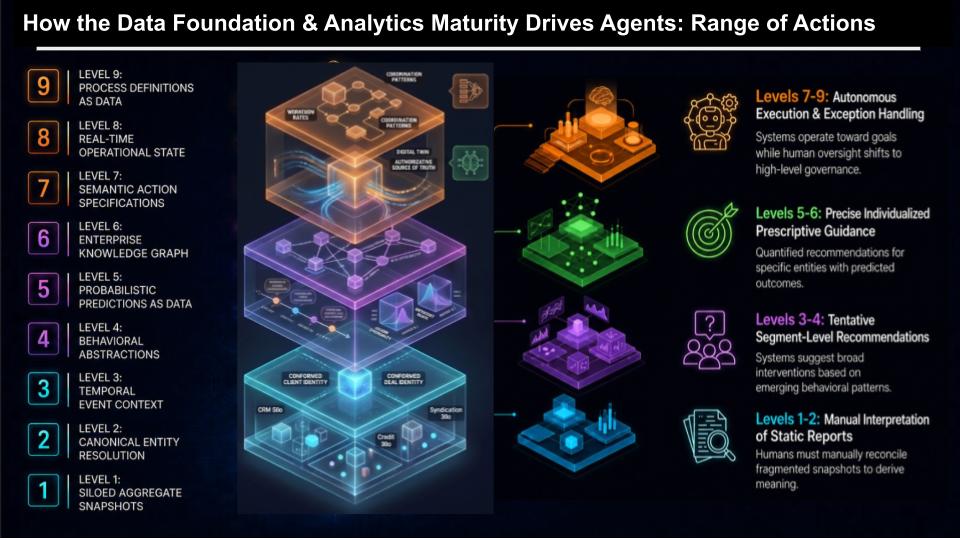
At levels 1 and 2, there is essentially no real agent action. This is the “talk to your data” phase that vendors began showing last year. Agents can read data, use metrics and dimensions, answer questions in natural language and generate dashboards or conversational responses. This is where capabilities like Snowflake Intelligence and Databricks Genie begin. They make data more accessible, but humans still interpret the output and decide what to do. The system can help find information, but it is not yet operating the business.
There is an important implication here for the BI layer. Once the system of engagement can generate the user interface based on governed metrics and dimensions, the dashboard becomes less handcrafted and more dynamic. If a platform owns the metric and dimension definitions, it can generate the dashboard on demand. That is why control of the semantic layer matters so much. The BI tool becomes less important if the system of engagement can create the interface directly from trusted business definitions. This is one reason Microsoft’s move to constrain Databricks’ Power BI access is notable. The fight is not just over dashboards – it is over who controls the definitions that generate the business view.
Levels 3 and 4 move into tentative segment-level recommendations. This is where the system starts seeing behavioral signals and can recommend actions for cohorts. A Salesforce Data Cloud-style example might say things like similar customers showing Maria’s hesitation pattern convert at a much higher rate when sent a discount within 48 hours. That is a useful recommendation, but it is still heuristic. A marketer still decides whether to act. An agent may execute the campaign, but a human initiates or approves the decision.
Levels 5 and 6 become more precise and individualized. The system is no longer making broad cohort suggestions. It can generate quantified recommendations for a specific entity, customer, account, order or asset. For example: Issue Maria free shipping, which is predicted to reduce her churn risk from 19% to 7%. That is materially different from “run a campaign for this segment.” The recommendation is tied to a specific customer, specific predicted outcome and specific action. Humans are still in the loop, but the system is beginning to provide decision-grade guidance.
Levels 7 through 9 are where the action model changes. At level 7, actions themselves are modeled. The agent can reason about an action space rather than merely invoking a hard-coded API. It can understand that the goal is to retain Maria at an acceptable margin, resolve her delivery complaint, and then issue a retention offer. Autonomous execution begins here, but only within governance bounds.
At level 8, the agent acts against live business state. If the system sees mid-flow that the tent Maria wanted has just gone out of stock, it can substitute an alternative, recommend a different offer or stop the action before triggering something the company cannot fulfill. Human oversight moves from approving every step to handling exceptions.
At level 9, the process itself becomes data. The agent is not just executing the process; it is learning how the process should improve. It may discover that resolving complaints before issuing promotions retains deal-driven buyers like Maria more effectively. The system then has the basis to recommend or eventually adjust the process.
Here’s the flow:
- Levels 1-2: humans interpret static reports;
- Levels 3-4: systems recommend broad segment actions;
- Levels 5-6: systems recommend quantified individual actions;
- Levels 7-9: agents discover, plan, execute and improve within governance bounds.
This is also where the backup and recovery discussion becomes more strategic. In a mature agentic system, the enterprise is not only backing up data. It is capturing the state of the business – what the agent knew, what it reasoned, what action it took, which tools it invoked and why the decision was made. That is the foundation for trust, recovery and learning. If the agent does something wrong, the organization needs to understand not only what happened, but the logic that drove the action.
The takeaway is that agent autonomy is not a switch. It is a maturity curve. The richer the data foundation, the more sophisticated the analytics. The more sophisticated the analytics, the more range of action agents can safely take. Enterprises should not confuse “talk to your data” with autonomous operation. They are related, but they sit at very different levels of maturity.
Critical emerging layers: where agents learn, prove and improve
This final slide below zooms in on layers three, four and five of the System of Intelligence because these are the layers that will determine whether enterprises merely deploy agents – or actually build learning organizations around them. The bottom deterministic layers are necessary because they map the business and encode the rules. But the top layers are where the system begins to capture judgment, institutional memory and the reasoning exhaust required to improve agents over time.
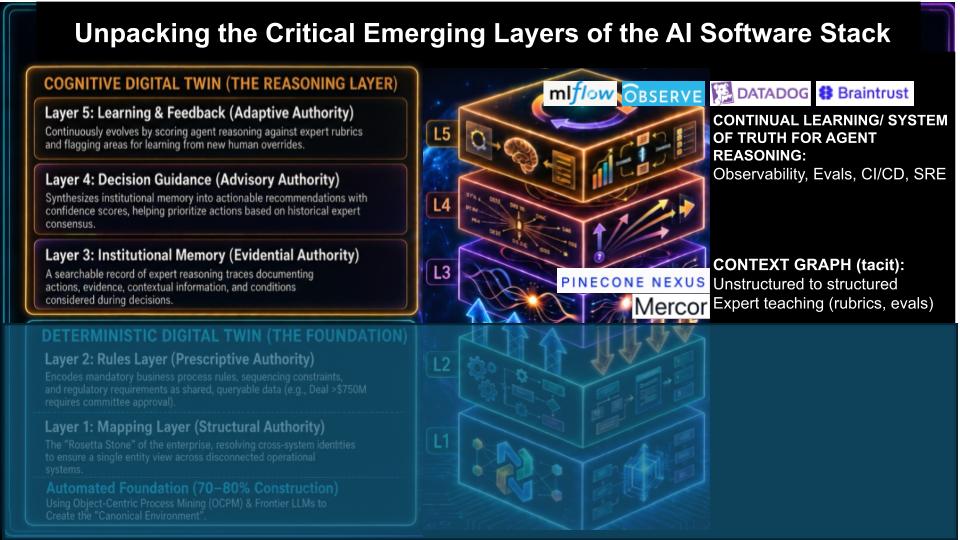
The most important layer here is Layer 5 – learning and feedback. We believe this becomes the new source of truth for agent reasoning. In the database world, the write-ahead log was the real source of truth because it recorded what happened before the tables were updated. In the agentic world, the equivalent source of truth is the observability substrate that captures how agents reasoned, what context they pulled in, what tool calls they made, what the tools returned, how subagents interacted and what state of the business existed when a decision was made.
This is a much bigger data problem than traditional cloud observability. Clickstreams drove the big data movement because they created orders of magnitude more data than traditional analytic systems were built to handle. Agent exhaust could create another step-function increase – potentially 1,000x to 100,000x more data than what observability platforms captured for cloud-native applications. And this is not just after-the-fact diagnosis. It becomes the system that teaches agents, scores their reasoning, gates their release and monitors them in production.
That is why observability, evals, CI/CD and agent reliability engineering collapse into one substrate. Evals score how an agent reasoned. Those scores become gates in the deployment process. The same traces are used to improve the next version of the agent. And in production, reliability agents can use that same substrate to intervene when another agent starts to drift, fail or violate policy. This is why Snowflake bought Observe, why Databricks is extending MLflow toward agent observability, why Datadog is well positioned around this layer and why newer players like Braintrust may be more valuable than people realize. The market may still think of this as monitoring. We think it is becoming the learning system for agentic software.
Layer 3 is the other crucial piece. This is the context graph – but not in the shallow “throw documents into RAG” sense. We believe classic RAG is insufficient because it fails to capture much of the structure embedded in documents, conversations, policies, contracts and expert communications. The enterprise has to move from unstructured to structured knowledge. That means extracting, representing and serving the 90% of corporate knowledge that lives outside traditional databases.
This is a new form of data engineering. The old data engineering model took operational data and transformed it into analytic data through pipelines. The new model takes knowledge assets – documents, Slack threads, emails, contracts, policies, call notes, process documents – and extracts structure from them so agents can reason over them. Pinecone’s move beyond simple vector embeddings toward Nexus is a good example of this direction. The point is not “vector search is enough.” The point is that enterprise knowledge has to become structured enough to be part of the System of Intelligence.
The second part of Layer 3 is expert teaching. This is where domain experts show the system how to reason through a hard decision. They document what good reasoning looks like, what evidence matters, what tradeoffs apply and how to grade the quality of the decision. Firms like Mercor sit in this expert-teaching lane, helping create rubrics and evaluations that can be used to train and assess agents. This is important because many business decisions are not deterministic. The rules may conflict. The evidence may be incomplete. External context may change the answer. When that happens, agents need more than access to documents – they need examples of how experts reason.
Layer 4 is where that institutional memory turns into guidance. The system synthesizes prior expert reasoning, deterministic business rules and the current state of the business into recommendations. In some cases, the confidence will be high enough for an agent to act. In other cases, the system will surface the evidence and ask a human to make the call. Either way, the result feeds back into Layer 5, where the decision, the reasoning and the outcome become part of the learning loop.
The takeaway is that the System of Intelligence is not just a semantic layer or a catalog. It is a living system that captures knowledge, reasoned judgment, agent behavior and feedback. These layers explain why data platforms, observability vendors, model makers and agent frameworks are all converging on the same territory. The risk for customers is lock-in. If the agent platform owns the observability, the evals, the memory and the learning loop, switching models or platforms becomes extremely difficult. That is why enterprises should think carefully about who owns these layers and how portable this intelligence will be over time.
Our closing view is that personal agents will spark the productivity boom in enterprise AI, but enterprise advantage will ultimately come from learning systems. The firms that win will capture how work gets done, how decisions are made, how agents reason, and how the business improves from every interaction. That is the foundation for moving from personal productivity to organizational intelligence.
Action item
Build the enterprise intelligence architecture before agent sprawl hardens.
Chief AI Officers should encourage bottom-up adoption of personal agents, but only inside a top-down architecture that prevents a new generation of intelligence silos. Every agent, skill, workflow and data product that proves useful should have a path to become a governed enterprise asset – tied to common identity, shared ontology, data governance, policy, observability, evals and audit trails. The mandate is not to slow experimentation; it is to make sure local productivity gains feed organizational intelligence rather than disconnected pockets of automation.
The biggest trap is letting each department – or worse, each vendor – define its own system of intelligence. Frontier models are critical, but the enterprise operating context cannot be outsourced blindly to a model maker’s bundled agent environment. The Chief AI Officer’s job is to work in concert with the business and technical teams to define the architecture where agents can reason and act safely across the business. Shared data definitions, business rules, process context, agent traces, learning loops and governance should be incorporated intentionally. Personal agents light the fuse; the enterprise-wide System of Intelligence determines whether that energy becomes a durable advantage or another silo problem moving at machine speed.