Ahead of CoreWeave’s Fully Connected conference, we have made a notable investment in proprietary customer research with Qualitate. Rather than simply repeat the earnings call, we went to the people evaluating, buying and running the infrastructure. This analysis draws on thirteen in-depth interviews and more than seven hours of interview time. We then compared that data with CoreWeave’s financial disclosures and the public statements of CEO Michael Intrator and CFO Nitin Agrawal.
Our research indicates that GPU scarcity opens the door for CoreWeave, but performance, cost and the operating experience give customers reasons to stay. Inference is growing alongside training. Notably, training is not declining at the expense of inference. Inference is growing on a very steep curve and training workloads continue to grow as well. At the same time, the hyperscalers remain deeply embedded in the application estate, and not every successful CoreWeave PoC turns into a signed customer.
The question is whether CoreWeave is converting a GPU availability advantage into a durable AI cloud. We believe the customer evidence strengthens that case. It also shows exactly where the case still needs work.
Welcome to this week’s Breaking Analysis #328 CoreWeave’s next text…From GPU scarcity to a durable AI Cloud.
Access the full slide deck with survey details in the appendix.
Survey sample and customer profile
Below we look at who participated in the research project and why these inputs are so important. Our goal was to complement public information with deep customer evidence and go beyond another earnings recap. We commissioned the study through Qualitate, our data partner and key contributor to the research design and execution.
We designed this study to answer a key set of questions.
- Why do buyers choose CoreWeave?
- Which workloads do they put on the CoreWeave platform?
- What would cause them to place a workload in a hyperscale cloud?
- And where to neo-clouds fit into the buying decision?
- When does on-prem ownership make more sense?
Notably, these results are based on in-depth conversations with CoreWeave customers and prospects that have evaluated the platform. The methodology consolidates the findings of structured conversations with open-ended answers. These are not a series of multiple-choice clicks.
As shown here, the research includes thirteen interview records, with more than seven hours of conversations. Nine respondents work at organizations classified as large enterprises. The panel spans healthcare, technology, financial services, professional services, retail and one organization we classified as other. It includes buyers in the United States, Canada, the Netherlands, the United Kingdom and Germany.
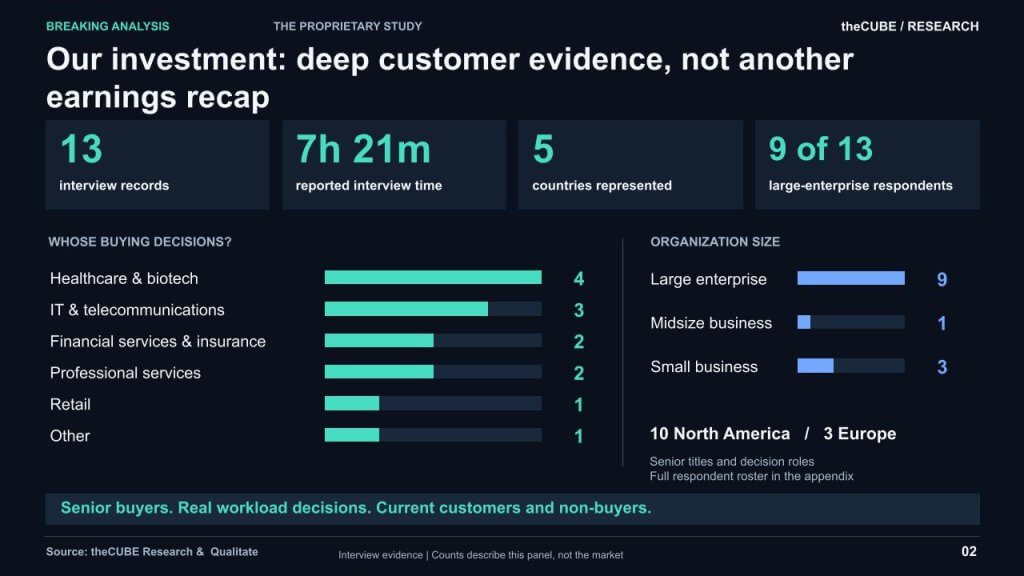
The titles were generally senior people ranging from a field chief officer and vice president to directors, a functional head and a senior manager. They all had influence over or final decision-making authority for the buying decision with budget approval, technical evaluation and operating responsibility. We are not presenting this as a statistically representative market survey. Its value is the depth of evidence about actual buying decisions, including decisions that did not favor CoreWeave.
Importantly, this is not a collection of thirteen happy customer references supplied to us by CoreWeave. We sourced these interviews working with our friends at Qualitate to get to the ground truth. The panel includes users, evaluators and even buyers who evaluated and passed on doing business with CoreWeave.
Testing Mike Intrator’s claim
Demand is broadening beyond the largest AI buyers
In his statement, Intrator is addressing investor concerns around high customer concentration with AI labs and hyperscalers. Let’s see what the survey respondents said…
Of the thirteen customers, seven respondents report significant current CoreWeave use. This includes one financial-services account that is still combining pilot and evaluation activity with some production load. Three are evaluating. One completed a successful pilot but has not rolled out the product. Two decided not to proceed with CoreWeave: one stayed with Azure and one chose on-prem infrastructure.
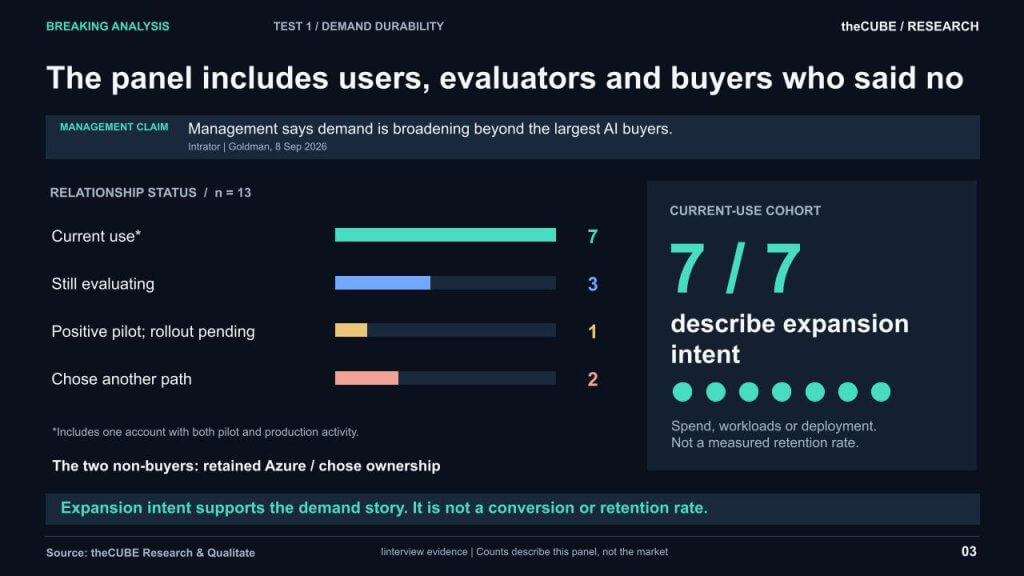
Among the seven current-use respondents, all seven describe an expansion-oriented future outlook for CoreWeave spending or workloads. Some expect to move into a higher spending band; others expect to grow within their existing band or add production usage. The current-use group ranges from below one hundred thousand dollars in reported annual spending to above five million dollars. See the appendix for more details.
This supports management’s argument that enterprise demand is becoming real and recurring. But the other six interviews are equally important. Positive AI demand does not automatically become CoreWeave revenue. A buyer can like the technology and still face an operating, financing or end-customer-demand constraint. We therefore keep current use, evaluation and future intent separate.
Let’s now explore what brings those buyers through the door, and what makes them stay?
GPU Scarcity brings customers in, what keeps them there?
Intrator on his Q2 earnings call says platform quality brings customers back and expands their footprint.
Let’s test that.
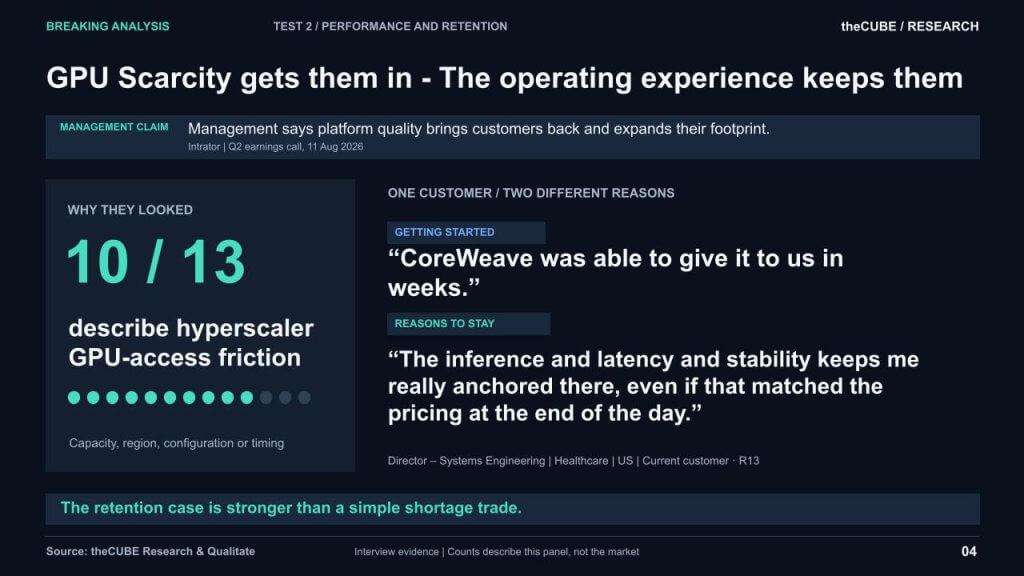
Ten of the thirteen respondents describe specific hyperscaler GPU-capacity or product access friction as part of the buying decision. That includes lead times, regional availability and difficulty obtaining a desired configuration.
Now, look, we’re not saying ten people independently named one identical issue as their single most important reason. Remember what we said last week – Qualitate builds the buckets on the read not the write – meaning instead of forcing customers to respond to multiple choice questions, the responses are encoded after the survey is complete. This is done by grouping the responses into logical categories. So the coding preserves the distinction between categories.
The more interesting evidence is what happens after the initial purchase. A healthcare IT director says CoreWeave delivered capacity in weeks, versus having to wait months from AWS. In the same interview, the customer says CoreWeave’s better inference latency and stability would keep the relationship in tact – even if competing prices improved. That demonstrates evidence of value beyond initial availability and supports Intrator’s claims.
Other current users describe enterprise support, reliable multi-node performance, Kubernetes fit and the ability to match GPU type to the workload as key factors in the buying decision. These are all operating benefits. Our research hence supports management’s claim that the customer is buying more than a chip-hour. But we would still avoid treating this as universal price advantage, particularly as contract structures and market prices change.
With supply shortages and a quality advantage, CoreWeave, we believe, has pricing power and will likely use it. So the buying decision will depend on the the ability for its customers – like Caterpillar, which is frequently mentioned, to monetize AI infrastructure on their end.
The premise is value is now extending across the AI lifecycle, not stopping when training ends.
Our findings confirm this.
Inference is growing but it does not mean training is shrinking
Intrator at the Goldman conference and in his earnings calls emphasizes that CoreWeave doesn’t think about infra for training and separate infra for inference. Rather they think of it as AI Infrastructure.
The customer evidence supports that notion. All seven current-use respondents describe inference running on CoreWeave, alongside training, fine-tuning or model-development activity.
The chart below shows the quote from one healthcare customer, saying inference growth is stacking on top of the baseline rather than replacing it. Its training-to-inference mix moved from ninety-ten in the first year to sixty-forty today, with a roughly fifty-fifty mix expected in twelve months. That is a change in mix. It does not tell us that training volumes fell. A separate buyer explicitly says training remains steady as new model generations arrive, while inference stacks on top of that baseline.
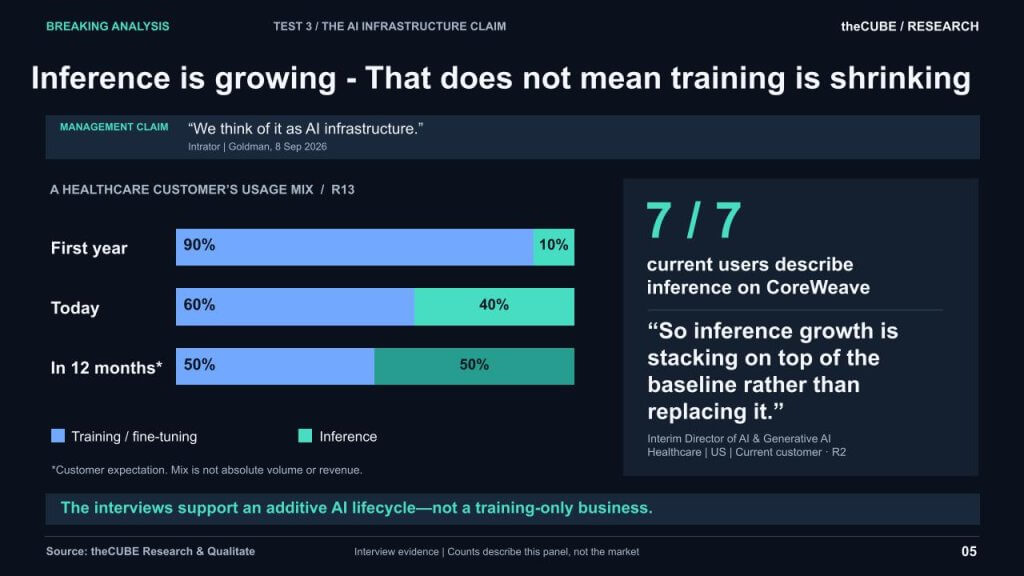
This is important to the business model. CoreWeave can initially engage through a training need and stay involved as models reach production. Other buyers may enter through inference and then add model development. We believe that dynamic supports a recurring AI workflow. It does not establish that every workload uses identical hardware or that inference already accounts for most of CoreWeave’s revenue.
But winning the AI workload does not mean winning the whole cloud estate. So let’s examine how the hyperscalers fit into the equation.
The data suggests Hyperscalers keep the app estate and CoreWeave gets the AI work
This is consistent with Intrator’s claims that its dominant swim lane is the layer required for AI workloads.
In our view, this is the most important competitive finding. All seven current-use respondents retain hyperscalers in their broader environment. That is not the same as saying the hyperscalers own most of every customer’s GPU budget. As shown below, a large technology buyer places ten to twenty-five percent of its GPU spending with CoreWeave. Another healthcare buyer places more than half there. Both retain a broader hyperscaler relationship.
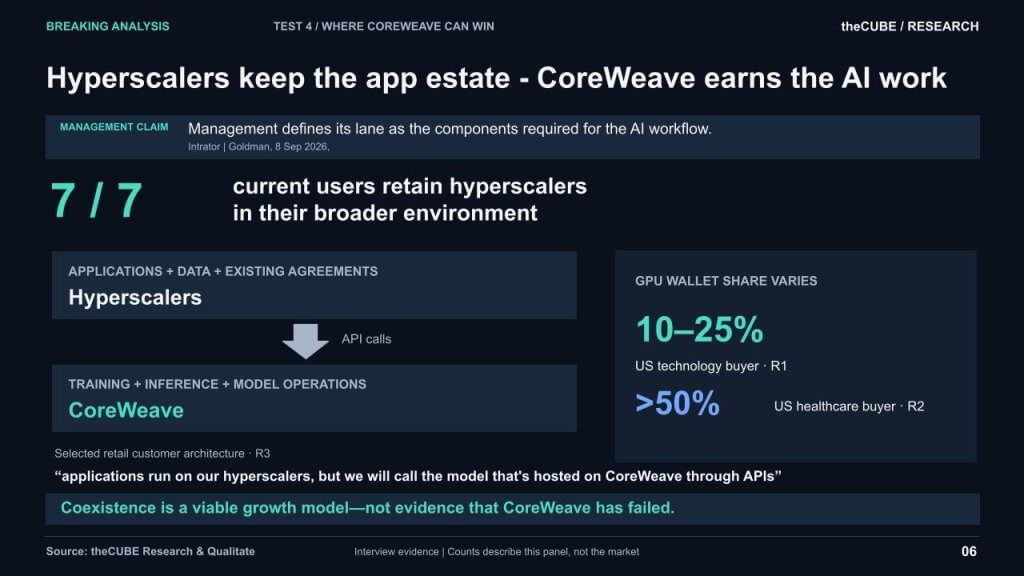
The retail director explains the architecture in the following sentence as we show above: applications run on the hyperscalers but we call models hosted on CoreWeave through APIs. That underscores the division of labor between CoreWeave and the hyperscaler. Existing application services, data platforms, governance and commercial agreements favor the incumbent hyperscaler. We saw this in many of the conversations. Specialized AI performance and operating experience are the wheelhouse of CoreWeave. CoreWeave competes on a superior experience and the premise is this will allow CoreWeave to maintain its position.
Nonetheless, we believe the hyperscalers have secured a durable position in the application estate over many years. CoreWeave does not need to rebuild every one of those services to win valuable AI workloads. But the risk to evaluate for investors is that better hyperscaler GPU availability and economics make consolidation on the incumbent cloud more alluring. The opportunity for CoreWeave is to make the AI layer valuable enough that customers choose to keep it separate. And expand its service offerings including networking, storage and software.
We have seen this portfolio expansion with CoreWeave and other neo-clouds. CoreWeave specifically, is expanding its portfolio in a way reminiscent of AWS in its early days. As well, acquisitions like Weights and Biases provide valuable AI visibility tools for customers. And Omni, is the company’s AI stack CoreWeave will license for use in private data centers.
So we see CoreWeave pioneering in AI clouds in many ways that have proven effective. Essentially, one could argue that CoreWeave is becoming an AI hyperscaler. The company bristles when you refer to them as a neo-cloud. So ultimately, like AWS, it will be the operating quality that sets CoreWeave apart from other GPU clouds.
Let’s dig into that for a bit…
Testing neo-clouds around operating quality, not just GPU supply
Sticking with our framework of testing management claims…
Intrator said at the Goldman Sachs conference that purpose-built infrastructure and software create a performance advantage relative to neo-clouds.
The customer interviews support a meaningful quality distinction within the GPU-cloud/neo-cloud category. The best evidence is a healthcare buyer that evaluated Lambda and other providers. The exact quote from a Director of AI & GenAI in Healthcare is CoreWeave edged out Lambda Labs mainly due to superior enterprise support, also cluster availability at scale, and also better flexibility. Those are requirements for a working AI service, not simply access to the same NVIDIA hardware.
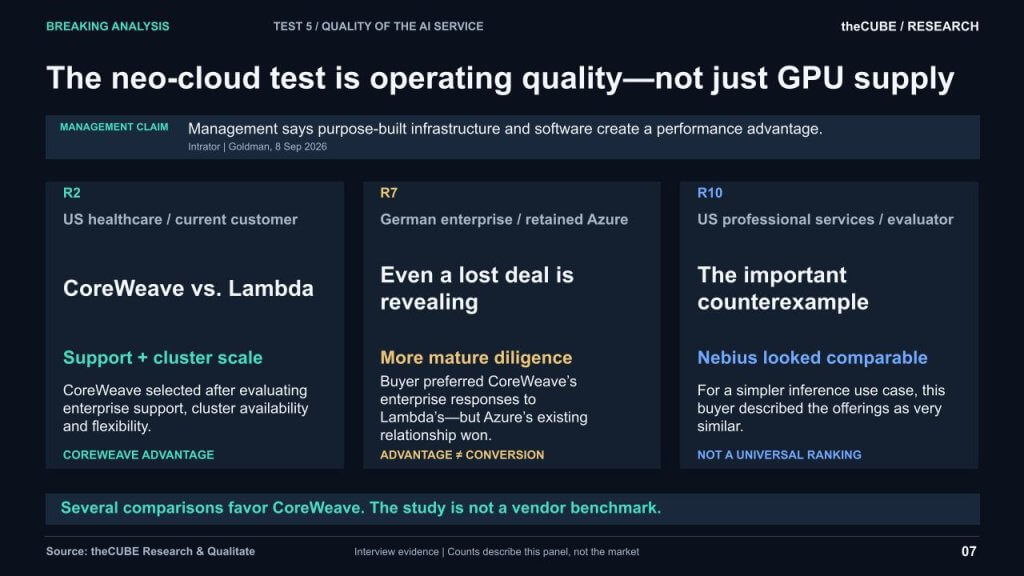
The German enterprise shown in the middle column is particularly revealing. It ultimately stayed with Azure because of an existing strong relationship, yet described Lambda’s enterprise support and compliance responses as less mature than CoreWeave’s. A lost CoreWeave deal can still reveal differentiation against another GPU cloud. That is why including non-buyers that were serious evaluators strengthens this study.
We also preserve the counterexample. As shown in the rightmost column above, a professional-services evaluator described Nebius as very similar for a basic inference use case.
Our conclusion is nonetheless, that CoreWeave’s support, scale and operating reputation are real advantages in several buying decisions. We are not claiming every neo-cloud competitor loses every workload, or that better infrastructure automatically makes the model’s answers more accurate. But the evidence within this sample suggests that CoreWeave is ahead of other GPU clouds with respect to the quality of its AI services.
The other alternative we want to explore is to own the infrastructure on-premises. Here, the utilization metric is especially useful.
On-prem economics depend on sustained use; and more
The management claim we found that most closely maps to this issue is a question CoreWeave an other AI clouds get often – what happens when supply and demand come into balance.
Intrator at Goldman argues CoreWeave can remain durable beyond supply constraints.
The ownership issue becomes more useful when we ask what utilization a buyer believes it can sustain and where the breakeven level occurs . The customer estimates span roughly fifty to eighty percent. At the low end, a medical-domain evaluator cites a consultant’s fifty-to-sixty-percent rule of thumb. A technology buyer’s informal modeling points above seventy percent. A healthcare director of systems engineering says a model required about eighty percent to break even. The exact verbatim is: I did a TCO model and I needed maybe about 80% utilization just to break even, so it didn’t make sense.
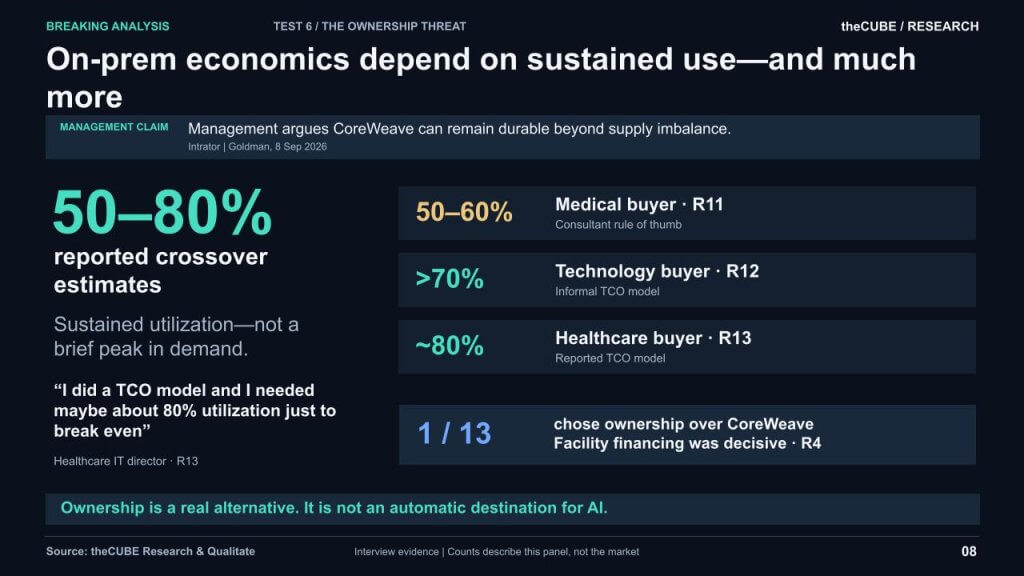
Our anecdotal evidence from customers in our travels suggests that most early on-prem buyers struggle to even come close to 50%. We’ve seen 10-15% sustained GPU utilization as common in early private cloud AI PoC cases.
Remember, we’re not claiming these three datapoints represent an accepted cost curve. They are account-specific estimates with different assumptions. The common finding is nonetheless logical – i.e. that expensive hardware needs sustained, predictable use to spread its costs. As well, power, cooling, staffing, procurement and financing can still block a buildout even when utilization looks promising.
One of the thirteen respondents chose owned infrastructure over CoreWeave. That decision was driven heavily by favorable facility-renovation financing, not a finding that CoreWeave was technically inferior. Another buyer intends to revisit ownership when GPU supply loosens. Our research indicates that on-prem ownership is a narrow competitive threat, not a blanket repatriation wave. High utilization is critical for TCO, but the organization must also be able and willing to operate the system.
The flip side of course is governance, compliance, security and certifications. Just as we saw with AWS in its early days, while its security (for example) was often quite good – it was perhaps just different than the customer’s required. As such it took some time for AWS to mature its offerings and get certified for things like FedRAMP and the like.
This dynamic could favor on-prem deployments in the future, or cloud players. The key for CoreWeave is to mature these aspects of its offerings before supply and demand come into balance.
Even buyers that stay in the cloud may divide their workloads according to data sensitivity. So let’s take a look at that.
Compliance shapes workload strategic fit but it’s not a blanket veto
Intrator on the last earnings call said enterprise-grade security and observability are essential to the platform.
The research definitely does not show regulated industries rejecting CoreWeave as a category. It does however show buyers deciding which data and workloads they are prepared to place there. One healthcare customer sends anonymized model training to CoreWeave and keeps sensitive information in dedicated compliant environments. The exact verbatim is: Compliance helped us split our setup, sending anonymized model training to CoreWeave.
Another keeps a residual protected-health-information workload on AWS because it is more connected to existing compliance tooling.
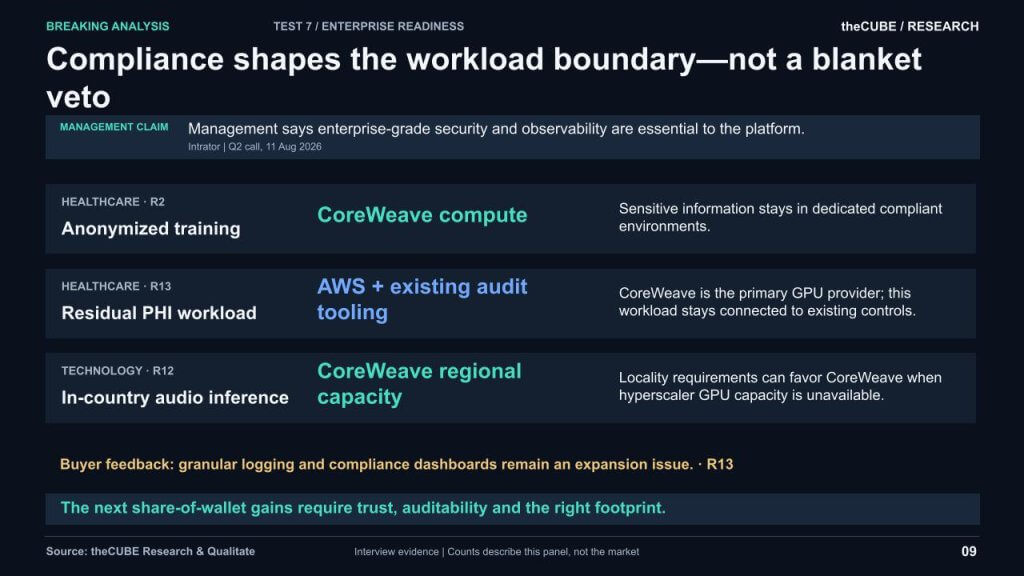
There is also an important positive counterpoint shown above as respondent 12 (R12). In this case a technology industry customer selected CoreWeave for regional inference where it could satisfy customer data-locality requirements and the hyperscaler could not supply the needed GPU capacity. So data residency and sovereignty can create an opening as well as a constraint.
The remaining gap is often compliance tooling maturity. A healthcare director reports that with CoreWeave, a business associate agreement is in place (BAA) and SOC 2 Type 2, but they still want more granular logging and a real-time compliance dashboard.
The respondent’s situation here underscores a distinction that is easy to conflate. Specifically, having a compliance certification is not the same as having compliance tooling. A BAA and SOC 2 Type 2 establish that CoreWeave meets a baseline standard (i.e. a checkbox item), but they do not give the customer the ability to monitor, audit, and demonstrate compliance in real time from their own console. Here’s the verbatim quote:
SOC 2 Type 2 is there, but they don’t have CloudTrail-equivalent granular logging and real-time compliance dashboard. That’s what AWS gives us.
Now, that is one customer’s feedback, not a certification audit. We haven’t done that research. But it does suggest a maturity gap, at least in a point in time when the customer evaluated the soluton. At the same time, we believe CoreWeave has earned access to enterprise AI workloads, while deeper penetration depends on making sensitive workloads as manageable and auditable as customers expect from their established clouds. This will simply take more time.
There is a second factor beyond technical readiness that we now want to explore – which is how the customer wants to buy capacity.
Flexible financing must translate into flexible buying
This pivots off of Intrator’s claim on the last earnings call: Clients want to buy compute for 2 years or 3 years.
The seven current customers in our panel do not all buy CoreWeave in the same way. Three describe committed contracts, three combine committed and flexible capacity, and one reports fully on-demand use. That is a more nuanced picture than saying CoreWeave only serves customers willing to make a large fixed commitment, which is often the narrative heard from CoreWeave detractors.
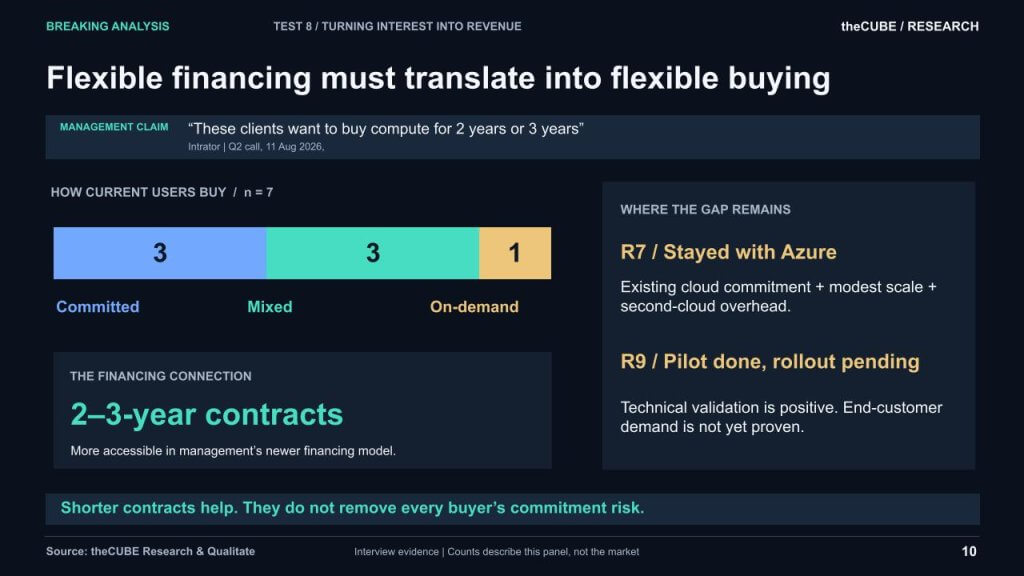
But the non-conversions show where adoption blockers exists. The German enterprise stayed with Azure because the scale of the workload, an existing consumption agreement and the cost of a second cloud relationship outweighed CoreWeave’s advantages. The Canadian buyer completed a positive pilot but is still validating demand before committing meaningful production capacity, saying we are not comfortable committing to significant GPU capacity before we see how the customer respond to the product, at least for a year.
This comment ties back to our AI Bubble Breaking Analysis where one of the risks we cited was the off-take demand from enterprise customers not materializing fast enough.
A current healthcare customer also wants more flexibility for future overflow usage. To add some color here, the concern from this customer is that CoreWeave’s annual or quarterly commitment structure works well for predictable baseline workloads but creates friction for the overflow use case, where demand is inherently variable. The specific comment is:
I think the burst overflow, it would probably need some sort of more flexibility to be cost-effective. So maybe monthly pay-as-you-go, some kind of strategies there as well.
This connects directly to the financial story. Intrator says newer financing can support buyers seeking two- or three-year contracts. That can widen the enterprise opportunity. Yet two years is still a commitment for a buyer that cannot forecast the next twelve months. We believe the financing change addresses the right problem, but the next evidence to watch is whether these technically positive evaluations turn into paid production.
Indeed Coreweave is rolling out shorter duration contracts and spot pricing that should mollify customer concerns over lock-in. At the same time, the forward pricing model for memory-intensive technology has inverted. Tech used to be deflationary, with prices dropping with every new CPU architecture. Today, prices are going up due to memory shortages and so some customers want predictability. The point is CoreWeave must continue to evolve its pricing optionality.
Our take is CoreWeave is on top of this issue with increasingly flexible pricing options, including:
- Shorter duration contracts
- On-demand consumption models
- Committed capacity with flexible usage models
- Managed inference offerings, which have grown from $1M to $100M in a very short period of time.
And that brings us to what the customer study can – and cannot – say about the financial model. Let’s test the financial durability for CoreWeave’s model.
The customer case is strong. The cashflow and balance sheet tests remain
Nitin Agrawal, CoreWeave’s CFO says initial contract cash flows repay asset-level debt and deliver additional returns.
The reported numbers put the scale of the opportunity in focus. Second-quarter revenue was about $2.6B, up 112% year over year. Management reported $104B of revenue backlog with another $25B in the first month of the current quarter. Our customer work supports the direction of enterprise demand, but it does not give in indication to the timing of when that the backlog converts to revenue.
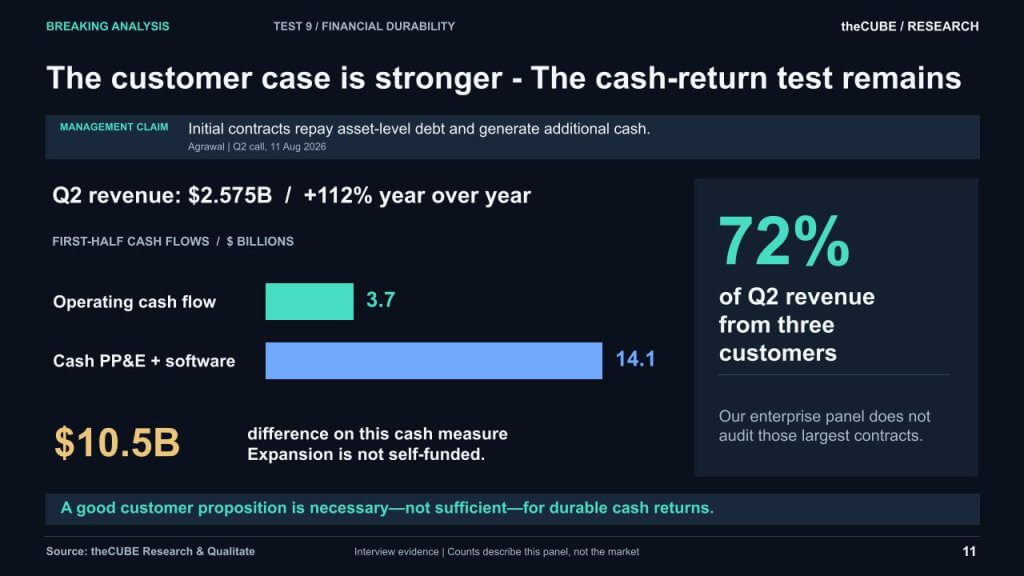
The financial challenge is the timing and scale of investment. In the first six months, operating cash flow was about $3.7B. Cash purchases of property and equipment, including capitalized software, were about $14.1B. That is a roughly $10.5B gap on this simple measure. Positive operating cash flow does not mean the expansion is self-funded.
We should also remember that three customers accounted for 72% of second-quarter revenue. Our panel is informative about enterprise adoption, not necessarily the economics of those largest contracts from the three firms, rumored to be Microsoft, OpenAI and Meta. Management may be right that an individual contract delivers attractive returns over its life. Current consolidated cash spending neither proves nor disproves that claim on its own. The tests will be delivery, customer payment, operating performance and what remains after capital and financing obligations.
Not a fortress balance sheet
Then there’s the balance sheet. CoreWeave is pursuing an aggressively financed infrastructure build. It does not have a fortress balance sheet. Cash improved sharply in the latest quarter, which is good. But debt and lease obligations are growing much faster than the equity cushion.
CoreWeave’s growth, therefore, depends not just on demand, but on matching customer cash receipts with a rapidly expanding set of financial obligations. The company’s business is expanding much faster than its equity cushion and its cash flows are not self-funding.
The bottom line in our view is CoreWeave’s balance sheet shows both the scale of the opportunity and the financial risk of pursuing it. Assets nearly tripled in a year, but the equity cushion did not keep pace. Liquidity improved, and the company has substantial financing availability, so these figures do not by themselves establish a near-term funding crisis. But the infrastructure build remains externally funded. The point is, excessive demand or a larger backlog are not the only issue for investors to watch. The key will be converting customer commitments into cash quickly and consistently enough to support debt, leases and the next generation of infrastructure.
CoreWeave itself highlighted this caveat in its recent 10Q. The filing says 98% of second-quarter revenue came from committed, take-or-pay contracts. It also explicitly warns that a move toward pay-as-you-go or other consumption-based models could affect cash-flow predictability, margins and its financial condition.
Let’s close with a scorecard.
Our verdict: The AI cloud thesis is earning customer support, the asset base needs to earn its keep
The ultimate test is, of course, customer behavior, not management’s repetition of its talking points.
Our research indicates that the strongest parts of CoreWeave’s story are supported by the customer evidence. Buyers show up because of access constraints from hyperscalers and on-prem headwinds, but several stay for performance, cost and the experience of operating AI. Inference is already present across our current-use cohort, and it is adding to a continuing model-development cycle. CoreWeave’s business is not simply a temporary outlet for training demand.
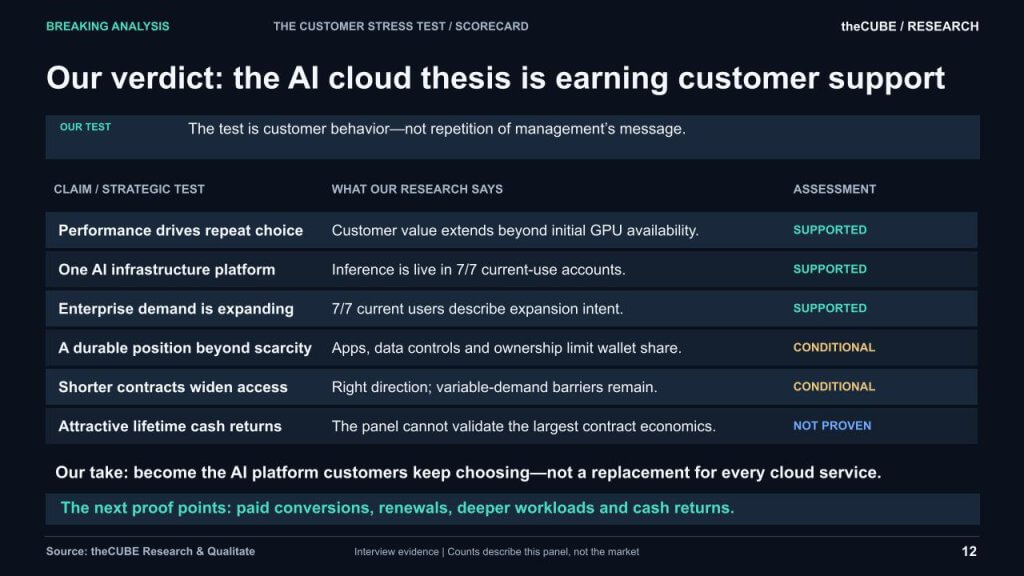
The more critical demand issue in our view is how far CoreWeave can expand inside the enterprise. Hyperscalers will likely retain application and data relationships. Sensitive workloads require deeper assurance and tooling. Lots can change in the market prior to CoreWeave achieving that maturity. On-prem owned infrastructure remains rational for a subset of buyers but the lack of data center capacity and requisite AI skills narrow the TAM for now. Favorable technical evaluations still need a commercial structure and sufficient end-customer demand to become recurring revenue.
Watch conversion timing and free cash flow. As CoreWeave’s mix moves to shorter duration contracts and on-demand pricing, predictability will become more opaque. We saw this in 2022 with hyperscalers exiting COVID. Visibility worsened and cost optimization became the buzzword. To reiterate, the balance sheet numbers do not establish imminent distress. They do establish that funding access, timely deployment and contract economics are central to the business model.
We believe the opportunity for CoreWeave is to become the AI platform customers keep choosing, without needing to replace the entire cloud estate. Ahead of Fully Connected, the action item at the event is to look for proof that CoreWeave is closing those remaining gaps. Specifically, production conversions from pilots, customer experience through repricing and renewal, broader approved workloads, and cash returns from deployed capacity. That is how a scarcity advantage becomes a durable business.
We are pleased to share this proprietary research advantage that combines the awesome power of the Qualitate platform with theCUBE’s large observation space from Silicon Valley to Wall Street and around the world.
We’ll be at Fully Connected broadcasting next Wednesday and Thursday in Moscone South. Do stop by and see us if you’re there.