
In a recent AnalystANGLE conversation, I spoke with engineering think tank and services firm STEP executives Ed Walton (CEO), Todd Kelly (CTO), and Bill Krutke (Solution Architect) about the real-world state of private 5G, Wi-Fi 7, and hybrid wireless environments. See the full video below. The discussion traced the evolution of private 5G from early hype to practical deployments, examined how vendors such as Nokia, Ericsson, HPE, and Celona are reshaping the market, and showcased live use cases spanning the Kentucky Bourbon Festival, large construction sites, and healthcare systems. The central theme was clear: this is not a Wi-Fi versus 5G debate. The winning model is a hybrid wireless fabric that aligns the right connectivity with the right workflow, backed by strong management and observability.
The private 5G market: from hype to hybrid reality
STEP’s field experience suggests the private 5G market has matured more slowly than many early forecasts predicted, but momentum is now building. Early deployments centered on large manufacturing, logistics, and campus environments. Today, new verticals such as healthcare and construction are emerging with clear, repeatable use cases.
On the supply side, the vendor landscape is shifting from telco-centric experiments to enterprise-ready platforms. Nokia and Ericsson still bring carrier-grade, “gold standard” radio technology for mission-critical use cases. But enterprise-focused solutions from Celona, HPE (via Athonet), and others are gaining traction because they are easier to integrate with existing LAN, WLAN, and security stacks and can be managed like other enterprise infrastructure.
A key inflection point is the move from private 5G as a parallel, telco-style deployment to a true extension of the enterprise network, plugging into existing management consoles, identity systems, and security policies. That shift lowers operational friction and makes private cellular far more approachable for enterprise IT teams.
Hybrid wireless as a workflow fabric, not a technology battle
A recurring message from STEP is that Wi-Fi 7 and private 5G are complementary, not competitive. The right design starts with workflows and outcomes, not radio technologies.
Kelly framed it as workflow density vs. workflow mobility:
- Wi-Fi / Wi-Fi 7 excels where devices are dense and largely local: high-throughput, fixed or semi-fixed use cases such as machine vision stations, high-bandwidth user access, or office and campus productivity. With 6 GHz spectrum, multi-link operation (MLO), and higher throughput, Wi-Fi 7 is well suited for these “high-density, high-bandwidth in a defined area” scenarios.
- Private 5G shines where mobility, predictability, and coverage are paramount: AGVs and forklifts moving quickly across large warehouses, cranes and heavy machinery on construction sites, or clinical workflows that must stay connected across a hospital campus. Here, deterministic mobility, better handoffs, and wider coverage with fewer radios create clear advantages.
The practical result is a hybrid mobility fabric: Wi-Fi 7 handles the mass of user and IoT devices, while private 5G carries the most critical, latency-sensitive, or highly mobile workflows, and provides mobility redundancy when Wi-Fi is saturated or out of range.
COWs, Rovers, and “living labs” for hybrid design
One of the most tangible examples of this hybrid approach is STEP’s work at the Kentucky Bourbon Festival in Bardstown, Kentucky. The event draws 50,000–75,000 attendees, more than 70 distillers, and a dense mix of applications: public Wi-Fi, point-of-sale, RFID wristbands, video security, media, and social traffic.
STEP deploys a hybrid architecture centered on a Cellular on Wheels (COW) solution that combines:
- Public and private Wi-Fi
- Private cellular for secure slices and critical operations
- SD-WAN–based uplinks using multiple carriers
- Full-stack security and campus-wide video surveillance
- RFID tracking and data collection across a three-mile radius
The environment acts as a “living lab” for hybrid networking at scale, shifting from zero to tens of thousands of users over four days, then back to zero, without sacrificing performance or security.
The same architectural principles are now being extended via STEP’s Rover platform, a “skinny COW” designed for remote, hard-to-reach sites. Ruggedized, mobile, and self-sustaining (solar, generators, or line power), Rover combines private 5G, Wi-Fi, video, and SD-WAN backhaul (often bonded cellular plus Starlink) into a portable unit that can be towed behind a vehicle and rapidly deployed. (see below)
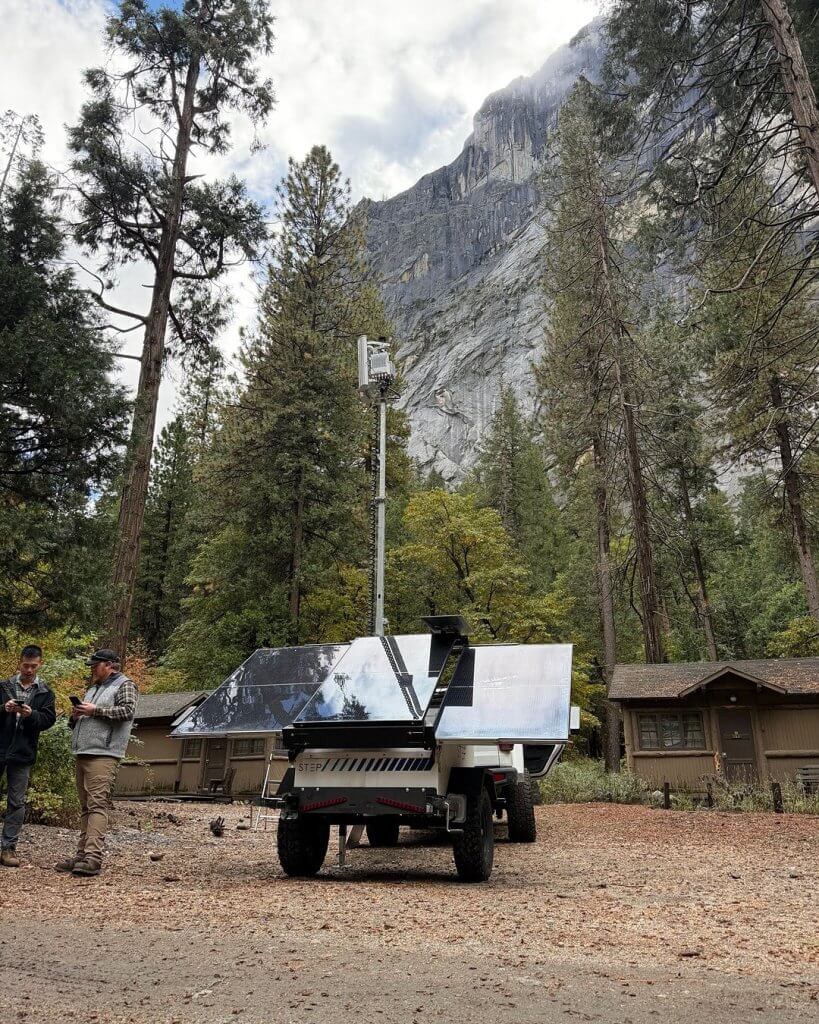
For large construction sites that span several miles and lack fiber or stable connectivity, Rover has become a practical way to get tablets, cameras, heavy machinery, and field teams online quickly. The payoff is straightforward: fewer delays, better equipment utilization, and the ability to support AI, robotics, and rich digital workflows on sites that previously struggled with basic connectivity.
Healthcare: reclaiming the “clinical network”
Healthcare provides another compelling hybrid use case. Krutke described how hospital Wi-Fi has evolved from a “clinical network” focused on nurse call, VoWiFi, and critical workflows to a heavily shared environment, absorbing BYOD, guest access, and a surge of IoT devices and sensors.
In that context, private 5G (often using CBRS indoors) offers a way to reclaim predictable, high-assurance connectivity for clinical operations:
- Offload critical voice and alerting workflows to private 5G on Zebra handsets and other clinical devices
- Improve coverage and penetration in older, concrete-heavy facilities
- Extend reliable mobility across sprawling healthcare campuses, not just within a single building
Meanwhile, Wi-Fi 6/6E/7 continues to serve the bulk of general-purpose and guest traffic. The hybrid model improves experience, reduces interference, and supports new safety and security use cases, such as more pervasive sensors and cameras deployed in and around healthcare environments, which became particularly important post-COVID.
Designing and operating a hybrid wireless network
From an architecture perspective, STEP emphasizes workflow-driven design over technology-first thinking. Kelly advocates an architecture development methodology (ADM) that starts by mapping:
- What workflows exist today
- Which are mission-critical vs. best-effort
- Where mobility and coverage are required
- How performance and reliability impact business outcomes
From there, Wi-Fi, private 5G, and backhaul options are aligned to those workflows. In many environments, a best practice is emerging around mobility redundancy, using private 5G as the primary fabric for critical mobile operations (e.g., forklifts) with Wi-Fi as a backup, or vice versa, depending on the use case.
Equally important is end-to-end observability and management. STEP built its Navigator platform on LogicMonitor to provide a single view across:
- Wired and wireless infrastructure (Wi-Fi and private 5G)
- SD-WAN and backhaul connectivity
- Security controls
- Servers, applications, and key vertical systems (e.g., Epic, Cerner, Oracle in healthcare)
For CIOs and CTOs already grappling with constrained IT teams, this unified operational view is critical. It turns hybrid wireless from a science experiment into an operationally manageable, business-aligned capability.
Practical guidance for CIOs
For organizations curious, but cautious, about private 5G and hybrid wireless, the advice from STEP is pragmatic:
- Start with use cases and pain points, not radios. Identify where connectivity issues create real business impact: overtime, safety risks, SLA violations, or poor customer experiences.
- Run targeted proofs of concept. Use a mobile platform like Rover or a limited private 5G deployment to test specific workflows, such as material handling in a warehouse or connectivity at a remote construction site.
- Align OT and IT early. Many of the highest-value use cases sit at the intersection of operational technology (OT) and IT. Bringing those teams together early in the process avoids cultural and architectural disconnects.
- Plan for convergence. Over the next few years, eSIM adoption, better multi-radio devices, and converged policy frameworks will simplify hybrid design and operations. Early experimentation now will pay off as those capabilities mature.
OurANGLE
The key takeaway from this conversation is that hybrid wireless, combining Wi-Fi 7, private 5G, and intelligent backhaul, is quickly shifting from edge case to expectation. Whether it’s a bourbon festival, a construction megaproject, a manufacturing plant, or a hospital campus, organizations are looking for connectivity that is reliable, observable, and aligned with how work actually gets done.
Enterprises that start now, by understanding their workflows, partnering with experienced practitioners, and piloting targeted hybrid deployments, will be better positioned to support the next wave of mobility, automation, and AI-driven use cases that depend on the network being “always on” and architected for outcomes, not just access.
For more information on STEP, please visit their website