
Recent survey findings and early production deployments from companies such as Doozer.ai indicate a clear inflection point in enterprise AI strategies for knowledge work, powered by agentic AI decision-making. The next wave of value is no longer coming from task automation or content generation but from AI systems that support higher-order reasoning, judgment, and decision-making. Following an initial surge of interest in generative AI, organizations are now asking a more consequential question:
How do we convert these capabilities into durable, measurable business outcomes?
That question is driving a shift to decision-centric workflows, where knowledge-savvy digital coworkers work alongside humans to interpret information, evaluate options, and guide decisions. Enterprises are moving beyond incremental efficiency gains and rethinking the definition of an “intelligent enterprise.” The focus is no longer on automating predefined processes but on augmenting human thinking itself, creating digital knowledge workers that can understand intent, weigh trade-offs, and help teams make faster, more confident, and more explainable decisions.
At the same time, the obstacles are becoming more visible. Many organizations remain constrained by fragmented ownership, underdeveloped governance models, and limited trust in AI-driven judgment. As a result, ROI is often confined to isolated use cases rather than scaled across the enterprise. The lesson emerging from the data is clear: scaling agentic AI is as much an organizational and cultural challenge as it is a technical one.
This research brief explores the factors behind that gap and the practical path forward. It combines data from the Agentic AI Futures Index, which includes 625 pre-qualified business & tech AI professionals answering 61 questions, with real-world insights from Doozer.ai, a company leading in deploying digital coworkers that produce measurable results.
Together, they offer one of the clearest perspectives yet on how organizations progress along the maturity curve, from experimentation to scaling and from statistical correlation to trusted reasoning.
The Next Frontier of AI
The latest results from the Digital Labor Transformation Futures Index indicate a market full of ambition yet still struggling to translate early promise into solid business results (ROI).
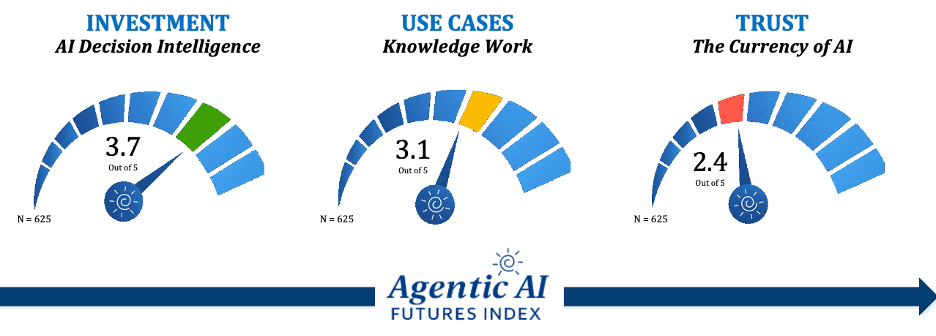
Drawing on 625 pre-qualified AI business and technology leaders across 13 industries, the index yielded a score of 3.1 out of 5, indicating high ROI aspirations but gaps in achieving scalable AI from automation-based use cases alone.
The index found an unmistakable aspiration to transition from generative AI to agentic AI, shifting from automation to decision-making. At the top level, 61% of companies report that they are either deploying or planning to deploy AI agents within the next 18 months, a notable figure given the market’s relative newness. These early adopters observe a clear shift happening: from basic task automation to knowledge work and decision-making empowered by AI reasoning.
The survey data tell a story of strong investment momentum that will fuel the rise of knowledge-based digital labor, growing use-case maturity, but a trust gap that could limit ROI if not addressed directly.
- Investment (3.7) – A Shift to Agentic AI Decision-making: Nearly three-quarters (73%) plan significant or strategic investments in AI reasoning and decision intelligence capabilities over the next 18 months.
- Use Cases (3.1) – The Rise of Knowledge Work: Enterprise leaders envision a shift from AI that makes predictions to AI that can make judgment-based decisions.
- Trust (2.4) – The Currency of ROI: Trust remains the biggest barrier to realizing value (ROI). Only about half of AI professionals say they have high confidence in agents’ ability to make decisions.
These findings signal the beginning of a structural pivot: from automation for productivity to decision intelligence as strategic advantage, with higher-level, more strategic ROI objectives in mind.
Taken in aggregate, the data reveals that most enterprises now see AI agents as essential partners in future knowledge work, yet many are still learning how to align strategy, governance, and workforce readiness to make that vision operational. The findings highlight three defining shifts reshaping the landscape:
- The vast majority envision a higher ROI than GenAI can deliver alone.
- The shift beyond task automation to AI-driven decision-making is accelerating.
- Trust has emerged as the true currency linking investment to impact.
Paul Chada, CEO of Doozer.ai, sees the same pattern playing out in the field.
“A lot of executives are saying they’re deploying agents because the board is asking, ‘What are you doing with AI?’ But the real work—the part that drives ROI—is getting the agents to be reliable and accepted by the people who use them,” he said. “If the agent isn’t dependable, it becomes a shiny object that’s quickly cast aside. This is especially true with knowledge work and decision-making use cases.”
GenAI: A Gateway to Something Bigger
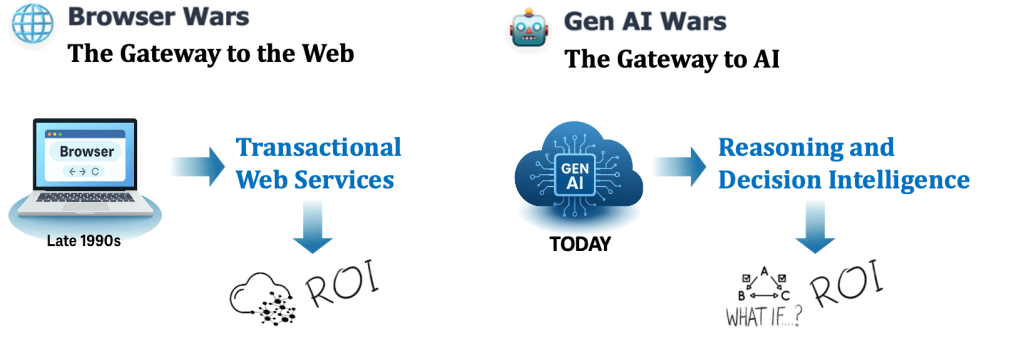
A generation ago, the web browser became the defining interface of the early internet. Much of the industry debate centered on which company would “own” the gateway to the web, and browser choice was treated as a strategic, high-stakes business decision. In hindsight, that focus missed the larger point. The browser itself was never the endgame; it was the entry point. The true value of the internet emerged through the layers built on top of it: new platforms, applications, business models, and operating systems that transformed basic connectivity into productivity, commerce, and insight.
A similar pattern is now playing out in AI. Generative AI and large language models (LLMs) have become the modern equivalent of the browser, essential interfaces that open the door, but not the destination themselves. The intense competition of the 2023–2025 “GenAI wars,” featuring OpenAI, Google, Anthropic, Meta, and DeepSeek, mirrors the early scramble for browser dominance. Yet, as Scott Hebner has observed on The Next Frontiers of AI podcast, the real transformation will not be defined by who controls the interface, but by what organizations build on top of it, and how effectively those foundations are turned into scalable business value.
“Generative AI is just a gateway to the world of AI. The real ROI comes from what we build on top of it, just like the browsers in the internet age, where they were extended from connectivity and access to transactional commerce and advanced insights.”
That “next layer” is agentic AI: systems that go beyond predicting the next word or automating a known process. Built upon the foundation of GenAI and LLMs, agentic AI promises to introduce reasoning, judgment, and decision-making into digital workflows. Just as the browser transformed from a simple tool for accessing information into a platform for creating enterprise value, such as e-commerce, the new wave of AI agents is evolving to represent the next level of decision intelligence. These agents are not just tools; they’re collaborative digital coworkers that assist humans in thinking, acting, and making better decisions. That is, digital coworkers that help perform knowledge work.
LLMs have accelerated enterprise adoption of AI, but their limitations are becoming increasingly evident. They can predict but not judge, correlate but not explain, and automate tasks without true reasoning. As Chada puts it:
“A prediction is not a decision. You can only trust an agent when it understands the goal, the context, and the consequences of its actions.”
Enterprises are discovering that LLMs alone “run out of gas” when applied to high-value, decision-intensive use cases. Despite widespread experimentation, fewer than one in five organizations achieve measurable ROI at scale, largely because most models remain statistical engines constrained by correlation rather than understanding.
What’s missing is reasoning: the ability to build domain knowledge, grasp cause and effect, evaluate trade-offs, and justify outcomes. This is why 2025 represents a clear inflection point. The market is shifting from building ever-larger models to assembling more capable AI ecosystems, anchored in decision intelligence. By integrating LLMs with reasoning frameworks, knowledge graphs, memory, and causal models, enterprises can move beyond task execution to explainable, adaptive decision-making and unlock the next wave of AI-driven ROI.
In this sense, Agentic AI represents the layer of enterprise AI, where productivity, trust, and reasoning converge. As Scott Hebner framed it,
“Just as the browser became the portal to the digital economy, Gen AI is the portal to the reasoning economy, but in both cases, you need to populate the portal with new technologies that deliver new value.”
A Shift to Agentic AI Decision-Making
The first wave of enterprise AI focused on automation. The next phase is defined by augmentation, where AI systems support and enhance human judgment in knowledge work. The Digital Labor Transformation Futures Index shows this transition accelerating, with 62% of organizations now viewing AI agents as part of their decision-making processes. This signals the emergence of AI knowledge workers as a new class of digital labor, not just tools that execute tasks.
Automation continues to play an important role, particularly for routine and repetitive work. However, enterprise investment is increasingly shifting toward knowledge work that requires domain expertise, contextual understanding, and defensible judgment. AI knowledge workers are designed to operate in this space. They help evaluate options, reason through trade-offs, and justify recommendations rather than simply carry out predefined steps. These capabilities place them closer to decision-making roles that influence business outcomes, customer experiences, and strategic direction.
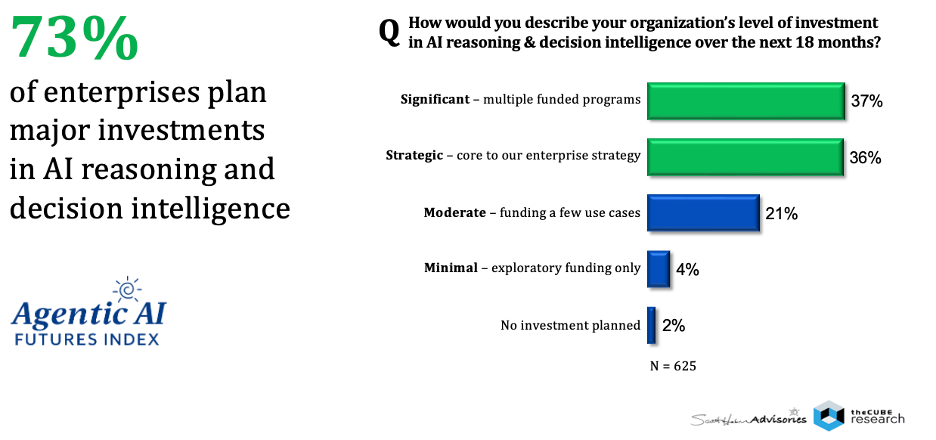
This new wave of investment indicates a broader maturing of AI use cases. The initial phase of enterprise AI focused on automation and productivity, utilizing technology to complete repetitive tasks more efficiently, generate content, or compile information. However, as those improvements plateau, business leaders are targeting a higher goal: augmenting human judgment and supporting data-driven, explainable Agentic AI decision-making at scale.
As Chada explained in the podcast,
“Every company is now asking how to build reasoning into their workflows. It’s not about automating the easy stuff anymore; it’s about giving your teams judgment and decision support at scale.”
To achieve this, organizations are investing not only in larger models but also in smarter model ecosystems that build upon the foundation of generative AI. Agentic AI decision-making require a fundamentally different architecture, one that extends LLMs with:
- Semantic understanding of the business domain, so agents grasp context, meaning, and intent behind data and processes, anchored in dynamic knowledge graphs.
- Judgment frameworks allow them to evaluate trade-offs, interpret ambiguity, and simulate alternative courses by modeling the consequences of various decisions.
- Causal reasoning enables them to understand why certain decisions lead to specific outcomes and what influences those outcomes (cause & effect).
- Collaborative learning loops, so agents can interact naturally with their human counterparts, testing assumptions, presenting evidence, and converging a mutual decision.
These capabilities mark a major shift from rule-based automation to reasoning-based enhancement. Instead of just following steps in a workflow, next-generation AI agents will help determine which steps to take and why. They will provide insights, suggest actions, and clearly explain their logic, acting less as digital assistants and more as digital colleagues that can improve decision-making in enterprises. This increase in decision-intelligence investment indicates that the enterprise AI narrative is shifting from focusing on productivity improvements, measured in hours saved, to emphasizing strategic gains, measured in better outcomes.
The message: Better problem-solving and remediation decisions will also trump automation in scaling ROI within enterprise settings. Money talks.
The Rise of Digital Knowledge Workers
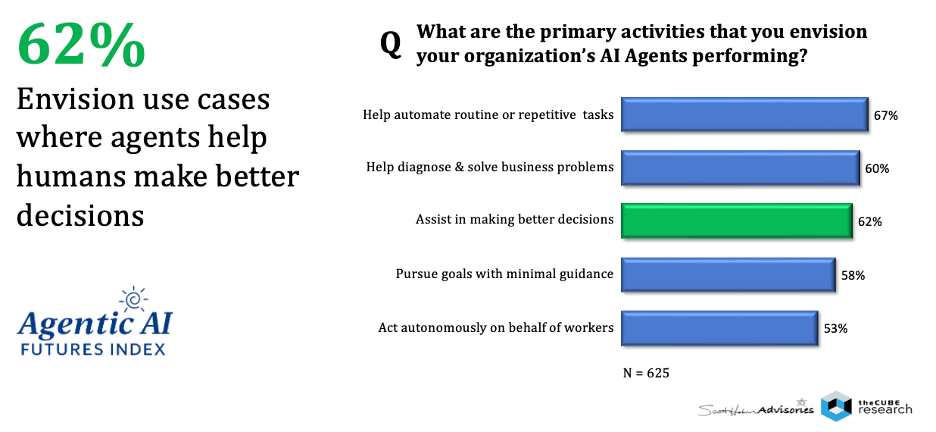
If the first phase of enterprise AI was about automation, the next is clearly about augmentation—enhancing human intelligence in knowledge work. The Digital Labor Transformation Futures Index shows that this shift is speeding up: 62% of companies now see their AI agents as a key part of decision-making. This marks a big move from the automation-focused past toward a new era of AI-driven decision intelligence.
Traditional automation remains important (67%) as leaders still see value in streamlining routine or repetitive processes, but the next frontier is clearly moving upward. Knowledge work, defined as work that requires domain-specific judgment to make business-critical decisions, is becoming the primary focus of AI investment (namely, agentic AI decision-making). Unlike procedural tasks such as provisioning systems, updating records, or booking travel, knowledge work involves reasoning about the right action or decision and justifying it. These are the kinds of decisions that influence business results, shape customer experiences, and guide strategic direction.
In this context, the role of AI agents is evolving from automating the “known” to assisting in the unknown, helping humans reason through ambiguity, evaluate trade-offs, and act with confidence.
As Chada explained,
“There’s a big difference between using AI to do work faster and using it to help people think better. The best deployments we’re seeing are the ones where agents help humans see what they might have missed—and then make the right call with confidence.”
This evolution reflects the broader trend identified in the Digital Labor Transformation Futures Index, where over 90% of leaders agreed that digital labor is inevitable. Enterprises no longer question whether humans and AI agents will collaborate, but rather how quickly and how deeply that collaboration will extend into knowledge-based, agentic AI decision-making. The rise of these use cases underscores that agentic AI isn’t just about efficiency—it’s about reshaping how expertise is applied and scaled across the enterprise.
To fulfill this vision, organizations are investing in agents that can go beyond pattern recognition to understand meaning, context, and consequence. Decision-intelligent agents must have at least the following five attributes:
- Understand semantic content
- Apply reasoning frameworks
- Make judgments, not just predictions
- Evaluate consequences and trade-offs
- Collaborate with humans (“what-if”)
These capabilities are giving rise to a new class of digital knowledge workers: agents that do not replace human reasoning but enhance it. They can analyze large-scale scenarios, consider multiple viewpoints simultaneously, and provide evidence-based recommendations that humans can understand and trust.
Ultimately, the shift toward decision-focused knowledge work marks the next frontier of digital labor. As enterprises adopt agentic AI, they’re moving from “doing things faster” to “making better decisions,” unlocking higher-value outcomes through collaboration between human judgment and machine reasoning.
Trust: The New Currency of ROI
Enterprise AI is advancing rapidly, fueled by growing ambition, investment, and experimentation. Yet many organizations continue to struggle with converting early promise into sustained performance and measurable ROI. Awareness is rising, but execution often lags behind vision. As enterprises use generative AI and LLMs as the gateway to more transformative use cases, a clearer reality is emerging: trust has become the primary constraint on value creation. As Scott Hebner noted on The Next Frontiers of AI podcast,
“Trust is emerging as the currency of innovation. No trust, no ROI.”
Survey results confirm that trust extends well beyond model accuracy. It is built through explainability, collaboration with humans, and clear visibility into how outcomes are produced. When people understand how and why an AI system reaches its conclusions, adoption increases. Systems that can explain their reasoning, respond to challenges, and adjust based on evidence are far more likely to be trusted and used at scale.
The Digital Labor Transformation Futures Index exposes a significant trust gap. Only 49% of enterprise leaders express high confidence in AI agents’ ability to make accurate, trustworthy decisions. Confidence drops further across key dimensions of Agentic AI Decision-making, including planning and problem-solving at 50%, explainability at 47%, and autonomous action at 44%.
These findings reveal a clear pattern: organizations trust AI to execute tasks, but not yet to make decisions. As Paul Chada has emphasized, success depends on agents performing reliably in real-world conditions, with the consistency and transparency required to earn user confidence and expand adoption.
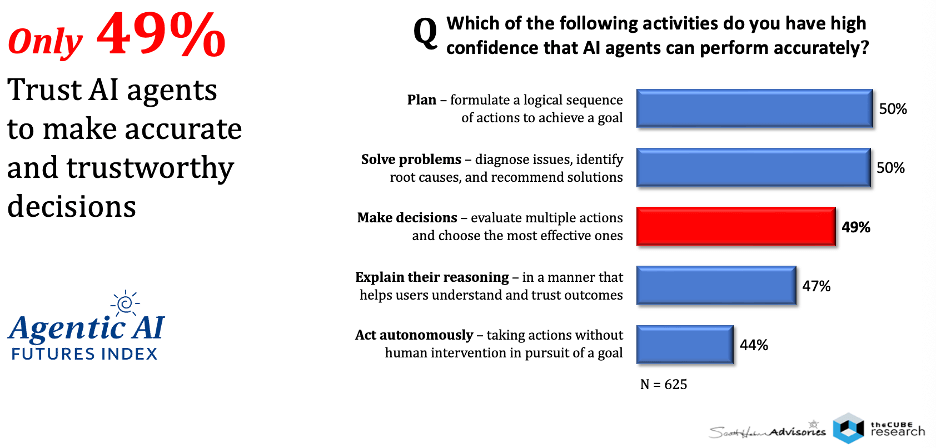
Trust, therefore, is the key difference between statistical prediction and judgment-based reasoning. Generative AI finds patterns in data; however, AI reasoning must also understand the consequences of decisions, and thus cause and effect. That shift — from correlation to reasoning — is what will deliver true decision intelligence, and ultimately the ROI goals of agentic AI investments.
Our research and field observations identify several important traits that make AI trustworthy.
- Accuracy and Consistency
- Conversatinal Explainability
- Human Collaboration:
- Semantical Awareness
- Root Cause Detection
- Consequence Evaluation
As Chada explained from Doozer’s real-world deployments, trust develops through parallel operations, where agents run alongside human teams until confidence in decision quality is established.
“Organizations are just wanting to run it in parallel right now. As they see it make the correct decision repeatedly, trust builds naturally, and that’s when autonomy becomes acceptable.“
This “trust drag” isn’t just technical, it’s cultural. Organizations are discovering that deploying agents is not like installing software. It’s more like hiring employees. Workers must believe their digital counterparts will behave consistently, explain their reasoning, and improve over time. Without trust, adoption stalls, and ROI vanishes.
The future of AI, therefore, won’t be defined by which model produces the most words or the fastest predictions, but by which systems can reason, explain, and be trusted to make decisions that matter. Trust isn’t just a feature; it’s the foundation of the intelligent enterprise. As Hebner concluded,
“If you don’t trust a human coworker, you’re not going to work with them very well. The same is true for digital coworkers. Until people trust them to make sound decisions, agentic AI will remain a parallel experiment rather than a full participant in the workforce.”
What Leaders Should Do Next
The survey data and studies of real-world deployments have created a clear picture. Investment in AI reasoning and agentic AI decision-making is accelerating, but trust and adoption remain the primary constraints on enterprise ROI. The next two years will separate organizations that scale trusted decision intelligence from those that remain stuck in perpetual experimentation.
For leaders, the risk of waiting is real. Falling too far behind may mean never catching up. To close this gap, leaders must move beyond task automation and refocus their AI strategies on knowledge work:
- Elevate a labor strategy: Roadmaps for AI reasoning, agents, and orchestration are not the same as operating models for workforce trust, governance, and role evolution. Both must be developed in parallel and connected through shared metrics. The objective is not just efficiency, but better, explainable decisions at scale.
- Climb the value curve faster: Automation and generative AI are the gateway, not the destination. The real payoff comes when agentic AI decision-making supports human judgment in complex, high-impact decisions. Leaders in decision intelligence will define the next decade of enterprise performance. The shift from testing to deployment must begin now.
- Make TRUST a first-class design principle: Confidence in automation is high, but trust in AI reasoning and autonomy remains fragile. Trust must be built deliberately through explainability, transparency, and shared problem-solving. Without trust, innovation stalls. With trust, ROI scales.
- Communicate relentlessly and inclusively: When aspirations outpace execution, confidence erodes. Leaders must communicate progress openly, involve employees early, and reinforce that AI is a partner, not a replacement. Clear communication accelerates adoption.
For a broader view of how these principles fit into an enterprise-wide operating model and how to operationalize agentic AI decision-making, see Digital Labor Transformation: A Guide for Leaders, published by theCUBE Research.
Watch the Podcast Discussion
In this episode of Next Frontiers of AI, host Scott Hebner is joined by Paul Chada, CEO of Doozer.ai, to explore one of the most urgent questions in enterprise AI: What is the real state of agentic AI ROI, and where is it headed? The answer is: from task automation to decision intelligence.
If you’d like to explore the complete data and analysis in more depth, please reach out here or connect with me on LinkedIn.