
For the past decade, enterprises have been conditioned to treat transformation as a sequential discipline – e.g., modernize infrastructure, clean up data, standardize processes, then finally “turn on” the next layer of innovation. That playbook worked reasonably well in the era of legacy IT because the value creation curve was linear and the risk profile rewarded methodical execution that minimized risk-taking.
Our research shows that AI completely breaks that model.
The conventional wisdom today says: get your data house in order before you spend real money on AI. In our opinion, this guidance – while rooted in good intent around governance and trust – often becomes a structural excuse for delay. Our research shows the highest-value organizations are doing the opposite. Specifically, they are standing up a modern data foundation (including retrieval and vector capabilities, where appropriate), choosing outcome-driven use cases, and then using AI and agents to cleanse the data and do the incremental work required to deliver business results. In other words, “data readiness” isn’t a prerequisite to AI value – it’s increasingly a byproduct of putting AI to work.
This view is grounded in theCUBE Research studies and firsthand work with leading adopters across financial services, healthcare, manufacturing, and energy. We consistently see the same pattern in sophisticated enterprises. Leaders, including Amazon.com, Capital One, Dell, Eli Lilly, Google, IBM, JPMorgan Chase, L’Oréal, Oracle, Siemens, Walmart and others, have prioritized getting on the AI learning curve and speeding their path to an AI operating model. Key learnings from a number of these organizations suggest:
- Don’t wait for perfect data. Get on the AI learning curve early, pick a use case, build a repeatable delivery factory, and let the flywheel compound;
- The early use cases take time to “get right,” requiring data harmonization, trials and adjustments – often as much as 18 months. Subsequent projects of comparable complexity compress time to value and feed off earlier learnings;
- Choice of foundation model doesn’t seem to be a critical or gating factor. Maintaining flexibility and diving in is more important. While cost is always a consideration, early feedback shows that business-side benefits (productivity, efficiency, time to market) far outweigh the cost-optimization benefits.
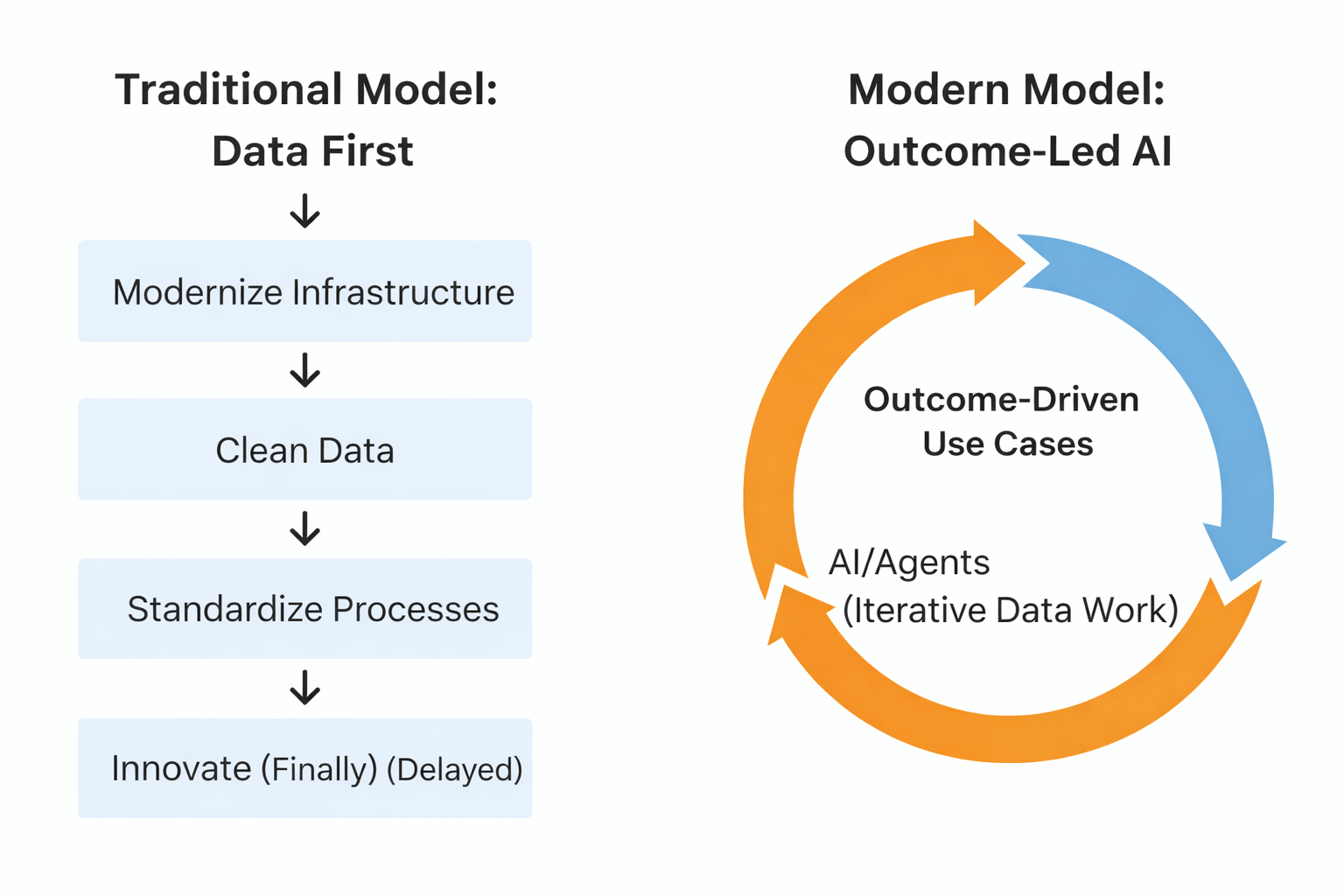
Data first is seductive, but slows results
The “clean your data first” argument sounds responsible because everyone has lived through decades of failed analytics and BI initiatives. Enterprises have been burned by inconsistent definitions, fragmented systems, and brittle/complex pipelines. So the instinct is to remove uncertainty before deploying AI.
The problem is that the enterprise can’t define “data done” in advance. Data quality is contextual. What “clean” means depends on the specific workflow, decision, customer interaction, and risk control you’re trying to improve. Attempting to “fix the data” across the enterprise before delivering AI outcomes is a multi-year effort with unclear endpoints, and it significantly delays the organizational learning that actually drives AI success.
Our research with leading AI practitioners suggests that much of their data corpus remains messy, and that is not a concern. However, the active AI projects, which clearly require good data hygiene, get there much faster with the help of AI. Leaders focus on outcome-led modernization. Specifically, build a quality data substrate (i.e., infrastructure, database and surrounding tools), pick projects that are important, deliver measurable outcomes, and iteratively improve the data as a function of those outcomes. We’re not at all suggesting organizations ignore trust. AI trust is critical. Rather, it’s a call to embed trust into the delivery system rather than treating it as a gate that must be passed before work can begin. Leaning into AI is the fastest path to getting there.
“Most of our data is still messy, and that’s ok. AI helps us get to the right data, make it better, and focus where it matters.” Chief AI Officer, Global Manufacturer
The real business driver is compounding learning velocity
We’re finding that AI adoption behaves less like a traditional infrastructure project and more like a learning curve. The first set of deployments produces reusable assets that accelerate everything that follows, such as retrieval workflows, evaluation tools and feedback loops, successful agentic patterns, security policies, operational runbooks, and governance mechanisms. These become organizational assets that compound and create operational leverage.
Compounding is the competitive differentiator. Organizations that wait “until the data is ready” defer the very learning they need to mature. Meanwhile, leaders build momentum, and momentum becomes structural advantage. In our view, the adoption gap is widening between leaders and laggards. Our research shows that marginally better tooling is far less important than the speed at which organizations can learn and gain muscle memory.
The economics favor speed by a wide margin
At theCUBE Research, we’ve modeled dozens of scenarios based on our underlying research. The difference between a staged approach and a direct path to a mature state is transformational. Here’s an example of a representative case. We studied a $10B manufacturing division inside a $40B conglomerate. We took the learnings from our research and modeled two scenarios: 1) The enterprise choosing a slow, staged modernization path, versus 2) Accelerating to a mature AI-enabled operating model. The results are consistent with what we see across multiple industries: the fast path to AI delivers dramatically higher value capture and a far better financial profile. As an example, over a five-year period, we project:
- Business value of $3–$4B more for the $10B division when getting to AI fast, versus a staged approach;
- ~7–8X the benefit relative to the slow path;
- $2–$3B higher NPV driven by earlier realization of value and compounding productivity and efficiency gains;
- IRR in the high triple digits (~700%+) versus low double/single digit outcomes for staged execution;
- Breakeven around 19 months, roughly half the payback time of the slow path (35+ months).
This is why we believe AI strategy should be increasingly evaluated like a capital allocation decision, not an experiment. Standing up a RAG-based chatbot is relatively easy and delivers modest business value. Transforming processes with powerful AI can deliver a 5–7X productivity advantage and a radically different financial outcome. The central question becomes, “Can my operating model absorb change and what do I need to do technically, operationally, and culturally to enable transformation?”
The hidden gem is that AI becomes the “data work engine”
One of the most important changes we see is where incremental technology spend is going. Over the next decade, our research indicates organizations will significantly increase technology investment – from roughly 4% of revenue to 10% or more on average. But it’s not just “more spend.” It’s different spend.
That incremental investment increasingly shifts away from legacy infrastructure, manual processes, and slow change control toward AI-enabled capabilities that do what enterprises traditionally tried to do with large teams and long programs – e.g., data cleansing, harmonization, semantic understanding, classification, and workflow automation. Agents are emerging as force multipliers for business processes, but also for the very work of making data more usable.
This flips the logic of “data first.” If AI and agents are increasingly the mechanism by which data becomes more usable, then delaying AI until data is “perfect” becomes a chicken-and-egg problem. Our research suggests it is strategically backward.
What leaders are doing differently
While every industry has its own constraints, leaders have shown remarkably consistent behaviors. They don’t treat AI as a handful of isolated pilots; they treat it as a production system that must scale without labor.
They focus on building the minimum modern substrate needed to support iteration – modern data platform and services, retrieval pipelines, vector capabilities, graphs, etc., where appropriate, and an operational layer to run, observe, and govern AI workloads. Then they put the business in motion with a small number of high-impact outcomes that generate reusable patterns and executive confidence.
What we see among leading adopters:
- They prioritize speed to a repeatable delivery factory, not “perfect architecture” on day one;
- They let outcomes drive data investment, accepting that “good enough + governed” beats “perfect + late;”
- They operationalize trust via guardrails, monitoring, evaluation, and workflow controls rather than attempting to eliminate uncertainty upfront.
In our view, this is the most durable way to reduce risk – i.e., don’t delay deployment, but supercharge governance with AI as deployments scale.
The real competitive risk is moving too slowly
Our premise is that the strategic risk for most enterprises is not that they move too fast. It’s that they move too slowly and allow competitors – or new entrants – to capture compounding learning advantages that become increasingly difficult to unwind.
This has the following implications:
AI maturity is an operating model transformation, not an exercise in tooling.
Organizations that keep AI in innovation labs and pilot programs will not capture flywheel benefits. The goal should be a repeatable system that takes projects from idea to production with governance embedded.
Modernization should be designed to accelerate AI, not delay it.
Modern data foundations matter. But the value comes from using those foundations to ship outcomes and learn, not from treating modernization as a multi-year prerequisite.
Finally, the economic case should be framed as a portfolio, not a set of experiments.
When the delta is measured in billions of dollars, multi-hundred-percent IRR, and halved payback periods, the right executive conversation is “what is the optimal sequencing to maximize NPV while maintaining trust?”
A pragmatic path forward
We believe the most effective approach is outcome-driven, governed, and fast:
- Establish the modern data and AI substrate needed to support iteration;
- Select a small number of high-value outcomes tied to measurable productivity or throughput gains;
- Use AI and agents to do the last-mile data work required for those outcomes, iteratively;
- Instrument trust from day one – security, policy enforcement, logging, observability, evaluation, guardrails, workflow controls, etc., so speed does not come at the expense of safety;
- Scale via repeatable patterns so the second and third deployments are materially faster than the first.
The endgame is not “doing AI.” The endgame is building an AI operating model for the enterprise that compounds learning, accelerates throughput, and embeds trust as a feature of production.
Bottom line
In our opinion, “data first, AI later” is often a strategic delay disguised as prudence. Our research indicates the higher-return strategy is to modernize the enabling foundation, pick outcomes, and get on the AI learning curve early – using AI to continuously improve data in service of business value. Our research and modeling clearly shows that the economics and competitive dynamics mean speed to maturity wins by a huge margin.