
Last year, Satya Nadella made the claim that “SaaS will dissolve into a bunch of agents” sitting on top of CRUD databases. He was actually trolling Marc Benioff of Salesforce, who had called Copilot the next “Clippy.” Ironically, it increasingly looks like Nadella was partially right, but only for single-user apps, such as Office. And that is creating a threat to the company that he clearly did not anticipate. The collapse of SaaS valuations as the threat of Anthropic agents looms over traditional enterprise software vendors is actually a different issue. We see the stock market reaction as mostly a threat to the SaaS pricing model. But it’s missing the larger picture, which is the potential for massive TAM expansion for those whose applications can be part of a platform that supports armies of agents and humans collaborating on end-to-end business processes.
The real issue is that Nadella’s prediction exposes a vulnerability to Microsoft’s single-user productivity franchise. Specifically, we see agents and a new work surface as the primary interface for knowledge work. Office risks being partially disintermediated – reduced from the place where humans and agents collaborate to a set of file formats that agents can create, edit, and orchestrate using open-source engines while users live inside a new work surface – some container that’s more editable than Claude Cowork, and where Word, Excel, and PowerPoint are plug-ins. In other words, imagine a world where agents can create Office documents without the need for Microsoft apps by reading and writing the underlying file formats. And when knowledge workers collaborate with agents, Office is moved from the center of their world to a bunch of plug-ins.
This sets up Nadella’s hard choice – i.e., protect the Office annuity, or sacrifice parts of its app-centric model to ensure Microsoft owns the governed agent platform. Microsoft’s current model largely assumes that Copilot 365 drives Office apps via APIs, with Microsoft aiming for an army of agents licensed to use Office. In our view, the market will flatly reject this approach. In this Breaking Analysis, George Gilbert and I lay out what we see as a likely path for Microsoft and how Microsoft will change its productivity software architecture to shift from app-centric to a more platform-centric approach where the value proposition forms around a new work surface, identity, security, information management and governance, and enterprise control, and more work is orchestrated by agents.
Watch the full video analysis
Nadella’s sacrifice: the fork in the road
All right, let’s start with a little tongue-in-cheek setup. We’re showing “Nadella’s sacrifice” and the conundrum he faces. “Satya Abraham” is about to sacrifice his Office son named Isaac. Below, we further explain the metaphor and what Microsoft is being asked to sacrifice.
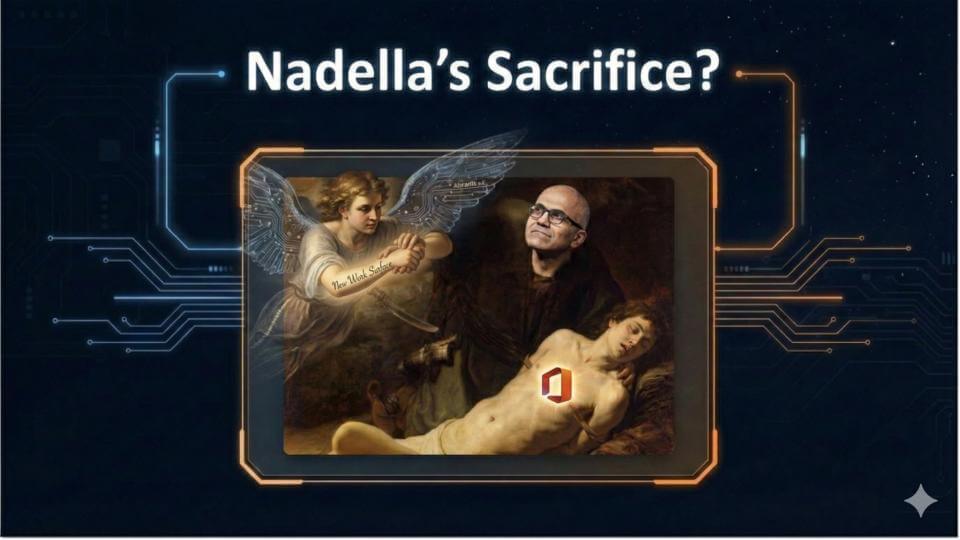
The issue is that Nadella is facing a fork in the road.
On one fork, he continues on the same path he’s on now – to keep trying to make Copilot agents work with the Office apps, which apparently were never really designed to expose the complete functionality programmatically for access by agents.
On the other fork is the sacrifice – he accommodates the very future he was trolling Benioff about. It’s a future where agents don’t need to use his Office apps, and users interact with Office through some new container or work surface.
To put a finer point on it, to really own the future of work, he needs to sacrifice Office’s centrality – both for agents and for users – so he can have the new work surface that everything else plugs into. In our view, Nadella didn’t originally envision sacrificing Office’s centrality. He put forth an approach where Microsoft can keep pushing Copilot deeper into apps, but our observation is that those apps were not designed for agentic access. The right path, in our view, is for Microsoft to build a new work surface that becomes the primary interface for users and agents, even if that means Office becomes less central to the experience.
How the worm turned on Nadella
Okay, let’s have some more fun. The slide below uses the sandworm from the movie Dune as the metaphor – Claude Cowork is the giant worm, and Nadella and Office are the people about to get swallowed.

The point is that the worm has turned on Nadella.
Nadella was trolling Benioff with the idea that apps become secondary and that the application logic moves into agents. That jab came after Benioff took a shot at Office Copilot by calling it “Clippy.” But now the same logic is boomeranging back on Microsoft. Agents can increasingly work without using the Office apps at all.
In that world, Office starts to look like the logic tier, and the “CRUD database” becomes the Office file format. The sandworm represents the existential threat to Microsoft’s productivity franchise in that if agents can do the work without going through Office, the center of gravity shifts away from the apps and toward the agent layer.
Wall Street’s SaaSpocolypse reaction to AI and the impact on Microsoft Office
Let’s take a look at how the market reacted to the recent headlines out of Anthropic. The chart below captures Wall Street’s response to the Claude Cowork news. Investors didn’t treat it as a routine product update. They kind of freaked out – almost like another ChatGPT moment – and the result was a reset in software valuations generally, and Microsoft specifically.
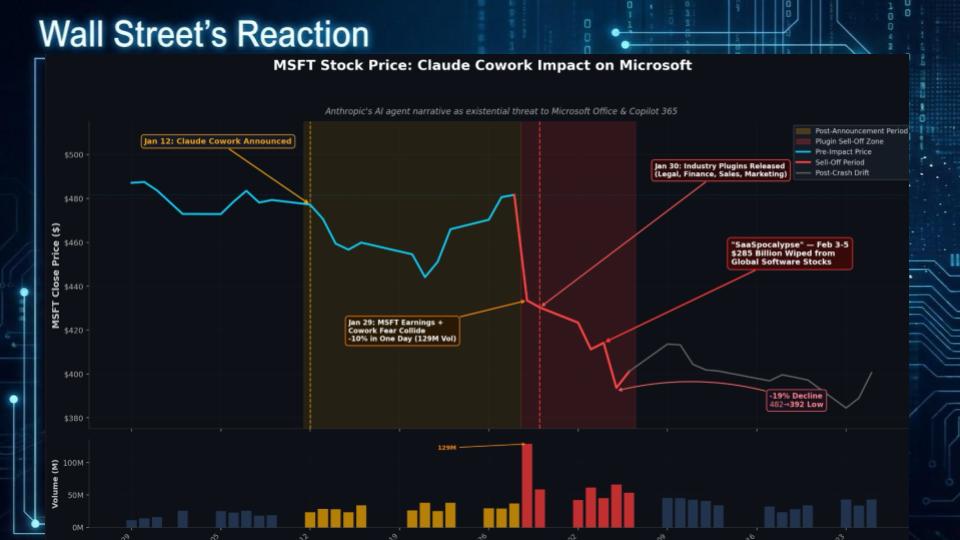
The first big drop after Microsoft’s earnings announcement was tied to Microsoft confirming fears that returns on its enormous capital expenditures have been modest so far. Microsoft even had to rob Peter to pay Paul by taking about two percentage points worth of what otherwise would have been GPUs for Azure growth and using that capacity for R&D. This ties back to an earlier Breaking Analysis point that the market is reacting to a perceived decoupling between capex, which is growing in percentage terms, and Azure, which decelerated in percentage terms.
The drop that followed earnings was the SaaS scare – triggered by the release of Claude Cowork and the narrative that it was the new work surface: an agent that would make SaaS apps disappear. That narrative is misguided, as we’ll explain, but it does highlight an issue that forces Microsoft to adapt and respond.
Nadella’s original argument: SaaS gets hollowed out in the agent era
Let’s go back and explain what Nadella was originally saying, because it’s the key context for this whole analysis.
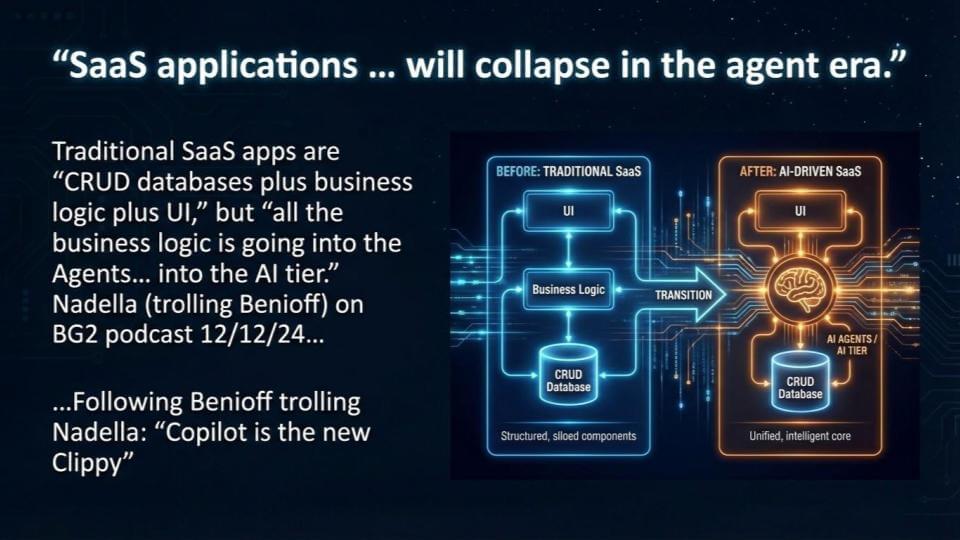
As described above, traditional SaaS is basically three layers: a CRUD database – create, read, update, delete – with business logic on top of that, and then the UI we’re all familiar with on top of that. In the agent era, the argument is that the focus changes. The business logic and workflow move into the agent and AI tier, and the SaaS app gets hollowed out into data, permissioning, and so on. That was the shot across the bow to SaaS incumbents, Salesforce in particular.
It also sets up a bigger question for Microsoft. Specifically, if agents become the interface and the logic layer, what happens to Microsoft’s app-centric franchise, such as Office and now Copilot?
The graphic above captures what Nadella was describing – the logic tier moving into the agent tier and replacing what used to sit in the middle. It was such a clear statement of direction and vision that a lot of people in the industry treated it as a manifesto written by Nadella, the “philosopher king.”
But as we’re going to get into, it never really works the way he described it for multi-user SaaS apps. It can work for single-user apps, and Office is the prime example. And therein lies the unexpected vulnerability.
AI doesn’t vaporize SaaS, but it shifts the battleground to the System of Intelligence (SoI)
SaaS isn’t going to just go away. The change is that the app starts to look less like the traditional UI we’re all used to and more like an intelligent conversation layer between people, agents, and data. That’s the shift the slide below is capturing. The fight is not “apps versus agents.” It’s who owns the intelligence layer that sits between them – what we’ve been calling the System of Intelligence, or SOI.
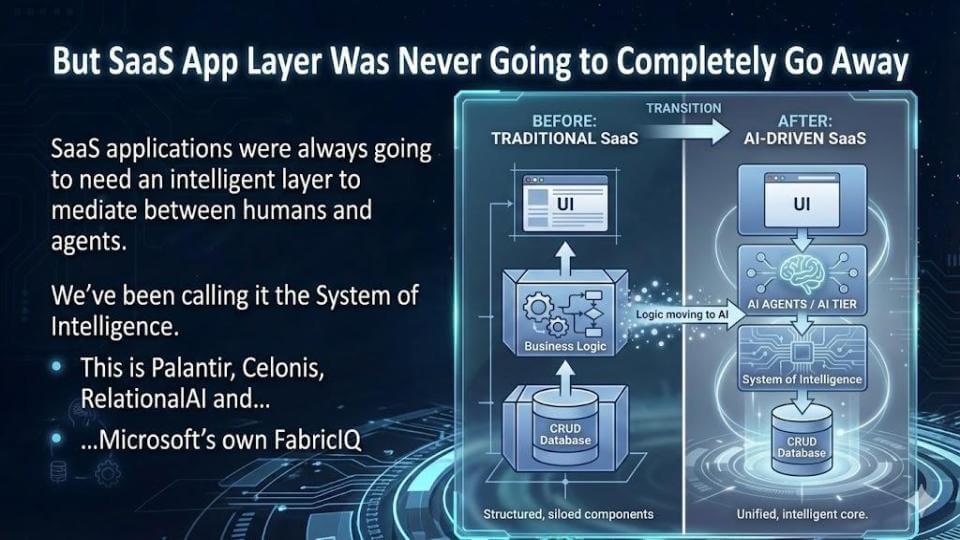
The key distinction is where Nadella’s premise holds and where it breaks. It works for single-user apps. It doesn’t work for multi-user SaaS. And the former is a massive threat to Microsoft.
In multi-user environments, the logic tier doesn’t go away. It changes shape. It becomes the mediating layer – the “4D map” – that agents and humans use to navigate the estate of operational apps and analytic data. It harmonizes the systems and gives one view of the state of the business, so you can get context to make decisions. And over time, it has to do more than context. When an agent takes an action that touches multiple underlying applications, you need transactional consistency across systems – either all of it happens, or none of it happens. You also need governance of the action space and the data that informs it, including the workflow.
That’s why the deterministic combination of logic and database never goes away for multi-user apps. If agents talk directly to databases across hundreds of applications, all in their own language, you get a Tower of Babel, and it’s ungoverned. That’s where this SOI layer shows up, which is why it pulls in players like Palantir, Celonis, and Microsoft itself.
Single-user productivity apps are a different animal. You don’t need to build a digital representation of the enterprise to write a Word doc, a PowerPoint, or a spreadsheet. It’s a sequential stream of activities that a user controls. There may be dependencies and variables, but you can accommodate them as placeholders in a spreadsheet, comments in a document, or a simple variable in a spreadsheet. It’s a much simpler environment than multi-user enterprise apps.
And that’s the irony in what Nadella put forth last year. In the single-user world, the CRUD database is the Office file formats. Those formats are well known and readable and writable – Microsoft opened them up a long time ago. Agents can talk to the Office file format directly, as if it were a CRUD database. In other words, the SaaS collapse argument he was making as a shot across the bow was, in a weird way, mostly true for his own Office franchise.
Copilot 365 and Nadella’s dream: an army of agents licensed to run Office
Satya’s original bet was that agents increase the value of Office. They drive more work through the existing SaaS and desktop apps. Copilot becomes the intelligence layer sitting inside Word, Excel, PowerPoint, and Teams, using those apps as the execution environment.
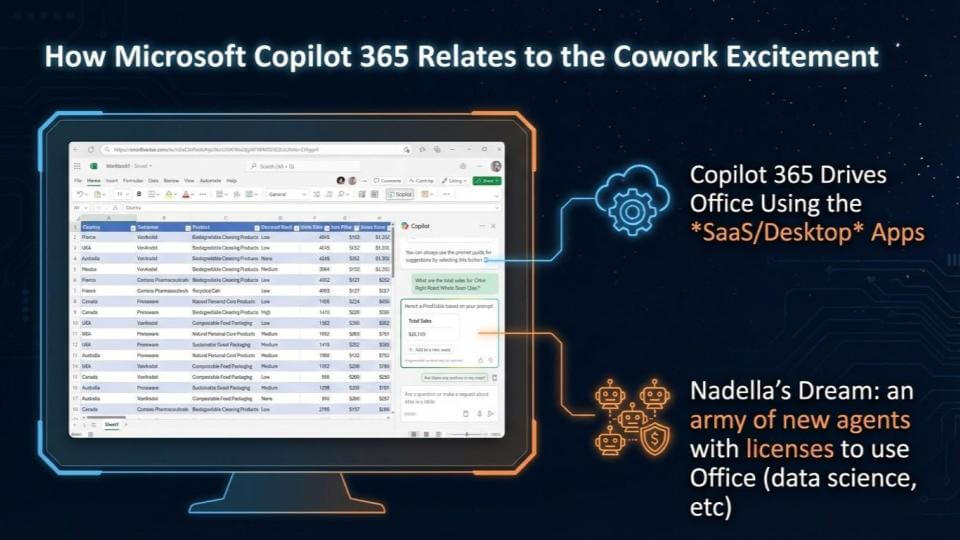
The bigger dream was even more ambitious – not just a user with Copilot, but an army of specialized agents. Analytics, finance, sales ops, legal – each effectively licensed to operate inside the Office platform. It’s a massive TAM expansion with a very attractive pricing model, if it works.
This is the world Nadella described as recently as last November on the Dwarkesh podcast: an army of agents, each needing their own Office license. He even pointed to a version of Excel in which an OpenAI model had been post-trained to navigate it as a data scientist.
The problem is what Cowork surfaced. You don’t necessarily need to work through the Office app to do the work. You can operate on the underlying data model directly – think DataFrame libraries rather than clicking around Excel. Everything about Copilot had been predicated on using Office as the app engine for agents – leaning on the Office object model as the control surface. That’s different from agents working directly with the Office file formats or the underlying data structures.
And that’s where the script starts to flip. If the world doesn’t need Office as the execution engine for agents, the whole “army of agents each licensed for Office” model gets a lot shakier.
There’s a historical echo here. Microsoft had a vision in the mid-to-late ’90s that it would be the gatekeeper and tollbooth for internet commerce. That toll-taking model did happen – just not through Microsoft. Apple and Android ended up taking a cut of digital commerce at scale. The fear for Microsoft is that this plays out the same way. In other words, Office was supposed to be the front end that drags Azure along behind it, but the agents may not want – and may not need – to go through Office at all.
And that’s the trap in big platform transitions. When a company tries to apply its existing model to the next wave, sometimes it works. Often it doesn’t.
How Anthropic’s Claude Cowork changes the game
If you haven’t seen Cowork in action – take one minute to watch this clip, which is summarized below:
Claude Cowork demo clip: what it’s doing
- Finance uses Cowork to identify growth blockers.
- Claude pulls details across customer touchpoints and surfaces the most actionable insights.
- Cowork creates a spreadsheet with the findings, synthesizing data across sales pipelines that would have taken an analyst days.
- It flags a competitive driver: Clear Edge winning 38% of competitive deals, tied to faster onboarding timelines.
- Claude turns the spreadsheet output into a PowerPoint presentation, translating raw data into digestible insights.
- The deck includes product loss trends plus recommended actions.
- Claude cleans up the slide design on request.
- The finished deck is shared to the wider team on Slack.
Cowork drives Office without the apps: Office shifts from container to component
That clip resonates because it flips Microsoft’s original Copilot premise on its head. Nadella’s dream was agents driving more value through the Office apps – more usage, more seats, more revenue, and more Copilot adoption. Cowork is pointing to a different world, where agents operate on Office artifacts directly – documents, spreadsheets, presentations – through open libraries and file interfaces, with the user living in a separate agent work surface.
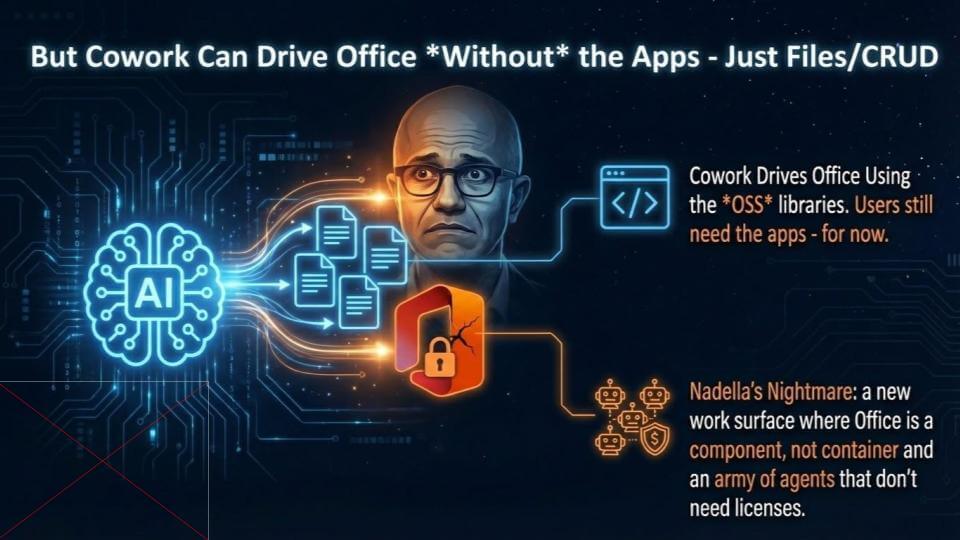
Two things in that model likely really unsettle Microsoft.
First, Cowork becomes the work surface – not Office, and not Copilot. As Anthropic expands MCP for connecting agents with apps, apps such as Office can display their UI as a component inside a work surface controlled by Anthropic. Cowork today isn’t really an editing surface, but it can move in that direction. If Anthropic controls the work surface, it controls the feature surface area that plugin apps can use, and ultimately their pricing. They control the bundle and the boundary for what gets plugged in.
Second, when Cowork is working in agent mode, it doesn’t need to work through the Office apps. The “agent data scientist” idea Nadella talked about can use a DataFrame library, read and write results to an Excel file, and then the user can work with them. That removes the need for agents to have their own copies of the apps and eliminates the TAM expansion Nadella was counting on.
That’s why “without the apps – just files and CRUD” is economically disruptive to Microsoft. Office still exists, but it stops being the container where the work happens and becomes a component that gets called when needed.
Microsoft’s likely response: more platform, less application
Microsoft isn’t going to let Anthropic wipe out its productivity franchise without a fight. The company has been through these platform transitions before. If agents can disintermediate the app UI, the question becomes how Microsoft responds without gripping the legacy so tightly that it misses the transition.
The path that makes the most sense is “more platform, less application.”
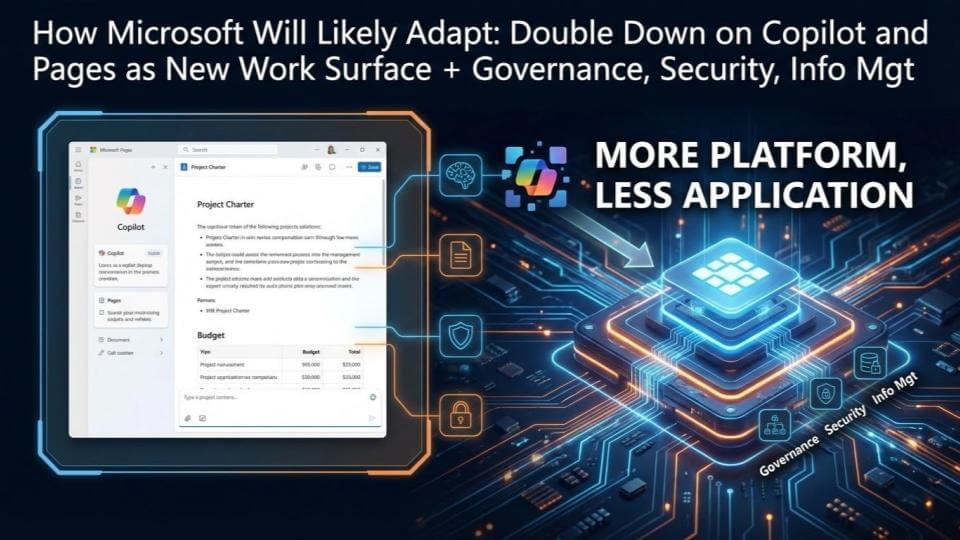
Instead of Copilot being a feature inside Word and Excel, the emphasis shifts to a new work surface where humans and agents collaborate, and the Office apps become plugins. A likely candidate for that new work surface is Copilot Pages. It’s a collaborative surface where spreadsheets can plug in, presentations can plug in, and communications can plug in. The individual apps become plugins, and the work surface orchestrates the apps, orchestrates the agents, and orchestrates the people. Everyone collaborates there.
If Microsoft can make that work, that’s the salvation, because Microsoft then owns the container and the work surface. That’s vital. Otherwise, Office becomes a plugin component inside someone else’s work surface.
And there’s another set of embedded attributes shown above that are invisible, but it’s where the value sits. Specifically, governance, security, and information management are native to the platform. While largely invisible, it’s still monetizable. If Copilot becomes the control plane for the agent era – not just an add-on to Office – that’s where Microsoft has leverage that others don’t.
Copilot pricing: sticker shock, tokenomics, and the outcome-based gap
The slide below captures the customer sentiment from an ETR roundtable. There’s consternation at $30 per user per month for Copilot. One IT director calls it “sticker shock.” A nonprofit CIO says the pricing “seems exorbitant.” A municipal IT manager says they felt “a little bit of potential sticker shock” when they saw it. It’s polite language, but the point is obvious.
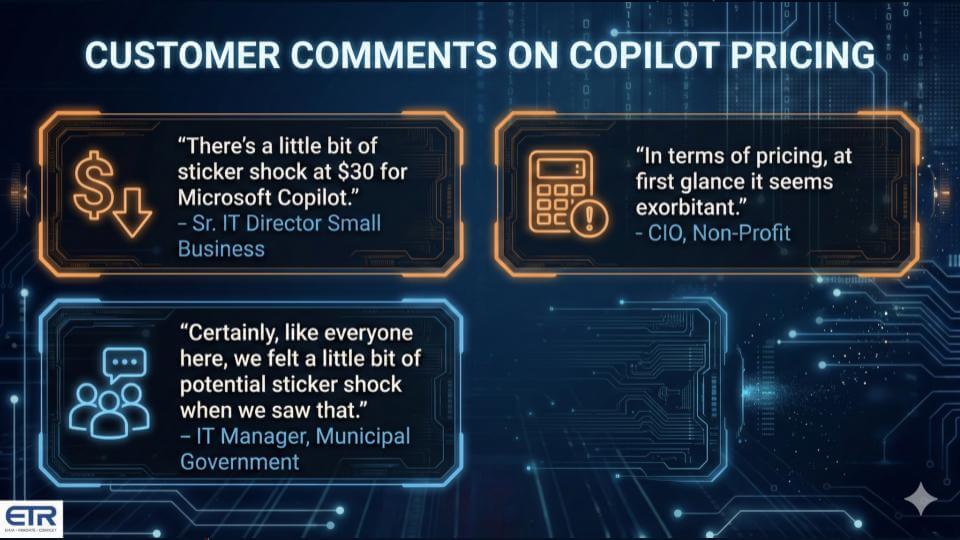
The bigger issue is the pricing model transition. When we moved from on-prem to SaaS, pricing changed. Now we’re moving again. The productivity bundle becomes more of a platform and user experience shell and less of a suite of applications. Underneath, it’s held together by information management, governance, and security. That value is there, but as we stated, it’s embedded natively into the platform. The value will shift to the platform, and Microsoft will monetize it.
The seat-based model Microsoft wanted to extend into the agentic era probably doesn’t hold. Everybody is still struggling with how AI pricing should work. Vendors want to get to something closer to outcome-based pricing, where they capture some of the value created when the system actually does the work, not just pay for tooling.
So far, nobody has really figured that out. The only thing working today is token-based pricing – basically, an extension of the infrastructure consumption model. Sometimes it gets packaged as an entitlement, a periodic bucket of tokens. That’s what’s working. It’s also not the last word on pricing.
Outcome-based pricing is the dream. If you resolve a customer service case without involving a human, there’s a price per resolution. That’s outcome-based. You can imagine pricing based on completing an end-to-end workflow. But the reality is that vendors are using tokens as a proxy for outcomes because outcomes are hard to measure and even harder to forecast. Tokens start looking like cell phone minutes. It’s not clean, and it’s not a long-term solution.
There’s also a bigger tension under all of this. Benioff has said the trillion-dollar software industry can now address $13 trillion in human labor. That’s the TAM expansion argument, and outcome-based pricing was supposed to be how vendors captured a piece of that labor value. Customers are pushing back. If the industry stays stuck in token-based pricing, vendors are still essentially selling infrastructure, and everyone is trying to get past that.
That’s part of why the market keeps getting nervous. Vendors are putting enormous capital in the ground to produce tokens. If they can’t charge for some of the value they’re creating by substituting for labor, Wall Street’s concern about whether vendors can capture enough value to pay for that capex becomes valid. And of course, this isn’t only a Microsoft problem. Salesforce, ServiceNow, and every other software vendor has to deal with the same transition.
Closing: Wall Street confusion, the pricing gap, and the transition risk
The market is sending a pretty strong signal right now. It doesn’t understand what the world is going to do with all this manufactured intelligence – all these tokens – and how it gets monetized. What it sees first is job displacement. That feeds fear of higher unemployment, less disposable income, and weaker demand. What it doesn’t yet see clearly is the incremental value – the new services, new products, and new categories that create demand and eventually create jobs. That uncertainty is what’s driving the ticker tape, and it’s fascinating to watch because it’s what happens in every major transition.
The near-term irony is that we just had what felt like a second ChatGPT moment when coding agents started to really work. This wasn’t just a chat window next to a developer. You could hand it a big task, and it would go off and do it. Senior developers who have seen a lot of tech shifts are saying they haven’t ever experienced an abrupt change like this.
And unlike the first ChatGPT moment, there is already a business model that works here. Coding agents and the derivatives of that are paid for. Tokens are consumed and billed. That’s a known model. So when Wall Street freaks out that “we can’t monetize this,” it’s missing at least one major point – some of the most important early value is already monetized, and the market has a working consumption model.
The harder part is the longer-term outlook. Previous industrial revolutions played out over decades, even a century, giving societies time to absorb the transition. This one is happening faster. The risk isn’t that every company is going to do mass layoffs in 2027. The risk is that the disruption shows up quicker than organizations, labor markets, and institutions can adjust.
In the longer term, there will be roles for humans. They may look very different, but the evidence is already there in tech organizations watching certain individuals become monstrously productive with these tools. The worry is that the transition period and the structure it reinforces – i.e., a platform-based economy where the winner takes most, and the number of winners shrinks as the tools get more powerful. If that dynamic spreads across the broader economy, our economic and political systems aren’t ready for it.
That’s where we leave off. The Cowork moment was a Microsoft awakening, but it’s much more. This is a reminder that the AI era is forcing two resets at the same time:
- A software reset – apps versus agents quickly becomes a fight over the work surface and the system of intelligence that sits between humans, agents, and data.
- A business model reset – seat pricing doesn’t fit cleanly to agentic work, token pricing is an imperfect proxy for outcomes, and vendors are trying to find a way to capture value without breaking the customer’s willingness to pay.
The train isn’t stopping. The question is whether the industry can get the pricing and trust layers right quickly enough to keep the transition from turning into a drawn-out dip.