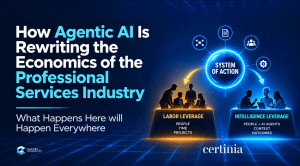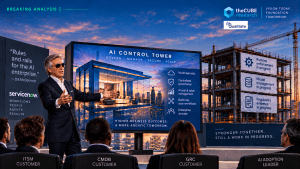
Professional services automation is entering a new phase, and Certinia’s April 2026 launch of Veda signals where the market is heading. Certinia is positioning Veda as a modern AI operations engine for the intelligent services enterprise, extending AI across the full services journey, from first bid to final invoice, and moving beyond advisory AI toward action-oriented agentic workflow orchestration.
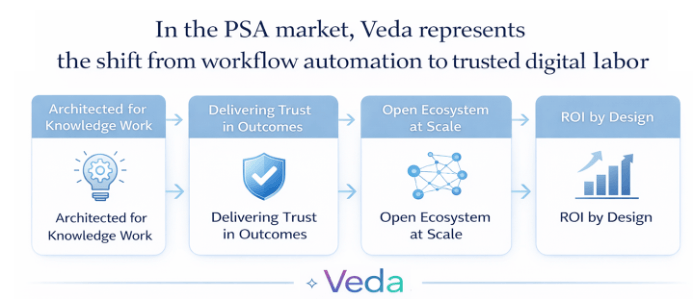
In practical terms, that means shifting PSA from traditional workflow automation toward a trusted model for executing digital labor in knowledge work.
What makes the announcement notable is not merely that Certinia has added AI agents to its platform. Veda appears to be architected for consequential enterprise workflows. Built on Salesforce Agentforce and grounded in Certinia’s system of record, it combines specialist agents, intelligent actions, business rules, permissions, and continuous context across estimation, staffing, delivery, financials, customer success, and margin management.
Just as important, Certinia has elevated trust from a governance afterthought to an architectural principle, with explainability, auditable actions, domain-bounded agents, human control, traceability, and a trust Layer all playing central roles. The result is a more tangible AI value proposition than much of the market currently offers.
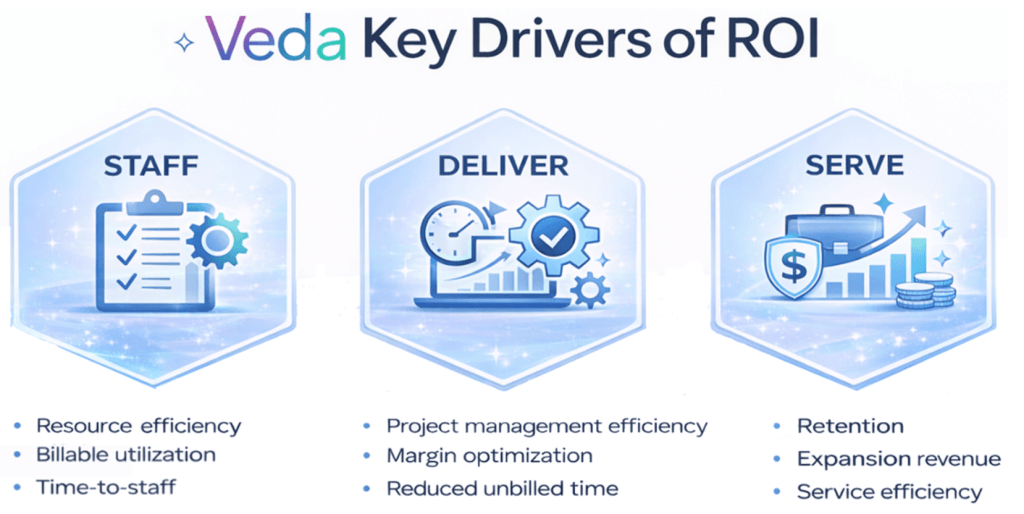
Certinia is tying Veda to measurable outcomes across the three operational domains that matter most in services: staff, delivery, and service. That frames AI not simply as labor savings, but as a force multiplier for utilization, margin protection, revenue growth, and customer retention. In that sense, Veda is emerging as an early blueprint for the deployment of trusted, agentic AI in real-world knowledge-work environments.
Against that backdrop, the following Q&A with Raju Malhotra, Certinia’s Chief Product & Technology Officer, offers a useful look at how the company is thinking about the future of PSA, digital labor, and enterprise AI.
Q: Why is professional services becoming such an important proving ground for agentic AI?
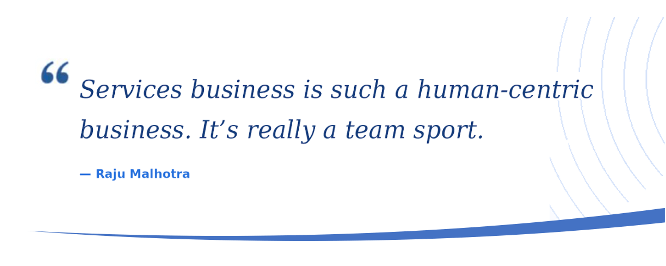
Raju Malhotra: Professional services is one of the most human-centric and bespoke parts of the enterprise. It runs on collaboration, staffing trade-offs, delivery coordination, margin discipline, and customer relationships. We believe that makes it a natural place for agentic AI to create value, because the opportunity is not just to automate repetitive tasks, but to help knowledge workers make better decisions and work together more effectively.
Q: Certinia talks a lot about collaboration. What does that really mean inside a services lifecycle?
Raju Malhotra: We view collaboration as much more than communications. Collaboration in our world starts with a unified customer record and a single source of truth that spans sales, delivery, finance, and customer success. We then enable these teams to work from the same record across the services delivery cycle. Just as importantly, they can track what is being delivered, utilization rates, and margins in real time, and coordinate around customer outcomes far more effectively. That is the foundation for collaboration at scale.
Q: What exactly is Veda?
Raju Malhotra: Veda is Certinia’s suite of packaged agents and intelligent actions for professional services. It builds on our long-standing workflow automation foundation, but adds a new agent-orchestration layer designed for humans and digital workers to work together. Our agents are not generic assistants, but rather agents built around specialist roles across functions such as services estimation, staffing, customer success, and financial management. We are also enabling them to not just advise people, but to help execute work across the services lifecycle.
Q: Why did Certinia choose to start with specialist, role-based agents rather than generalized agents?
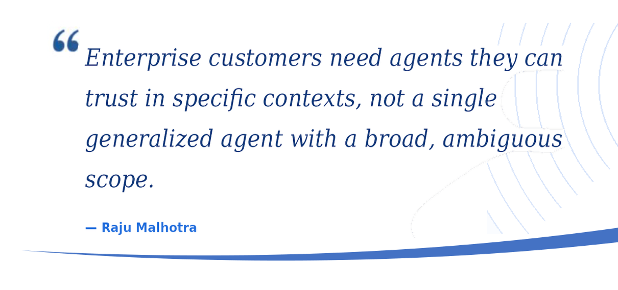
Raju Malhotra: Domain specialization is critical. It’s the foundation of our belief system. Our view is that enterprise customers need agents they can trust in specific contexts, not a single generalized agent with a broad, ambiguous scope. In our client’s world of professional services, requirements vary widely across staffing, delivery, customer success, and financial management. Each area has its own workflows, policies, metrics, and data. That is why we have taken a specialist approach with role-based agents and intelligent actions. Trust. Which comes, in part, from delivering the right domain context, the right
guardrails, and the right behaviors for each and every use case.
Q: How does Certinia think about hybrid teams of humans and agents?
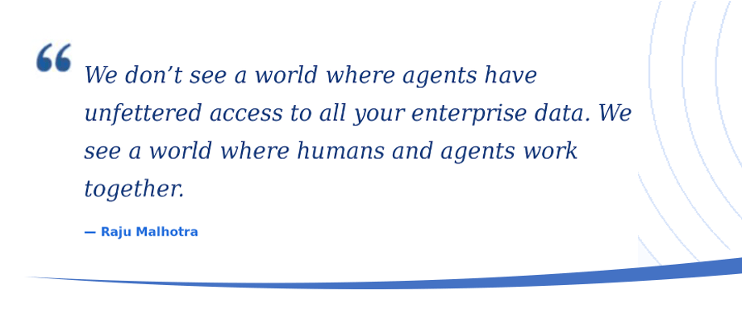
Raju Malhotra: I think hybrid teams are rapidly becoming a reality, and it’s changing the economics of professional services because firms can now more easily address the constraints traditionally limited by human capacity. It’s by infusing collaborative, specialist agents across every part of the delivery model that loosens up the constraints. It’s a big deal for many firms. These hybrid delivery models will materially expand the addressable services opportunity, while also changing how firms think about resourcing, margins, and growth.
Q: How should executives think about the difference between automation and true agentic execution?
Raju Malhotra: They should start with the perspective that traditional automation is very good at following predefined workflows. It can move data, trigger steps, and handle repeatable processes. Agentic AI is very different and requires a different perspective. It’s different because it introduces context, reasoning, and adaptability into the flow of work. With professional services firms, conditions change all the time. Staffing changes, project risks change, and financial realities change. So, the goal is not just to automate a fixed set of steps; it’s to help teams respond intelligently to change. That is where agents, intelligent actions, and the right reasoning layer come into play. For us, that is the shift from simply automating work to helping orchestrate work in a more dynamic, more aligned way with business.
Q: Why does trust matter so much in enterprise AI, especially in PSA?
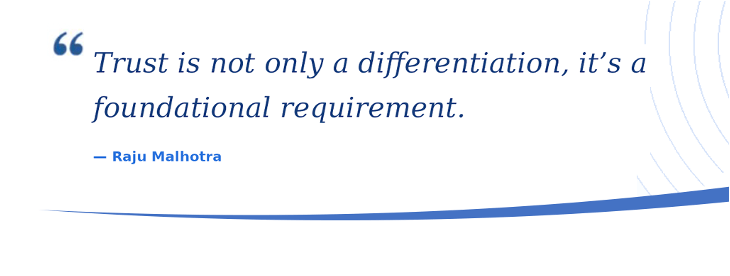
Raju Malhotra: Trust is everything. Because in services, poor AI recommendations can affect client outcomes. Inaccurate financial data, incomplete or misleading compliance reporting, etc., can become a nightmare. Certinia’s position is that trust is foundational to digital labor transformation, agentic AI, and ROI. People will become more trustworthy since it has greater predictability, stronger guardrails, and role-based permissions, governed by humans in the loop. We’re explicitly building agents designed to align with company policy and mirror the performance of a firm’s best employees, rather than acting as uncontrolled black boxes.
Q: Why isn’t an LLM-only approach enough for these workflows?
Raju Malhotra: LLMs are foundational, but not sufficient on their own. We see enterprise AI being defined by a layered architecture that starts with customer data and metadata, adds business logic, context, and reasoning, and then surfaces those capabilities through the user experience. In the service environments we deal with, AI is only as good as the policies, financials, timecards, and other things that are critical, but which LLMs are not designed to handle. Certinia argues that enterprises need more than probabilistic generation. LLMs need a reasoning and domain context to make services workflows deterministic, controlled, and trustworthy.
Q: What role does Salesforce Agentforce play in the Veda strategy?
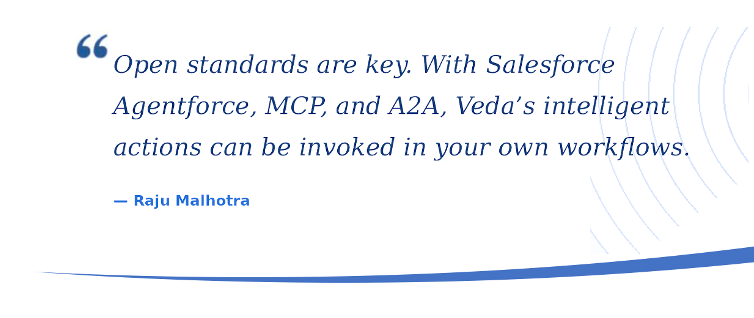
Raju Malhotra: We are Salesforce’s largest native ISVs, and that gives us an important advantage. Because Veda and related Certinia offerings operate natively on Salesforce, we can work directly from the customer’s shared data foundation rather than copying or integrating data across disconnected systems. Agentforce provides an important part of the AI stack foundation, while we bring the domain knowledge, data, telemetry, workflow logic, and reasoning needed for professional services use cases. The result is a native, enterprise-scale experience optimized by individual use cases.
Q: What should executives do now if they want to move beyond AI pilots?
Raju Malhotra: It’s clear in our view that the market has moved beyond experimentation alone, although it has not been easy. Despite this, most firms are now focused on connecting AI to real operational problems and real production outcomes, and speeding delivery cycles. AI should no longer be treated as something the board asked for or as a side experiment. It should be treated as a means to solve meaningful, high-impact business challenges with measurable ROI. That shift, from pilot thinking to operational value, is where the market is now.
Watch the Full Interview
AnalystANGLE
What emerges from these conversations is a clear picture of Certinia’s thesis: the future of professional services ROI will be shaped not by AI that simply generates answers, but by trusted agentic systems that help people collaborate, decide, and execute together.
Veda is Certinia’s effort to build that next operating layer, grounded in domain context, system-of-record data, and enterprise guardrails. Whether the broader market adopts that model remains to be seen. But the direction is clear, and professional services may be one of the most important places to watch it unfold.

📩 Contact Me 📚 Read More AI Research 🔔 Subscribe to Next Frontiers of AI Digest