As AI Moves from Experimentation to Production, Infrastructure Requirements Are Changing
One of the clearest themes emerging across the technology industry in 2026 is that artificial intelligence is no longer primarily an exercise in experimentation. Enterprises are moving beyond proofs of concept and pilot projects toward operational deployment, forcing organizations to rethink the infrastructure required to support AI at scale.
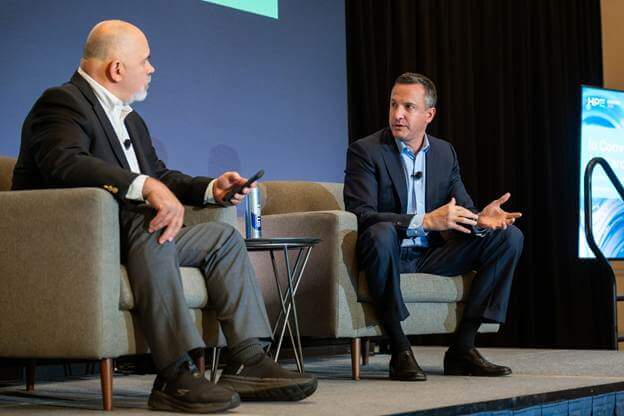
I was fortunate to have a discussion at HPE Discover 2026 with VULTR CEO J.J. Kardwell, who provided insight into how this transition is reshaping the cloud infrastructure market. While much of the AI conversation continues to focus on GPUs and model development, Kardwell highlighted a broader reality: successful AI deployment requires a combination of compute, storage, networking, operational expertise, and enterprise-grade reliability.
From Bootstrap Success Story to Global AI Infrastructure Provider
VULTR’s growth trajectory is noteworthy. Founded as the hosting business Constant in 2001, the company spent most of its history as a fully bootstrapped business before rebranding and entering the cloud market in 2014. According to Kardwell, VULTR became the largest bootstrapped cloud infrastructure company in the world before raising its first outside funding in late 2024.
Today, the company operates across 33 cloud locations in 17 countries and serves a global customer base, positioning itself as the world’s largest privately held hyperscaler, as stated by Kardwell.
What makes VULTR particularly interesting is that it entered the AI infrastructure market relatively early, beginning GPU investments in 2021 before the explosive demand surge that followed the emergence of generative AI in 2023. That timing has given the company a unique vantage point on how AI consumption patterns have evolved.
The Shift from Training to Production
Perhaps the most important observation from Kardwell was how dramatically the composition of AI demand has changed. Three years ago, most AI infrastructure spending originated from research organizations, AI startups, and experimental projects. The primary objective was model development. Today, the demand profile looks very different.
Organizations are increasingly investing in AI because it delivers measurable business outcomes. Whether through productivity improvements, operational efficiencies, software development acceleration, or customer-facing applications, AI is beginning to influence business performance in tangible ways. As a result, infrastructure demand is shifting from model training toward production inference environments.
This transition matters because production AI workloads introduce a completely different set of requirements. Training environments can often operate as isolated GPU clusters. Production environments require integration with existing enterprise applications, cloud services, storage platforms, security frameworks, governance models, and operational processes.
As Kardwell noted, AI may dominate the headlines, but enterprises still run businesses on traditional applications and infrastructure. CPUs, storage, networking, and cloud services remain essential components of any production AI architecture.
Why Enterprises Are Rethinking Infrastructure Consumption
Another key theme from the discussion was the growing mismatch between traditional enterprise infrastructure planning cycles and the pace of AI innovation. Historically, organizations could spend months evaluating facilities, infrastructure platforms, and deployment strategies. AI has changed that equation.
GPU availability, power constraints, and rapidly evolving hardware generations have compressed decision timelines. Organizations increasingly need infrastructure capacity immediately rather than years down the road. This reality is driving many enterprises toward consumption-based infrastructure models that offer flexibility, speed, and access to the latest technologies.
According to Kardwell, even the world’s largest technology companies are increasingly balancing capital expenditures with cloud-based consumption models. The result is not a wholesale migration to the cloud, nor a complete return to on-premises infrastructure. Instead, organizations are adopting hybrid approaches that combine owned infrastructure with cloud-delivered services.
While many enterprises will continue investing heavily in owned infrastructure, the need for agility, geographic expansion, burst capacity, and rapid deployment ensures that third-party infrastructure providers will continue playing a critical role.
Networking Becomes Strategic Infrastructure
One of the most compelling aspects of the discussion was the emphasis placed on networking. For years, AI conversations have largely centered on GPUs. Today, networking is emerging as a critical determinant of AI performance and efficiency.
As clusters scale from individual servers to rack-scale systems and eventually to massive, distributed AI fabrics, network performance increasingly determines overall system effectiveness.
Kardwell highlighted how the bottleneck often shifts from the GPU interconnect inside a server to the east-west fabric connecting thousands of GPUs across racks and data centers.
This observation aligns with a broader industry trend visible across networking and other infrastructure providers. AI is elevating networking from a supporting technology to a strategic architectural component.
The growing importance of high-performance fabrics, automation, observability, and self-healing operations reflects the reality that AI infrastructure is becoming too large and too complex to manage manually. Organizations that optimize network performance, reliability, and operational efficiency will have a significant advantage in delivering AI services at scale.
The Importance of Trusted Partnerships
Kardwell also emphasized the increasing importance of enterprise-grade partnerships as AI deployments become more mission-critical.
As AI investments grow into multi-billion-dollar initiatives, enterprises are placing greater emphasis on reliability, supportability, security, compliance, and operational accountability. This dynamic helps explain VULTR’s expanding relationship with HPE.
The partnership spans both infrastructure and networking technologies, combining VULTR’s global cloud platform with HPE’s enterprise heritage and networking expertise. For large organizations evaluating AI deployments, trusted ecosystems often become as important as the underlying technology itself.
The combination of proven infrastructure, operational expertise, and established support models can help reduce deployment risk while accelerating time to value.
Looking Ahead
The conversation with Kardwell reinforced a broader industry reality: AI infrastructure is entering a new phase. The market is no longer defined solely by GPU availability or model development. Instead, success increasingly depends on delivering production-ready environments that combine compute, networking, storage, security, governance, and operational simplicity.
As enterprises move from experimentation to operational deployment, infrastructure providers must evolve accordingly. VULTR’s growth, global expansion, and focus on enterprise AI workloads suggest that the next chapter of cloud infrastructure will be defined less by raw scale and more by the ability to deliver flexible, trusted, and operationally efficient platforms that support AI at enterprise scale.
For infrastructure providers, that represents both a challenge and an opportunity. For enterprises, it highlights an increasingly important reality: successful AI adoption requires far more than GPUs. It requires an infrastructure strategy capable of turning innovation into operational outcomes.
For more information on VULTR, please visit their website.