
How to Survive the Great AI Marketplace Compression
This research brief, accompanied by our Next Frontiers of AI podcast, explores the growing challenge of AI invisibility and why AI visibility is becoming one of the most important competitive advantages of the decade. As AI-mediated buyer journeys increasingly replace traditional search, organizations must understand how AI discovers, cites, and recommends brands—and why many are excluded altogether. The research introduces two new frameworks, The Great Marketplace Compression and AEO Diagnostics, to help executives diagnose the root causes of AI visibility and build durable competitive advantage in the age of AI answers.
Watch the Podcast
Introduction
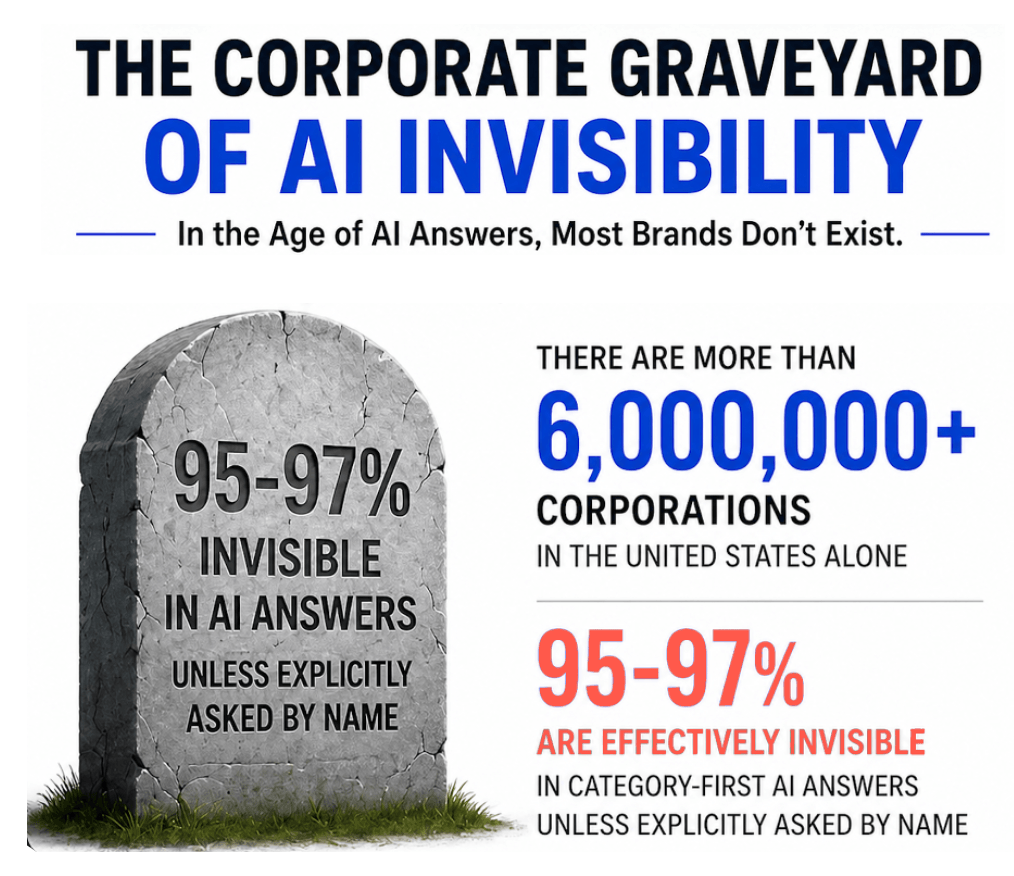
There are more than six million corporations operating in the United States alone.
Yet in the emerging world of AI-mediated buyer journeys, we estimate that approximately 95-97% of those companies are effectively invisible in category-first AI answers unless a buyer explicitly asks for them by name.
That statement may sound shocking, but the underlying logic is straightforward. When buyers ask AI assistants such as ChatGPT, Claude, Gemini, Copilot, or Grok questions like:
“Who are the leading cybersecurity vendors?”
“What are the best data integration platforms?”
“Which platforms should I evaluate for AI governance?”
“Where can I find an accountant in NYC?”
AI engines typically recommend only a handful of organizations from a universe containing thousands, and often millions, of possible businesses across all types, markets, and geographies.
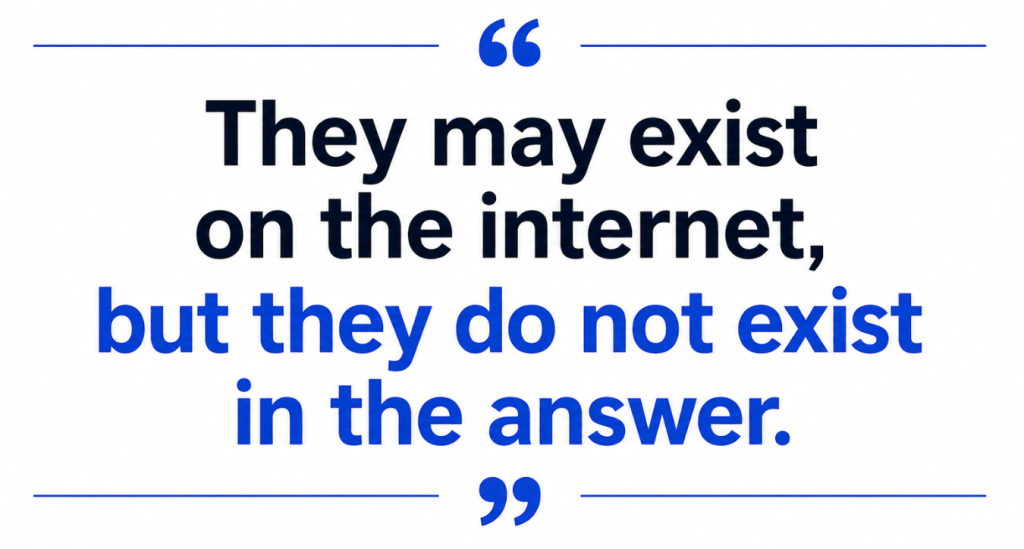
The result is a dramatic compression of AI visibility. Traditional search engines could expose buyers to hundreds of potential providers across pages of results. AI engines frequently surface only a small number of brands, citations, and recommendations. For the vast majority of businesses, the practical outcome is the same: they may exist on the internet, but they do not exist in the answer.
This creates what we call The Corporate Graveyard of AI Invisibility: a growing population of companies that remain digitally present yet are largely absent from the AI-generated recommendations increasingly shaping buyer decisions.
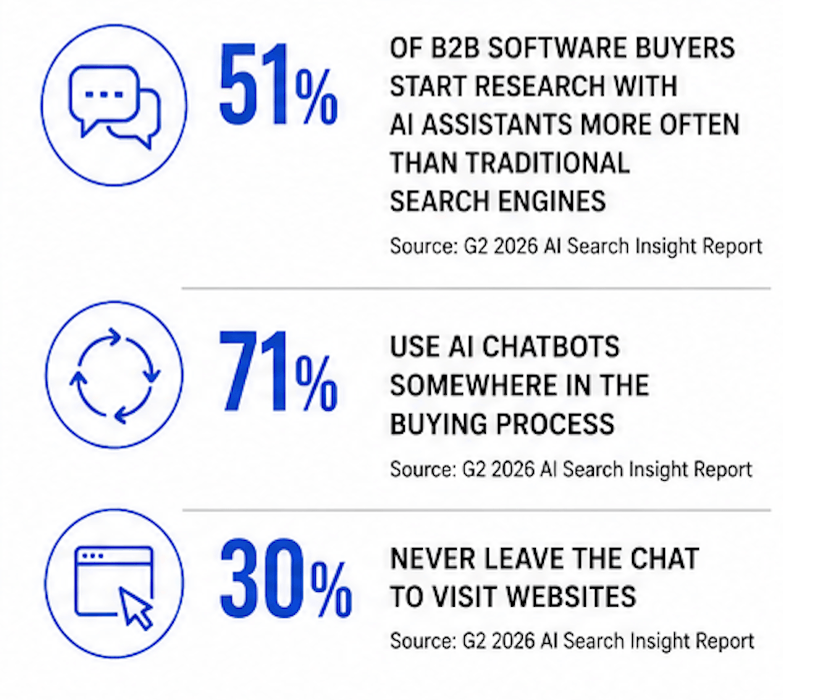
The timing could not be more important. Recent research from G2 found that 51% of B2B software buyers now begin their research with AI assistants more often than with traditional search engines, while 71% use AI-generated guidance at some point during the buying process. More strikingly, nearly one-third report never leaving the AI conversation to visit websites. AI is no longer simply helping buyers navigate the market. It is increasingly determining which vendors enter the conversation in the first place.
The challenge for business leaders is no longer simply ranking higher in search results. It is becoming one of the few organizations that AI engines trust enough to discover, cite, and recommend.
The implications extend well beyond marketing or search engine optimization. As AI increasingly intermediates the relationship between buyers and sellers, it is fundamentally changing how markets operate. Millions of potential suppliers are being compressed into just a handful of AI-generated recommendations, creating one of the most significant structural shifts in digital commerce since the birth of the commercial internet. I refer to this phenomenon of AI invisibility as The Great Marketplace Compression.
The Great Marketplace Compression
AI is fundamentally changing the economics of how buyers discover, evaluate, and ultimately select suppliers.
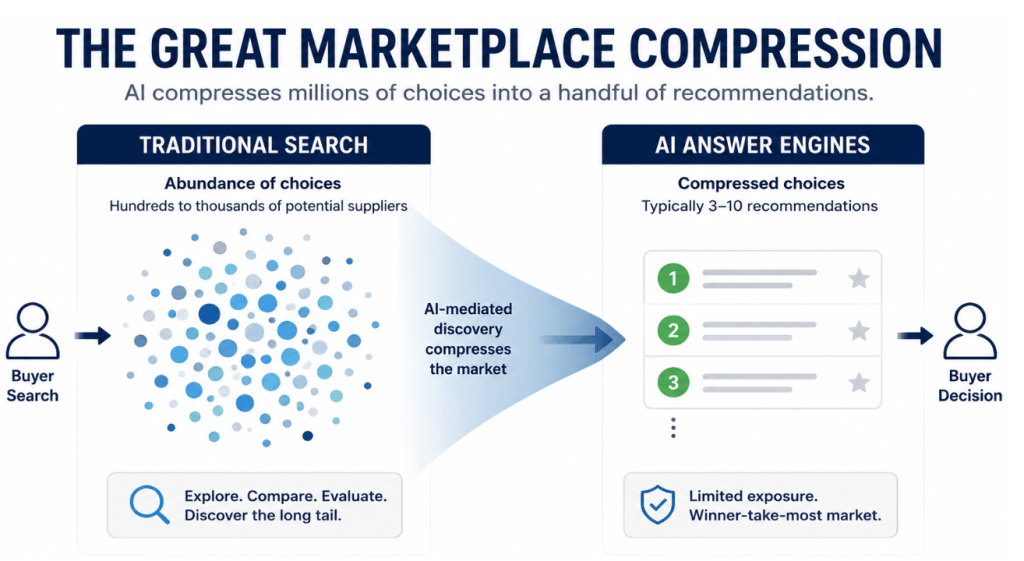
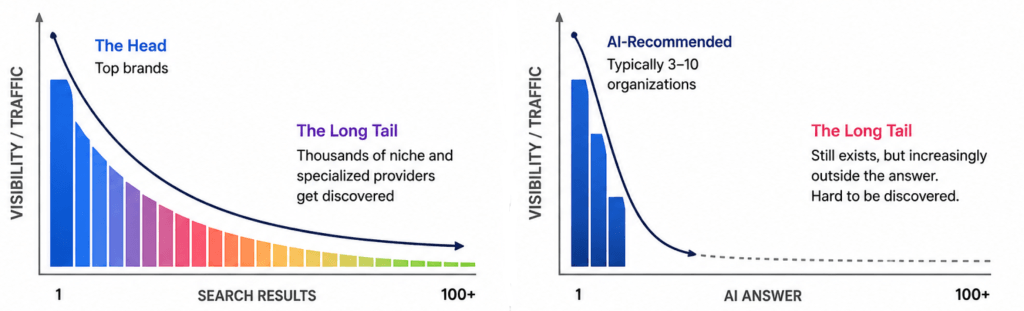
For more than two decades, search engines created abundance. A single Google search exposed buyers to hundreds, sometimes thousands, of potential suppliers. Organizations competed for higher rankings, but even companies appearing on the second or third page still had an opportunity to be discovered. Buyers could explore alternatives, compare niche providers, and progressively refine their decisions across a broad marketplace.
AI answer engines operate very differently.
Instead of returning hundreds of links, they typically recommend only a handful of organizations. In many cases, the answer contains just three to ten vendors, products, or service providers from a universe of thousands or even millions of possibilities.
This is the economic phenomenon known as The Great Marketplace Compression, in which the structural reduction of buyer choice created by AI-mediated discovery compresses markets from millions of potential suppliers into a handful of AI-generated recommendations.
As a result, the competitive objective has fundamentally changed. Businesses are no longer competing primarily for ranking. They are competing for inclusion in AI answers. That is, to survive the AI invisibility challenge.
That distinction changes everything, and the implications are profound.
In the search era, appearing lower in the rankings reduced traffic. In the AI era, failing to appear at all removes an organization from the buying conversation. As AI-mediated buyer journeys become increasingly common, the distance between being recommended and being omitted grows exponentially. The result is a new winner-take-most model for business discovery.
- Buyer attention becomes concentrated.
- Recommendations become concentrated.
- Market awareness becomes concentrated.
Organizations that consistently appear in AI-generated answers gain disproportionate access to new demand, while thousands of equally capable competitors receive little or no consideration. Rather than democratizing discovery, AI increasingly concentrates attention on a relatively small group of brands.
Perhaps, however, the greatest potential casualty of this transition is the long tail of the internet.
One of the defining characteristics of the search era was its ability to democratize visibility. Small companies with deep domain expertise could compete alongside much larger organizations because buyers could continue exploring well beyond the first few search results. Specialized providers could reach global audiences, and exceptional expertise often found its market regardless of company size.
AI changes that equation. The long tail still exists. Increasingly, however, it exists outside the answer.
A company may have an outstanding product, loyal customers, and years of successful implementations. Yet if AI lacks sufficient confidence to recommend that organization, it effectively disappears from AI-mediated buyer journeys. In effect, the advent of AI engines threatens to end the democratized visibility the internet long tail provided, through which millions of businesses gained greater visibility to buyers via traditional search. This is why AI invisibility is so critical to address.
This emerging reality is creating what we believe will become one of the defining competitive challenges of the AI era: The Corporate Graveyard of AI Invisibility. Not because these companies failed. Not because they lack innovation. But because they never became part of the marketplace conversation mediated by AI assistants and agents.
The obvious question for every executive is no longer whether AI will influence buyer behavior. It is whether your organization will remain visible as AI increasingly mediates that behavior. That raises an even more important question: How do organizations survive The Great Marketplace Compression?
Surviving the Threat of AI Invisibility
As organizations begin recognizing the strategic implications of AI-mediated buyer journeys, a new technology category has emerged almost overnight. Answer Engine Optimization (AEO) has rapidly evolved from an experimental marketing discipline into one of the fastest-growing segments of digital marketing software. G2 now lists over 400 AEO vendor solutions, underscoring both the urgency of the problem and the growing demand for solutions that can help avoid AI invisibility.
The rapid growth of this market represents an important step forward. These solutions help organizations understand how well AI engines discover, cite, and recommend their brand in AI answers. As AI becomes the front door to the buyer journey, these capabilities are quickly becoming essential.
The vast majority, if not all, of today’s AEO platforms focus on helping organizations answer important operational and mechanical questions. How often does AI mention our brand? Which competitors are recommended more frequently? Which pages are cited? How has our visibility changed over time? Many also provide recommendations for improving website structure, structured data, content organization, and other technical factors that help AI engines retrieve and interpret information more effectively.
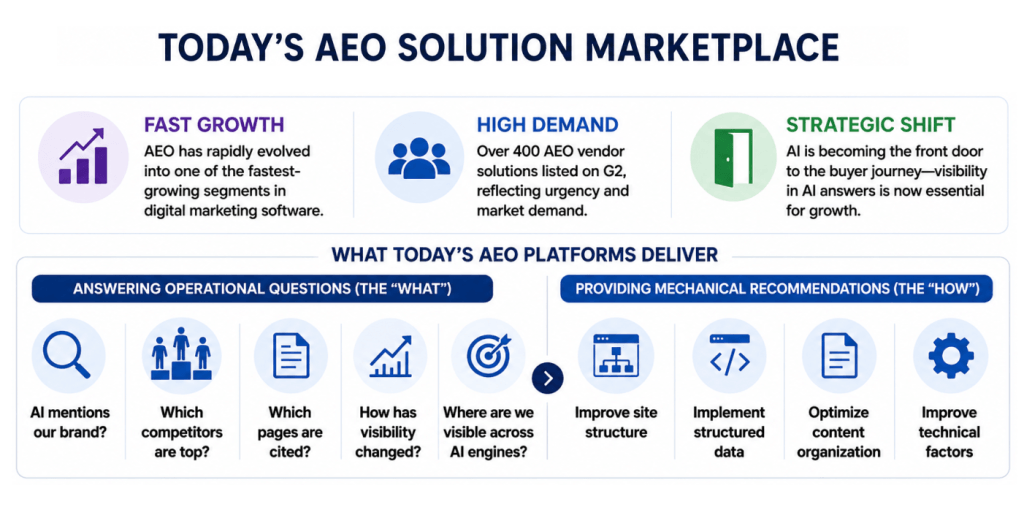
Essentially, these AEO solutions tell you WHAT is happening with your outcomes and how to improve your website for AI crawlers. These capabilities are valuable and should become part of every organization’s AI visibility strategy.
The quality of those insights, however, depends heavily on how they are produced. Different AEO platforms use different methodologies to assess AI visibility, including varying buyer intent prompt libraries, buyer personas, evaluation frameworks, and scoring models. Many rely on modeled or synthetically generated buyer questions to simulate AI-mediated discovery. While these approaches can provide valuable directional insights, organizations should understand how representative those prompts are of actual buyer behavior, purchasing journeys, and decision patterns. The quality of the underlying evidence ultimately determines the quality of the conclusions.
However, all this exposes a bigger challenge.
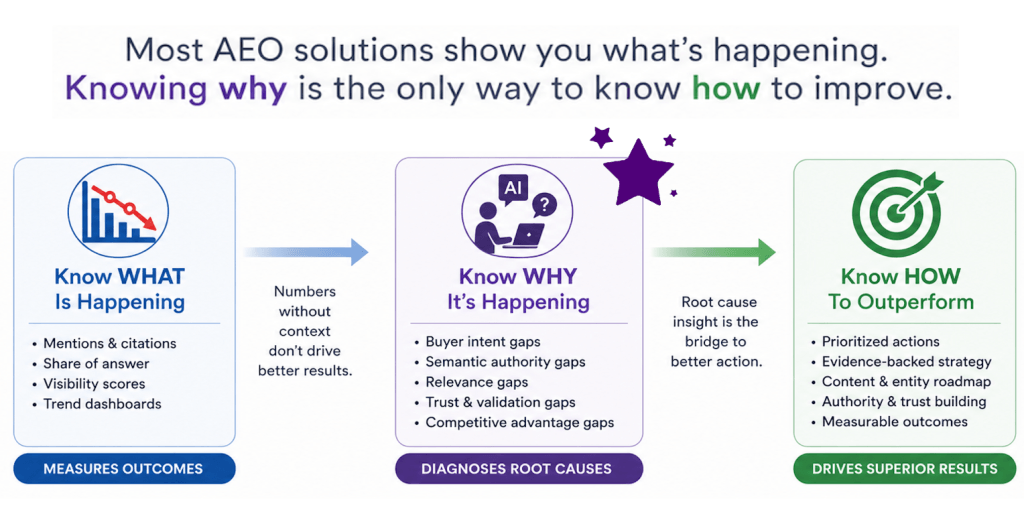
Knowing WHAT is happening is not the same as understanding WHY it is happening. And knowing WHY the outcomes are what they are is key to understanding HOW to improve them.
A dashboard may report that one competitor appears twice as often in AI-generated answers. Another platform may recommend adding structured data or publishing more comparison content. Yet executives are increasingly asking a different question:
Why did AI recommend that company instead of ours?
Answering that question requires a fundamentally different level of analysis.
It requires understanding the underlying drivers of AI recommendation behavior, not simply measuring the outcomes. It requires separating observed evidence from inferred conclusions. It requires understanding how buyer intent, semantic authority, third-party validation, content relevance, citation strength, and trust signals interact to influence AI-generated recommendations.
This distinction will become increasingly important as organizations invest in AEO technologies. When evaluating AEO platforms, executives should ask a simple but powerful question:
Can this platform explain why AI produced this outcome, and can it support that explanation with evidence? If the answer is no, organizations risk optimizing symptoms rather than addressing root causes.
Every recommendation should be supported by measurable evidence. Every conclusion should distinguish between observation and inference. Every explanation should be transparent enough to withstand scrutiny. And it should be repeatable to effectively track progress and trends.
We believe this represents the next evolution of the AEO market. The first generation of AEO solutions measures visibility. The next generation will diagnose visibility.
Just as application monitoring evolved into observability and business intelligence evolved into causal analytics, AI visibility is beginning a similar transition. Organizations will increasingly require evidence-based diagnostics that explain not only what AI engines are doing, but why they are doing it.
We believe this represents the next evolution of the AEO market.
The first generation of AEO solutions measures visibility. The next generation will diagnose visibility.
Just as application monitoring evolved into observability and business intelligence evolved into causal analytics, AI visibility is beginning a similar transition. Organizations will increasingly require evidence-based diagnostics that explain not only WHAT AI engines are doing, but WHY they are doing it. We refer to this emerging discipline as AEO Diagnostics.
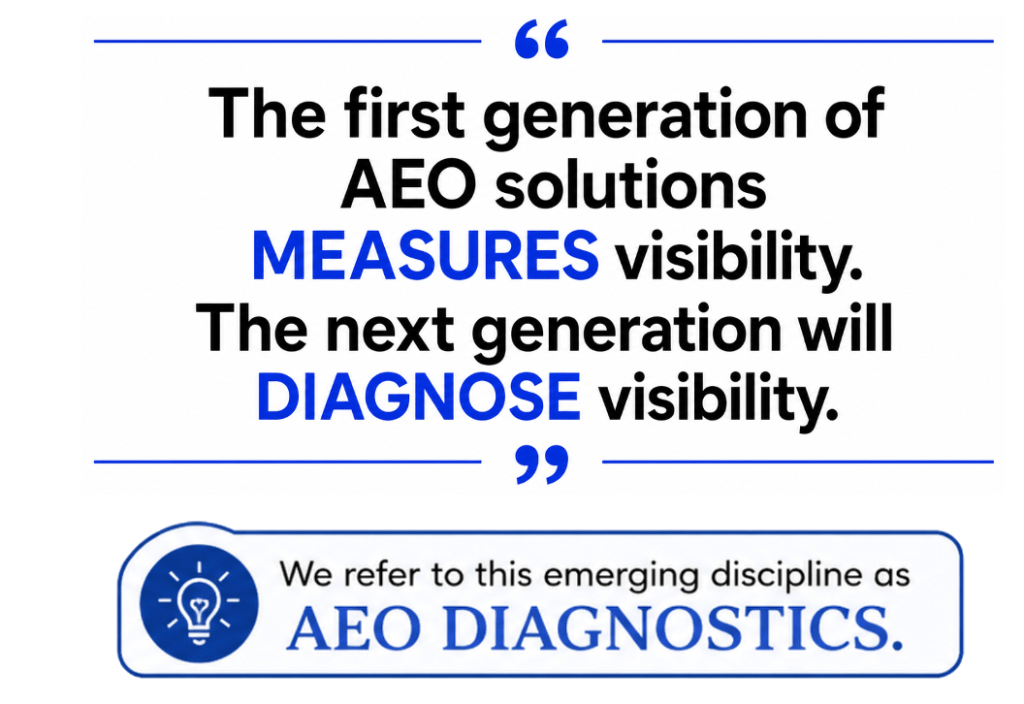
In the age of AI-mediated buying, understanding that distinction may determine which organizations survive the Great Marketplace Compression and which become part of the Corporate Graveyard of AI Invisibility.
AnalystANGLE – Our Take
We believe the emergence of AI-mediated buyer journeys and the threat of AI invisibility represent one of the most significant shifts in business go-to-market since the commercial adoption of the internet. Organizations are no longer competing simply for website traffic or search rankings. They are competing to become one of the few organizations AI engines choose to discover, cite, and recommend.
This is the essence of The Great Marketplace Compression.
As buyer choice becomes increasingly compressed into a small number of AI-generated recommendations, understanding why those recommendations occur becomes a strategic imperative. Organizations that simply monitor AI visibility will inevitably find themselves reacting to outcomes. Organizations that understand the underlying drivers of those outcomes will be positioned to influence them. That is why we believe the AEO market is entering its second generation.
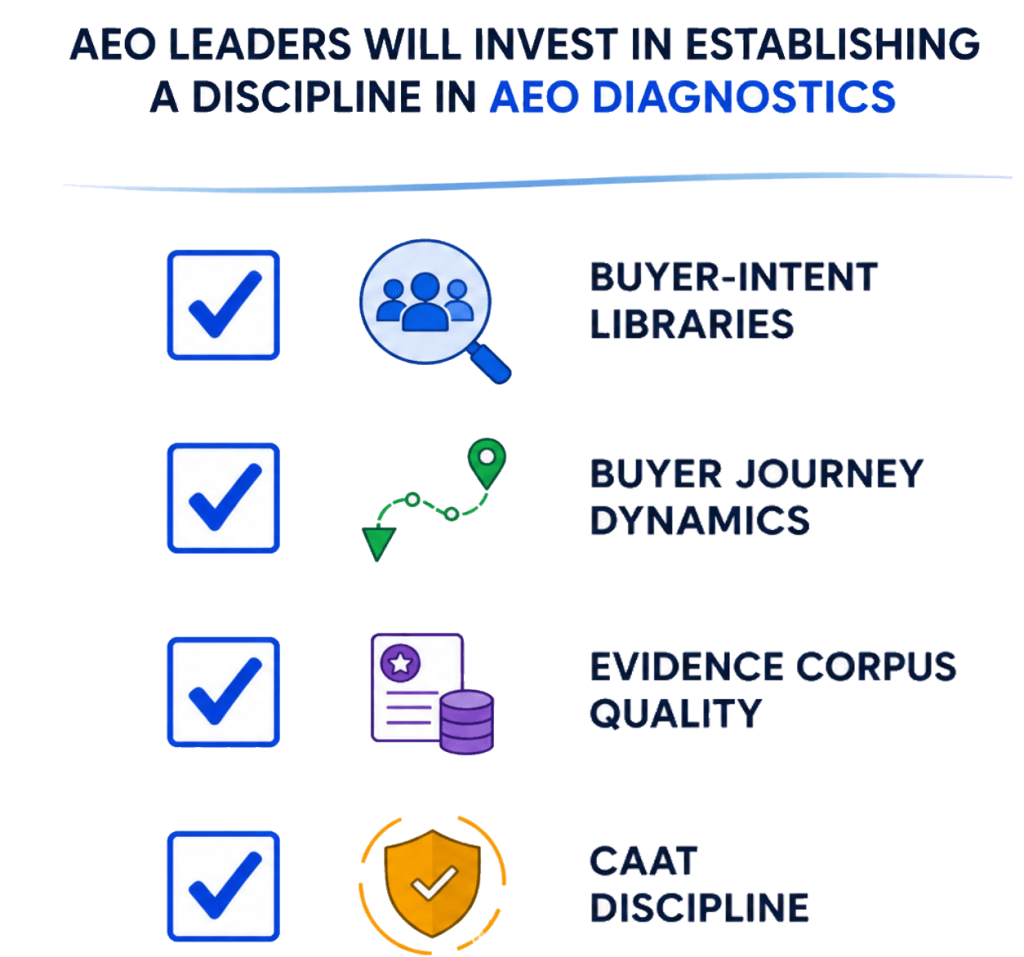
We believe the organizations that outperform in AI-mediated buyer journeys will increasingly invest in four foundational diagnostic capabilities —
- Buyer-Intent Libraries: Leaders will build buyer-intent libraries grounded in actual, observed buyer behavior rather than relying solely on modeled or synthetic prompts. Understanding how real buyers discover, evaluate, and compare vendors will become significantly more valuable than optimizing against hypothetical questions.
- Buyer Journey Dynamics: Leaders will develop a deeper understanding of AI-mediated buyer journey dynamics. Visibility should not be measured in isolation, but within the context of how buyers move from awareness to evaluation, shortlisting, and ultimately vendor selection.
- Evidence Corpus Quality: Leaders will continuously strengthen the quality of their AI-visible evidence corpus. AI recommendations increasingly depend on the freshness and consistency of evidence from trusted third-party sources, authoritative content, structured knowledge, and validated expertise.
- CAAT Discipline: Leaders will recognize that the ultimate competitive advantage is in establishing ever-expanding credibility, authenticity, authority, and trust (CAAT). Organizations that consistently demonstrate these attributes through independent validation will be better positioned to earn AI confidence than those relying solely on technical optimization.
Collectively, these capabilities represent what we believe will become the foundation of AEO Diagnostics, directly reflecting how AI engines actually operate. Learn more from the research on how LLMs decide who, when, and where to surface in AI answers, and The New Rules of Brand Visibility.
Rather than simply measuring visibility, AEO Diagnostics seeks to explain the underlying factors that determine whether AI engines discover, trust, cite, and recommend an organization. It shifts the conversation from optimization to understanding, from symptoms to root causes, and from tactical improvements to durable competitive advantage.
The AEO Advantage Index was developed around this philosophy. It combines evidence-based diagnostics with executive guidance to help organizations understand not only where they stand today but also why those outcomes exist and which actions will have the greatest long-term impact.
The organizations that survive the Great Marketplace Compression will not necessarily be those with the largest marketing budgets or the most content. They will be the organizations that best understand why AI chooses some brands—and ignores others.

📩 Contact Me 📚 Read More AI Research 🔔 Subscribe to Next Frontiers of AI Digest