

Sovereign AI — the column. On the “Open Weights and American AI Leadership” letter, and the sleight of hand hiding in the second word.
On July 24, twenty-five companies signed a letter titled “Open Weights and American AI Leadership.” Meta signed. Microsoft signed. a16z, Hugging Face, IBM, Mistral, Palantir, Perplexity, Y Combinator — a coalition deep enough to look like consensus.
And there, in the logo bar, sat the tell: NVIDIA.
Stop and hold that for a second. The single most valuable arms dealer of the AI era just signed a petition arguing that the ammunition should be free. When the guy who sells the guns lobbies to make the bullets free, you don’t nod along. You ask what he knows about how the bullets get used.
I read the letter three times. It is well written, mostly true, and quietly one of the most effective pieces of industrial policy marketing I’ve seen this year. It is also — read with the pillars in hand — a masterclass in why “sovereign” and “open” are not the same word, and why the difference is worth exactly one adjective that the coalition was kind enough to print on the cover.
Let’s do the work.
Credit where it’s due — and there’s real credit here
I want to be fair before I’m sharp, because the letter earns it.
Open weights are genuinely good for sovereignty. Not rhetorically — mechanically. A model you can download, inspect, fork, and run on your own iron clears the Technological pillar in a way no API ever will. It collapses inference from an uncapped token meter into a predictable compute bill, which is a real answer to the Financial pillar. It lets a hospital in Lyon or a ministry in Abu Dhabi run advanced AI inside its own perimeter without phoning Redmond every time a clerk asks a question.
That is not nothing. That is, in fact, most of the reasons I’ve spent a year arguing that control beats capability. The open-weights camp is right that concentrating frontier AI behind three closed APIs is a single point of failure dressed as safety. They’re right that transparency beats obscurity. They’re right that you cannot red-team a model you’re not allowed to open.
So: the weights are good. Take the weights. Hold that thought all the way through what comes next, because the letter is going to try to sell you a great deal on the model and slip a flag into the shopping bag while you’re admiring it.
The Turn: read the second word
The title is not “Open Weights and Sovereignty.” It is “Open Weights and American AI Leadership.” The coalition told you whose sovereignty this is about in the headline, and then — remarkably — spelled it out in the first paragraph.
Their opening argument is that open-source software “created a shared foundation of knowledge on which generations of American engineers and entrepreneurs built their institutional sovereignty.” Their words. Open source, in the letter’s own telling, was not a gift to the world. It was the substrate of American sovereignty. The letter then proposes to do the same thing again, with weights instead of code.
Which means the honest one-sentence summary of the document is this: open weights are how America diffuses its AI into every sector of every economy, including yours, and calls the result leadership. Paragraph two says it almost verbatim — leadership judged “not by one frontier model but by whether the United States builds a broad, open ecosystem that diffuses into every sector.”
Diffuses. Into every sector. That is not a sovereignty pitch. That is a distribution pitch, and it is a superb one, and you are the distribution.
Four cuts
Cut 1 — Jensen’s arithmetic. Why does the arms dealer want free ammunition? Because the moat was never the model. Open weights commoditize the one layer NVIDIA doesn’t sell — the model — which means every open model that lands on someone’s infrastructure is more inference, and more inference is more chips. A free Llama or Nemotron isn’t charity; it’s a demand generator. That’s not a knock on you for buying GPUs — buying compute is the price of doing business, and no serious person expects a hospital or a ministry to go build a fab. It’s a read on why the coalition looks the way it does. Jensen’s support here is structural, not ideological: he wins if AI diffuses, on anyone’s chips, forever. Worth noting the market is finally giving that dependency some company — AMD is putting its hat in the ring, and silicon optionality is the healthy answer, not silicon autarky. The point isn’t “don’t run on NVIDIA.” The point is: “don’t confuse a vendor’s generosity with a vendor’s incentive.”
Cut 2 — count who didn’t sign. OpenAI didn’t sign. Anthropic didn’t sign. Google didn’t sign. The three labs whose entire moat is the closed weight declined to sign a letter asking everyone to open the weights. Shocking, I know. This is not a neutral survey of the industry; it’s a position paper by the half of the industry that profits from diffusion, addressed to the other half that profits from concentration. Every signatory benefits — and each benefits at a different layer. NVIDIA at silicon. Meta and Mistral at distribution. Microsoft at cloud and on-prem. Perplexity, Replit, ServiceNow, Box at the app layer sitting on top of cheap, plentiful models. It’s a beautifully balanced coalition because everyone gets paid in a different currency.
Cut 3 — the clause they buried. The real ask isn’t “openness.” It’s four sentences near the bottom, about distillation — training a small model on a big one’s outputs. The letter defends it as “a widely used technique” in “a long tradition of learning from, building upon, and improving existing technologies,” and asks that concerns about “unlawful extraction from closed models” be handled by “targeted legal frameworks rather than sweeping restrictions.” Translate: don’t outlaw the one technique challengers use to catch the leaders without a billion dollars of pretraining. That’s the whole game. The soaring prose about open ecosystems is the cathedral; the distillation paragraph is the collection plate. That single clause is worth more to the signatories than the other two thousand words combined.
Cut 4 — the haircut. The document is styled as a people’s revolution — democratize AI, break up concentration, put power in many hands. But look at the hands. Meta. Microsoft. NVIDIA. a16z. These are not insurgents storming the tower; they are the tower, and they’re describing a settlement that happens to route through their layers. This isn’t a people’s revolution. It’s an incumbents’ manifesto with a rebel’s haircut.
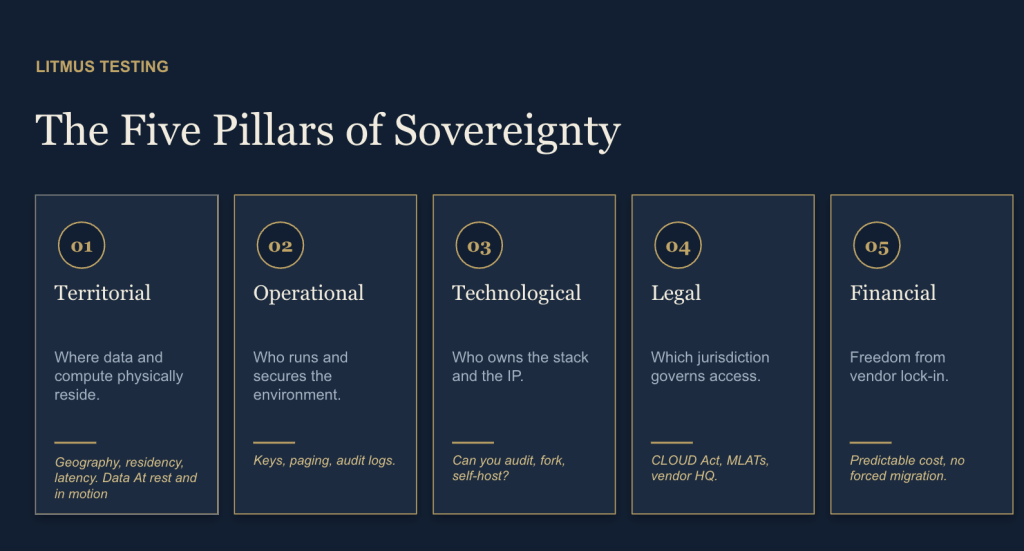
The Scorecard
Run the letter through the five pillars — but do it from the chair that matters. Not from a startup in Palo Alto, for whom this letter is an unambiguous gift. From a non-American sovereign: a European ministry, a Gulf fund, an Asian bank. What does “open weights, American leadership” actually score for them? Fair warning: it scores well — better than the cynics want it to — and the interesting part is where it doesn’t.
| Pillar | Score | Read |
|---|---|---|
| Territorial | 8/10 | The weights run wherever you put them — genuinely portable, genuinely yours to localize. Data at rest, data in motion, all inside your perimeter. This is what territorial control is supposed to feel like. |
| Operational | 8/10 | A real strength, not a caveat. Who runs, secures, and maintains the environment? You do — keys, isolation, audit logs, patching, paging, nothing phoning home. You can operate open weights sovereignly all the way down. The only honest asterisk is capability, not permission: you need the muscle to actually run and maintain it, or you outsource operations to a “sovereign managed service” and quietly re-open the door you just closed. |
| Technological | 9/10 | The pillar the letter actually earns. Download, inspect, fork, self-host. This is the truest sentence in the document, and it’s worth a lot. |
| Legal | 8/10 | The counterintuitive one — and, read honestly, a strength. “Which jurisdiction can compel access?” For a model you’ve forked and run on your own iron, the answer is essentially none. The CLOUD Act reaches US providers who hold your data; a pile of downloaded weights with no US party in the loop has no custodian to subpoena, no telemetry to seize, no account to suspend. Owning the weights is the single best escape from vendor-HQ capture there is — it’s the antidote to the CLOUD Act, not an instance of it. The real asterisk isn’t jurisdiction, it’s the license: Apache/MIT weights leave you clean; restricted “open” licenses (Llama-style community terms) are a US-governed contract with an acceptable-use policy stapled on. Read the label — but the label is the license, not the fact that the code was born in California. |
| Financial | 8/10 | Predictable compute beats an uncapped token meter — a real, structural win, and the pillar most enterprises actually feel first. Own the weights and inference becomes a capacity-planning problem, not a ransom note. |
And now the dual score, the way I did it for Apertus:
As American industrial policy: 9/10. It’s coherent, it’s honest about its aim, and it will work.
As sovereignty for the rest of the world: 7/10. This is the honest surprise: open weights clear four pillars cleanly and even beat the CLOUD Act on the fifth. The residual isn’t a legal trap — it’s a strategic one, and it doesn’t live in any single pillar. You own the model. You do not own the roadmap. Sovereignty over the instance, downstream of the frontier.
Sovereignty of whose, exactly?
I’ve spent a year asking sovereign-washed products the same question — sovereignty of what, and for whom? — and watching vendors squirm because the honest answer was always “ours, not yours, and please don’t check the label.”
This letter is different, and I want to give it real credit for the difference: it doesn’t hide the flag. It prints it on the box. “American AI Leadership,” right there in the title. For once, a document in this category tells you exactly whose sovereignty it’s optimizing before you’ve finished the first sentence. That’s not a criticism. That’s the most refreshing thing about it. It’s the most honest sovereignty pitch of the year, precisely because it isn’t pretending to be one.
The mistake would be to read “open” and hear “neutral.” Open weights are open the way a highway is open. Anyone can drive on it. It still goes where America paved it.
The Verdict
The open-weights coalition has produced the best-argued, most transparent, most self-aware piece of AI diffusion policy of 2026. Every load-bearing claim in it is true. Open weights really do strengthen four of the five pillars — and quietly hand you the best defense against the CLOUD Act that money can’t buy. Concentration behind closed APIs really is a systemic risk. And NVIDIA really would like you to run all of it, at scale, forever, on its chips.
All three of those things are true at once. Hold them together. The letter is right, and it is an ad, and the ad is for an American export. The sophistication is in getting you to accept the first, enjoy the second, and never notice the third.
The Way Out
So what does a real sovereign do with this letter? Not reject it — that’s the amateur move. Take the weights. Refuse the frame.
Accept the gift, because it’s a good one — and it’s more of a gift than the cynics admit. Open weights genuinely hand you four pillars and beat the CLOUD Act on the fifth. Then remember that a gift is not a strategy. Owning today’s model is not owning tomorrow’s direction, and that’s the gap nobody in the logo bar is going to close for you:
- Read the license before you read the manifesto. The legal exposure isn’t the flag on the cover — it’s the fine print. Prefer genuinely open licenses (Apache, MIT) over restricted “community” terms that are a US-governed contract with an acceptable-use policy attached. Same weights, very different strings.
- Keep your compute optional. Nobody’s asking you to fab your own chips — that’s not sovereignty, that’s a fantasy. But price the dependency honestly and keep a second door open. AMD stepping into the ring is good news for exactly this reason: optionality, not autarky, is what keeps a vendor’s incentives aligned with yours.
- Own your data and your evals. The one thing that’s actually, unforgeably yours is the crown-jewel data and the benchmarks that reflect your reality, not Menlo Park’s. That’s where sovereignty compounds — and it’s the part no open model ships with.
- Own the roadmap, not just the instance. This is the real one. A forked model is a snapshot; the frontier keeps moving on someone else’s schedule. Fine-tune it into your own worldview, build the capability to advance it yourself, and treat the download as a starting line, not a destination.
Call it the Agentcy Agenda: owned data, owned infrastructure, owned governance — and open weights as the raw material, not the finished house. The letter hands you a beautiful set of timbers, milled and delivered for free. What it doesn’t hand you is the architecture, the foundation, or the decision about which direction the house faces — and those are the parts that decide whether you’re living in something you own or something you’re renting with extra steps.
Full disclosure, because you should always know where an analyst is standing: this is the thesis my firm, Agentcy Labs, was built to execute — helping organizations turn downloaded weights into a stack they actually own end to end, from data to inference to governance. So take the pitch with the appropriate grain of salt. But the framing holds whether you ever call us or not: the coalition is right that open weights are the raw material of sovereignty. They’re just not the sovereignty. That part is still on you to build.
Open source built American institutional sovereignty. The letter says so, in the first paragraph, out loud. The only question it leaves for the rest of the world is whether we’re going to read that sentence as an invitation — or as instructions.
Free is a price. It is not a strategy.
Own the stack. Don’t rent the outcome. Read the license, not just the manifesto — and remember that owning the model is not the same as owning where it’s going.
— Amit