
Is this the next chapter in the AI Sovereignty Wars?
Sovereign AI series — by Amit Eyal Govrin
Today, the weights drop.
As I write this, Moonshot AI is releasing the full weights of Kimi K3 — at 2.8 trillion parameters, the largest open-weight model ever shipped. It went to #1 on the Frontend Code Arena leaderboard with 1,679 points, edging out Anthropic’s Claude Fable 5, and it beat Opus 4.8 and GPT-5.5 on a slate of coding and agentic benchmarks at roughly 40% lower cost. A Chinese lab most Western enterprises had never heard of eighteen months ago is now setting the pace — and handing the world the file to run it themselves.
Silicon Valley is, in the words of one headline, freaking out. The Trump administration is reportedly weighing everything from adding Chinese labs to the Commerce Entity List to quiet “soft-law” cybersecurity advisories designed to spook regulated enterprises away from deploying them. David Sacks, the administration’s own AI adviser, fired back that this is exactly “how you lose the AI race” — and warned that the leading closed labs want government to eliminate their open-source competition. Call it what it is: a regulatory capture fight dressed up as a security debate.
But step back from the noise, because the noise is the point — and it’s a distraction from the real war.
The freeloading story, and its mirror
The narrative today is about theft. Who distilled whom.
In January 2025, OpenAI accused DeepSeek of distilling its models — training a cheaper Chinese challenger on the outputs of an American frontier system. The “freeloader” framing was born. Then in February 2026, Anthropic leveled the same charge at Moonshot: 3.4 million Claude exchanges, allegedly used to train Kimi through distillation. The tell? Kimi K3 now benchmarks within a few points of the very models it was accused of copying.
Here’s the uncomfortable truth nobody in this fight wants to say out loud: all roads lead to the same destination. Distillation, synthetic data, shared research, leaked techniques, the same three chip architectures, the same transformer papers — intelligence is converging. Closed or open, American or Chinese, the models are marching toward rough capability parity. The moat isn’t the model. It never was.
So if capability commoditizes, what’s left to fight over?
Control. And the question is — control of what?
Two levers, one war
There are only two levers that matter in the stack, and whoever holds them shapes everything downstream.
Who controls the silicon. Export controls, Nvidia allocations, the entire compute chokepoint strategy. This is the one Washington understands.
Who controls the models. This is the one it’s only now waking up to — and it’s the more insidious of the two, because a model isn’t a chip. A chip is inert. A model has a point of view.
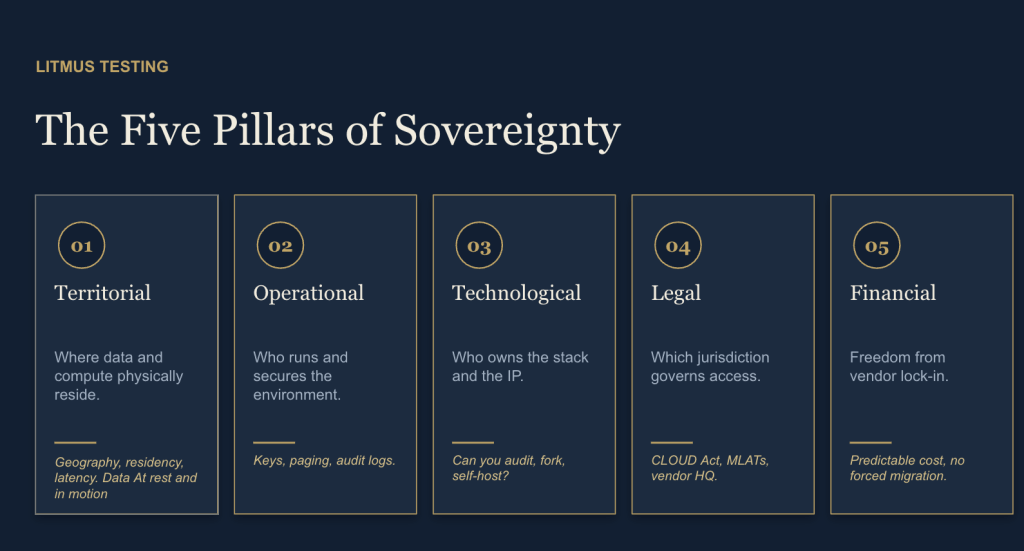
Put those two levers together, and you’re not describing a trade war. You’re describing who gets to influence the tech stack of every nation that builds on top of it. That’s the Sovereignty war — the one I’ve mapped across the Five Pillars: Territorial, Operational, Technological, Legal, Financial. The Open Weights Battle lands hardest on the Technological pillar — who owns the stack and the IP, can you audit it, fork it, self-host it — and bleeds straight into the Legal one — which jurisdiction’s values and rules travel with the artifact.
Open weights is not open source
This is the part the industry keeps conflating, and it’s the most important distinction in the whole debate.
Open weights means you get the finished brain. It does not mean you get the upbringing.
Open source — real open source — gives you the training data, the eval suites, the code, the guardrail logic, the full provenance. Almost no “open” model does this. What you actually download is a set of frozen weights: an inception of thoughts, ideas, data, evaluations, safety choices, and yes — biases — already baked in. You inherit someone else’s baseline. You inherit a fingerprint.
Don’t believe me? Interrogate the models.
Ask DeepSeek V3.2 about Tiananmen Square in 1989, and it will tell you “some activities took place in Beijing aimed at maintaining social stability” — no protests, no students, no tanks, no casualties. In independent censorship testing, it failed roughly 81% of politically sensitive prompts. Now here’s the nuance that actually proves the point rather than the lazy “Chinese models = censored” take: ask Kimi the same question and it engages honestly — scoring 98.8%, matching Claude and GPT. Two Chinese labs, two completely different baselines. The fingerprint isn’t national. It’s whoever seeds the intelligence.
And it goes deeper. The same GLM model, identical weights, served through two different API providers, showed a 15-point swing in behavior — because the filtering layer wrapped around the weights differed. The weights are only the beginning. Whoever seeds the intelligence, and whoever wraps it, gets to influence the narrative that everything downstream is built on.
To be clear: this isn’t destiny. A baseline can be overcome — fine-tuned, re-aligned, audited, red-teamed. But that’s exactly the point. A baseline is a starting position of influence over the next generation of the stack — and starting positions compound. The lab that seeds today’s model shapes the assumptions of the model distilled from it tomorrow.
Yes, there are the harder-edged concerns too — backdoors, supply-chain implants, latent vulnerabilities. Real, and worth a paper of their own. But they’re the acute symptom. The chronic condition is influence: who gets to set the defaults, the refusals, the framing, and eventually the rules of the game.
The fingerprint follows the deployment
Put biases and geopolitics aside for a second, because here’s what makes this urgent rather than academic.
The Chinese labs have proven they can compete — and increasingly, outperform. Any US developer chasing state-of-the-art has a rational, defensible reason to reach for Kimi, or Qwen, or GLM. The capability is real. That’s not the debate.
The debate is what happens next. Because these models don’t stay in a sandbox. They get dropped into enterprise environments. They get installed inside Sovereign government datacenters — the exact deployments I spend my days architecting. And when they do, the influence fingerprint travels with them. The defaults, the framing, the embedded assumptions about what’s true and what’s unsayable — all of it lands inside the most sensitive stacks a nation runs, pointing quietly back toward whoever won the Open Weights Battle.
The table just moved to Chengdu
Here’s the move most people missed while arguing about bans.
On July 24 — three days before Kimi’s weights dropped — 21 APEC economies signed the Chengdu Statement, endorsing the development of open-source AI paired with “strong security assurance through development and deployment.” Read the signatory list: the United States is on it. Washington is still debating internally whether to blacklist Chinese open models, and it just co-signed a pact — on Chinese soil — blessing them.
That’s the whole game in one document. The fight over “open vs. closed” is effectively over; open won in the sense that it’s not going away. As analyst Wei Sun framed it, the debate has moved to “building an open ecosystem that is trusted enough for deployment.” Trust. Security assurance. Governance. That’s the new battleground — and China is hosting it. Beijing has already floated a World AI Cooperation Organization, potentially seated in Shanghai, to set the rules and advance what it openly calls “algorithmic sovereignty.”
Seeding the model was chapter one. Seeding the rulebook is chapter two. Whoever convenes the table gets to define what “trusted” means, what “secure” means, whose assurance counts — and right now, the table is in Chengdu.
Run it through the litmus test
Every sovereignty claim has to survive the Five Pillars. So let’s stop theorizing and actually score the Open Weights Battle against each litmus test:
- Territorial — Where do data and compute physically reside? Open weights win outright. A downloaded model runs in your datacenter, your region, air-gapped if you want it — no inference call ever leaves the building. This is the pillar open weights were built for.
- Operational — Who runs and secures the environment: keys, paging, audit logs? You do. Self-hosted weights put your team on the keys and the runbook. But the guardrails, refusals, and safety logic arrived pre-seeded — you operate the model, you didn’t raise it.
- Technological — Who owns the stack and the IP: can you audit, fork, self-host? Here’s the trap. You can fork and self-host, yes. But open weights ≠ open source: no training data, no eval suite, no provenance. You can inspect the what, never the why. You inherit a fingerprint you can’t fully audit.
- Legal — Which jurisdiction governs access: CLOUD Act, MLATs, vendor HQ? Self-hosting severs the runtime umbilical — no vendor to subpoena for data you hold yourself. But the governance layer is moving above the model, and the Chengdu Statement shows the rules of “trusted deployment” are being drafted on someone else’s soil.
- Financial — Freedom from vendor lock-in: predictable cost, no forced migration? The strongest pillar for open weights. No per-token meter, no forced-migration gun to your head, no vendor holding your roadmap hostage. Kimi K3 at ~40% below the closed frontier is the entire argument in a price tag.
Tally it and the pattern is unmistakable: open weights dominate the physical pillars — Territorial and Financial — and win the operational surface, while Technological and Legal expose the catch. You gain sovereign control of the runtime and cede control of the baseline and the rulebook. That’s the real trade every enterprise and every government is making the moment they pull those weights down.
That’s why the Washington fight isn’t really about backdoors, and it isn’t really about distillation. Those are proxies. The real prize is control of the narrative — the ability to seed the intelligence that seeds the next intelligence, to convene the table where “trusted” gets defined, and to shape the story the world tells itself about which stack it can trust.
Sovereignty, in the end, is not about where the GPUs sit or whose logo is on the invoice. It’s about whether you understand the fingerprint you’re inheriting — and whether you chose it with your eyes open.
The weights are open. The influence never was.
Action Item for Developers
Treat every open-weight model as a software supply-chain dependency with an embedded behavioral baseline, not as a neutral block of code. Before placing models such as Kimi, Qwen, DeepSeek, or GLM into production, developers should establish a model-assurance process that documents provenance, licensing, training disclosures, deployment jurisdiction, safety behavior, and known limitations.
Engineering teams should maintain a model bill of materials, run independent evaluations for accuracy, censorship, refusals, security vulnerabilities, and political or cultural bias, and test both the underlying weights and any provider-specific filtering layers. Where the model’s baseline does not align with organizational requirements, developers should fine-tune, re-align, wrap, or reject it – and continuously monitor behavior after deployment. The central question developers must answer is “Do we understand the intelligence, assumptions, and rules we are importing into our systems?”
Amit Eyal Govrin is CEO & Co-Founder of Agentcy Labs and host of the Sovereign AI series on theCUBE / NYSE Wired.