

This month, The Information reported that Canva cut its 2026 revenue growth forecast to 20%, down from 30%, because the AI features it shipped cost far more to run than management had planned.
Read that again. Not a margin miss. A growth forecast cut — caused by an input cost.
The details are worth sitting with:
- Q2 CY2026 revenue landed at $921.9M, up 25.2% year-on-year — strong at that scale, and below their own guidance.
- CEO Melanie Perkins told shareholders the company had been leaning too heavily on third-party frontier models.
- Backers reportedly wrote roughly $10B off a $42B valuation. The IPO timeline appears to have slipped to 2027.
- The fix wasn’t a negotiation. It was a rebuild: in-house models, the Leonardo.AI acquisition, task-level routing. Result: roughly 90% off the cost of serving an AI task, with their video model reported at 17x cheaper than a frontier equivalent and their image model at 30x.
(Canva is private and publishes no results. These figures come from the Q2 CY2026 shareholder letter as reported by The Information, the AFR, Startup Daily and Fortune.)
Now hold that next to the profile of the company it happened to. Canva has been profitable for nine consecutive years, holds $1.47B in cash, serves 265 million monthly actives, and is run by operators nobody accuses of carelessness.
And someone else’s price list still moved their guidance, their valuation, and their listing date.
That is not a cost-control problem. It’s a sovereignty problem — and it is the pillar almost nobody stress-tests.
Territorial sovereignty gets the headlines. Legal sovereignty gets the lawyers. Technological sovereignty gets the architects excited.
Financial sovereignty is the one that decides what you’re allowed to do three years from now.
Every other pillar describes a property of your stack today. Financial sovereignty describes whether you’ll still have a choice tomorrow. It is the only pillar that compounds — and the only one that lands on the P&L whether or not anyone in the room was tracking it.
The uncomfortable version: most organisations don’t lose sovereignty in a decision. They lose it in a renewal, or in a usage curve.
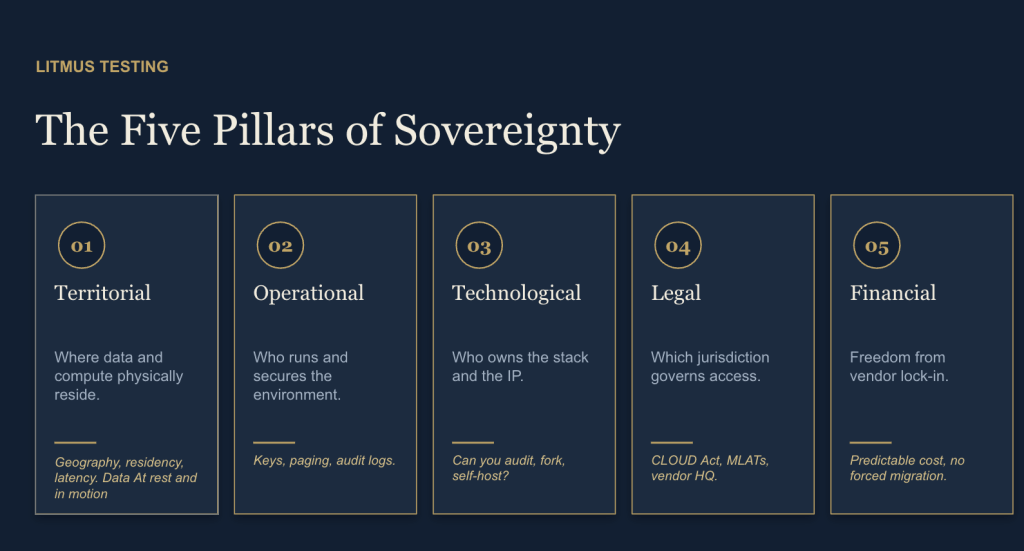
The litmus test, restated
The five pillars, and the single question each one asks:
| Pillar | The question |
|---|---|
| Territorial | Where do data and compute physically reside — at rest and in motion? |
| Operational | Who runs and secures the environment — keys, paging, audit logs? |
| Technological | Who owns the stack and the IP — can you audit, fork, self-host? |
| Legal | Which jurisdiction governs access — CLOUD Act, MLATs, vendor HQ? |
| Financial | Are you free from lock-in — predictable cost, no forced migration? |
Note what the Financial test is not. It is not “is this cheap.” It is not “did we cap the spend.” Capping spend on someone else’s meter is cost control. It is not sovereignty.
The Financial test has exactly two clauses:
- Can you predict the price?
- Can you leave — and do you know what leaving costs, today, as a number?
If the answer to either is no, you are not the party setting your AI strategy. Your vendor is. They just haven’t told you yet.
Run Canva against it. Territorial, Legal, Operational — arguably fine. Financial — fail. Not because they overspent, but because the cost of the thing their product was built on was set by a counterparty, moved in a direction they didn’t model, and the only exit was a full architectural rebuild funded out of forward growth.
Note also what the remedy was, because it’s the whole thesis in one move: they went and owned the layer. In-house models where it mattered, routing they controlled, frontier calls reserved for the tasks that genuinely needed them. Crown jewels owned, edges movable. That’s the pattern, and Canva paid ten billion dollars of valuation to learn it in public so the rest of us don’t have to.
Five patterns, with receipts
Financial sovereignty failures aren’t hypothetical. They’re a documented genre with recurring plot structures. Here are the five that matter, each with a real precedent.
1. The repricing — Broadcom / VMware
The reference case, and the one every CFO now recognises.
- Broadcom killed perpetual licensing outright, collapsed 168 products into a handful of bundles, and moved everything to subscription. There is no path back.
- Reported renewal outcomes run from 150% to over 1000%. AT&T faced proposals reported at roughly a 1050% increase.
- A 72-core minimum introduced in April 2025 hit smaller estates with 4–5x jumps regardless of actual consumption.
- A €500K annual bill becoming €2M in year one, then 10–20% annual uplift on top, is described as a typical scenario by European advisors.
- Ingram Micro — one of the largest distributors on earth — terminated its Broadcom relationship. The German IT user association VOICE filed a complaint with the EU Commission alleging abuse of customer lock-in.
Nobody made a bad decision in 2019. They made a decision that was fine right up until the counterparty changed and they had no exit priced.
Sources: clouditiv on 2026 VMware economics · SoftwareSeni on the licensing crisis · Redress 2026 pricing report
2. The metric change — Oracle Java
The vendor doesn’t raise the price. They change what they’re counting.
- January 2023: Oracle replaced per-processor and per-named-user metrics with a per-employee subscription. Every employee. Plus contractors, temps, and outsourcer staff. Java usage is irrelevant to the count.
- Gartner measured 2–5x increases for identical usage. Some organisations reported far worse.
- Oracle’s own published example put a 28,000-person company at roughly $2.3M annually.
- The tail risk is retroactive: audit exposure stretching years back across an entire headcount.
- The market response was an exodus. Gartner projected 80%+ of Java applications on third-party runtimes by 2026, up from 65% in 2023.
Sources: Gartner via InfoWorld · Computer Weekly on audit posture · Redress Java pillar 2026
3. The forced migration — model deprecation
This is the one specific to AI, and it is the most under-priced risk on any 2026 roadmap.
You do not control the retirement date of the model your production system depends on.
- OpenAI’s April 2026 notice retires GPT-4o, GPT-4, GPT-4 Turbo, GPT-3.5 Turbo and the o-series on 23 October 2026 — the largest single deprecation notice any provider has issued.
- Anthropic retired Claude Sonnet 4 and Opus 4 on 15 June 2026, Opus 4.1 on 5 August. Google retires Gemini 2.5 Pro and Flash on 16 October.
- Even DeepSeek retired its legacy model names in July 2026. Switching providers does not get you off the treadmill.
- And the migration is rarely a config change. Independent analysis found that moving off GPT-4.1 also means moving from the Chat Completions API to the Responses API — substantial rewrites across request handling, streaming and tool calling.
- Microsoft Foundry now runs an 18-month GA lifecycle for most models, 12 months for several third-party families. That is your effective architectural half-life.
Re-validation, re-benchmarking, prompt re-tuning, eval re-runs, regression risk in regulated workflows — none of it is on the vendor’s invoice. All of it is on your budget, on their calendar.
Sources: Anthropic deprecation docs · TensorOps on the GPT-4.1 rewrite · 2026 deprecation calendar
4. The meter — inference economics
Per-token pricing is the only major enterprise cost line that scales with your own success.
- Uber’s CTO disclosed the company burned its entire 2026 AI coding tools budget in four months.
- GitHub Copilot moved to credit-based consumption on 1 June 2026. The seat price stays; it now covers completions only. Everything else meters.
- Goldman Sachs projects agentic adoption driving up to a 24x increase in token consumption by 2030. Gartner projects per-token inference costs falling ~90% by 2030. Both are true, and the aggregate bill still goes up.
- Inference is now the majority of AI budgets — up from roughly 20% in 2023 to as much as 85% — and it is not currently priced at cost. Frontier labs are running compressed or negative margins on inference. That gap closes eventually, and it closes in your direction.
The efficiency paradox is the trap: your engineers optimise the agent, the agent does more work, the bill grows. There is no version of “we’ll just use it less” that survives contact with a productivity mandate.
Canva is the cleanest illustration available. Their users loved the AI features. Adoption ran ahead of the model. Success was the mechanism of the damage — which is exactly why this risk never shows up in a pilot. Pilots have bounded usage. Production doesn’t.
Sources: Fortune on token economics · Vista on inference cost structure · The Information Difference on inference budgets
5. The counterparty — your vendor’s balance sheet is in your dependency graph
This is the pattern almost nobody has in their risk register, and it is the newest.
- The Bank for International Settlements named circular AI financing, alongside an AI capex bust, as one of the three biggest risks to global financial stability in its 2026 Annual Report. That is a central bank, not an analyst.
- Neoclouds borrow against GPUs as collateral. CoreWeave’s total debt exceeds $21B, up from under $8B in 2024. The chain runs: GPU depreciation → tenant default → SPV distress → ABS impairment.
- Vendor-financed capacity carries revenue-share obligations and debt service baked into the rate card. You are paying the terms of a financing arrangement you were never party to.
- OpenAI’s own compute commitments have been restated publicly from $1.4T to ~$600B to ~$750B through 2030, against audited 2025 losses of $38.5B on $13.07B revenue. Its CFO has flagged internal concern about honouring future compute contracts if revenue lags.
None of that is a prediction of collapse. It is a statement that provider financial stress is transmitted to customers as pricing changes, capacity rationing, and contract restructuring — and that a counterparty risk assessment is now part of an AI architecture review, not just a procurement checkbox.
Sources: Capacity on circular financing and the BIS report · Quartz on GPU-collateralised debt · Quinn Emanuel client alert on data centre financing risk · Quartz on the $750B revision
The exit toll — and a date worth putting in your calendar
The reason lock-in works isn’t that leaving is impossible. It’s that leaving is unpriced, so nobody models it.
- The UK CMA’s cloud market investigation concluded in July 2025 that competition is not working well, naming egress fees and technical barriers — and found that fewer than 1% of customers switch provider in any given year.
- Gartner has observed egress running at 10–15% of a total cloud bill.
- Under the EU Data Act (Regulation 2023/2854), switching charges — expressly including egress fees levied for switching — are prohibited entirely from 12 January 2027. In the interim they must be genuine cost pass-through, not margin.
That deadline converts exit cost from an unknowable deterrent into a number. Which means the excuse expires. From January 2027, if you still can’t say what leaving costs, that is a governance failure, not a vendor tactic.
And note the trap: removing the toll doesn’t remove the lock-in. Proprietary APIs, vendor-specific data formats and identity binding hold you longer than any invoice ever did.
Sources: Data Act switching deadline analysis · Kemp IT Law on switching charges · Cloud exit cost audit
The honest part: sovereignty is not the same as cheap
I’ll argue against my own position, because the sovereign-washing crowd won’t.
Self-hosting open weights is not automatically the cheaper answer, and anyone selling it that way is selling you a different kind of lock-in.
- Break-even estimates for self-hosting cluster somewhere between roughly 2–5 million tokens/day on reserved capacity at the optimistic end, and 1.5–2 billion output tokens/month at the conservative end once GPU amortisation, MLOps salary and orchestration are counted.
- The dominant variable is engineer time, not GPU rack rate. Teams have hired two infra engineers to save $40K/year in API spend. That is a bad trade dressed as a principle.
- Utilisation wrecks the math. Break-evens assume 60–85% sustained utilisation. Real traffic is bursty.
- Open-weight enterprise share actually fell — from 19% in 2024 to 11% in 2025, per Menlo — even as capability converged.
So no: “self-host everything” is not the thesis.
The thesis is that the decision has to be yours, made with the exit priced, on a timeline you control. Financial sovereignty is not the cheapest bill. It’s the bill you can still change.
Sources: self-hosting TCO analysis · open-weight adoption paradox · break-even decision guide
Four questions for your next architecture review
Not a maturity model. Four questions, and you should be able to answer all four with numbers.
- What does leaving cost? One figure, in your currency, refreshed quarterly. Data extraction, re-integration, re-validation, parallel run. If nobody owns this number, nobody owns your strategy.
- What’s the unit-cost sensitivity? If your per-token rate triples, what happens to the business case? If the answer is “the programme dies,” you have a single point of financial failure.
- What’s your architectural half-life? Which of your production dependencies have published retirement dates inside 18 months? Put them on one slide.
- What’s your counterparty exposure? Not “is the vendor big.” Is the vendor’s pricing underwritten by debt, a revenue-share obligation, or an investor subsidy that has to end?
- What happens if adoption beats the forecast? The Canva question. If your users love it twice as much as planned, does the business case get better or worse? If worse, you have built a product that punishes its own success.
The reframe
Sovereignty is not binary. It never was. It’s control with an acceptable risk sidecar — named risks, owned by named people, priced.
Financial sovereignty is the pillar that rules the others because it’s the pillar that determines whether the other four are decisions or descriptions. Territorial residency you can’t afford to maintain isn’t residency. Technological ownership you can’t fund isn’t ownership. Legal jurisdiction you’d have to abandon at renewal isn’t jurisdiction.
The architecture that survives this decade is the same one I keep arguing for: own the crown jewels, stay movable at the edges. Own the layer where your leverage lives — your data, your context, your orchestration logic, your evaluation harness. Rent the layer that’s genuinely commodity, and rent it in a way you can unwind in a quarter.
The worst position is not being locked in. Plenty of good architectures are locked in somewhere, deliberately, with the price known.
The worst position is the ostrich: not knowing where your gaps are, and finding out at renewal — or in a shareholder letter you have to write yourself.
Canva found out and had the balance sheet, the engineering bench and the nine years of profit to absorb it, rebuild, and come out with a 90% cost reduction and a stronger position.
Most companies will not get that landing.
Price your exit. Before someone prices it for you.
—Amit
Amit Eyal Govrin is lead analyst for sovereign AI at theCUBE Research and CEO of Agentcy Labs, which designs and builds sovereign AI platforms for enterprises and governments. His research for theCUBE Research is conducted under theCUBE Research’s editorial standards and is not sponsored or directed by Agentcy Labs. Agentcy Labs may hold commercial relationships with vendors covered in this research.
References
- Canva AI cost reset: The Information’s post, Fortune, Startup Daily on the shareholder letter, The SaaS CFO on AI COGS as an earnings risk, valuation writedown and IPO timing
- Broadcom/VMware repricing: clouditiv, SoftwareSeni, Redress Compliance
- Oracle Java metric change: InfoWorld/Gartner, Computer Weekly, Redress Compliance
- Model deprecation: Anthropic docs, TensorOps, benchr deprecation calendar, Microsoft Foundry retirements
- Inference economics: Fortune, Vista Equity Partners, The Information Difference
- Counterparty and circular financing: Capacity, Quartz, Quinn Emanuel, Quartz on OpenAI’s $750B
- Exit cost and the EU Data Act: Sixteen Pillars, Kemp IT Law, Cloud & Clear
- Self-hosting TCO: Digital Applied TCO, Digital Applied decision guide, Luiz Neto on open-weight adoption