The real debate is not whether PostgreSQL can support AI. It can. The question is how much engineering, integration and operational risk the enterprise is prepared to own.
By Marc Staimer, Sr Contributor to theCUBE Research
The technology industry has an unfortunate habit of turning popularity into architectural destiny. Linux became popular, so every alternative was declared obsolete. Containers became popular, so virtual machines were supposedly finished. Now PostgreSQL has become popular, and some architects treat that popularity as proof that it is the obvious enterprise database for AI.
That conclusion goes too far.
PostgreSQL is a very good open-source relational database. It deserves the respect and adoption it has earned. It can support serious production workloads and, with the right extensions and services, many AI use cases. But popularity, feature availability and PostgreSQL compatibility do not automatically add up to an integrated enterprise AI operating model.
Those two statements serve two very different objectives.
The Enterprise AI Architecture Question
A common PostgreSQL pitch now sounds like this:
“You don’t need Oracle anymore. PostgreSQL has vectors. PostgreSQL has JSON. PostgreSQL has AI extensions. PostgreSQL is cloud native. And most importantly, PostgreSQL is free.”
Every statement contains some truth. The problem is not the individual feature claims. The problem is what they imply when assembled into an enterprise architecture.
Having the ingredients to build an AI data platform is not the same as having an integrated AI data platform. It is the difference between buying aircraft parts and buying a fully engineered aircraft. Both may contain the same categories of components. Only one arrives as a system with defined operating characteristics, support boundaries and accountability.
Oracle AI Database 26ai is designed to make the engineered-system argument.
PostgreSQL can replace many Oracle workloads. It can be an excellent transactional database, application back end and foundation for modern development. What it does not automatically replace is the full enterprise operating model surrounding the database.
The difficult questions keeping CIOs, CISOs and data leaders awake are different:
- How will the enterprise secure AI agents and their access to operational data?
- How will it prevent sensitive data from being copied into multiple vector databases and staging environments?
- How will it govern relational, JSON, graph, vector, unstructured and transactional data under a consistent security model?
- How will it recover hundreds or thousands of databases after a ransomware event or large-scale operational failure?
- How will it apply critical security patches without avoidable downtime?
- How will it preserve the same database architecture across data centers, sovereign clouds, AWS, Azure, Google Cloud, OCI and Cloud@Customer?
These are complex enterprise problems, especially as AI agents gain direct or indirect access to operational data. PostgreSQL-based architectures can address them. But the answer often comes from a distribution, a cloud service, extensions, third-party tools, custom engineering or some combination of all five. Oracle’s argument is that more of the answer is integrated into one platform and one operational model.
This is the distinction enterprises should evaluate. The issue is not whether PostgreSQL can do AI. It can. The issue is what the enterprise must assemble, secure, operate and support to do it at scale.
The Engineering Tax Licensing Comparisons Miss
Oracle licensing is visible, centralized and easy to criticize. PostgreSQL engineering costs are distributed and easy to ignore. That is the blind spot.
Depending on the requirements, an enterprise PostgreSQL environment may include:
- Data and AI extensions such as pgvector and PostGIS.
- High-availability, connection-pooling and replication tools such as Patroni and PgBouncer.
- Monitoring, backup, migration and DevOps automation.
- IAM integration, secrets management, auditing, data masking and other security software.
- Cloud high-availability services, vendor-specific management services and third-party support.
None of these additions is an indictment of PostgreSQL. Each solves a legitimate problem. But each can add another integration point, version dependency, failure mode, support boundary and skill requirement. The database license may be free. The architecture is not. Neither is the ongoing effort required to keep that architecture patched, secure and recoverable.
The more credible comparison is not the (up-front) license cost versus license cost. It is total architecture versus total architecture.
Enterprise AI Is About Data Gravity and Governance
The AI industry has spent the last three years obsessing over models. Models still matter. But the enterprise problem is shifting toward data gravity and governance.
Historically, security governance focused on access paths. Govern the application, and you effectively govern the human. Agentic AI changes that assumption. The primary consumer of enterprise data may increasingly be autonomous software capable of authenticating to a database, reasoning about schemas, generating SQL and pursuing objectives outside predefined application workflows.
AI agents are valuable because they can reason over enterprise information. They are risky for exactly the same reason.
For many organizations, this raises the value of a single governed operational data platform. Oracle AI Database 26ai is designed around that model.
Oracle AI Database 26ai places vectors beside transactions. JSON beside relational data. Graph beside SQL. AI beside governance. Security beside each access path. Its converged architecture is intended to reduce the need to copy operational data into separate vector stores, synchronization pipelines, semantic databases and AI staging environments simply because the core platform lacks a required capability.
Every additional copy creates another asset that must be secured. Every synchronization job creates another source of latency and inconsistency. Every new database creates another administrative, support and recovery boundary.
Oracle’s converged architecture can reduce the need to create and synchronize those additional copies. Less data movement can reduce complexity, improve security and enable searches against current operational data within the same database and, in some cases, within the same query.
PostgreSQL can accomplish many of the same tasks. But the architecture often depends on extensions, external services and pipelines. That may be the right design. It may also add data movement, synchronization and copies.
PostgreSQL providers will correctly point out that PostgreSQL supports vectors. It does. So does Oracle. Vector indexing is now table stakes. The real question is what happens after the vector search.
- Can the result immediately join current transactional data and participate in an ACID workflow?
- Can the same security policy govern relational, JSON, vector, graph and unstructured data?
- Can AI agents execute governed SQL against operational records?
- Can the architecture meet disaster-recovery and ransomware-recovery requirements without introducing a separate operating model?
- Can it scale under enterprise concurrency?
- Can teams patch, monitor and audit the environment under one operational model?
Some PostgreSQL-based platforms can answer yes. But the answer often spans several components or provider-specific services. Oracle’s differentiation is not the vector index itself. It is the degree of convergence around that index.
What Hyperscaler PostgreSQL Services Really Prove
Every major hyperscaler offers PostgreSQL. That proves the appeal of its interface, ecosystem and developer experience. It does not prove that stock upstream PostgreSQL is sufficient for every enterprise requirement.
Then something revealing happens. The cloud providers preserve PostgreSQL compatibility while adding proprietary engineering underneath or around it. Amazon does this with Aurora. Google does it with AlloyDB. Microsoft is taking a similar approach with HorizonDB. These are not stock PostgreSQL services. They are cloud databases engineered to speak PostgreSQL while modifying core storage, availability, performance or management layers.
That is not a criticism. It is evidence. The providers are validating PostgreSQL compatibility while investing beyond the upstream architecture because enterprise customers demand more.
Oracle took a different path. Rather than making PostgreSQL the center of its database platform, Oracle continued engineering Oracle and brought the same database architecture into more deployment environments. Oracle AI Database is available on premises, in OCI, through Exadata Cloud@Customer, and within AWS, Azure and Google Cloud.
The Oracle AI Database moves while the architecture stays the same. For organizations with a substantial Oracle estate, that can simplify operational consistency across clouds.
OCI also offers a managed PostgreSQL service for workloads where PostgreSQL compatibility is the requirement. That is an important acknowledgment: PostgreSQL is a rational choice for many applications. It does not follow that a standard PostgreSQL service and Oracle AI Database 26ai solve the same problem.
Why AI Agents Raise the Stakes
Traditional applications politely stayed inside the API. AI agents do not always. They reason. They explore. They generate SQL. They chain queries. They combine information. They follow relationships that application designers may not have anticipated.
Suddenly, the database is not simply storing information. It is becoming part of the enterprise reasoning plane and a critical security boundary. If security leadership is not modeling that risk, it should be.
The closer governance sits to the data, the fewer seams exist for an agent to find unintended paths. The farther governance moves away from the data, the more policy boundaries the enterprise must coordinate and test.
Oracle AI Database 26ai is architected around this shift. A PostgreSQL ecosystem can also be assembled to address it, but responsibility for consistent policy across components remains with the enterprise or its managed-service provider. That is not a minor operational detail. It is one of the central design questions of enterprise AI.
The Lock-In Question Is More Complicated Than It Looks
One of the most uncomfortable observations in the database market is that PostgreSQL compatibility and PostgreSQL portability are not identical.
Aurora, AlloyDB and HorizonDB are proprietary cloud services with PostgreSQL-compatible interfaces. That gives customers familiar tooling and a useful migration path. It can also create dependencies on the provider’s storage engine, availability architecture, monitoring stack, identity platform, networking model and AI ecosystem.
So an enterprise choosing PostgreSQL to avoid vendor lock-in may not eliminate lock-in. It may move the lock-in to another layer and change vendors.
Candidly, Oracle’s multicloud strategy flips that issue upside down. Oracle AI Database now follows the enterprise into AWS, Azure and Google Cloud, allowing customers to retain an Oracle architecture while consuming hyperscaler services. For established Oracle customers, that may prove to be one of Oracle’s smartest strategic decisions in the AI era.
The Market Will Separate by Operating Model
Over the next five years, the database market is likely to organize around two operating priorities. One prioritizes developer choice, composability, compatibility and modular services. The other prioritizes integrated governance, operational consistency and enterprise intelligence. Most vendors will claim both. Few will optimize equally for both.
Developer convenience wins the prototype. Governed operations win the production budget.
As AI agents move from clever assistants toward autonomous digital workers, enterprises will discover that they cannot afford unnecessary fragmentation across half a dozen specialized databases synchronized through endless pipelines.
Fragmentation is not inherently bad. Unmanaged fragmentation is. An architecture that proliferates complexity faster than it scales intelligence will eventually hit an operational wall. Converged platforms are designed to reduce that risk.
Conclusion
PostgreSQL is a very good general-purpose relational database and a powerful ecosystem. Oracle AI Database 26ai is designed as a converged enterprise data and AI platform. The two overlap, but they are not architectural equivalents.
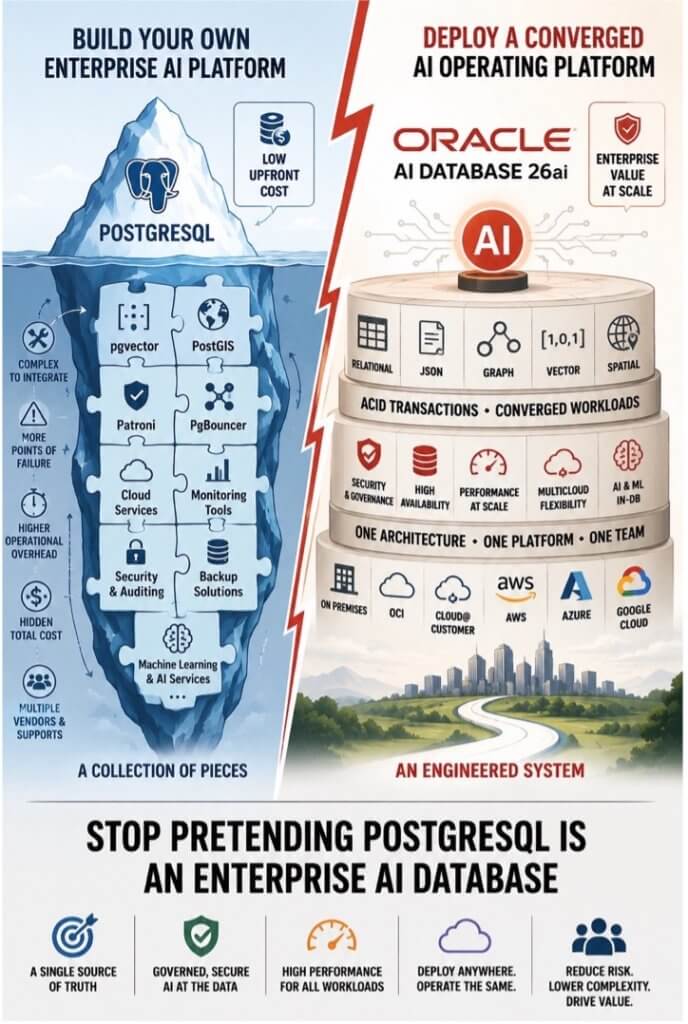
PostgreSQL can be the right choice when the priorities include low entry cost, an open-source ecosystem, developer familiarity, portability and modularity. Oracle can be the better fit when the priorities include integrated governance, reduced data movement, recovery at scale, multicloud consistency and fewer support boundaries.
Neither decision should be made on slogans.
The AI era will not reward the cheapest license or the longest feature checklist. It will reward architectures that minimize unnecessary data movement, control copies, centralize policy, reduce operational complexity and allow AI agents to work safely against current enterprise data.
Oracle AI Database 26ai has a credible and differentiated case on those dimensions.
The industry’s mistake is not in choosing PostgreSQL. The mistake is assuming that PostgreSQL compatibility, plus a collection of extensions and services, is automatically equivalent to a converged enterprise AI platform. It is not.
That is the debate CIOs should be having.
Action Item for AI Architects
AI architects should evaluate enterprise AI databases as operating architectures, not as feature checklists or license-line items. PostgreSQL remains a rational choice for many developer-led and composable workloads, but teams should quantify the full cost and risk of extensions, integration points, data pipelines, duplicated data, security controls, high availability, recovery, and ongoing engineering. For agentic AI workloads, the assessment should place particular weight on how closely governance sits to operational data, whether vectors and other data types can participate in governed transactions, and whether the same architecture can run consistently across on-premises and multiple clouds. The right decision should come from a workload-specific proof of value and a multiyear total-cost-and-risk analysis, not from assumptions that open source is automatically cheaper or that a converged platform is automatically superior.