
Open Models Are Becoming Infrastructure, Not Just Alternatives
A Tekonyx Point of View on the State of Open Models in 2026
The open-model market has entered a new phase. For several years, the discussion centered on whether open models could match the capabilities of proprietary systems from OpenAI, Anthropic and Google. That framing is now too narrow. The strategic question is no longer simply whether an open model can compete on a benchmark. It is whether an open-model ecosystem can become embedded deeply enough across developer workflows, enterprise infrastructure, hardware platforms and agentic systems that replacing it becomes difficult.
Recent studies provide important evidence of this transition. Between January and August 2026, public model repositories grew from 2.43 million to 2.96 million. Datasets increased from 711,000 to one million, while Spaces expanded from one million to 1.44 million. But the headline is not the number of repositories. The more important story is how concentrated, geographically diverse and infrastructure-oriented the open-model ecosystem has become.
Roughly 85.6% of models have fewer than 200 lifetime downloads, while just 1.5% of repositories account for 99.2% of downloads. OpenAI may appear highly fragmented at the supply level, but actual usage is concentrated around a relatively small number of models, formats and toolchains.
Attention Is Not Adoption
One of the strongest findings is the separation between the models receiving attention and those receiving sustained usage. Among the top 25 model repositories ranked by downloads during 2026 and the top 25 ranked by likes, only one appeared on both lists. Likes generally accumulate around major launches and highly visible frontier models. Downloads tend to accumulate around smaller, older and more stable models that have already been incorporated into production pipelines.
The all-MiniLM-L6-v2 embedding model, for example, generated approximately 1.55 billion downloads during the seven-month measurement period despite being released years earlier. No model published in 2026 reached the top 25 by downloads. This distinction is critical because the AI industry routinely confuses visibility with adoption.
A frontier model may dominate social media, benchmarks and developer discussion for several weeks. That does not mean it has become part of the operational foundation of enterprise AI. Real adoption occurs when a model is embedded into applications, retrieval pipelines, development frameworks, edge devices, security systems or automated workflows that run continuously. For technology providers, the lesson is straightforward: launch momentum is temporary, but integration creates persistence.
The most strategically valuable model may not be the one receiving the most attention. It may be the small embedding, reranking, classification or extraction model quietly executing millions of times inside an application.
China Is Defining the Open Frontier
The geographic center of gravity in open models continues to shift. According to some recent analysis, Chinese labs repeatedly released larger open models than American labs during the first seven months of 2026. China’s monthly upper limit ranged from approximately 754 billion to 2.78 trillion parameters. In five of the seven months, the largest American open releases remained below 130 billion parameters.
Parameter count does not automatically translate into model quality, efficiency or commercial adoption. Mixture-of-experts architectures can also have very large total parameter counts while activating only a portion of those parameters for each token. Nevertheless, the scale and frequency of these releases demonstrate the level of capital, engineering capability and strategic commitment being directed toward open models in China.
Chinese developers are pursuing two distinct strategies:
- Moonshot, MiniMax, Xiaomi and Z.ai are concentrating primarily on frontier-scale releases. Their portfolios appear designed to establish technical credibility, attract API demand and create global visibility.
- Alibaba’s Qwen and, to a degree, Tencent are pursuing a broader platform strategy. They are offering models across multiple sizes and use cases, allowing developers to move from small local deployments to large hosted systems without leaving the model family.
The second approach is more likely to produce durable ecosystem control. A frontier-only strategy can attract attention. A full-spectrum model family can become a standard.
Qwen Is Building Ecosystem Gravity
The most important open-model development may not be the size of Qwen’s largest model. It is the amount of downstream activity being built around the Qwen family. Recent reports suggest more than 151,000 Qwen-derived repositories, approximately 2.6 times Meta’s total footprint and 4.7 times the number specifically derived from Llama. Qwen derivatives were being created at a rate of roughly 180 to 210 repositories per day during the first seven months of 2026.
The Qwen ecosystem benefits from three reinforcing characteristics:
- A consistent release cadence.
- Coverage across model sizes and workload types.
- Generally permissive licensing that reduces friction for commercial use, modification and redistribution.
Together, these elements create a compounding cycle. More model sizes attract more developers. More developers generate more fine-tunes, quantizations, tools and integrations. Those derivatives reduce deployment friction and attract the next group of users.
Qwen’s approximately two billion measured downloads during the period were about 55 times Moonshot’s total, despite Moonshot’s strong frontier visibility. The difference illustrates the gap between publishing a powerful model and building an ecosystem.
Meta should pay particular attention to this shift. Llama helped establish the modern open-weight movement, but an installed base is not permanent. If developers increasingly view Qwen as the default starting point for fine-tuning, quantization and local deployment, Meta risks losing control of the ecosystem it helped create.
Small Models Remain the Economic Center
Frontier models dominate the public narrative, but small models continue to dominate actual distribution. Models with fewer than one billion parameters account for 83% of all-time downloads among repositories that declare a parameter count. Models above 100 billion parameters represent only about 1%. During 2026, models above 70 billion parameters generated just 3% of the measured download volume. This is not evidence that large models are unimportant. It reflects the economics and physical constraints of deployment.
Small models can operate on laptops, smartphones, edge devices and modest cloud instances. They offer lower latency, lower inference costs and greater control over data placement. They can be specialized for narrow tasks where the broad reasoning capabilities of a frontier model provide little incremental value.
For enterprises, the future architecture is therefore unlikely to be based on one model handling every workload. It will be a portfolio:
- Frontier models for complex reasoning, planning and multimodal interaction.
- Mid-sized models for domain-specific applications.
- Small models for high-volume, latency-sensitive and edge workloads.
- Embedding and reranking models for retrieval and knowledge systems.
- Policy and security models for validation, routing and monitoring.
The key enterprise competency will be routing workloads across models based on quality, latency, cost, security and deployment location.
Quantization Is Becoming a Strategic Distribution Layer
The community is also changing what “local inference” means. Formats and runtimes such as GGUF and llama.cpp are allowing increasingly large models to operate outside conventional hyperscale inference environments. Studies suggest repositories declaring GGUF support grew 464%, compared with approximately 16% growth for repositories associated with Transformers and PEFT.
The fastest-growing layer of the ecosystem is not necessarily model creation. It is the infrastructure that determines where models can run. Quantization, inference runtimes and hardware-specific optimization are becoming the open-model equivalent of software distribution channels. They convert theoretical access to model weights into practical deployment. A model that cannot be efficiently quantized, packaged, verified and deployed across available hardware is not meaningfully open for most developers. It is merely downloadable.
Model developers should stop treating community conversions as an afterthought. Officially supported quantizations, documented precision tradeoffs, signed artifacts and reference deployment configurations should be available at launch. This would improve security, reproducibility and performance while reducing dependence on unofficial conversions.
Hardware Vendors Are Using Models to Sell Infrastructure
AMD and NVIDIA were reportedly the two organizations publishing the largest number of new open-model repositories during 2026, with each releasing more than 200. This reflects a broader change in hardware strategy.
Open models are becoming executable demonstrations of hardware capability. An optimized model proves that an accelerator, inference engine or software stack can support real AI workloads. The model becomes part of the hardware vendor’s developer acquisition and platform adoption strategy.
NVIDIA can use Nemotron to strengthen the relationship between its models, CUDA software and accelerated infrastructure. AMD can use conversions and optimizations to demonstrate that widely used models operate efficiently on its hardware. Chinese chipmakers can pursue the same strategy by optimizing domestic models for domestic accelerators. This creates a tighter coupling between models and compute platforms.
Open models may reduce dependence on proprietary model APIs, but they do not automatically eliminate infrastructure lock-in. Lock-in can move downward into compilers, kernels, quantization formats, inference runtimes, orchestration software and hardware-specific optimizations. Enterprises evaluating open models must therefore examine the complete execution stack, not just the model license.
Open Weights Shift Where Value Accumulates
Many of the largest Chinese releases have been distributed under permissive or comparatively accessible terms, although licensing is becoming more complicated as some providers introduce commercial restrictions, revenue thresholds or custom conditions.
This reinforces a critical point: open weights are not necessarily the product. They can be the mechanism used to create demand for something else.
The commercial value may accumulate in:
- Hosted inference APIs.
- Cloud consumption.
- Accelerators and servers.
- Enterprise support.
- Fine-tuning and evaluation platforms.
- Security and governance tooling.
- Proprietary data.
- Developer distribution.
- Ecosystem influence.
This resembles earlier open-source infrastructure markets. Giving away the foundational technology can expand the market while shifting monetization toward operational services, infrastructure and control points surrounding the technology.
Enterprises should not assume that access to weights produces independence. If the organization still depends on a particular cloud service, accelerator architecture, inference runtime or vendor-managed toolchain, the dependency has moved rather than disappeared.
Licensing also requires greater scrutiny. “Open model,” “open weights” and “open source” are not interchangeable terms. Commercial thresholds, acceptable-use restrictions, redistribution requirements and revenue-sharing provisions can materially affect an enterprise’s ability to deploy or embed a model.
Agents Are Becoming Infrastructure Consumers
Agents are beginning to search repositories, retrieve models, create datasets, launch jobs and interact with development infrastructure programmatically. In this environment, the primary consumer of a model repository may no longer be a developer browsing a website. It may be another machine. This changes how AI infrastructure must be designed.
Repositories will need machine-readable metadata, verifiable provenance, standardized evaluation results, clear licensing information and trusted deployment artifacts. Documentation written only for humans will become insufficient. Agents need structured interfaces that allow them to determine whether a model is suitable, licensed appropriately and safe to execute.
An autonomous agent that can retrieve code, download models and execute workloads can propagate compromised dependencies or malicious model artifacts more rapidly than a human developer. Model hubs will increasingly require the equivalent of software supply-chain security: signed artifacts, reproducible builds, dependency scanning, behavioral testing and runtime isolation.
The open-model ecosystem is therefore converging with the software supply chain. Model governance will need to evolve accordingly.
The Tekonyx View
The market is moving from model competition to ecosystem competition. Benchmark performance will remain important, but it will not determine the winners by itself. The durable positions will be held by organizations that combine capable models with broad model families, permissive and understandable licensing, efficient deployment formats, strong community participation and integration across hardware and agentic workflows.
Qwen currently illustrates this strategy more effectively than most competitors. Its advantage is not simply that Alibaba can release large models. It is that developers can remain within the Qwen ecosystem across sizes, use cases and deployment environments.
Small models will continue to carry most production volume because enterprise AI is governed by economics, latency and infrastructure constraints rather than benchmark excitement. Frontier systems will handle the most difficult tasks, but specialized models will perform much of the repetitive work.
At the same time, open models will not eliminate platform concentration. Power is shifting into new control points: model families, quantization formats, inference runtimes, hardware optimization and agent-accessible distribution systems.
The companies that control those layers may capture more economic value than the organizations that simply publish the largest models.
Recommendations for Technology Providers
Technology providers should:
- Build model families rather than isolated flagships. Developers need a consistent path from edge deployments to large-scale inference.
- Treat quantization and packaging as primary product deliverables. Official GGUF and hardware-optimized builds should ship with the original weights.
- Make licensing explicit and machine-readable. Enterprises and agents must be able to determine commercial rights without interpreting ambiguous custom terms.
- Optimize across multiple hardware environments. Model openness has limited strategic value if practical deployment depends on one proprietary execution stack.
- Measure downstream derivatives and integrations, not just downloads or benchmark results. Ecosystem reuse is a better indicator of long-term influence.
- Design repositories for agents as well as humans. Metadata, provenance, evaluations and security policies must be accessible programmatically.
Recommendations for Enterprises
Enterprises should:
- Build a model portfolio instead of standardizing prematurely on one provider.
- Separate model openness from operational independence. Evaluate the entire stack, including infrastructure, runtimes, formats and management tools.
- Use small and specialized models for predictable, high-volume workloads.
- Establish license and provenance controls before allowing agents to retrieve or deploy models automatically.
- Test quantized versions independently. Their behavior, performance and security characteristics may differ from the original model.
- Track ecosystem durability. A model supported by active tooling, conversions and downstream development may be a safer long-term choice than a newer model with stronger launch benchmarks.
Conclusion
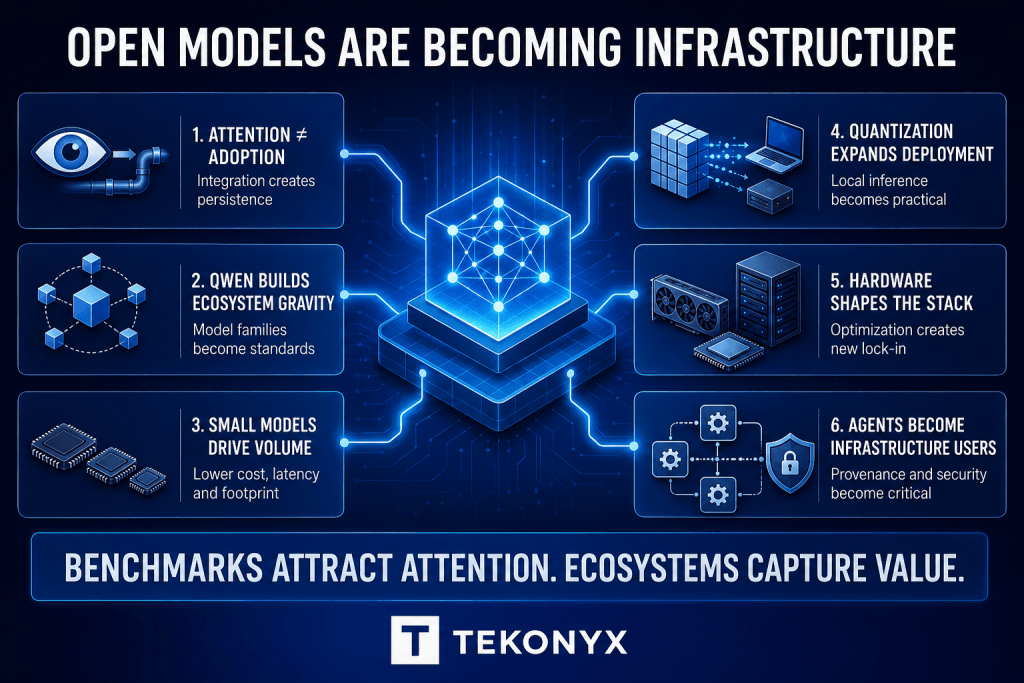
Open models are no longer simply lower-cost substitutes for proprietary APIs. They are becoming a strategic infrastructure layer.
The competitive advantage will not come from publishing the largest model for a few weeks. It will come from becoming the model family developers fine-tune, the format inference engines support, the workload hardware vendors optimize and the resource agents automatically discover.
That is why the most important statistic is not the parameter count of the largest model. It is the widening gap between models that attract attention and ecosystems that accumulate adoption. In the next phase of AI, model intelligence may attract users. Ecosystem gravity will determine who keeps them.