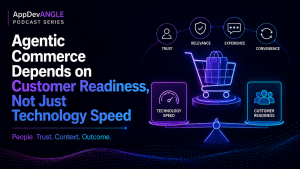
Enterprise AI Spending Is Outpacing Customer Trust and Adoption
Enterprise spending on artificial intelligence and machine learning continues to surge, but translating software delivery investments into superior customer experiences remains a significant operational hurdle.
According to theCUBE Research’s data, nearly three in four enterprise IT leaders name AI and machine learning as their top spending priority over the next twelve months. Furthermore, 64% of organizations have integrated AI-driven functionality directly into their software delivery pipelines. Yet despite faster delivery models and smarter infrastructure, most enterprise leaders still struggle to point to a customer experience that has tangibly improved as a result.
In this episode of AppDevANGLE, I spoke with Megan Carrigan, SVP of Strategy & Innovation at Valtech, about why enterprise commerce initiatives are breaking down between backend AI development and frontend consumer adoption.
Our conversation explored the distinction between autonomous agentic commerce and conversational discovery, why customer trust is lagging behind enterprise technology ambitions, how Digital Experience Platforms (DXPs) must evolve to serve AI agent personas, and why multi-agent orchestration layers offer a more realistic operational path than monolithic platform consolidation.
What emerged is a clear theme: successful agentic commerce is becoming less about how fast an organization can build autonomous capabilities and more about how effectively it aligns technical orchestration with customer readiness and brand trust.
Definitional Ambiguity Is Clouding Commerce Strategy
One of the primary friction points in current enterprise planning is the confusion around what agentic commerce actually entails. Enterprise leaders frequently receive board mandates to deploy agentic systems, but internal definitions vary widely across executive, product, and engineering teams.
As Carrigan explained, clients often request agentic capabilities without realizing the operational scope required. “Even in conversations with clients, they’ll say, ‘I want to have agentic commerce.’ But what they’re really kind of thinking in their mind is much more sophisticated AI powered search,” said Carrigan.
She emphasized that commerce AI sits on a spectrum. On one end is true agentic commerce: autonomous agent-to-agent interactions where software makes independent purchasing decisions based on parameters. On the other end is conversational commerce: interactive, agent-assisted discovery that enhances traditional search. Currently, the market has blurred these distinct concepts together under one label.
To build an effective roadmap, Carrigan noted that teams must pause and align on expectations before committing capital. “When someone starts talking about agentic commerce, it is necessary to pause and say, ‘What do you mean? Do you mean truly autonomous, or do you mean conversational agent assisted shopping and discovery?’” Carrigan said. Establishing that baseline ensures technology investments match actual operational goals.
Consumer Trust Lags Behind Enterprise AI Speed
Even when enterprise teams build functional autonomous technology, customer adoption creates a secondary barrier. Enterprise delivery speed driven by hyperscalers and platform vendors is moving significantly faster than consumer trust and habit change.
Carrigan pointed out that while consumers readily use AI for discovery and research, they remain reluctant to hand over transactional control to autonomous software. “Consumers are still very much trusting and changing behavior in AI around discovery, but they do not like doing the transaction yet,” Carrigan explained.
Deploying fully autonomous purchasing workflows before consumers are comfortable creates substantial financial and operational risk. If customers refuse to interact with autonomous agents at the point of purchase, major development investments will fail to deliver business outcomes.
Carrigan advocates for an incremental approach focused on trust-building and smaller experimental deployments. “Oftentimes it’s taking a beat, taking a deep breath, and understanding that we’re probably still in that conversational space,” Carrigan said. “We’re not yet at that autonomous space because the consumers aren’t there yet.”
Digital Experience Platforms Must Shift From Catalogs to Storytelling
The rise of AI answer engines is altering the traditional role of brand websites and Digital Experience Platforms (DXPs). Historically, DXPs functioned as the foundational hub for content, data, and digital touchpoints, driving users to brand websites for catalog browsing and basic product research.
Today, rational comparison shopping and basic product information are increasingly handled inside third-party answer engines before a customer ever visits a brand property. As a result, brand dot-com websites must shift their focus from serving as simple product directories to driving brand identity, mission, and emotional connection.
Carrigan noted that as search behaviors evolve, brand properties must offer something answer engines cannot replicate. The website must clearly articulate brand values and unique selling points, creating a deeper connection that extends beyond transactional details.
This shift forces platform teams to rethink their DXP architecture. The platform must move from static catalog management to dynamic, storytelling-driven engagement that reinforces brand equity when qualified traffic arrives.
AI Agents Are Becoming a First-Class Content Persona
As discovery shifts to external AI interfaces, content strategy must evolve to accommodate non-human consumers. Enterprise content can no longer be authored solely for human visitors; it must be structured specifically for AI agents to ingest and process.
Carrigan highlighted a recent discussion with industry analysts regarding this emerging architectural requirement. “That new persona is an agent,” Carrigan said. “So making sure that your content is structured for agents to read and understand, but also providing all of that context.”
Structuring content for agents requires going far beyond basic product metadata. Merely labeling an item as a hoodie is insufficient if the system lacks context around usage scenarios, fit, climate suitability, and styling context.
Without structured context, AI agents cannot evaluate how products meet complex consumer needs, limiting a brand’s visibility in answer engine results. “If you don’t have all that information structured in a way for them to understand, they’re not going to be able to perform better in the answer engines and bring more qualified traffic to your site,” Carrigan explained.
Orchestration Layers Outperform Monolithic Platform Consolidation
To support multi-channel AI experiences, many software vendors are advocating for full platform consolidation—encouraging enterprises to migrate all data and workflows into a single vendor’s ecosystem. However, this approach ignores the reality of enterprise infrastructure, where decades of legacy investments, specialized platforms, and siloed data stores coexist.
Carrigan argues that forcing a monolithic migration creates unnecessary change management overhead and capital expense. Instead, enterprises should lean into multi-agent orchestration layers that connect existing platforms without replacing them.
An orchestration approach allows organizations to establish clear roles for existing systems—such as CRMs, DAMs, and heritage databases—while using central governance and multi-agent coordination to synthesize insights. This enables leadership to move from ad-hoc experimentation to purposeful implementation without overhauling core infrastructure.
Analyst Take
Enterprise AI investments are reaching a critical turning point where operational deployment must align with customer willingness to adopt. While IT leaders are allocating substantial budget toward machine learning and pipeline integration, accelerating engineering speed without centering customer trust risks generating infrastructure that yields negligible return on investment.
Megan Carrigan’s perspective highlights a fundamental reality for application development and platform leaders: technical feasibility does not equal market readiness. Moving directly to fully autonomous agentic workflows risks creating friction with consumers who are comfortable using AI for conversational discovery but remain hesitant to delegate financial transactions to software.
The strategic path forward relies on architectural orchestration rather than vendor consolidation. Attempting to solve multi-system complexity by migrating to a single monolithic platform introduces unnecessary risk and cost. Instead, platform engineering teams should focus on building orchestration layers that unite legacy systems, CRMs, and DXPs while establishing centralized governance across multi-agent workflows.
Simultaneously, content architectures must evolve to recognize AI agents as a distinct persona. Brands that fail to structure rich contextual data for agent ingestion will find themselves invisible within the answer engines that now drive top-of-funnel discovery.
The larger lesson is this: success in agentic commerce is not about deploying fully autonomous agents as fast as possible. It is about building flexible, orchestrated architectures that serve AI agents, empower conversational discovery, and scale at the exact pace of customer trust.