Executive Summary
The increasing popularity of Claude Code, GitHub Copilot, Gemini Code Assist, Amazon Q Developer, or dozens more GenAI application coding assistants has raised a difficult question. Did it kill the low-code, no-code market? The answer is an emphatic “No.”
The low-code/no-code application development market was generally promising for years: “Tell us what you want, and we’ll build the application for you.” That’s a very attractive promise that turned out to be mostly incomplete. The problem wasn’t just building an application. The problem was building an application that an enterprise can actually trust, operate, secure, modify, govern, and maintain for years.
The advent of GenAI-assisted coding changed the discussion. Now, despite all of the market hype, GenAI has actually made that problem considerably more acute. It enables anyone with a prompt and an AI coding agent to create an application. And they can do so astonishingly quickly. The unintended consequence is that it can be — and often is — a governance, security, maintenance, and cost nightmare.
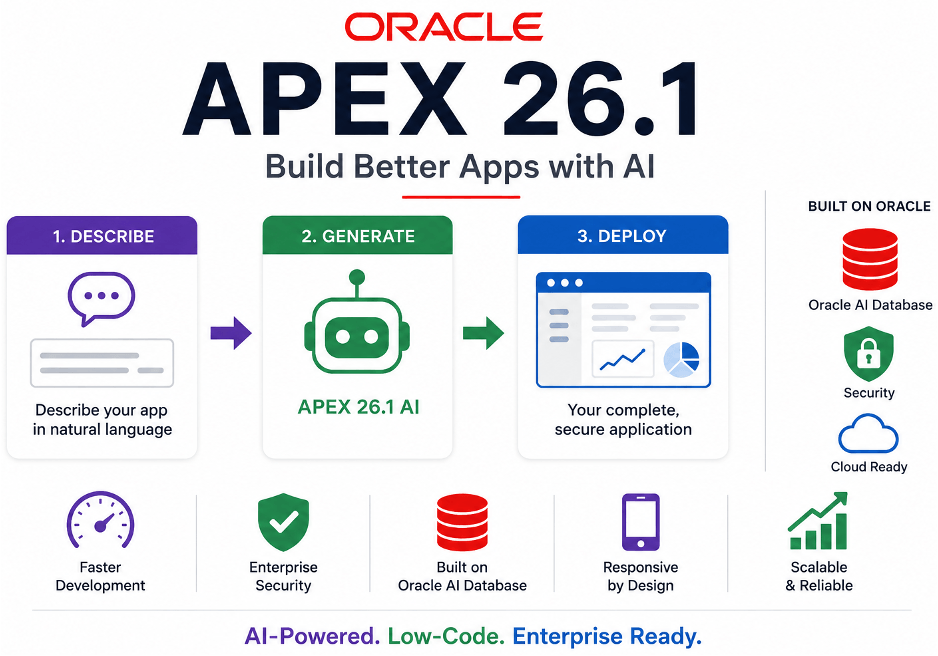
This is where Oracle’s recent release of its latest low-code development generation, APEX 26.1, becomes particularly interesting. Oracle isn’t simply bolting an AI chatbot onto another low-code development environment. APEX 26.1, formally named APEX AI Application Generator, fundamentally changes what the AI is asked to generate. Rather than having an LLM generate massive quantities of conventional application implementation code, Oracle gives AI a declarative application definition language called APEXlang. This language defines what the application is supposed to be and do at an abstract level. It doesn’t generate code. Oracle APEX then compiles and executes those definitions within its managed runtime. This is a distinction that matters quite a bit.
Why it matters is because AI has a significant coding problem that’s becoming increasingly noticeable. While GenAI has made writing software appreciably easier and faster, it has made owning that software a lot more complicated and difficult.
Ask an AI coding agent to build an application, and it can generate HTML, JavaScript, CSS, SQL, API calls, configuration files, authentication logic, validation routines, and application-specific code. Then ask it to change something — or anything, for that matter. The AI now has to understand what it generated. Okay, now change something else. The AI has to understand the changed version. Then another developer makes a modification. Once again, the AI has to understand everything in the version to be changed as well. This is how technical debt can be generated at machine speed.
Quite ironic, really. The industry spent decades trying to reduce software complexity through abstraction. Generative AI is now frequently and inadvertently reversing that progress by making it extraordinarily inexpensive to create more source code. More code isn’t necessarily more productivity. Sometimes it is simply more code.
APEX AI Application Generator takes on this problem head-on. This research digs into what it does to solve these AI application development problems. In summary:
- APEXlang changes the artifact AI generates from implementation code to application intent.
- Blueprint turns requirements into reusable application scaffolding.
- APEX keeps AI activity inside governed security boundaries.
- The Oracle AI Database-centric architecture differentiates it from broader low-code platforms.
- That architecture changes the economics of enterprise AI application development.
Oracle APEX AI Application Generator’s Different Approach
Oracle APEX AI Application Generator doesn’t make the AI write the application. Instead, it makes the AI define the application. That is the fundamental idea behind APEXlang. APEXlang is an open, declarative, human-readable specification language for Oracle APEX applications. Applications can be represented as structured .apx files that can be reviewed, versioned, diffed, validated, scanned, and governed using conventional development tools. (Oracle Documentation) This means the AI isn’t being asked to reinvent the application runtime. It’s being asked to define the application to a runtime that already knows how to execute it.
AI coding tools essentially ask: “Tell me what software to write, and I’ll write it.”
Oracle APEX AI Application Generator says: “Tell me what application you want, and I’ll construct it using an existing enterprise application platform.”
That is a profoundly different proposition from general AI coding. Just look at the difference.
Traditional AI coding process
- Business requirement established and presented to the LLM
- The AI creates thousands of lines of implementation code
- It tests the code
- Debugs the code
- Then creates more code
APEX AI Application Generator process
- Business requirement established and presented to the LLM
- The AI creates application specifications
- APEX delivers the runtime
APEX already knows how to implement forms, reports, charts, workflows, navigation, security, database access, and other application capabilities. The AI doesn’t have to reinvent those capabilities every time. That is just the first major advantage.
Where it gets interesting economically is that Oracle APEX AI Application Generator logically means fewer AI tokens[1]. It can reduce the number of AI tokens consumed during AI-assisted application development. Claiming the exact percentage is speculative until there are independent benchmarks. But a reasonable working hypothesis for typical enterprise, data-centric applications would be somewhere around 50–70% lower cumulative token consumption compared with conventional AI coding. The actual results will vary considerably by application complexity.
Why the hypothesis of 50-70% lower cumulative token consumption? How did we come up with this assumption? And it is an assumption. It’s because tokens aren’t only consumed when generating new code. They’re also consumed understanding existing code. Every time an AI coding agent has to ingest a large codebase, determine dependencies, reason about implementation details, make a modification, and validate the result, tokens are being consumed.
APEX’s declarative model changes that equation. The AI works at a higher level of abstraction. That potentially means APEX: generates less code, reads less, modifies less, regenerates less code. The savings will therefore compound over the application’s lifecycle.
And that is much more interesting than simply making the initial application generation faster. That lifecycle advantage sets up the next layer of Oracle’s approach, Blueprint. Blueprint converts that higher-level abstraction into practical application scaffolding.
[1] AI tokens are small units of data that AI models use to process text (and other inputs), such as whole words, parts of words, characters, or punctuation. Before the model can understand your input, it gets broken into tokens (tokenization), and then the model processes the tokens to produce output tokens. AI tokens translate directly into cost.
Blueprint: Turning Requirements into Governed Application Scaffolding
APEX AI Application Generator introduces another clever layer that Oracle calls Blueprint. It’s a spec-driven development. It works by providing a functional specification and Oracle AI Database schema to an AI coding agent. The agent generates an APEX blueprint describing the application pages, navigation, regions, reports, forms, charts, filters, actions, and page behavior. APEX then uses that blueprint to generate the application. (Oracle Documentation)
Oracle specifically notes that blueprint scaffolding can be faster and more token-efficient than generating APEXlang directly. This is because common APEX page patterns can be represented as reusable structures. (Oracle Documentation) This is really important because it creates another abstraction layer.
- Requirements → Blueprint → APEX application.
Instead of:
- Requirements → millions of tiny implementation decisions.
That is exactly the sort of abstraction AI needs today. The fundamental APEX AI Application Generator differentiator is that the AI-generated application remains an enterprise application.
This is where APEX separates itself from much of the AI coding frenzy, popularly called vibe coding. The application doesn’t stop being an enterprise application because AI created it. It remains an APEX application. It remains connected to the Oracle AI Database. It remains within the APEX security and application model. And the generated application specification can become a governed development artifact.
Oracle describes the approach rather bluntly: “if you generate it, you own it.” (Oracle Blogs) That’s a much more compelling proposition to an enterprise CIO than: “Don’t worry. The AI wrote the code.”
Once AI-generated application intent becomes a governed artifact, the next question is how safely that AI can act inside the enterprise application environment.
Security
That security question matters because application architectures are no longer limited to the traditional user-to-application path. For decades, application architectures tended to separate user to application, application to application server, and application server to database. GenAI introduced a different path: LLM to agent, agent to tools, tools to application, application to application server, and then to the database.
That creates a security and governance problem. What exactly is the AI or agent allowed to do? Keep in mind that data governance has, for nearly two decades, been about controlling the user path. AI agents don’t follow that path.
APEX AI Application Generator addresses this with AI Agents and AI Tools. The agent can reason about a request, but its ability to act is bounded by the tools that developers explicitly expose. Oracle says tool execution occurs within the APEX application boundary. (Oracle Blogs)
That’s incredibly important. The enterprise doesn’t have to give an LLM unrestricted database access and hope for the best. The application defines what the AI agent can do while Oracle AI Database enforces access at the data layer. APEX applications inherit foundational data-layer security from Oracle AI Database, while AI Tools constrain what an AI agent can do at the application layer. Oracle refers to this as “Secure at Source.” That’s a much more enterprise-friendly agent architecture.
AI Interactive Reports are another example of this built-in security philosophy. Whereas APEX AI Application Generator lets users interact with reports using natural language, it deliberately avoids simply allowing AI-generated SQL to run against the database.
Instead, AI interprets the request and applies declarative Interactive Report settings such as filters, sorting, grouping, aggregations, pivots, charts, and other supported operations. All of these operations are within the existing report and data-access rules. (Oracle Blogs)
That’s a key design decision. The AI can change what the user sees without being given carte blanche to change what the database does. The data is secured and governed by the Oracle AI Database. Governance again wins over AI cleverness.
With that governance model established, the competitive question becomes less about whether APEX has AI and more about where its AI-assisted application model fits relative to other low-code platforms.
How APEX AI Application Generator Compares Competitively
Does all of this make APEX AI Application Generator actually better than other low-code platforms? Not universally. That would be marketing rather than analysis.
The competitive comparison is clearest when viewed across four dimensions: ecosystem fit, data gravity, the AI-generated artifact, and governance model.
Microsoft Power Apps: Ecosystem Fit
Power Apps now allows users to describe applications using natural language and have Copilot generate applications and data models. Microsoft is also embedding Copilot and agents into applications. (Microsoft Learn)
That means Oracle doesn’t win simply because it has AI. Microsoft has AI. The more interesting distinctions are where the application abstraction lives and the data platform the application is optimized around.
Power Apps is deeply optimized for the Microsoft ecosystem, particularly Dataverse, Microsoft 365, and the Power Platform. If an organization is deeply invested in Microsoft 365, Dataverse, and the Power Platform, Power Apps can be an extremely logical choice.
APEX is deeply optimized for Oracle AI Database and data-centric enterprise applications. That matters enormously for organizations whose business applications already live on Oracle AI Database. When the data is already within the Oracle AI Database, the application-development platform doesn’t have to create another data abstraction layer simply to make AI happy. The database remains the center of gravity.
Mendix, OutSystems, and Appian: General-Purpose Low Code
Mendix is a popular and serious low-code competitor. Mendix has made substantial investments in AI through Maia. Mendix Maia can assist developers, generate portions of applications, and, with its “Start with Maia” capability, generate an application from a textual description, including a domain model, data-management pages, test data, and a homepage. (Mendix Documentation)
That’s impressive. But again, the differentiation is architectural. Whereas Mendix is fundamentally a general-purpose low-code application development platform, Oracle APEX AI Application Generator is a database-centric application development platform.
For organizations with large Oracle estates, that distinction is likely to be decisive.
The issue is not simply which platform can generate an application. Several can do that. The more important question is which platform can generate an application closest to where the enterprise data, business rules, security controls, and operational infrastructure already live. For Oracle-centric enterprises, APEX AI Application Generator is an easy decision.
Mendix, OutSystems, Appian, and other leading low-code platforms have spent years building sophisticated abstractions around application development. If an organization wants a broad, multi-platform low-code development environment, those products deserve serious consideration. Their strengths are breadth, portability, and general-purpose application delivery.
APEX AI Application Generator: Data Gravity and Governance
APEX AI Application Generator has something different: it’s included with Oracle AI Database and inherits its scalability, security, and governance. That means APEX can turn an organization’s existing database investment into an application-development substrate. AI can operate against that application model without reinventing the underlying implementation, while enterprise governance remains anchored in the Oracle data and application stack.
That positioning leads to the larger strategic implication: APEX AI Application Generator is not just competing as another low-code tool, but as a different model. It’s a new approach to designing, building, and maintaining AI-assisted enterprise application development.
Changing the Game
The bigger competitive advantage isn’t the fact that APEX is “low code.” This is where the industry needs to stop thinking about APEX as merely another low-code platform.
APEX AI Application Generator is arguably becoming an AI-native application specification and execution environment. That’s quite different from any other low-code platform.
The traditional low code pitch was: “You don’t have to write as much code.”
The new APEX pitch is closer to: “The AI doesn’t have to write the code either.”
That’s a subtle but enormous distinction. The first eliminates some human typing. The second changes the artifact that humans and AI collaborate on. Instead of AI producing implementation code, AI produces application intent. Oracle APEX AI Application Generator specifies the intent, and APEX implements the intent. That creates a much tighter feedback loop between the business requirements, the GenAI LLM, the agent, the application specification, and the enterprise runtime. All of that changes the economics of application development.
The low-code revolution was supposed to reduce the cost of application development. GenAI promised to reduce it again. But if AI merely makes conventional programming faster, enterprises could end up with more applications, more code, more cost, and less governance.
APEX AI Application Generator offers a different possibility.
It enables AI to make applications less expensive to create without proportionally increasing the amount of code an organization has to own, manage, patch, revise, update, secure, govern, and upgrade. That’s an intriguing value proposition.
When the application is represented declaratively, the runtime supplies the implementation, the AI works against a constrained application model, and the artifact can be versioned, reviewed, and governed. Then, AI can increase application velocity without necessarily increasing application complexity at the same rate. That’s the breakthrough moment of enterprise low-code application development.
Conclusion
Taken together, those architectural choices explain why Oracle APEX AI Application Generator isn’t important simply because Oracle added AI to a low-code product. Everybody is adding AI.
It’s important because Oracle is solving a much harder problem. It is making AI-generated applications fast enough for the AI era without making them increasingly complex, insecure, and/or expensive to own.
APEXlang is the key. Blueprints make the approach even more interesting. AI Agents give the application controlled agency. AI Interactive Reports gives users natural-language access to existing data without handing an LLM unrestricted SQL authority. And the Oracle AI Database provides the underlying data and application foundation.
The result is a different vision of AI application development. That vision is to not have the AI generate more code. But rather have the AI generate less code at a higher level of abstraction inside a governed application platform that already knows how to execute it.
That is why the most interesting metric for APEX AI Application Generator won’t ultimately be applications generated per developer. It will be enterprise application capability delivered per AI token and per unit of technical debt created.
As APEX demonstrates that it delivers substantially more application functionality with substantially fewer AI tokens and considerably less generated implementation code, Oracle will have something much more significant than another low-code AI platform.
It will have produced a trustworthy blueprint for enterprise application development in a world where generating code is easy, but managing complexity, security, and governance remains hard.