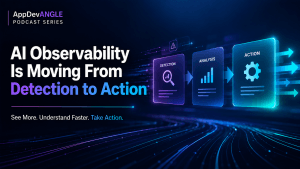
Enterprise observability is entering another major transition. For years, the market expanded around metrics, logs, traces, application performance monitoring, and increasingly sophisticated analytics. Yet the operational burden has continued to grow. According to ECI Research, 75% of organizations use between six and 15 different tools for observability, creating complexity across monitoring, security, incident response, and application operations.
AI is now adding another dimension to that challenge. Applications are becoming increasingly non-deterministic as enterprises integrate large language models and autonomous agents into software experiences. At the same time, AI agents themselves are emerging as consumers of observability data, creating the potential for systems that not only detect problems but evaluate, diagnose, and eventually act on them.
In this episode of AppDevANGLE, I spoke with Steve Tack, Chief Product Officer at Dynatrace, and Aparna Dhinakaran, Co-founder and Chief Product Officer at Arize AI, about what the convergence of traditional observability and AI observability means for enterprise software operations.
Our conversation explored Dynatrace’s acquisition of Arize AI, why AI applications require different approaches to tracing and evaluation, how shared telemetry could reduce operational fragmentation, and why observability is moving beyond dashboards toward becoming an intelligence layer for both humans and autonomous agents.
The larger market signal is significant: as AI changes the applications enterprises build, it is also changing how those applications must be observed and operated.
Non-Deterministic Software Changes the Observability Problem
Traditional observability developed around software that was largely deterministic. An application receives an input, executes known logic, interacts with predictable services, and produces an expected result. Metrics, logs, and traces provide engineering teams with visibility into that execution path.
AI applications behave differently. LLM-powered applications and agents can produce different responses to similar inputs. They can select different tools, generate different reasoning paths, and interact with software infrastructure in ways that are more difficult to predict in advance. That changes what enterprises need to measure.
“Products [are] becoming non-deterministic,” Dhinakaran said. “Evaluating no longer just becomes about is it right or wrong, but it becomes about actually measuring the quality of the responses.”
That distinction is fundamental. An API call can be evaluated relatively easily. It returned the expected response, or it did not. An AI agent requires a broader definition of success. Did it understand the request correctly? Was its response accurate? Did the interaction meet the quality expectations of the application? Traditional software telemetry remains necessary, but it cannot answer all of those questions independently. That is where AI observability and evaluation become increasingly important.
AI Observability and Application Observability Are Converging
The acquisition of Arize AI by Dynatrace reflects this broader architectural change. Dynatrace has historically focused on observability across applications, infrastructure, Kubernetes environments, and distributed systems. Arize has developed observability and evaluation capabilities specifically around machine learning, LLMs, and agents. These categories are becoming difficult to separate.
AI applications do not operate independently from traditional software. An agent may call an API, query a database, invoke another service, interact with Kubernetes infrastructure, or use external tools as part of a single workflow.
Tack described customers increasingly asking to see these environments together. “We start to hear about, hey, we’re bringing these together,” Tack said. “We’re looking at not only how we look at AI engineering and through the lifecycle, but then how do we bring that from an operational standpoint together.”
The need for convergence becomes even clearer as enterprises move agents into production. When an agent fails, the underlying cause may not be the model. It could be the prompt, a tool call, an application service, or the data. It could also be the quality of the agent’s generated response.
Troubleshooting therefore requires context across AI behavior and the traditional software stack supporting it. Dhinakaran described those environments as increasingly “joined at the hip.” That makes the separation between AI observability and traditional application observability increasingly artificial.
Shared Context Could Become More Valuable Than Another Dashboard
The observability market already has a complexity problem. Enterprises have accumulated specialized tools for infrastructure monitoring, application performance, logging, security, incident management, cloud environments, and increasingly AI workloads. Adding another standalone AI observability platform risks expanding that operational surface even further.
That is why the strategic value of combining these capabilities may depend less on feature breadth and more on shared context. Tack argued that fragmentation creates a deeper problem than simply having too many vendors. “Where the real loss often happens is they lose the ability to have a system mindset,” he said. “How can we bring a broader view together? How can we have shared context? How can we take action?”
That shared context matters because modern incidents increasingly cross organizational boundaries. When each team works from a separate system, diagnosing the overall problem becomes slower and more difficult.
A unified telemetry layer has the potential to give those stakeholders a common operational picture. The objective moves past fewer dashboards to fewer gaps between the people and systems responsible for making decisions.
Observability Is Shifting From Human Consumption to Agent Consumption
Perhaps the most important shift discussed in the conversation is who consumes observability data. Historically, observability platforms were designed primarily for humans. Engineers looked at dashboards, SRE teams investigated alerts, and operations teams correlated telemetry during incidents.
AI agents are beginning to enter that loop. “Observability is no longer about humans looking at dashboards and metrics and logs,” Dhinakaran said. “It’s about action.”
This could fundamentally change the observability market. If coding agents, SRE agents, and other autonomous systems can consume telemetry directly, the primary value of observability becomes less about visualization and more about providing precise context that another system can reason over.
That creates a progression from detection to understanding to action. This is much closer to the vision enterprises have been promised under AIOps than simply improving alert prioritization. The difference is that increasingly capable agents may finally provide an execution layer capable of acting on the intelligence observability platforms generate.
Autonomous Operations Depend on Trustworthy Context
The move toward action also introduces a critical requirement: confidence. Enterprises will not allow autonomous agents to change production systems simply because a monitoring platform detected an anomaly. The system must understand enough context to make an accurate decision.
Tack emphasized precision and accuracy as prerequisites for automation. “One of the ways that we see giving our customers confidence to drive more automation is in the precision, the accuracy of the analytics and those answers you’re pulling back.”
This creates an important relationship between observability and AI governance. The more authority enterprises give agents, the more important the quality of the underlying telemetry becomes. The stakes increase significantly when the output of observability is no longer a recommendation displayed to an engineer, but an instruction executed by an autonomous system.
This means agentic operations will require guardrails, policy controls, validation mechanisms, and clearly defined boundaries around autonomous remediation. The path toward autonomous operations is therefore becoming a trust problem in addition to an AI capability problem.
AI Engineering Is Becoming Part of the Production Lifecycle
Another important implication is the collapsing boundary between AI development and production operations. AI teams need experimentation and evaluation tools while developing agents. Once those agents reach production, they need operational telemetry from the broader software environment.
Arize’s model reflects that lifecycle. Its Phoenix open-source project gives teams a lightweight entry point for tracing and evaluating AI applications, while its managed capabilities support production-scale environments.
But as Dhinakaran noted, debugging agents increasingly requires visibility beyond AI-specific telemetry. “Having this ability to not only debug agents with AI observability but also have all the context of the software that they use to call tools or the underlying infra behind the agents… just makes us build better products and better experiences for our customers.”
That convergence could reshape how enterprises organize AI engineering. Rather than maintaining separate observability systems for development, model evaluation, application operations, and infrastructure, enterprises may increasingly expect a continuous operational context spanning the entire lifecycle.
This becomes especially important as agents themselves become part of the software development process. Coding agents are already writing and modifying software. SRE agents are beginning to assist with operational tasks. AI engineering is therefore becoming intertwined with application engineering rather than remaining a specialized discipline on the side.
Observability Platforms Are Expanding Toward Operational Intelligence
The broader strategic question is whether observability remains a monitoring category at all. The market is already moving beyond that definition. Enterprises increasingly expect observability platforms to correlate telemetry, understand dependencies, provide causal analysis, assist with troubleshooting, and automate operational workflows.
Agentic AI accelerates that trajectory. Tack described the opportunity as changing not just the technology enterprises use but how teams themselves operate. “The market’s not just layering another technology on top,” he said. “They are changing the way they want humans to work. Where does the agent step in?”
That question points toward a broader category of operational intelligence. The future observability platform may need to understand applications, infrastructure, AI workloads, agents, security context, and developer workflows simultaneously. More importantly, it may need to expose that intelligence not only to humans but to fleets of autonomous systems.
The dashboard does not disappear, but it may no longer be the primary interface. The observability platform increasingly becomes the context layer underneath an automated operating model.
Analyst Take
The Dynatrace-Arize combination is important less because it adds another AI capability to an observability portfolio and more because it illustrates where the observability market itself is heading.
Two transitions are occurring simultaneously. Applications are becoming non-deterministic, requiring enterprises to observe prompts, responses, evaluations, tool calls, and agent behavior alongside traditional metrics, logs, and traces. At the same time, the consumer of observability data is changing. Humans will continue to investigate complex incidents, but AI agents will increasingly consume telemetry directly to diagnose problems, recommend changes, and eventually perform bounded remediation.
This fundamentally changes the role of observability. The market has spent years promising AIOps, but much of what enterprises received was better correlation and alerting. Agentic AI creates the possibility of closing the remaining gap between insight and execution.
The big challenge will be trust. Autonomous operations require accurate telemetry, shared context, strong evaluation, causal understanding, governance, and clearly defined guardrails. Giving an agent incomplete operational context and permission to act could create more risk than value.
This is why the convergence of AI observability and traditional observability matters. An enterprise cannot understand an AI agent solely by observing the model, just as it cannot understand the application solely by observing the infrastructure. Agents, code, APIs, data, Kubernetes environments, models, and infrastructure increasingly operate as one system.
Observability needs to reflect this reality. The next competitive phase of this market will therefore be defined less by which platform collects the most telemetry and more by which platform can turn that telemetry into trustworthy context for action. Observability is becoming the intelligence layer that helps humans and agents decide what should happen next.