
Follow-up to “Korea Eliminated Its Own Sovereignty”
The clock I left running at the end of the last edition has stopped, and then the story kept moving.
On 10 September, NIPA notified Motif Technologies that its objection was dismissed. 기각. One word. [1]
Motif had submitted six pages. It asked for six things: [2]
- the detailed per-item scores for every team
- the substance of the evaluations themselves
- how the benchmark points were split between the Artificial Analysis index and the NIA test
- the specific judgment criteria the expert panel applied
- the user evaluation methodology
- whether blind conditions were used
Every one of those is a question about what the program was measuring. None is a request to be reinstated. Motif had already said twice, in writing, that it would not enter the third round whatever the ruling. [3]
The government’s reply was a single line with no reasoning attached. A ministry official said working-level staff would meet Motif separately to explain. [2]
A national sovereignty program was asked, formally and in public, to state what sovereignty meant. It answered privately.
Then on 21 September, Deputy Prime Minister Bae Kyung-hoon told reporters what the third round will be judged on. [4]
Usability.
The full criteria publish in about a month. The framing has shifted away from closing the gap to the world’s best models and toward whether Korean models can win users against foreign alternatives and carry a business model on top of that adoption. [4]
Read the sequence. Korea eliminated the strongest independent model in the field on usability scores, dismissed the request to explain how those scores were reached, and then elevated usability to the organizing criterion for the rest of the program.
That is not a government walking back a contested decision. That is a government formalizing it.
Two postures, two kinds of pressure
On 27 August, nine days after the elimination and with the objection running in every Korean tech outlet, the ministry released the component scores. With the consent of the other three teams it published the benchmark, expert and user breakdowns. [5] [6] Those are the numbers that made the last edition possible.
Two weeks later, asked the same question through the formal channel, it published nothing.
Korea disclosed when the pressure was journalistic and withheld when the pressure was procedural. Scores tell you who won. Criteria tell you what the country was buying. Korea published the first and classified the second, and the order tells you which one it was protecting.
The tell is in the benchmark
Motif did not only lose on the soft scores. On the NIA benchmark, the government’s own Korean-language evaluation, it came last there too: SK Telecom 13.4, Upstage 13.3, LG AI Research 12.8, Motif 12.7. [7]
Seven tenths of a point across the entire field.
On the Artificial Analysis index the same four models scored 47, 37, 35 and 31. [8]
That is the whole case, sitting in plain sight in the government’s own disclosure. A benchmark component where a sixteen-point capability spread compresses into less than a single point decides nothing. Forty of the hundred points were nominally performance. In practice those forty came out near-identical across all four teams, which handed the outcome to thirty-five points of expert opinion and twenty-five points of user preference. [8]
The user evaluation was 49 AI startup executives and 185 randomly selected members of the public. [5] Motif finished last in both halves.
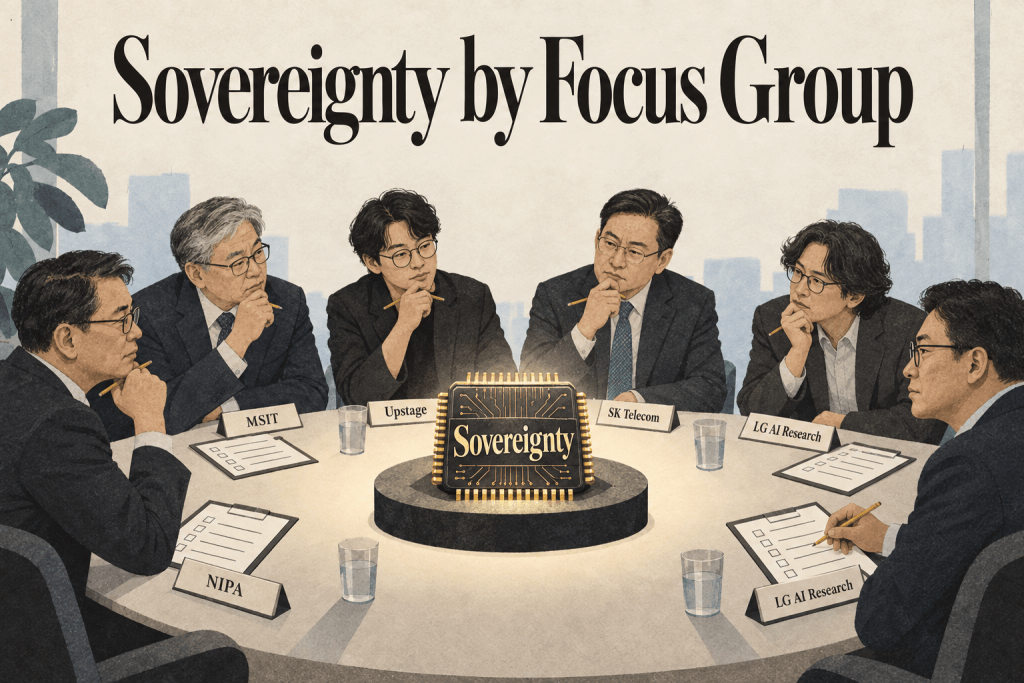
So the composition of Korea’s national AI sovereignty decision, once you strip out the instruments that could not discriminate, was ten external reviewers and a focus group.
No bad faith required. The scoring scheme made the result inevitable the day it was written, and nobody in the room appears to have noticed until a startup put it in a press release.
What this is really about
I have spent the last two weeks watching people read the Korea story as a Korea story. It is not. Every element of it is currently being drafted into somebody else’s RFP.
The pattern is always the same. A government or a board decides it needs sovereign AI. The money gets approved before the definition does, because capital allocation runs on a faster clock than policy. By the time anybody asks what sovereignty means in this context, procurement is already scoring submissions, and the definition gets reverse-engineered from whatever the evaluators happen to reward.
Korea ran that sequence in public over fourteen months. In January it disqualified Naver Cloud for building on Alibaba’s Qwen vision encoder and weights, which said sovereignty means provenance. [9] [10] In August it eliminated Motif for scoring poorly with users, which said sovereignty means adoption. [11] In September it announced that round three will be judged on usability, which says the August definition wins. [4]
Three positions. None of them written down before the submissions they judged.
First principles, before the RFP
Here is what I now put in front of every client standing up a sovereign initiative. None of it is technical. All of it has to happen before anybody drafts a requirement.
Write the disqualifier first. Not the scoring weights. The disqualifier. What single property, if absent, makes a submission ineligible regardless of how well it performs? Korea had one in round one and abandoned it by round two. If you cannot state yours in a sentence, you are not running a sovereignty program, you are running a procurement with sovereignty in the title.
Separate the capacity question from the control question. These are different purchases with different economics, competing for the same budget line. Capacity is priceable by anyone, which is why it wins by default. Control has to be specified before it can be priced at all. If your RFP cannot tell them apart, every dollar drifts toward the thing with a unit price, and you end up with gigawatts and no governance.
Treat every scoring weight as a policy statement, then test it for dynamic range. Korea assigned 40 percent to performance and then selected instruments that could not separate a 47 from a 31. The stated weight was 40. The effective weight was close to zero. Before an RFP goes out, run your criteria against two deliberately mismatched candidates and confirm the scores actually diverge. If they do not, that criterion is decorative and something else is deciding.
Put usability downstream of sovereignty, not inside it. Usability is a real and important question. It is a product question. It belongs in the adoption phase, measured against the thing you have already established you control. Scoring both in one rubric means the vendor with the best onboarding beats the vendor with the best claim to independence every time, and you will have spent a sovereignty budget on a user experience outcome.
Apply the reconstruction test. Could a competent outsider, holding only your published criteria, reconstruct why you chose what you chose? If the answer requires a meeting, you have a preference rather than a policy. Preferences are exactly what a sovereignty framework exists to constrain, which is why the rubric gets written before the submissions arrive and published once it is.
Decide in advance what evidence would change your mind. Korea received a six-page argument that its instruments were miscalibrated, using its own published numbers as the exhibit, and returned one word. Whatever the merits, no mechanism existed to absorb the finding. Build the appeal path into the program before the first evaluation, because the objection that matters will come from the party you are about to eliminate.
The pillar this lands on
Operational sovereignty gets heard as an infrastructure question. Who holds the keys, who carries the pager, who owns the audit log.
It is a question about whether the decisions that shaped the stack can be inspected afterward by somebody who was not in the room.
Korea held the log and declined to open it. The reasoning exists, apparently, and will be delivered to one company across a table. That is not an audit trail. That is a conversation.
Motif asked for a public record and received a private appointment. It is still not entering round three.
What this costs you
If you cannot publish your sovereignty criteria, you do not have any. And until they exist on paper, every won and every dollar defaults to buying capacity, because capacity is the only thing anyone can price without a definition.
That is how a country commits over a thousand trillion won to data centers [12] while budgeting roughly $350 million for the model that was supposed to make them sovereign [13], and then eliminates the team that built the best one.
Write the rubric first. Publish it. Then look at where the capital is going and watch the ratio correct itself.
We run this as a two-week engagement before the RFP is drafted, or as a rescue when one is already in market and the definitions have started drifting. The second costs more.
Book a Sovereignty Assessment – info@agentcylabs.com
Amit
References
[1] ZDNet Korea, “모티프 독파모 이의제기 기각…정부, 구체적 사유는 추후 설명,” 11 September 2026. https://zdnet.co.kr/view/?no=20260911171005
[2] Edaily, “[단독] 6장 입장문 냈는데…독파모 이의제기에 돌아온 정부 답변은 ‘기각’ 한줄,” September 2026. https://www.edaily.co.kr/News/Read?newsId=04988886645578808
[3] Electronic Times (etnews), “모티프 ‘독파모 이의제기’에 절차 검증…배경훈 부총리 ‘평가방식 재검토’,” 27 August 2026. https://www.etnews.com/20260827000262
[4] Money Today, “배경훈 부총리 ‘3차 독파모 기준은 사용성’…다음달 공개 전망,” 21 September 2026. https://www.mt.co.kr/tech/2026/09/21/2026092117180234173
[5] Money Today, “‘독파모 탈락’ 모티프 이의신청에 정부, 2차 점수 전체 공개,” 27 August 2026. https://www.mt.co.kr/tech/2026/08/27/2026082720014296593
[6] Kyunghyang Shinmun, “Ministry of Science and ICT releases scores after Motif Technologies objects,” 27 August 2026. https://www.khan.co.kr/en/article/202608272234017/
[7] Nate/News, “‘독파모’ 평가 논란에 과기정통부 세부 점수도 공개,” 27 August 2026. https://m.news.nate.com/view/20260827n35146
[8] Korea Times, “Motif challenges national AI model project after elimination,” 27 August 2026. https://www.koreatimes.co.kr/business/tech-science/20260827/motif-challenges-national-ai-model-project-after-elimination
[9] Digital Daily, “네이버클라우드, 독자 AI 2차평가 진출 고배 ‘독자성 요건 부족’,” 15 January 2026. https://m.ddaily.co.kr/page/view/2026011517434177623
[10] Hankyung, “‘中 모델 도용 논란’ 네이버의 굴욕…독파모 ‘충격의 탈락’,” 15 January 2026. https://www.hankyung.com/article/202601153114i
[11] Bloomberg, “Korea Jettisons Startup From High-Stakes Sovereign AI Contest,” 18 August 2026. https://www.bloomberg.com/news/articles/2026-08-18/korea-jettisons-startup-from-high-stakes-sovereign-ai-contest
[12] DatacenterDynamics, “South Korea announces $919bn investment into three mega projects, plans to build 18.4GW worth of data centers by 2035,” July 2026. https://www.datacenterdynamics.com/en/news/south-korea-announces-919bn-investment-into-three-mega-projects-plans-to-build-184gw-worth-of-data-centers-by-2035/
[13] SemiAnalysis, “Korea’s Trillion-Dollar Sovereign AI Investment: Nvidia Wins, Hynix Loses,” 1 September 2026. https://newsletter.semianalysis.com/p/koreas-trillion-dollar-sovereign
[14] Korea Herald, “Motif Technologies joins sovereign AI foundation model project,” February 2026. https://www.koreaherald.com/article/10679368
[15] VentureBeat, “Kimi K3’s full weights are here, but they’re ‘open’ with a caveat: what enterprises should know,” July 2026. https://venturebeat.com/technology/kimi-k3s-full-weights-are-here-but-theyre-open-with-a-caveat-what-enterprises-should-know