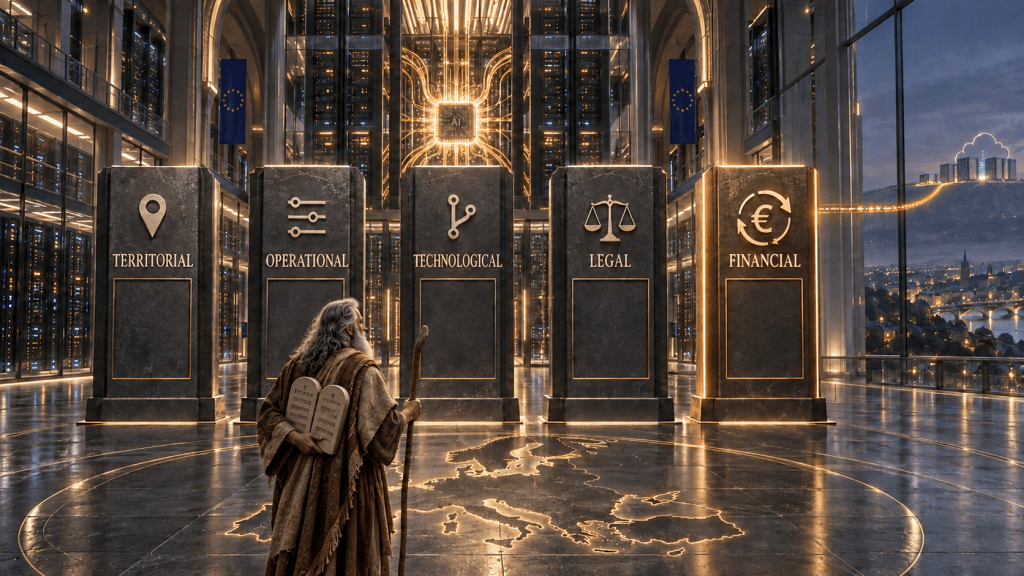
Seventeen founding members, the best definition of AI sovereignty any foundation has put in writing, and a charter that promises to build nothing. Brussels has a congregation. It still doesn’t have a rubric.
On Wednesday in Brussels, Europe got a church.
The Eclipse Foundation launched the Sovereign AI Foundation with 17 founding organizations: Ericsson, Bosch, Thales, Red Hat, Infosys, Renesas, Vector Informatik, CEA LIST, KU Leuven, the University of York and a strong bench of European open source shops.[1] Good names. Serious engineering. People who ship software into cars, factories and telecom networks, where “we’ll fix it in the next release” is not a strategy.
Now read the guest list again, for who didn’t RSVP.
No AWS. No Microsoft. No Google. No OpenAI. No Anthropic. Not Mistral. Not SAP. Not even Deutsche Telekom, whose engineers built Eclipse LMOS, one of the projects on the foundation’s own showcase slide.[2] The only US-headquartered founder is Red Hat, and Red Hat has belonged to IBM since 2019.[3]
That is not an oversight. That’s a seating chart.
And the sermon is good. I’ll give credit where it’s earned, and this one is earned in full. Eclipse defines AI sovereignty as “preserving meaningful choice and control over the systems on which organisations depend.” Not isolation. Not a ban on proprietary tech. The ability to understand, choose, adapt and govern.[1] Gaël Blondelle, Eclipse’s VP of community operations, then added the line that made me put my coffee down: sovereignty means keeping “viable alternatives and the freedom to change direction as costs, requirements, or provider terms evolve.”[4]
Costs. Provider terms. Freedom to change direction. That’s not a generic sovereignty definition. That’s my Financial pillar with a Brussels postmark.
Executive Director Mike Milinkovich went one better: “access to model weights alone does not provide the transparency, control, or independent governance that organizations may need.”[5] Open weights are necessary. They are not sufficient. I’ve been saying it for months. Nice-to-have company.
Then you read the fine print.
A foundation that won’t build anything
The Sovereign AI Foundation “will not develop software or specifications.”[1] Open the project page and it gets better. Under the hood it’s an Eclipse Interest Group. Existing Eclipse members only. No additional fee. The deliverables are use case mapping, trend monitoring and “whitepapers, blueprints, and reference materials.” Plus a mailing list.[6]
So Europe now has a sovereignty forum with no rubric. A church with no commandments. Seventeen congregants, a hymn sheet, and nobody grading the sermon.
A definition without a rubric is a vibe. Vibes don’t survive procurement.
To be fair, that’s the Eclipse model by design. The projects build, the forum talks. And the projects are where the real credit lives, so that’s what I’m grading: not the press release, but what a buyer would actually deploy. Eclipse Enclave for agent sandboxing. Eclipse PanEval for evals. LMOS for multi-agent systems. Theia AI and Open VSX for developer tooling. And an exploratory AI Registry for MCP servers, agent skills and plugins.[1]
Five pillars. Same test as always. What holds when someone pushes?
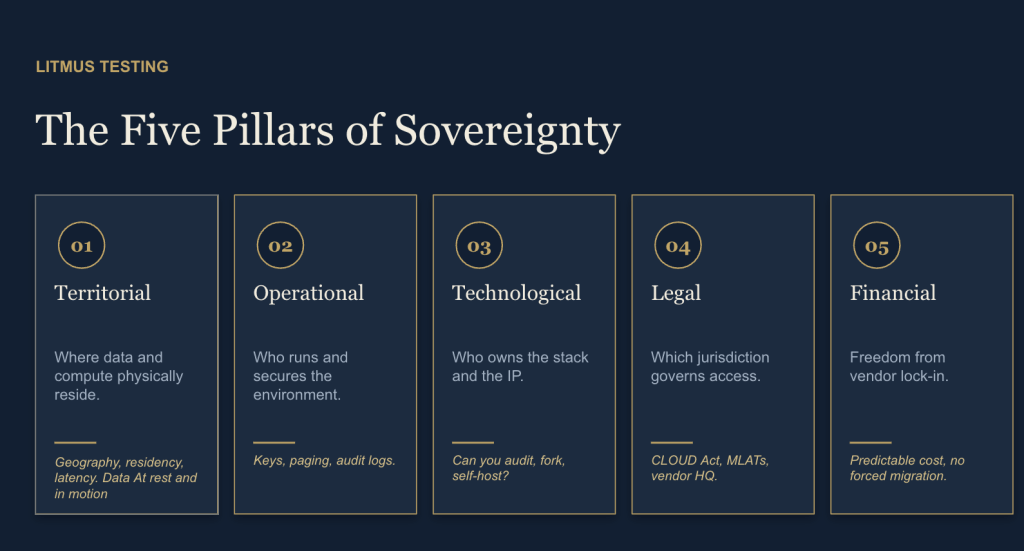
01 Territorial
The question. Where do your data and compute physically live, at rest and in motion, when the agent is actually thinking?
The story. Eclipse Enclave is the project I’d deploy tomorrow. Every agent session runs in its own container. The agents it supports out of the box? Claude Code and OpenAI’s Codex CLI.[7] So the sandbox sits in your data center in Stuttgart, and the reasoning happens on a GPU in someone else’s region, on someone else’s meter.
Under pressure. Enclave builds a beautiful vault, then lets the brain phone home to San Francisco on every token. Your prompts, your retrieved context and your agent’s intermediate reasoning all cross the boundary. Nothing in the Eclipse portfolio decides where inference runs. That’s your job. My standing rule applies: a hosted frontier model anywhere in the request path is an automatic fail on this pillar. Swap in open weights on hardware you control and the same stack passes.
The sandbox is sovereign. The inference isn’t.
VERDICT Breaks, unless you swap the brain.
02 Operational
The question. Who runs it, who holds the keys, who gets paged, and who can pull the plug?
The story. Here Enclave earns real credit. Separate filesystem and network stack per session. Only the mounted project directory is visible. A sidecar gateway filters DNS and proxies outbound traffic, so agents reach only the domains on your allowlist, and “everything else is blocked and logged.” MIT licensed. Audit logging for compliance.[7]
Under pressure. A coding agent gets prompt-injected and tries to ship your repo to a paste site. The gateway blocks it and writes it down. Your kill switch is stopping a container you run, on a host you own. That’s what operational sovereignty looks like when it isn’t a slide. The limit: it covers coding agents. Your customer-facing agents, your memory layer and your control plane are still homework.
VERDICT: Holds, for the slice Enclave covers.
03 Technological
The question. Can you audit it, fork it and self-host it without asking anyone’s permission?
The story. Eclipse PanEval is evaluation as a service for safety, bias and robustness, pitched at the EU AI Act obligations for general-purpose models. It builds on FlagEval from the Beijing Academy of Artificial Intelligence, on an independent codebase.[8] BAAI was added to the US Entity List in March 2025.[9]
Under pressure. I’m not raising that to scare anyone. I’m raising it because it’s the best advertisement for this pillar I’ve seen all year. Take a rival’s code, fork it, govern it under your own foundation and owe them nothing. That’s what “can you fork it” means in practice. Your procurement team will still ask about the lineage. Have the answer ready before they do. Across the portfolio: open source, independent project governance, permissive licensing.[1][7]
VERDICT Holds, and PanEval just proved the fork clause works.
04 Legal
The question. Which court can compel whoever holds your data, your keys or your model?
The story. The Eclipse Foundation is a Belgian AISBL registered in Brussels.[10] Good venue. Neutral ground. The forum sits exactly where it should.
Under pressure. A forum can’t change the jurisdiction of the model you call. Route your Enclave-wrapped agent to a US-hosted frontier model and the CLOUD Act rides along with every token. The foundation’s address doesn’t travel with your prompts. Neither does its neutrality. Not a knock on anyone. Just knowing where the subpoena lands.
VERDICT Holds for the host, silent on the stack.
05 Financial
The question. Can you leave? On your timeline, at a survivable cost, without a meter you don’t own setting your gross margin three years out?
The story. Eclipse wrote the best one-sentence description of this pillar any standards-adjacent body has published. “The freedom to change direction as costs, requirements, or provider terms evolve.”[4] That is Pillar 5, word for word. Then the charter declined to measure it. No unit economics criterion. No exit cost criterion. No grade.
Under pressure. Your agent vendor reprices from per-token to per-action and your bill triples. You call the Sovereign AI Foundation. They send you a whitepaper. It will be a very good whitepaper. It will not renegotiate your contract.
The forum itself is cheap. No fee on top of Eclipse membership, which runs from €6,000 a year for a small contributing member to €300,000 for a billion-euro strategic member.[11] Cheap to join. Free to leave. Tells you nothing about your own bill.
VERDICT Incomplete. Right sermon, nobody counting the collection plate.
The other half of the scorecard
Here’s the irony. A short walk from the Eclipse offices, the European Commission already wrote a rubric. The Cloud and AI Development Act, proposed June 3, sets four sovereignty assurance levels for cloud services.[12] Level 1: data processed and stored in the EU. Level 2: independence from third countries and supply chain transparency. Level 3: EU ownership and control, with citizenship criteria for personnel. Level 4: full supply chain control with no third-country interference.[13]
Run that through the pillars. Level 1 is Territorial. Levels 2 and 3 are Legal and Operational. Level 4 is Technological. Four pillars, fully staffed.
Financial? Not a line. EU tech chief Henna Virkkunen pointed out that the CLOUD Act makes the stricter levels hard for US providers.[13] True. Also entirely a Legal argument.
Europe did touch money elsewhere. The Data Act abolishes cloud switching charges on January 12, 2027.[14] Credit where due. But killing the exit fee tells you the door is unlocked. It says nothing about the rent. It won’t stop a per-token repricing, a forced model deprecation, or a vendor that moves your agent bill from tokens to actions.
So here’s where Brussels landed this week. Eclipse has the Financial definition and no rubric. CADA has a rubric and no Financial pillar. Two institutions, a short walk apart, each holding half a scorecard. Somebody should introduce them.
A rubric without Financial is a tenancy agreement with better paperwork.
The executive TCO
Joining the conversation is a rounding error. An Eclipse membership line item, €6,000 to €300,000 a year.[11] For Bosch, Thales and Ericsson, it won’t survive a budget review long enough to be noticed.
Adopting the stack is the real line item. Enclave, PanEval, LMOS and Theia are free to download and not free to run. The cost is engineering time, operations and ownership. That’s the point. Owning costs money. Renting costs alpha.
Staying rented is the cost you don’t see until the vendor reprices. When a frontier lab sets the price of your tokens, it sets your gross margin, and with it your roadmap. That’s your unit economic alpha sitting on someone else’s balance sheet.
The playbook hasn’t changed. Baseline on open-weight models running on infrastructure you control. Wrap the agents in Enclave-style containment. Evaluate them with a harness you govern. Burst to the frontier only when a task genuinely needs raw intelligence. Hybrid is fine. I’d sign off on it. Eclipse now supplies most of the parts for that baseline. None of them tells you what the baseline should cost, and that number is the one you have to own.
WHAT TO DO
Monday
Deploy Enclave, then check where the brain lives. Containment on your side, inference on theirs, is half a pillar. Name the model endpoint in the risk register.
Grade the portfolio, not the press release. A forum can’t pass or fail a pillar. The projects you actually run can.
Ask about lineage before procurement does. Forking a rival’s code is a feature. Being surprised by it in an audit isn’t.
Map your vendors to CADA, then add a fifth column. What does leaving cost, and what does a 3x token price do to your gross margin?
Don’t confuse a free exit with a fair meter. The Data Act unlocks the door. Your contract still sets the rent.
Watch the AI Registry. Whoever runs the registry for MCP servers and agent skills runs the supply chain of agentic AI. Better a Belgian nonprofit than a hyperscaler marketplace.
So who writes the commandments?
The best line of the whole launch came from KU Leuven’s Dr. Dimitri Van Landuyt: “Trust equals Transparency times Control.”[1]
It’s multiplication. Zero on any factor zeroes the product. I’d add one term: times the cost you control. Leave that at zero and your transparency and your control are worth exactly nothing when the invoice arrives.
Sovereignty isn’t binary. It’s control with an acceptable-risk sidecar. Own the crown jewels core. Stay movable at the edges. Eclipse just made the edges a lot more movable, and I’ll applaud that all day. But a church without commandments is a very nice building. Somebody still has to write the five, and one of them has to be about money.
That’s the gap our sovereignty certification is built to close: all five pillars, financially weighted, graded with an acceptable-risk sidecar instead of a pass/fail stamp.
If you want your vendor estate pressure-tested on all five, that’s what an
Agentcy Labs Sovereignty Assessment does. We score it, name the risks, then architect the crown jewels layer (identity, audit logs, agent memory and context, evals, control plane) that you own outright. Not licensed. Not hosted on Agentcy Labs’ terms.
Get in touch: info@agentcylabs.com
Amit
Amit Eyal Govrin is Principal Analyst, Sovereign AI at theCUBE Research and CEO and co-founder of Agentcy Labs. He was previously CEO of Kubiya, a Gartner Cool Vendor.
REFERENCES
- Eclipse Foundation, “Eclipse Foundation Launches the Sovereign AI Foundation,” GlobeNewswire, September 30, 2026. Link
- InfoWorld, “How Deutsche Telekom designed AI agents for scale.” Link
- CNBC, “IBM closes its $34 billion acquisition of Red Hat,” July 9, 2019. Link
- VMblog, “Sovereign AI Foundation Launches: Eclipse Foundation on Open Source and AI Control,” Q&A with Gaël Blondelle, September 2026. Link
- The New Stack, “Eclipse wants companies to be free to switch AI providers,” September 2026. Link
- Eclipse Foundation, Sovereign AI Foundation Interest Group project page. Link
- Eclipse Enclave, project documentation. Link
- Eclipse Foundation blog, “Eclipse PanEval: Advancing AI evaluation standards in Europe and beyond,” March 2026. Link
- Federal Register, “Additions to the Entity List,” March 28, 2025. Link
- EU Transparency Register datacard, Eclipse Foundation AISBL, via LobbyFacts. Link
- Eclipse Foundation, Membership levels and fees. Link
- European Commission, “Cloud and AI Development Act,” June 3, 2026. Link
- Jones Day, “European Commission’s Proposed Cloud Sovereignty Framework Creates New Compliance Tiers for Software Providers,” June 2026. Link
- European Commission, “Data Act explained.” Link