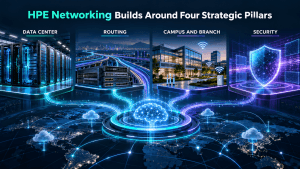
HPE used its Networking Investor and Analyst Day to make the case that networking is becoming one of the company’s most important engines for growth, profitability and strategic differentiation. The event provided an update on the integration of Juniper Networks, outlined an expanding AI infrastructure opportunity and established four strategic pillars for the combined business: data center, routing, campus and branch, and security.
Customer validation of the Self-Driving Network came from ServiceNow while Vultr’s a $1.2 billion AMD Helios order showed how the strategy could translate into business and operational value.
Networking Moves to the Center of HPE’s Strategy
HPE expects Networking revenue to grow in the high-teens to low-20% range in fiscal 2027, with operating margins in the mid-to-high 20% range. Through fiscal 2029, it projects high-teens annual growth. HPE also increased its fiscal 2026 expectation for cumulative Networks for AI orders to more than $3 billion.
Networking is no longer positioned as an adjacent infrastructure category. It is becoming the connective layer across compute, storage, cloud operations and security. The four-pillar structure clarifies where HPE expects that growth to originate.
Data Center Networking Expands from Scale Out to Scale Up
Data center networking is expected to be the fastest-growing pillar, with HPE forecasting annual growth in the 50% range through fiscal 2029. The company divides the AI networking opportunity into scale-up connectivity within a rack, scale-out fabrics connecting racks into clusters, and scale-across infrastructure linking clusters and data centers.
Praveen Jain, who leads HPE’s data center networking business, emphasized the importance of execution as the market changes: “If you are not innovating, I am not executing.” His broader point was that AI infrastructure requires rapid engineering cycles as Ethernet moves into denser, liquid-cooled environments.
The $1.2 billion Vultr order for AMD Helios AI Rack by HPE systems is the most visible proof point. Each rack includes 72 AMD Instinct MI455X GPUs and six HPE Juniper Networking QFX5252 scale-up Ethernet switch trays, alongside AMD processors, NICs and software. HPE combines these technologies with rack-scale engineering, direct liquid cooling, deployment services and lifecycle support.
The contract is a full-system award rather than $1.2 billion of networking revenue, but it demonstrates the synergy created by combining Juniper networking with HPE compute. HPE also plans to sell the networking trays independently.
Routing Becomes Critical to AI Connectivity
Routing is being reshaped by distributed AI infrastructure. Cloud providers, neoclouds and enterprises increasingly need to interconnect AI clusters across facilities and regions while connecting users securely to those resources.
HPE describes these opportunities as the AI on-ramp and scale-across networking. The MX routing portfolio and programmable Trio silicon provide the foundation for high-scale connectivity, multi-tenancy and inline security. The PTX portfolio addresses dense, power-efficient data-center interconnect requirements. HPE argued that control of its silicon enables it to optimize traffic management, interface density and power consumption as AI traffic patterns evolve.
A.E. Natarajan, who leads routing infrastructure, described Trio as “the x86 instruction set for the internet,” highlighting the silicon’s programmability and its role in adapting routing behavior to new AI traffic patterns. Efficient routing can improve GPU utilization, reduce latency and provide predictable access to AI services. HPE must convert its technical position into broader adoption in a competitive market.
Campus and Branch Centers on the Self Driving Network
Campus and branch remains the largest enterprise-facing pillar and the primary showcase for HPE’s self-driving networking vision. The combined portfolio includes wireless LAN, campus switching, SD-WAN and AI-driven operations, with Marvis increasingly serving as a common intelligence layer.
Sujai Hajela summarized the operational philosophy simply: “Up is not the same as good.” A functioning device does not necessarily translate into an acceptable application or user experience, which is why HPE measures service quality at the user level.
HPE does not plan to force Mist and Aruba Central into one platform. Mist retains its cloud-native model, while Aruba Central supports cloud and on-premises deployments. Underneath them, HPE is converging AI models, applications and hardware support.
ServiceNow provided strong validation. After consolidating around Juniper wired, wireless, WAN and Marvis capabilities, it reported approximately a 90% reduction in network-related incidents. Troubleshooting fell from hours to minutes, while annual patching effort declined from roughly 2,000–3,000 hours to fewer than 60. Its goal is a fully autonomous network by 2028.
ServiceNow began with AI-generated visibility and recommendations, validated the results and gradually expanded autonomous actions. For most enterprises, this progression will be more practical than moving directly to hands-off operations.
Security Becomes an Embedded Network Capability
Security is the fourth pillar and an important part of HPE’s competitive strategy. As security vendors add networking capabilities, HPE intends to move in the opposite direction by embedding more security throughout the network.
David Hughes, who leads the security business, said his team’s role extends beyond selling a discrete portfolio to ensuring that HPE has “an architecture that extends security edge to edge,” from wireless access through the data center.
The portfolio includes SD-WAN, SSE, SASE, SRX firewalls, network access control, identity and policy management. Some products will remain standalone, but the broader objective is to integrate security from the access point through the WAN and into the data center.
This approach could reduce gaps created by separate policy engines and telemetry sources. It also strengthens self-driving operations, which require identity, policy and threat context before the network can safely act. HPE expects high-single-digit security growth through fiscal 2029.
The Opportunity Now Depends on Execution
Rami Rahim captured the strategic premise: “The network has never been more critical to how businesses operate, and has never been more critical to how AI gets built, deployed and consumed.” The four pillars provide a clearer framework for customers evaluating the combined portfolio.
Execution will determine whether that breadth becomes an advantage. HPE must integrate software where it improves operations, preserve customer choice without creating confusion, enable partners to sell across the portfolio and convert cost synergies into sustained innovation. Vultr demonstrates the potential of the integrated infrastructure strategy, while ServiceNow illustrates the operational outcome.
For more information on HPE solutions, please go to the HPE website.