Enterprise technology teams have spent years investing in platforms, pipelines, and AI-assisted tooling to accelerate software delivery. The premise has been straightforward: better tools produce better outcomes. Yet delivery cycles remain slow, projects still fail at alarming rates, and engineering capacity continues to be consumed by work that has little to do with innovation. The uncomfortable reality emerging from both research and practitioner conversations is that the constraint is not technical. It is human.
According to data cited in this episode, 65% of organizations report that their engineering teams spend only up to 20% of their time on net new innovation, with another 30% spending only 21 to 40% of their time on genuinely new work. The implication is that the vast majority of engineering capacity is absorbed by everything except the work that creates competitive differentiation. Tooling and technical debt contribute to that drag, but they are not the only cause.
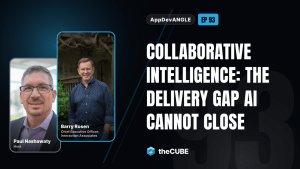
In this episode of AppDevANGLE, I spoke with Barry Rosen, Chief Executive Officer at Interaction Associates, a training and consulting firm focused on building what Rosen calls “collaborative intelligence” inside organizations. Our conversation explored why facilitation has become a critical delivery competency, how the project manager role has been fundamentally redefined by cross-functional complexity and AI adoption, why most project failures are people problems wearing technical disguises, and what it means to distribute collaborative capability across an organization rather than concentrating it in designated facilitators.
Most Project Failures Are People Problems in Technical Disguise
Engineering leaders are practiced at attributing project delays to scope creep, technical debt, integration complexity, and legacy constraints. These are real problems, and they deserve attention. But they also function as a socially acceptable language for a different category of failure that is harder to put on a sprint board.
Rosen was direct on this point. The pattern he observes repeatedly is not a technology breakdown but a communication and alignment breakdown: meetings that end without clear decisions, stakeholders who never genuinely agreed on what done looks like, and team members who nod through a discussion and then diverge in execution. “People weren’t really aligned,” he said. “Weird stuff happens when people get together.”
The challenge deepens in cross-functional and cross-geography environments, where cultural variation, competing organizational priorities, and asynchronous communication all compound the problem. A project manager tracking the schedule may not see that a key stakeholder in another function has a conflicting priority that will surface at the next milestone — not as a declared conflict, but as a slow drag on commitment and delivery.
This distinction matters because the diagnosis drives the remedy. If the problem is technical, the answer is a better tool. If the problem is that two senior stakeholders never actually aligned on requirements, no tool resolves that. The fix requires someone with the skill and positional credibility to surface the disagreement early, facilitate a real conversation, and build a durable agreement rather than a documented assumption.
The Project Manager Role Has Shifted From Schedule Tracker to Collaborative Process Owner
Twenty years ago, the project manager’s primary accountability was clear: track the schedule, manage the budget, escalate blockers. The role was fundamentally administrative. That version of the job is now partially automated, and the remaining work is categorically different.
Rosen frames the project manager as “the manager of a collaborative process, not just the manager of a meeting.” That shift carries significant implications for hiring, training, and team structure. The competencies that made someone effective in the administrative version of the role (e.g., precision, diligence, process discipline) are necessary but no longer sufficient. What is now required is the ability to read stakeholder dynamics, build agreements informally before they are formalized, challenge group thinking, and hold space for difficult conversations without the authority to mandate outcomes.
“The project manager has to be tracking that,” Rosen said, referring to competing priorities across team members, “and taking a look at what the critical decision is at the milestone — who are the key players in that, and scanning the environment for what could potentially go wrong.” This is not schedule management. It is organizational sensing.
The absence of formal authority makes this especially demanding. Project managers typically cannot direct the people they depend on. They must build commitment through influence, which requires emotional intelligence, trust, and a sophisticated understanding of what each stakeholder needs to feel confident moving forward. Organizations that have not updated their expectations or training investments for this version of the role are likely underperforming on delivery not because their tools are wrong, but because their project managers are equipped for a job that no longer exists.
AI Is Accelerating the Demand for Human Judgment, Not Replacing It
The conventional anxiety about AI in knowledge work is that it displaces human roles. In the context of software delivery and project management, the dynamic appears more nuanced: AI is handling the cognitive tasks that were once used to justify human involvement in administration, which exposes the human tasks that AI cannot perform and makes them more visible as the remaining constraint.
AI is genuinely useful for analytics, documentation, scheduling, and information aggregation. What it cannot do is manage the emotional dimensions of organizational decision-making. “What it doesn’t do is manage the more emotional aspects of the situation, like when stakeholders are misaligned, or when the team doesn’t have clear requirements, or the sponsor doesn’t give them the support they need.”
Rosen also raised a near-term scenario that enterprise teams should begin preparing for: AI agents participating in meetings as active parties. As avatar-represented agents join working sessions alongside human participants, the facilitator’s role expands to managing human-to-human and human-to-agent interaction simultaneously. The meeting leader will need to help the group engage productively with the agent’s outputs — questioning them, contextualizing them, and ensuring they do not short-circuit the deliberative process that produces genuine alignment. That is a more sophisticated facilitation challenge than anything project managers have historically been trained for.
Collaborative Intelligence Must Be Distributed, Not Concentrated
One of the more structurally important arguments in this conversation is that collaborative intelligence cannot be adequately served by a small group of designated facilitators. If the capability is concentrated, it becomes a bottleneck. If it is distributed, it becomes a cultural property that scales.
Rosen described what this looks like in practice at Interaction Associates: assessing where organizations are in their developmental maturity, identifying individuals who already demonstrate high collaborative intelligence, and building them into learning leaders who model and teach the capability to others. The competencies involved include self-awareness, active listening, speaking with clarity and impact, building and negotiating agreements, and stakeholder mapping, all of which are learnable. But they have to be deliberately cultivated, not assumed to emerge from experience.
This has a direct bearing on how engineering organizations should think about team composition and career development. As AI handles more of the analytical and administrative layer, the individuals who can navigate ambiguity, align stakeholders, and move decisions forward become disproportionately valuable. “Individuals can become leaders,” Rosen said. “They can step in at different times and move the ball because they have a better understanding of how people work together.”
The implication for enterprise talent strategy is real. Organizations that invest only in technical upskilling while leaving collaborative capability to develop organically will find themselves with technically proficient teams that are organizationally ineffective.
Facilitation Is Becoming a Measurable Delivery Variable, Not a Cultural Nice-to-Have
Perhaps the most important reframe in this conversation is the relationship between facilitation quality and delivery velocity. Rosen made the connection explicit: “Effective meeting facilitation actually reduces the cycle time of decision making.” This is not a claim about culture or employee experience. It is a delivery performance claim.
Decision-making cycle time is a concrete variable that affects every phase of software delivery, from requirements alignment through architecture decisions, vendor selection, deployment sequencing, and incident response. When decisions are delayed because stakeholders are not aligned, or revisited because agreement was assumed rather than built, the cost shows up in the schedule, the budget, and ultimately in the innovation ratio that opened this episode.
The measurement challenge is that facilitation quality and collaborative process effectiveness are not routinely tracked in the same dashboards as deployment frequency or MTTR. That gap makes it easy to underinvest in the human side of delivery while overinvesting in tooling that cannot compensate for it. The more important question becoming visible in enterprise delivery organizations is not which platforms they are running, but whether their teams have the capability to make decisions effectively across organizational, cultural, and functional boundaries.
Analyst Take
The enterprise software industry has a long pattern of treating human and organizational factors as residual — the problems that remain after the real work of technology selection and implementation is done. What this conversation surfaces is that the residual is becoming the primary constraint. As AI tools absorb the administrative workload that once occupied project managers and delivery teams, the distinctly human work is what remains, and it is not getting easier.
The traditional approach to project management training and team capability investment has not kept pace with how delivery actually works today. Cross-functional, cross-geography, AI-augmented teams operating without clear command authority require a different skill profile than the waterfall project environments that shaped most PM methodology. Organizations that continue to evaluate project managers primarily on scheduling and reporting discipline are measuring the wrong things.
The risk is compounding. As AI agents become active participants in organizational decision-making processes, the facilitation challenge grows more complex, not less. Someone has to manage the interaction between humans and agents in a way that preserves the deliberative quality of the decision by questioning outputs, surfacing disagreements, and building real rather than artificial consensus. That is a high-order human capability, and it is currently undersupplied in most enterprise delivery organizations.
The larger shift is that competitive advantage in software delivery is moving from technical infrastructure to organizational operating capability. The teams that deliver faster and more reliably over the next several years will not necessarily be the ones with the best CI/CD pipelines or the most sophisticated AI tooling. They will be the ones whose project managers can read a room, navigate a conflict, and build the kind of genuine alignment that turns a meeting into a decision and a decision into momentum.