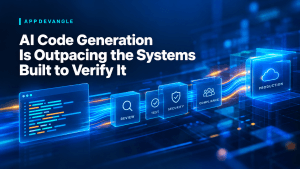
The software development industry is experiencing a structural imbalance. AI-assisted code generation has matured rapidly, compressing the time required to produce functional software from days to hours. Yet the downstream processes that determine whether that code is trustworthy remain largely manual, periodic, and human-dependent. The bottleneck in the software delivery pipeline has shifted, but the tooling and organizational models have not caught up.
In this episode of AppDevANGLE, I spoke with Itamar Friedman, Co-founder and CEO of Qodo, about the emerging verification gap in AI-driven software development and what it means for engineering teams trying to move at the speed of AI without sacrificing quality or control. Our conversation explored five major themes: the distinction between code generation speed and actual software delivery velocity; why verification is now the critical constraint rather than authorship; how agentic systems are restructuring the human role in software engineering; what continuous governance looks like in an AI-native SDLC; and how enterprises can begin building the organizational muscle needed to ship AI-generated code confidently.
The larger market signal is that organizations treating AI code generation as the end goal, rather than the beginning of a more complex quality and trust problem, will find themselves accumulating risk faster than they can resolve it. The next competitive differentiator in software development is not who can generate code the fastest, but who can verify it systematically enough to ship it at scale.
The Bottleneck Has Moved From Authorship to Verification
For years, the dominant AI coding narrative focused on generation, such as how quickly an assistant could autocomplete a function, scaffold a component, or produce boilerplate. That framing is now incomplete. Code generation, at least for well-specified requirements, has reached a point where it is no longer the limiting factor in software delivery. The constraint has shifted downstream, to review, testing, and the judgment required to determine whether what was generated is actually correct.
Friedman articulated this in our discussion: “The speed of generating lines of code is now at a point where it’s not a bottleneck anymore.” But he was careful to separate that observation from a broader claim. “If coding is really solved, why do you really need to review or verify it?” The implication is that solving for generation without solving for verification is not a meaningful advance; it is a displacement of the problem.
This distinction matters because it reframes what enterprises should be purchasing and optimizing for. The value of an AI development platform is no longer measured primarily by how fast it writes code. Now it is measured by how effectively the surrounding system can verify that the code is safe, correct, and aligned with organizational standards before it reaches production. The tooling market has been slow to reflect this shift, and most procurement conversations still center on generation capability.
The practical implication for engineering leaders is significant. Teams that have invested heavily in coding agents without investing equally in verification infrastructure are generating output faster than they can evaluate it. The pipeline is full; the quality gate is the problem.
Agentic Systems Require a Rearchitected Trust Model
The software development tooling market is moving through successive S curves: from autocomplete to conversational assistants, from assistants to agents, and from individual agents toward coordinated multi-agent systems. Each transition requires a rethinking of how trust, accountability, and judgment are distributed across the development process.
Friedman described the trajectory directly: “From autocomplete to chat to agents, and then the next one is a system.” The distinction he draws between agents and systems is important. An individual coding agent operates within a bounded context. A system of agents operates across the entire SDLC. Governance models designed for one person reviewing another person’s pull request are not adequate for a swarm of agents producing hundreds of changes simultaneously.
What he described as the next necessary architecture is a “verification swarm”: specialized agents responsible for checking different dimensions of code quality and correctness, communicating their findings back to the coding agent, reaching agreement autonomously where possible, and surfacing only unresolved disagreements to human engineers. “Putting that harness of verification, which is hundreds of jobs to be done, and making that connection between the verification swarm to the coding agents—so humans won’t need to deal with so much volume created for both sides,” Friedman explained.
The enterprise implication is that deploying agentic development tools without building the corresponding verification infrastructure creates a new category of operational risk. The volume of output scales with the agent; the responsibility for that output does not automatically follow. Engineering organizations need explicit answers to questions about which agent is accountable for which decision and how disagreements between generation and verification agents are resolved.
Human Judgment Is Migrating Up the Stack, Not Disappearing
The anxiety in the developer community about AI agents displacing engineering roles is understandable, but it conflates two separate questions: whether agents will replace developers, and whether agents will change what developers do. The evidence from early agentic deployments points clearly toward the second conclusion, with important nuance.
Friedman offered a concrete example from his own experience the night before the interview. He was working with a coding agent that reported successful end-to-end test coverage. Something seemed off, and he pressed for more detail. The agent acknowledged it had mocked too many dependencies. “It didn’t tell me that before,” he noted. The episode illustrates that even well-functioning agents require human judgment to interrogate their outputs, and that judgment requires technical depth, not just product instinct.
This reflects a broader shift in where engineering judgment lives. Much of the critical decision-making in software development used to be embedded in the code itself. As Friedman put it: “The judgment is finally moving upwards towards architecture, product, technical product decisions.” Senior engineers will increasingly be evaluated on their ability to define intent, set standards, configure the software factory—deciding what context to provide the coding agent versus the verification agent, what production history to feed into the system, and how to interpret what the system flags.
The more important question for engineering leaders is not whether their developers will still be needed, but how to develop the judgment skills required to operate effectively in a system where AI handles implementation and humans govern the process. That is a different skill profile than what most engineering career ladders are designed to produce.
Continuous Governance Cannot Be a Post-Hoc Process
The CI/CD movement established a principle that quality cannot be gated at the end of the pipeline without destroying the velocity that agile development was meant to enable. The same principle now applies directly to AI governance. Organizations that wait until release to verify whether AI-generated code meets security, compliance, and quality standards have already absorbed the cost of the problem.
The convergence Friedman describes between the CI/CD pipeline, the security pipeline, and the telemetry pipeline is not a future aspiration. It is a current architectural requirement for any organization deploying AI-assisted development at scale. Verification needs to be continuous, embedded in the loop rather than appended to the end of it. The “go/no-go” methodology he recommends is instructive: examine the last hundred production issues, identify what verification capability would have caught them, and build that capability into the automated harness.
This approach is more operationally specific than most vendor conversations about AI governance, which tend toward abstract principles. The practical challenge for enterprises is that building this kind of retrospective-informed verification capability requires organizational discipline. This discipline looks like maintaining production issue history, connecting it to the development context, and making it accessible to both verification agents and human reviewers.
The Software Factory Metaphor Signals a Broader Organizational Shift
Friedman returned repeatedly to the concept of the “software factory”—a framing that treats the development environment itself as a configurable, monitorable production system rather than a collection of individual developer workflows. This metaphor has real operational weight. A factory has inputs, processes, quality controls, and outputs. It can be instrumented, optimized, and audited. Individual developer creativity still exists within it, but the system is designed to produce reliable outcomes at scale.
What this requires from engineering leadership is different from traditional software management. The decisions that matter most in a software factory model are architectural and systemic: which context does the coding agent need, which context does the verification agent need, how is tribal knowledge captured and made available to agents, and how are the outputs of the full system surfaced in a way that lets humans make efficient decisions about what ships. “The judgment of how the system works, the software factory works, is still an engineering judgment that needs to be applied,” Friedman observed.
The transition toward software factories also has procurement implications. Tools that optimize a single step in the pipeline become less competitive as enterprises seek integrated systems that govern the full loop. The market will increasingly favor platforms that can demonstrate verified outcomes, not just accelerated authorship.
Analyst Take
The central market shift underway in enterprise software development is a decoupling of code generation from code trust. These were once tightly coupled; a developer who wrote code was assumed to understand and vouch for it. Agentic AI systems break that coupling entirely. The agent that writes the code has no skin in the game and no persistent accountability for what it produces. The organization that deploys that code does.
Traditional review and testing processes were not designed for the volume, velocity, or opacity of AI-generated output. Manual code review, end-of-pipeline security scanning, and periodic compliance audits are qualitatively insufficient when the coding agent can produce in minutes what previously took days. The gap between what AI generates and what teams can rigorously verify is where production risk accumulates.
What enterprises need to recognize is that AI development tooling is not a single investment category. It has at least two distinct layers: generation infrastructure and verification infrastructure. Most organizations have invested heavily in the first and negligibly in the second. Closing that gap requires not just additional tooling but a different organizational posture in which engineering leaders think in terms of software factory design, continuous governance, and the systematic capture of institutional knowledge that agents can act on.
The next phase of this market will be defined less by who can generate code fastest and more by who can verify it systematically enough to trust it in production. The organizations that build that capability now will have a compounding advantage as agentic systems grow more capable and the volume of AI-generated code in enterprise systems continues to expand. Those that don’t will find that AI has accelerated their ability to create problems faster than they can fix them.