
The AI buildout is making an enormous bet on what businesses will eventually be willing to pay for intelligence. In our research this summer on forecasting the AI bubble, we argued that a key indicator to watch is productive utilization by enterprise customers. Specifically, we said at the time, if infrastructure supply catches up before productive monetization materializes, the risk of a bubble popping increases to what we felt were dangerous levels. And we forecast that the supply constraints and healthy capital funding appetites at that time could provide conditions for a soft landing. And we pegged 2029 as the highest-risk year.
And that brings us to the next obvious question: What has to happen inside mainstream enterprises for their AI investments to become economically self-funding? Michael Burry’s analysis of Anthropic highlights the scale and interconnectedness of the commitments that Anthropic is making. Apollo’s research by Torsten Slok raises questions about how broadly the financial benefits are showing up today. And the history of the PC and internet eras reminds us that productivity gains aren’t always immediate, and that powerful technologies can coexist with what initially seem to be poor investment returns that take time to appear.
We think the path to a soft landing runs through changes in how businesses operate, specifically the work that they do, the people that they need, how they scale, and the value that their customers are ultimately going to pay for. Welcome to Breaking Analysis, episode number 332. Can enterprise AI pay for the boom?
Joining us today is Crawford Del Prete. He’s the former president of IDC and now senior advisor at PSG Equity. And for decades, Crawford has had a front-row seat on technology transitions, and he brings current perspectives on how software businesses are adapting to AI, how new AI-native companies are forming, and what the emerging operating model looks like. Crawford, welcome. Good to see you.
Crawford Del Prete: Hey, great to see you, Dave.
Where AI is changing economics
Dave Vellante: As of this recording, the Nasdaq is down almost 1,000 points, so it’s getting worse by the minute. It’s not quite at 1,000, it’s only down 937. There are a lot of reasons there. Of course, we had earnings last night from the big hyperscalers which were not well received.
Google’s disappointment in advertising and, AWS’s CapEx spend and negative cash flow were the culprits but the hyperscalers are cranking in cloud. Anyway, let’s start with what you’re seeing, specifically in the market, but also inside businesses. Where is AI changing economics from your point of view?
Crawford Del Prete: Well, AI is changing economics in so many different areas, right? So we’re starting to see the early signs of productivity gains, but we’re not yet seeing them in the numbers. And what I’m seeing is that companies are starting to automate workflows. They’re starting to use AI in different ways. And those ways are ways that you would expect initially, right? So we saw a big move toward coding. We saw a big move toward customer service. But now we’re starting to get into a lot of the other areas where individual tasks are starting to get automated within organizations.
And as that happens, it becomes very uneven in terms of how we’re starting to see the impact of AI in organizations on an everyday basis. Again, jobs are made up of hundreds, sometimes thousands of tasks. And now we’re starting to automate those tasks, but we haven’t necessarily changed the way work is wired in an organization. And so I think that makes for some of the inconsistencies that I think we’ll talk about in a minute in terms of the productivity numbers that we’re seeing.
Funding the AI buildout
Dave Vellante: Thank you for that. You and I cut our teeth during the PC era. And of course, we learned Moore’s Law was everything. We learned about the rapidly declining prices. Tech was always deflationary. Now tech is inflationary. Remember, you and I used to follow the disk drive markets, and customers would want to lock in. They’d want to have a forward pricing contract.
Crawford Del Prete: Yes.
Dave Vellante: Historic declines followed a curve according to Moore’s Law. Today you want to lock in current prices because they’re going up. So you’re seeing all kinds of crazy dislocations. The Anthropic S-1 came out this week, and there were definitely some positive numbers in the document. Everybody, of course, talks about the revenue growth. We’ve never seen anything like it before: 14x in the first half of 2026 to $16 billion. But what really stood out to me, Crawford, was the balance sheet. The company says they’ve got $132 billion in liquid assets, so cash and equivalents. And there are only two non-banks in the U.S.—and this has been reported—that have more cash than Anthropic. That’s, of course, Alphabet and Berkshire.
And remember, they’ve raised about $140 billion. So let that sink in for the audience a bit. It basically has burned $10 billion to get to a $32 billion revenue run rate. But the big question, of course, is around the economic return on that capacity that’s being committed.
Michael Burry, who writes Cassandra Unchained—his work, by the way, is unparalleled. His ideas are often poo-pooed. He got sort of slammed for the whole GPU lifecycle, and people dismiss him, but his research is deep and unique. And this diagram shows the interconnected financing and commercial relationships around Anthropic. He pulled this all together from the S-1, and you see it’s $537 billion of multiyear compute commitments across all kinds of different arrangements. You’ve got take-or-pay deals, minimum purchase agreements, lease deals, capacity that’s conditioned upon delivery, stuff like that. Of course, this isn’t current debt, but it’s stuff that they’ve committed to.
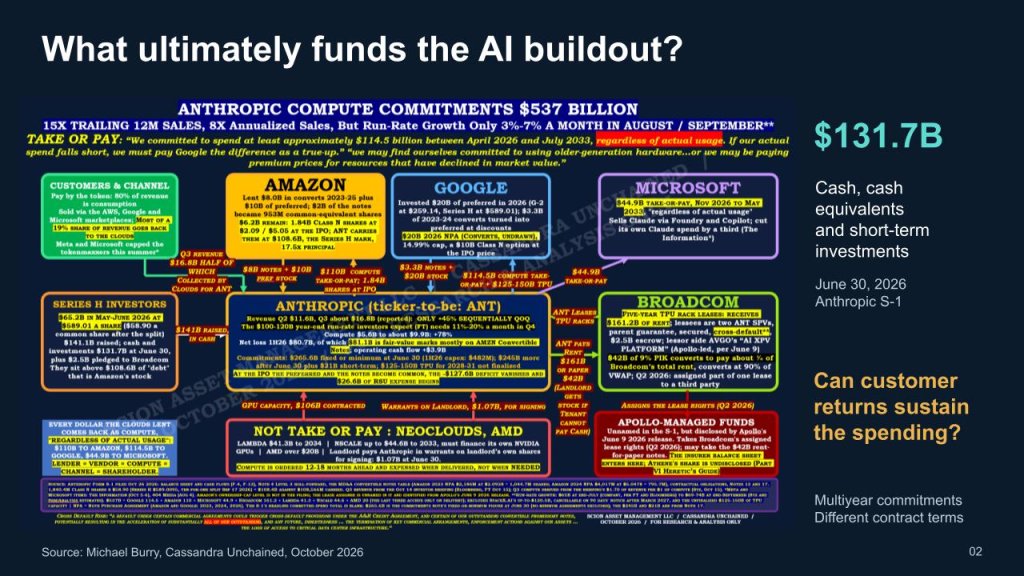
So Crawford, I’ve got a bunch of questions for you. Just answer them all, or whatever you have best visibility on. First of all, you’ve got capital providers and infrastructure suppliers and model companies. They’re all sort of interconnected. So how much of a concern is that? Are your portfolio companies spending more? Is it because AI is showing better return, or is it because they have FOMO and they’ve gotta remain competitive? And of course, your new startups are going like a rocket ship and growing with less labor, and they potentially show us the way to the future. What are your thoughts on all that?
Crawford Del Prete: So look, Dave, you and I have been around this industry forever, and we’ve never been at a point where you’ve got an interconnected industry that is built on yesterday’s architecture because a new architecture that came along had to be redefined. And so once it was redefined, it had to be built. And so you’ve connected the world, and now you’ve said, well, the stack that you had was the wrong stack. So we’re going to have to build a new stack, and that new stack is going to create applications and usage that will immediately be at 100% capacity.
So this circular financing is, in my opinion, a way to basically rebuild the stack around the world all at the same time. And so you ask the question: What are we seeing in terms of demand from end-user customers? And I would tell you, it’s an unsatisfying answer, but it depends on the customer, right?
So I talked to one customer this week that said to me, “I cannot get my hands on enough compute capacity.” And I pushed back and said, “Wait a minute.” “No, no, no, you don’t understand. All the capacity that I could buy from a Lenovo, all the capacity I could buy from an HPE, from a Dell—I’ll take it all.” And so they’re willing to get as much as an OEM is willing to give them. And these are obviously very, very quantitative-oriented customers. But again, the demand in a lot of these places is truly insatiable.
Other customers are starting to look at token spend. And what I’m seeing in those customers—and this will ring very, very true to things that you and I developed 25 years ago—they’re looking at workloads, and they’re starting to look at AI workloads, and they’re starting to teach people to say, “Hey, you know what? That Opus 4.8 model, not a very bad model. Probably don’t need to use the 5.0 on the extra effort and peel through six times as many tokens.” So they’re starting to agitate models for specific workloads.
And so we’re kind of at the beginning of that journey with customers, but I’ll tell you, this is going to look just like you and I looked at the server market back 20 years ago, where eventually you’re going to have different models for different workloads, and that’s going to include open-source and open-weight models that are inside of a data center or inside of a cloud. But the reality is, it’s all over the map. But I will tell you that I’m not seeing tons of customers saying, “I’ve got to pull back,” because it’s about competitiveness. I’ve got to be competitive, and I’ve got to give my team members the tools to achieve things they never could achieve before with AI.
Dave Vellante: We did slice the workload salami pretty thin at IDC, didn’t we? And to your point about this whole new architecture you’re seeing at Intel today, Intel’s down 30% today.
Crawford Del Prete: Yes.
Dave Vellante: Basically, general-purpose x86 is kind of being absorbed into accelerated computing. I guess PCs are obviously what folks missed. I don’t know how they missed it, but Intel doesn’t really have a strong position in GPUs. And AMD is eating away at its market share in PCs. And so that’s a real conundrum. In your quant example, that customer’s monetizing, right? That’s why they want as much compute as possible, right?
Crawford Del Prete: That customer is monetizing all day long and is saying, “Look, I can innovate by giving my users more capacity, and they can do things they never could do before. They can create analysis. They can create deliverables that they never were able to create before.” And so I would say that those kinds of customers exist, and they exist at scale. And I feel like there is not this big dichotomy between customers in terms of who’s willing to spend and who’s not willing to spend. Everybody’s willing to spend. It really just comes down to the amount of resources that they have.
Now, you asked the second question, which is: Are companies spending more because AI is improving their economics, or because they have to do it to remain competitive? And I will tell you that whether it’s a portfolio company or it’s not, there is no software company today that is not investing for AI. They have to. They’ve got to do it to increase their product set to be competitive, because there are many, many competitive factors that never existed before. And these are all things that I’m looking at every single day.
There’s a whole discussion around: Can an adjacent, large, at-scale platform, by using AI, absorb your area, the area you’re innovating in? And then separately, there’s the omnipresent question of—and we can talk about this for a while—can customers vibe code? And can they create a software product as opposed to licensing it or using it? So everybody is investing. And if you’re not investing in AI—there are a few companies in that category, but very, very few—then you’re probably writing your own death sentence.
Dave Vellante: Right. And you, as a capital allocator, aren’t that interested in investing in a company that’s not investing in AI.
Crawford Del Prete: Exactly.
From individual productivity to business results
Dave Vellante: Okay, so we’re going to try to square this circle, because we see these relationships that Anthropic and others have struck, how they’re funding the buildout. But our premise today is that the viability of those ultimately is going to depend on what value end customers can create from that capacity. Crawford just laid out that they can’t get enough compute, so that’s somewhat of a blocker. I would throw in governance, with all the surveys that we do around governance. People are afraid of AI. They’re worried about security.
Now, last weekend, Apollo Chief Economist Torsten Slok put forth his view of how far those benefits, the AI benefits, have spread. So he compared inflation-adjusted revenue per employee at the Mag Seven, which is that top line that’s going up, with the other 493 companies in the S&P 500. And you can see that top line pulling away. It was showing increases from around $600,000 per employee, which is pretty good, in 2023 to about $800,000 today. And then that broader group is kind of flattish. And his point is that AI hasn’t, at least, shown up broadly.
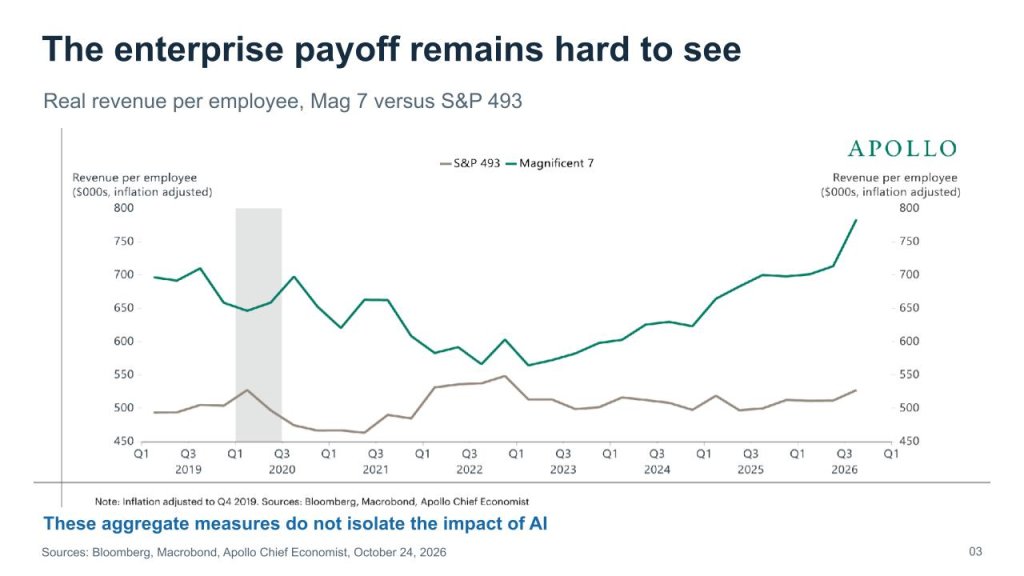
He also went on in the piece to point to the lack of productivity gains and highlighted the circular financing concerns. We’re going to talk about the J-curve in a moment, but I know you read that Apollo post.
Crawford Del Prete: Right.
Dave Vellante: How does it fit with what you were saying earlier inside of businesses? Are the gains kind of narrowly confined? You mentioned the quant company. You mentioned broadly everybody has FOMO.
Crawford Del Prete: Yes.
Dave Vellante: But the second part of that question is that we’re all clearly seeing it as personal productivity, individual tasks. But how do you see that bubbling up to firm-wide benefits, and even at the macro level?
Crawford Del Prete: Okay. So you’re seeing multiple moves inside of a business, right? And some of these companies, their business is incredibly AI-native. And so if you’re a coding business, you can immediately take advantage of AI and be able to achieve things you never could achieve before. Talking about security, security is just blowing up right now as a category, as we see these frontier models being applied to so much of the code that resided in the world.
What was the motivation to really deal with your technical debt in the past, to refactor your code? And now, all of a sudden, there are these tools to be able to refactor your code, make it secure. And of course, we’re seeing vulnerabilities being brought out by the more advanced frontier models every single day. So there are some very clear use cases that start to show up.
I would say that when you start looking at more general businesses, it’s really the streamlining of tasks. And I’m not sure I would characterize those as narrowly defined. I think they’re everywhere, and they ultimately will lead to higher levels of output, but they’re really hard to measure. And the reason that they’re hard to measure, I like to say, is that a lot of the things people are doing lived in the land of good intentions. It’s the business plan that never got written. It’s the scenario planning that never got done. It’s the rethinking of the deck that you wanted to create that never got built before.
And these things are really, really hard to quantify today until we start rethinking the way business gets wired and the way business gets created. There are some companies that have been able to deploy in specific use cases. But generally, it’s individual tasks that are getting automated. And as those tasks get automated, people get more capacity.
And so I think what we’re going to start to see is that people get significantly more capacity. And therefore you don’t have to bring as many people on, and your profitability grows, and your expectations for the units of work that a person can deliver continue to go up until we start rethinking the way the organization works. But that’s kind of how I’m seeing it laying out, given the companies I talk to.
Dave Vellante: So Crawford, one of the concerns I always had about RPA is I called it paving the cow path. It was basically taking an existing process and automating it based on what the human was doing. I’m inferring that you’re saying there’s actually good work going on in terms of rethinking the workflows and the processes. Although maybe I’ve put words in your mouth, it seems like those are the ones that are going to show success. If you’re paving the cow path, you’re not going to get—it’s like lifting and shifting in cloud. Okay, that’s nice. You might save a couple of points on labor costs, but you’re not going to change the operating model. Is that a fair assessment of what you’re seeing?
Crawford Del Prete: So let me try to frame it this way. What I’m seeing is that RPA was hard because you had to pave that path. You had to codify—you had to write down the actual steps, and then you had to put those steps into code, and then you built it. In this case, it’s from the bottom. It’s all these specific pain points that employees are facing, and then figuring out a better way to do it using natural language, and then teaching people how to turn those into projects, how to turn those into skills, how to turn those into things that can be replicated in the organization.
And that’s why, in the leading-edge organizations, step one is doing this organically. It’s going out and talking to your employees and driving AI hackathons that aren’t really hackathons, but they’re: How did you get around this problem that people have had in this organization for many, many years, and then start thinking about doing things in a different way? And then, once they can develop that as a project or as a skill, codifying that and putting that in the organization so they can share it across the organization. So think of it as an incredibly flexible, adaptable, and usable RPA that never existed before. And to me, that’s the difference.
Dave Vellante: Right. Okay. And so the point is that AI can make an employee more productive. They can do things faster. But when and how it shows up in the income statement is a different story.
Crawford Del Prete: Yes but once it kicks in that can be shared rapidly across the organization.
The productivity J curve
Dave Vellante: Right. But it’s not necessarily going to show up in the firm’s overall cost structure or income statement and growth rate right away. So the next point that we want to explore is what specifically needs to happen to translate those task-level gains into more obvious results in the income statement. We’re going to talk about the productivity J-curve because it gives us a possible explanation for that.
The delay that we just talked about—we haven’t seen it necessarily at the macro level. Businesses are investing in these process improvements, as Crawford just laid out. That means new tools, skills, getting data together. Crawford, I want you to tell your story in a moment about what happens when Claude goes down. But it takes time to harvest the full benefits of general-purpose technologies like this. And some of those investments, as Crawford just pointed out, are intangible.
The original work by Brynjolfsson, Rock and Syverson focused on how these intangible investments affect productivity and how you can measure that. And the curve we’re showing here, in case you’re listening and not watching, is a conceptual adaptation. But it makes the point that individual productivity gains can actually coincide with negative cumulative cash flow.
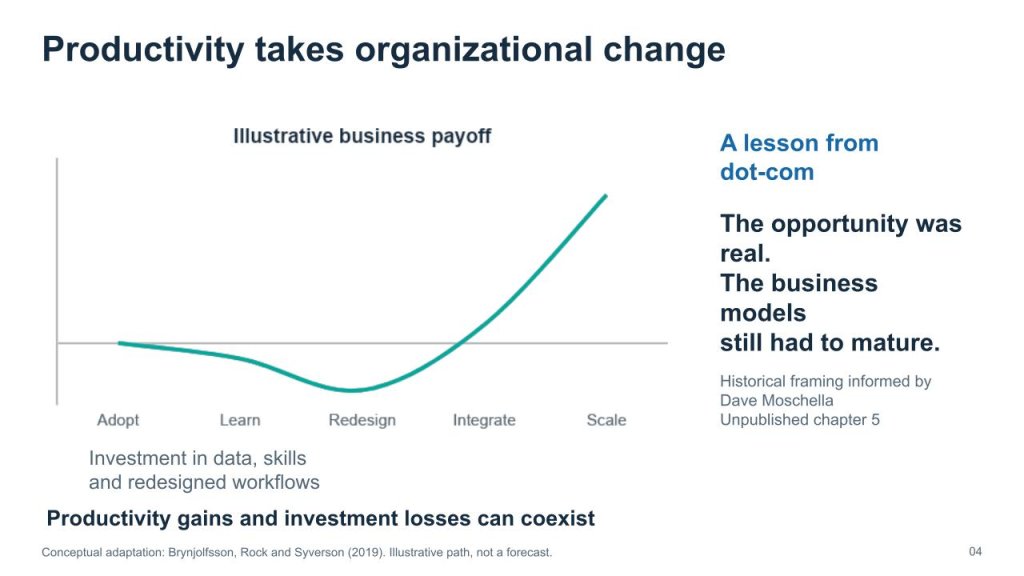
So the curve goes negative as we go from the adoption phase, and it goes down as we’re learning and then we’re redesigning. Then it starts to go positive as you integrate throughout the organization, and then there’s a really steep trajectory. That’s the whole point of the J-curve: when you start to scale, you hit breakeven, and then that flywheel kicks in. But, Crawford, we both watched the PC era and how that unfolded. We can talk about that. We’re seeing productivity everywhere except in the numbers.
Crawford Del Prete: Right.
Dave Vellante: The dot-com bust was another instructive example. Gains didn’t become visible until later on, when we got rid of dial-up and we got broadband and Web 2.0. You saw this top-down mandate, which was, “Thou shalt do AI.” So people said, “Okay, cool, let’s go get Claude or Codex or whatever.” And they started with this bottom-up approach. But I want you to tell your story about Claude and then what you’re seeing there on top-down, bottom-up.
Crawford Del Prete: We can start there, but I would just say that these productivity numbers are going to take a long time. Based on the history I’ve seen, it really wasn’t until 13 or 14 years after the PC was introduced that we started seeing productivity gains growing. And that was really that period, to your point, of connectivity between ’96 and 2000, 2002. So those gains, I think, are absolutely going to come.
The anecdote that I shared with you previously—let me just give you the backdrop—is that back in the dot-com days, we laid all that dark fiber, and the fiber stayed dark for a long, long time. We ended up with this massive overcapacity. I think what’s so unique, going back to my example of replacing the tech stack, is that every GPU that gets put out today is lit up and at 100% capacity as soon as it comes online.
What I see is that even though you may not have those anecdotes—the other day, again, we’re working in a private equity firm. You have a number of associates and people who are working every day with quantitative numbers. I’m working away in my office, and Claude goes down. Claude all of a sudden sends a strange message saying, “You’re out of credits.” And I knew we weren’t out of credits. So I go out to look in the office next to me and say, “Hey, are you seeing the same thing?”
And what do I see? I see this large group of cubes, and all the associates have stood up. They’re all talking to each other, and they’re all saying, “Is it down for you? Is it down for you? Is it down for you?” It’s because they are living in these applications every day. They’ve taken on such a significant amount of productivity, and we’re just beginning to be able to measure those levels of productivity, I think. But I’ve never seen a technology that the world is leaning into so rapidly.
What I worry about is the organizations that did exactly what you just mentioned a few moments ago: “I gave people Claude, or I gave people Copilot.” Then they’re going to get frustrated when they don’t see an institutional change in the way people work, and they don’t share those experiences across the organization.
Let’s wind all the way back to before the PC era, Dave. You and I worked together in the mid-’80s. I can remember—you and I worked at a content company, at a research company. We would write our reports longhand, then we would stand in line to type them into a Wang terminal, right? Which is how the reports got into the publishing system. My job before that, I worked on Wall Street in commercial lending. We would stand in line to use the spreadsheet on the one IBM PC that was in our department.
Nobody else was allowed to have a PC, but we all knew we needed that damn spreadsheet. So we would do it on graph paper, and then we would put it into a spreadsheet. And I can remember vividly, vividly working with you, going to the printer and taking a stack of paper and writing my slides out longhand. Then going and getting some time on a shared PC to create my slides, or having the production department create the slides.
These are all examples of before the company rewired itself and those layers collapsed. This is how work got done in a really inefficient way with an efficient tool. And I think we’re in exactly the same spot with AI today.
Dave Vellante: And that’s a great point. We had the same thing at IDC. It might have been as you were standing in line at your previous company, I was standing in line for the one IBM PC that was at the end of the hallway. Then finally we got all these PCs, but that was a capital expense. That meant you start the clock on cash flow. And then we all had to go get Lotus 1-2-3 training: slash, file, retrieve. We went to Newton Center, and we had to go several times.
That was another investment. Pat McGovern was investing in our people through training. And then, just like the point on the J-curve, it crossed over, and that’s when we killed Dataquest. So history offers these lessons about patience and discipline and individual productivity. These improvements can coexist when an investment is resetting, which is really the point that Crawford just so eloquently made.
Crawford Del Prete: Yes, and that reset takes a long time. I think people are going to get really frustrated. Are we going to ebb and flow in terms of demand? We are. But I’ve never seen demand for a technology come on this quickly. So, to me, that’s heartening in terms of adoption. How many conversations did we all have around the turn of the century—not Y2K, but around the year 2000—around, “Oh, I have the internet, but what do I really do with it? Where’s the productivity with the internet?”
I don’t think that question of how AI can help me, if you’re awake and you’re working in a white-collar job, is really asked a lot right now. Sure, there are some people who aren’t necessarily working with it, but I’ll get to those people in a moment. Today, I think the vast majority of people do understand at a base level how to use AI. And the ones that are at the cutting edge are like two miles ahead of everybody else in terms of what can be accomplished.
Now, I would argue that we are at a moment where, as we saw with Claude Code, it was hard to use and kind of not intuitive. But now, with Meta Muse, we’re starting to see a world where we can start to get a lot of people using AI for horizontal, consumery kinds of jobs that they want to get done. And I think that, as we look back, the emergence of those kinds of tools will likely be an inflection point for adoption into more SMBs and into the lives of people.
Security and accountability
Dave Vellante: And again, the market’s freaking out today because, hey, we’re spending all this money. The hyperscalers are negative cash flow, some of them anyway, and we’re not seeing the benefits. But as you pointed out, it takes some time. Dave Moschella, another colleague of ours from the IDC days, is writing another book. It’s basically a history of tech, and he gave me an advance copy to review. It’s typical Moschella: awesome.
He points out in that book how the dot-com bubble was different than previous bubbles. Of course, folks like Michael Burry say, “Oh, this time it’s different,” and they kind of make fun of that. But he points out, if you look at the tulip craze or Japan’s real estate bubble and then compare that with the internet, yes, they were all overhyped. But the internet was different, and it exceeded most expectations. The internet was not tulips, and it just needed time to move beyond dial-up. It had to get broadband into the last mile.
We thought PCs were going to be the way. When we first saw the Netscape browser, “Oh, it’s the PC. That’s how we’re going to get to the internet.” Well, guess what? It wasn’t until smartphones came out. And then we had to get beyond just going to a website. Web 2.0 was kind of the read-write web, if you will. He also pointed out how pay-per-click advertising made online spending much more measurable and actionable.
So the point is that change takes time. We’re talking about reforming workflows, developing new software. The infrastructure’s getting put in place, and today nobody really trusts agents to take critical actions without a human in the loop. Crawford, Sam Altman this week at Oracle OpenWorld basically advised enterprise customers—these are Oracle’s biggest customers—”Don’t even worry about productivity now. You should focus on plugging the security holes.” So that’s a great example of negative cash flow in the early days of a cycle. Your thoughts?
Crawford Del Prete: So look, I talked about it earlier. Security is going to be completely rethought. We have created so much code. There’s so much technical debt out there, and people do need to focus on plugging their security holes. That is ultimately going to be very, very valuable in the future. But you’re right: that’s another example of how the world is changing pretty dramatically.
At the same time, what’s different about this AI cycle is the number of people who can participate and how an organization can take advantage of technology in new ways. I think, Dave, this is really what’s different: in this AI moment, the technology’s not the hard part, right? The technology is actually the easy part, and it’s going to get easier and easier and easier.
The companies I’m talking to every day are trying to balance: how do I build a next-generation company that can automate significant amounts of workflow but can keep a human in the loop? Because that accountability is going to be super, super important. So this is how I’ve been thinking about software. As software continues to evolve, it has these three layers: an execution layer, a judgment layer, and an accountability layer.
That execution layer is the computational work that is done. You put the name into Salesforce, and it goes into the database, and you’ve got the stuff that happens on the call, for example, in the CRM. The judgment layer is really what a lot of agentic companies, or AI companies, are focused on right now: how do I create insights from that software in an automated way? You can create insights all day long. People can look at them, whether they make sense or not. People can help with that.
But frankly, the execution layer has been absorbed by AI. The judgment layer is being absorbed by AI. The accountability layer is where the companies are really focusing today. Who takes the call at 2 o’clock in the morning? Who’s on the hook for the compliance data? Who is responsible for this? As AI collapses each of these layers going forward, the smart companies are thinking about how to build next-generation software that’s going to be able to navigate that execution and that judgment layer as efficiently as possible and allow humans to do more, to be accountable for more decisions than ever before.
You and I have talked a lot in our history about systems of record and systems of action. What I’m seeing is that the companies that are doing a great job today are the companies whose software is developing data from customers. That is not only creating a system of record or a system of action, but it’s embedded in the most difficult parts of their workflow. And that kind of data is incredibly valuable.
Companies are focused on deploying AI to take that pain out of the workflow so that customers can focus on that accountability layer, can focus on being accountable—sorry, so that the software companies that are developing this data can provide that accountability, and people can provide that accountability going forward. And that’s going to be super, super important in this next generation of AI.
Dave Vellante: That’s a great point because ultimately, at the end of the day, the customer is responsible for their own sovereignty, absorbing the risks, putting in compensating controls for that risk. I’m reminded of the shared responsibility model in the cloud. There’s a new, what I’d call, shared accountability model. But to your point, the software vendor is responsible for the product working the way it’s advertised. That’s a lot of the flak that the frontier model vendors are getting now. Security vendors have to make sure it works as promised. Ultimately, the customer has to take accountability.
Crawford Del Prete: With the customer, and sometimes in partnership with that. Absolutely.
What enterprise buyers are telling us – Qualitate field work underscores the blockers
Dave Vellante: That’s why I say that I think there’s a new shared accountability model. The shared responsibility model was not well understood when the cloud started its ascendancy, and Amazon had to do some real educating of its customers. I think something similar is going to have to happen here, and it’s a lot more complicated.
I want to bring in some of the data from Qualitate, from one of the proprietary surveys we did with them. We did a field study ahead of CoreWeave Fully Connected, and it showed four useful buyer situations that we’re showing here. A healthcare and biotech customer—this was positive—moved from just pure burst training into permanent inference. They said cost was really good. It was really efficient. They got good performance and some early monetization. So that was the one positive. There were other examples, but I wanted to focus on some of the challenges.
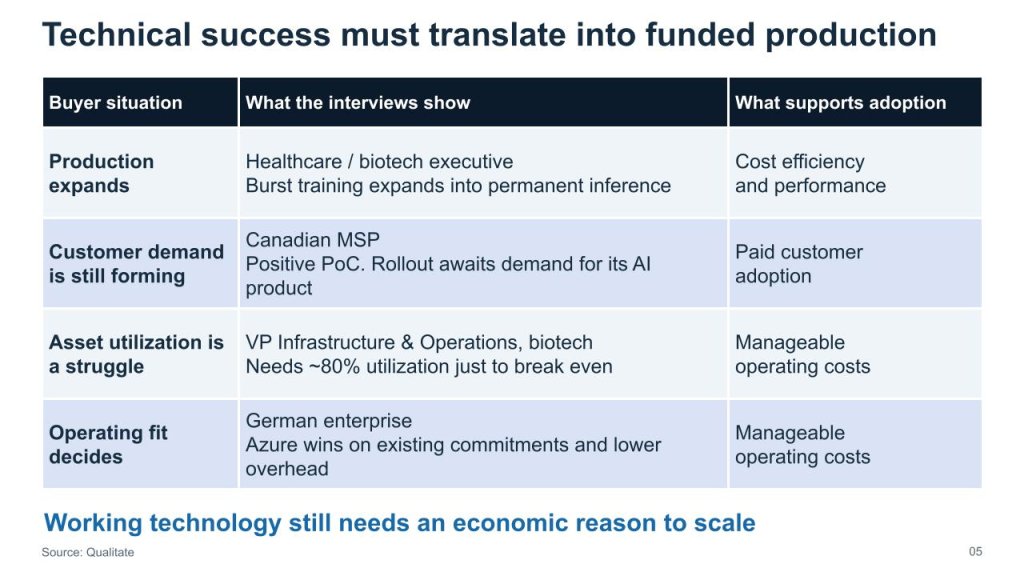
A Canadian managed service provider did a great technical POC. To your point, technology was pretty straightforward, but they weren’t ready to scale because they had to validate demand for their customer-facing AI product. They weren’t sure they could make money, so they’re being cautious. They wanted to make sure they had product-market fit.
Then several customers that we talked to wanted to bring AI on-prem for sovereignty and latency, to own their own tech stack, and to have financial controls. But this VP of infrastructure and ops said they needed 80% GPU utilization just to break even. To your point, the neoclouds and the hyperscalers are good at getting high utilization. Most enterprises can’t get there today. So the business case doesn’t pencil out, and they’re paying premiums to cloud companies.
The last example is a German enterprise that said CoreWeave had great technical advantages, but they stayed with Azure because a second cloud would have added operating overhead. Rather than take that on, they went the path of least resistance, stayed with Azure, and tapped their existing relationship and the credits they had. The point is that these concrete customer examples underscore the distance between getting a technology to work and then making money from that deployment.
Crawford Del Prete: Right.
Dave Vellante: So, Crawford, are these situations common from what you’re seeing? You pointed out before that technology is not the problem. What’s the way to the future?
Crawford Del Prete: And by the way, great research. These are very, very common problems that we continue to see. I think this is where customers are going to be working with cloud providers going forward. They’re going to be working with hyperscalers going forward. People think about it as a binary world where, “Oh, I’m going to have my data on-prem in a data center, and I’m going to have to have very, very high utilization to break even,” to the point you just made. Or, “I’m going to be in the cloud.”
I think what people aren’t thinking about enough is the hybrid permutations that can happen there. For example, what if I get an open-weight or an open-source model from a cloud provider where that utilization can be shared, and I can start to see my utilization go higher going forward? So I think you’re going to see a lot of experimentation. You’re also going to see other compute alternatives start to come onto the market. That’s going to represent incremental capacity, and that’s going to impact pricing as well.
You’re also going to see more efficient AI software going forward. We haven’t talked much about this, but I think we’ll get to it a little bit later. What we’re seeing out of some of the most progressive AI software companies is that they’re not thinking about human interface any longer. They’re thinking about MCP. They’re thinking, “I want to build software for agents to be able to manage.” That brings tremendous efficiency to the overall discussion. That can impact your token costs, get your token costs down, and get your utilization better.
I think this gets to that point: I’ve never seen a technology move so fast. Things build on each other in a six-month period, and then you get different solutions that come to bear. So those are real challenges that people are facing today, but they are surmountable. And I’m seeing the trial and error happening to be able to get over or around some of those problems.
Redesigning software companies and pricing
Dave Vellante: Awesome. Thanks for that. I want to tap your operating experience because you ran a fairly large company at IDC, and now you’re sitting on boards. So let’s explore how software companies redesign the business so the economics can keep pace. We’ve talked about the SaaSpocalypse endlessly. Established software companies have a lot of customers. They have deterministic workflows. They’ve got revenue to protect while they’re introducing these AI extensions into their product. They’re AI-fying it.
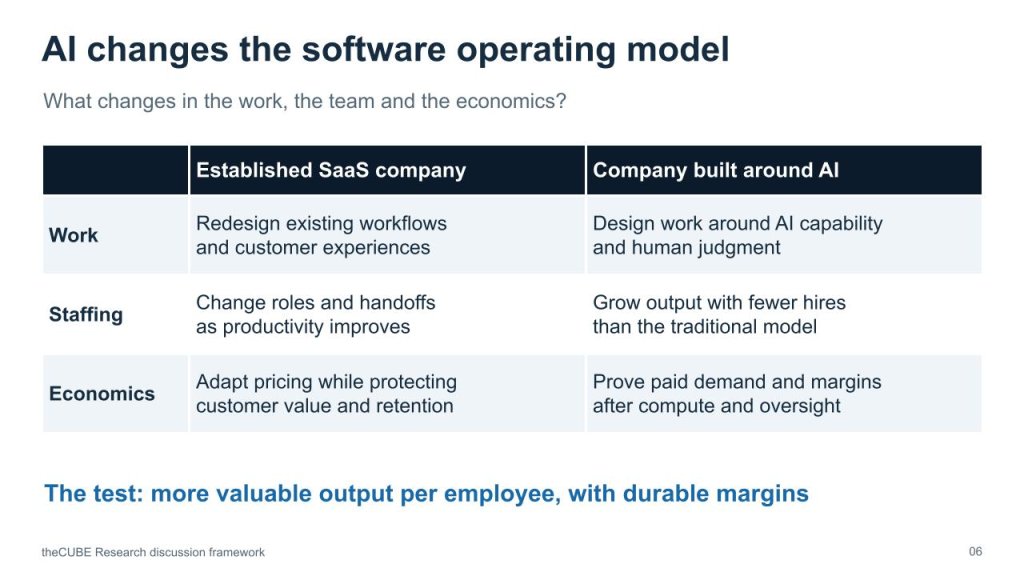
Then you’ve got AI-native companies that are building operating models that are modern. They’re agile. They’re designing their architecture and their labor and their pricing around AI from the start. So these create different opportunities and different constraints. Crawford, another sort of multipart question: When you help an established SaaS company become an AI business, how do you think about that? Where do you start? What does an AI-native startup look like?
And the hardest question is, no matter how you price software, you’re going to get it wrong. But if AI reduces the labor that’s required to write code and deliver software or a service, who captures that value? Is the vendor just going to get better margins? Competition comes in. The customer benefits. We talked earlier off camera about outcome pricing. How do you see all this?
Crawford Del Prete: Let’s unpack it a little bit. It starts at the top, right? When you’re talking about a historically SaaS-based company moving to becoming an AI company, if the ELT and the CEO are not bought into AI, if it’s just, ‘I’m going to give Copilot to a few people,’ it’s over. You’ve got to have buy-in from the very top. It sounds trite. It sounds easy, but it’s super, super important in terms of a transformation.
Probably one of the biggest areas that we see as companies start transforming is that roles are starting to blend. So you used to have a head of product, and then you had product management, and then you had product engineering. We’re seeing those roles all kind of blend together. Product management is probably the area where I’m seeing the biggest redefinition. It’s actually merging with product engineering, and you don’t necessarily need that handoff anymore.
You can start to see massive amounts of scale within how you engineer the product and then how you get that product out to market. You’re seeing technical product managers being able to use AI to kind of blend those roles together. I think that’s probably, in the early days here, one of the biggest changes I’ve seen in companies, whether they be AI-native companies or SaaS companies: those roles are all kind of getting slammed together.
Obviously, we saw the move to product-led growth under SaaS, and I think we’re seeing that even more so in AI, where you want to give the product a try, you want to be able to download the product, you want to be able to use the product. That’s also a big change. Another really big change is not only in the selling model, but how they think about bringing a product to market.
I’m seeing a lot of these small regional resellers becoming way, way more capable and able to use AI to become more efficient in their selling skills. What I’m also seeing is that a lot of the very large distributors are super interested in bringing on software assets into their marketplaces because they can make higher margins on them. So we’re seeing that the channels to market for AI companies are much more plentiful than we ever saw in the past. I would say those are some of the changes that I’ve seen in the marketplace.
Now, when you start thinking about how you price the product and how you bring that product to market from a pricing standpoint, I think the biggest change associated with AI, whether this is an established company or a company coming out, is that we’re seeing a lot of interest in usage-based pricing. I think the biggest thing for a non-SaaS company who’s bringing in AI, and this is the biggest challenge I see multiple times, is: How do I discretely monetize AI? How can I look and say, ‘I made these investments in AI, and I’m getting customers to pay more as a function of it’?
Because in so many cases, I see this: you don’t sell AI separately. You sell AI embedded into the core product that you have, and then you get customers to buy in. So what I’m starting to see is, you see it in cross-sell, upsell. You see it in price increases. And then you ultimately start to bring out incremental features that you can charge extra for that are AI-only going forward. You’ve got to start moving away from seat-based. You’ve got to start moving to usage-based, which is what I’m seeing most companies doing.
Now, the problem with the outcome-based stuff—and outcome-based comes up a lot—is that it becomes very episodic. It becomes exactly what you mentioned, which is it’s associated with a project. And when it’s associated with a project, then you don’t get that stickiness. Maybe, if you’re good, you get reoccurring revenue, but you don’t get recurring revenue. You don’t get that subscription revenue, and that’s a problem for these companies. Obviously, for the same reason that they moved to SaaS, they don’t want to move away from that.
The evidence for a soft landing
Dave Vellante: Right. So, it’s a complicated situation. Pricing always is for software, and it’s early days. But you’re clearly seeing some positivity. In our experience, and you’ve seen this, when we see a new wave, it’s oftentimes the case that the new is not large enough to offset the decline in the old. This time, there may be a difference because you look at what Anthropic’s doing. At the same time, we still want to test whether the monetization for mainstream enterprises happens before the bubble bursts, and that’s kind of what we’re trying to figure out.
I don’t think the bubble is bursting today. We started off down almost 1,000 points on the Nasdaq as we were recording this. We’re coming back a little bit. We’re only down 853 right now. So really a lot of pain. I don’t think this is the bubble-burst moment. In fact, we’re letting a little air out, which I think is a positive thing.
But in this chart, we’re looking at four related factors. One, are customers getting measurable outcomes? And maybe, if those become measurable, we can figure out software pricing a little bit better. Two, is there a product-market fit? In other words, does that product produce repeatable spending after the initial POCs? We’d love to see ARR, not just another project the next year.
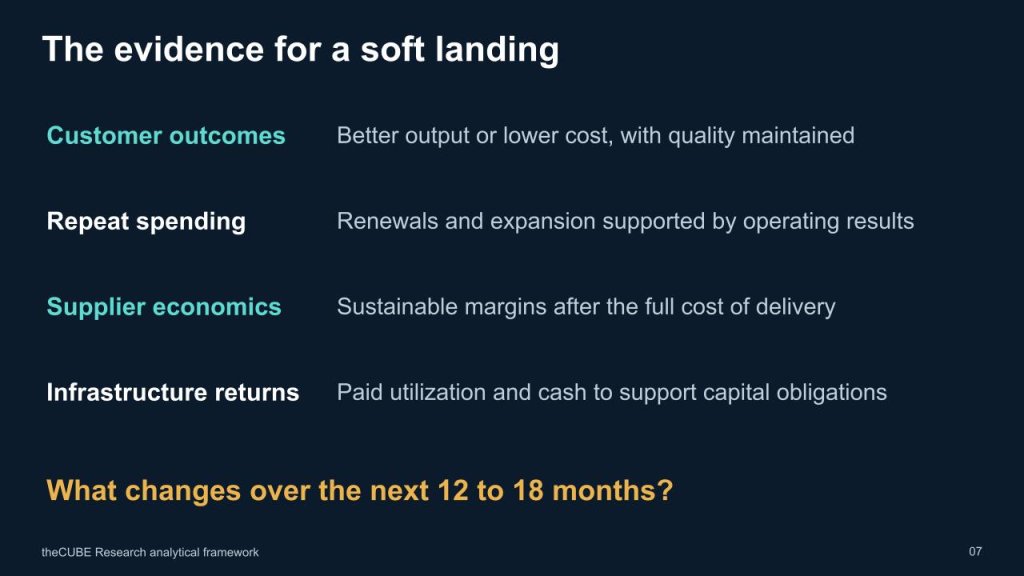
Three, can software and model suppliers earn sustainable margins after accounting for their delivery costs? The tokens—building intelligence is expensive. And four, does the infrastructure usage produce enough cash to support operations and capital obligations and to fund the next cycle? Customer productivity is necessary to our thesis. But remember, value can flow to customers through lower prices without necessarily supporting the returns of the factory. That’s something that infrastructure investors are looking at to justify the higher valuation. So you’ve got to examine the whole chain.
Crawford, over the next 12 to 18 months—maybe that’s too long of a time frame in this world—what are the key developments that we should be watching that are going to make you more confident that productive customer demand is catching up with the buildout? It’s widely spread. You said it’s not narrow. And what, by the way, would change your mind? What are the metrics and KPIs you look at with your portfolio companies? How do you see it?
Crawford Del Prete: So obviously, you’ve got to be looking at retention, right? You’ve got to be looking at net retention, at gross retention, and seeing how those are moving as they roll out new AI features. What I see is a lot of value in looking at win-loss analysis. Why did a customer leave? Where did a customer go? Did a customer go to a more AI-native factor? Did the customer go to an internal effort where they could create the product themselves? You see that on win-loss.
That’s a super important metric because it gets to what customers are willing to risk that accountability layer on by building it themselves, unless they’re building that accountability layer in. How much the company is able to uniquely monetize AI is also super important, or do you see it in the retention numbers in terms of cross-sell, upsell? The other areas that are really important to me are: Are you attracting more customers with your AI features? And is the product getting better over time because of those customers coming to the platform?
Then, even more importantly, is the product not only getting better, but is each incremental customer getting a better experience? Is the data that’s being created more valuable to that broad set of customers because they’re part of that ecosystem? And of course, that’s all fueled by better decisions associated with AI. The other thing that I’m spending a lot of time looking at is this notion of what is the next action that a company can find and uncover with AI.
So, for example, maybe they’re in the ITSM space. What happened to the ticket? Was it reopened? How long was it until the ticket was closed? Maybe you generated an invoice with a piece of AI software. Well, was that invoice disputed? Was it paid late? Was it written off? What was that next outcome? Maybe you made a recommendation. Did the customer accept it? Did they challenge it? Did they ignore it?
Those kinds of follow-on interactions fuel that two-way customer value, where more customers rejecting a recommendation tell you the recommendation wasn’t very good. So the recommendations get better. Those are all the kinds of things that I’m looking at in order to see the benefits associated with AI.
Dave Vellante: Basically that next best action is really interesting because we’ve been pretty good at what happened and pretty good at why it happened, but we’re not really good at what’s going to happen next and what we should do next, right?
Crawford Del Prete: That’s the possibility AI opens us up to.
Dave Vellante: Well, we continue to believe—we come full circle here—that the path to a durable AI economy goes through the mainstream enterprise operating results. And the good news is, as we talked about today, we have evidence that AI workloads are expanding and new operating models are emerging, as Crawford shared with us. The questions that remain are around how quickly those gains become repeatable customer spending patterns and sustainable cash flows broadly across the industry. And will that happen before a major financing or other dislocation occurs in the market?
What do you in the audience think? Are you making money from AI? Are your individual productivity gains translating into firm-level results that are measurable? If so, you’re likely one of the leaders in your field. And if not, how much time and patient capital do you have before results are proven and AI becomes self-funding? Let us know what you think. Crawford, thanks for helping connect the investment story to what businesses actually have to do to succeed. I really appreciate your time.
Crawford Del Prete: Absolutely. Thank you.
Dave Vellante: All right. Thank you for watching Breaking Analysis. For Crawford Del Prete, I’m Dave Vellante. We’ll see you next time.