
QDC26 shows progress in the hardware, software and tooling around quantum computing as customers look for evidence of better outcomes
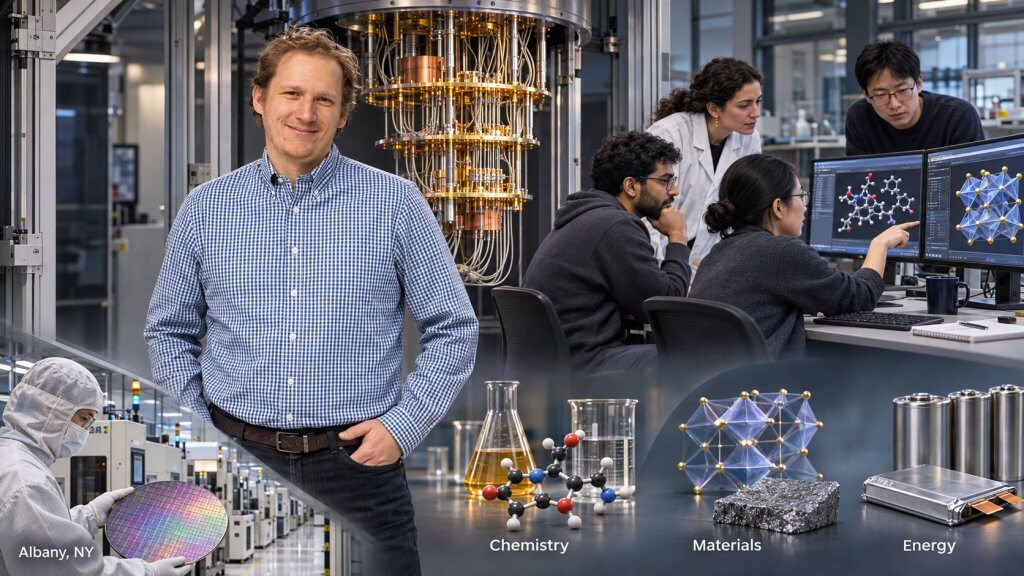
IBM’s Quantum Developer Conference (QDC26) in Chicago marked a change in emphasis. IBM claims that researchers have demonstrated quantum advantage in 2026 by working with the classical computing community. Its public presentations showed progress in processors, error correction, scientific software and the integration of quantum with conventional computing. The company’s quantum leader, Jay Gambetta, also set a new target. The next big milestone comes by demonstrating industry impact by 2028, conditional on collaboration across enterprise application researchers and the classical and quantum communities.
Our key takeaway is that IBM is assembling more of the full system required to turn a quantum experiment into useful scientific work. Hardware is important but the real innovation will come from software. Importantly, the tools that help a scientist formulate a problem, run it across different computing resources, check the result and understand the economics, are where much of the innovation is headed. These capabilities address several of the barriers customers described to us in our spring quantum tour of major scientific research labs; and the issues discussed with technologists on our Quantum 101 Series at theCUBE’s NYSE studio.
Despite the progress being made, the remaining gaps and challenges are many. Quantum science is advancing but impact on industries is still years away. Better software is the key to making dramatic improvements in quantum performance and a new service capability can attract researchers. But if a chemist needs to understand the deep nuances of quantum computing, it limits adoption. We believe the next phase of innovation will focus on abstracting quantum complexities and making measurable improvements in simplicity to drive further usage.
In this Special Breaking Analysis, we examine IBM’s public QDC proclamations through the prism of our spring interviews with six quantum and supercomputing experts. We add customer perspectives from our partner Qualitate, assess the implications of IBM’s foundry investments and consider what evidence would signal that progress is moving from scientific advantage to industry impact.
Three milestones with different proof points
IBM’s progress comes into better focus when evaluating its milestones separately. IBM’s goal of demonstrating Quantum Advantage by 2026 is generally accepted as met, based on achieving particular computation superiority relative to today’s classical methods. But to truly show industry impact, IBM needs to show results make a difference to an organization. Milestones around fault tolerant architectures will increasingly focus on the ability to sustain reliable computation in the face of errors. Progress in one category will definitely support another but it’s useful to look at milestones and proof points separately as shown below.
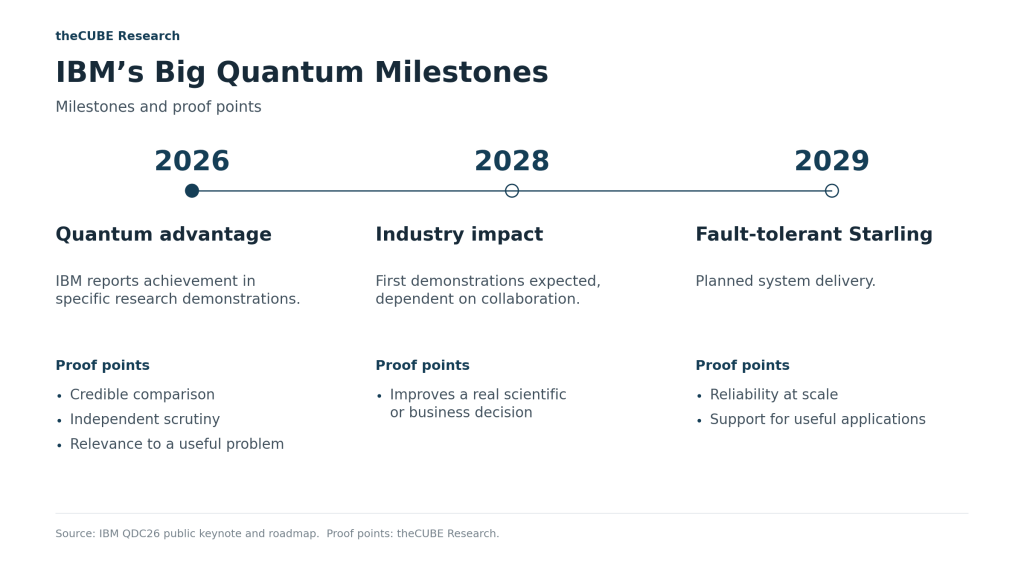
IBM deserves high marks for achieving that advantage but is subject to scrutiny. Gambetta’s keynote described classical researchers overtaking quantum results, claims being withdrawn as classical makes improvements, and subsequent quantum work moving the needle in favor of quantum again. This of course is how a competitive scientific ecosystem should operate. We’re eager to see the leapfrogging end and await a day where a quantum advantage becomes sustainable with clear evidence that classical computing has no chance of catching up for specified use cases.
Observers can rightly be concerned that incorrect inferences may be drawn from the term ‘advantage.’ The phrase can sound like a statement of superiority. But if that advantage is not consistently held then the broader industry might remain skeptical. The same applies to verifying that a customer outcome is attributable an underlying scientific model powered by quantum.
A public Allstate example is useful and illustrates the difference. IBM described underwriting-optimization results as comparable to classical optimization schemes. That can represent progress but it does not show that quantum has delivered a superior underwriting outcome. Customers need to decide how much they are prepared to invest in learning before a measurable benefit appears. IBM, in our view, is working hard to simplify the heavy lift and broaden adoption.
Our 2026 spring interviews provide practical research lab data points
The researchers we interviewed in spring 2026 for World Quantum Day were already thinking beyond the hardware. Their concerns included application selection, reliability, integration, software complexity and the ability to preserve optionality as hardware evolves. These were six independent editorial interviews conducted on theCUBE, made possible by Hewlett Packard Enterprise, across five institutions, offering a view of the work required to make quantum useful. The discussions were hosted by this author and Paul Gillin, Managing Editor at SiliconANGLE.
The following table highlights the to priority stated by each researcher at the time and our take on how IBM has responded in the past 6-9 months.
| Expert and affiliation | Priority in Q1 | How the public QDC material responds |
| Laura Schulz Argonne National Laboratory | Let scientists work without mastering every hardware detail. | AI skills and application tools reduce some assembly work; independent use still needs more proof. |
| Amir Shehata Oak Ridge National Laboratory | Coordinate quantum and conventional resources efficiently. | Managed workflows expose execution stages and combined resource usage. |
| Dr. Pascal Elahi Pawsey Supercomputing Centre | Identify the quantum portion of a larger scientific problem and supply expertise. | Problem-mapping tools and hybrid workflows support that approach. |
| Dr. Mikael Johansson CSC, Finnish IT Center for Science | Find useful applications and build skills across diverse technologies. | Chemistry, materials and optimization tools create more ways to experiment. |
| Tom Beck Oak Ridge National Laboratory | Connect promising science to reliable computation while preserving hardware options. | Materials workflows and error-correction work address parts of that requirement. |
| Dieter Kranzlmüller Leibniz Supercomputing Centre | Judge application performance and economics while retaining technological independence. | Usage visibility helps assess economics; portability remains a customer requirement. |
IBM is directing effort toward problems that these practitioners identified months earlier. We believe that is a strong indicator of product relevance, an even more important than hardware milestones.
It also gives us a more reasonable test of true progress. A scientist must be able to attack a meaningful problem with less setup effort, run it more reliably and compare the result with a credible classical alternative. IBM’s public announcements show capabilities intended to support that progression and the gaps identified this spring by our researcher friends. Thus far, however, they don’t show how broadly researchers can complete their tasks without specialist assistance. IBM shared additional capabilities to a small group of industry analysts under NDA, which look encouraging.
The practical measure is in running the experiment end-to-end
Some of the most interesting material in Chicago concerned ordinary operational friction. In the public developer sessions, IBM described experiments interrupted by sleeping laptops, dead notebook sessions, running out of memory or tokens and lost work in process. In quantum research, as with AI YOLO training runs, they add expense and blockers to work that already requires specialized expertise.
Managed workflows address this through simplification by moving execution into a hosted environment with conventional computing resources and tools to capture and save work in process. Researchers can associate quantum jobs with the workflow and monitor consumption across both quantum and classical support infrastructure. That creates a basis for repeating experiments and understanding where resources are consumed and how to optimize the complete process.
Take the chemistry approaches discussed at the event. Researchers can divide a larger molecular problem into smaller parts, use quantum or classical computing methods for appropriate parts and combine the results. At QDC26, IBM described improvements in classical algorithms that support the processing of quantum jobs. Classical solving steps can become a major bottlenecks and represent opportunities for optimization.
The relevant focus is increasingly the complete research workflow. Here we’re referring to the preparation, the quantum work, the classical processing and the validation. This expands the opportunity for IBM and its partners because more of the work can be supported through its software and services. It also shines a light on how the economic case needs to evolve, with a focus on the cost of an outcome.
Faster quantum hardware alone is not the answer. Conversely, better classical software can make quantum experiments much more productive. Both are developments that came into focus at QDC26. Customers need enough visibility to identify the bottlenecks and implement improvements.
AI’s role in reducing the cost of quantum
IBM’s pronouncements about AI are expected to address barriers raised in our spring interviews – i.e. the complexity of translating domain knowledge into a working quantum experiment. IBM must provide skills that assist with choosing methods, workflows, applying classical algorithms, etc. And validating implementations before longer, more expensive runs take place. Our developer conversations at the event underscore demand for AI assistance with calls for simpler packaging and managed services.
We believe this marks is an important near-term relationship between AI and quantum. AI can help scientists use quantum computing more effectively before quantum delivers a broadly demonstrated improvement in AI itself. The immediate opportunity is to simplify – i.e. reducing the effort required to apply specialized software and infrastructure.
This requirement has implications for how scientific software is packaged. A library contains reusable code. Increasingly, skills will supply context and guidelines for selecting and applying that code. As skills improve, we expect more of the integration work to be assisted by software. The value of a mature library will still depend on its performance and suitability for the task at hand. The public QDC releases include libraries, mapping tools and AI skills together; they hint toward an evolution in how software will be used in the future.
Another gap is accountability. For example, what happens if a workflow executes but uses invalid scientific assumptions. An AI-generated configuration can appear valid while making a poor trade-off between accuracy and cost, for example. In our view, a useful abstraction must maintain the ability to understand those AI decisions and validate them in terms that a domain expert/scientist comprehends.
This is where customer evidence must become more specific in our view. For example, can a chemist repeat useful work without a vendor team guiding them every step? Can another scientist reproduce the result? Can the organization see what exactly changed between runs? We would place considerable weight on those conditions when judging whether easier programming translates into broader scientific adoption.
Chemistry offers a clear fit but still requires more proof
Chemistry and materials are fields that provide a strong connection between our spring interviews and the public QDC discussions. Johansson at CSC emphasized the challenge of modeling interacting electrons. Beck at Oak Ridge described materials and chemistry research with potential relevance to fusion and biology. IBM’s sessions discussed tools for decomposing problems and processing results across quantum and conventional systems working in tandem.
We view these fields as particularly credible places to look for early useful applications because the scientific problems involve quantum behavior. That is a reason to prioritize research that benefits from quantum. Problem scope, accuracy and economics (or feasibility) relative to conventional methods will determine the ultimate usefulness of quantum.
The economics must include the full result
IBM’s performance progress is notable, but its points of comparison are instructive. Its headline 25-fold improvement in maximum circuit throughput compares Nighthawk r2 with Heron. Several application improvements also compare newer IBM quantum systems with earlier ones. Those figures demonstrate progress within IBM’s generations but a customer still needs a comparison with the best practical classical approach to the same problem.
The mot useful metric in our view is the cost and time required to obtain a validated outcome. The calculation should include all aspects of conventional preprocessing and post-processing, the quantum work done, job completion times and the intensity of the technical skills required perform and validate the result. Importantly, an important future measure is whether the process can be consistently repeated at scale.
Customers should absolutely invest before quantum consistently wins. The key is to identify those investments as a learning experience.
Qualitate customer data reveals little enterprise focus outside of PQC
Post-quantum cryptography (PQC) is a topic we unpacked at theCUBE’s Quantum Readiness Day this past September. Qualitate customer survey findings add another dimension to our PQC analysis. But don’t confuse PQC spend with quantum application adoption.
A query of Qualitate’s interview data on quantum adoption focuses heavily on PQC, a tactical topic that is top of mind for enterprises today. Organizations are spending to prepare existing information systems to resist future quantum-enabled attacks. The data include customers already taking action, as well as those evaluating.
“…now is the time we’re really starting to go all in on post quantum cryptography.”
The same participant explains the rationale in terms of future loss avoidance:
“We anticipate that this will significantly save us on dealing with enormous crises in the future.”
-Technology lead at a professional services company Source: Qualitate
Today’s enterprise focus as it relates to quantum is on modernizing cryptography. This is far ahead of investing to find useful applications for a quantum computer. Today’s practitioners are consumed with deploying and securing agents and making AI trustworthy. Quantum applications, other than PQC, are not top-of-mind for most enterprise customers. Security work to protect conventional systems is tactical and there’s little evidence of interest in running workloads on quantum hardware within organizations today.
NIST released its first three finalized post-quantum cryptography standards in 2024 and encourages organizations to begin transitioning. Its guidance also explains the risk that adversaries collect encrypted information today for possible decryption later. Unlike Y2K, which had a definitive date associated wth the risk, the timing of a capable quantum attack remains uncertain. As such, migration planning is sensible now, independent of IBM’s application and hardware milestones.
The following competitive signals are seen in the Qualitate data and are almost exclusively security-related:
| Vendor | Perception reported in the Qualitate surveys |
| IBM | Quantum-safe cryptography breadth and hybrid solutions, with existing relationships and executive sponsorship influencing interest. |
| Some participants associate quantum hardware expertise with credibility in defending against the future threat. | |
| Microsoft | An existing Azure environment makes Microsoft a natural extension of the customer’s current platform relationship. |
The opportunity for specialists also remains open. One participant states:
“The field is still not crystallized. And probably we will not necessarily rely on the hyperscalers. Probably will rely on specialists.” – Global head of analytics, financial services & Insurance, large US corporation
Source: Qualitate
Our take is that technical credibility and existing relationships, combined with the ability to affect a successful migration, may all influence these purchases. IBM has many assets, but customers are still evaluating alternatives. Success in quantum-safe security strengthens its commercial position without, by itself, resolving which quantum computing architecture or application platform will prevail when quantum goes mainstream.
Quantum chip manufacturing adds another dimension to the competition
Quantum computing also needs to progress from building exceptional devices to producing dependable systems repeatedly. The manufacturing announcements around IBM’s roadmap deserve scrutiny in that context.
In September, IBM acquired, Anderon, finalizing a $1 billion CHIPS award supported by an additional $1 billion IBM investment. IBM has reported it has an Albany, NY-based, 300-millimeter quantum wafer foundry serving customers across the ecosystem, with initial wafers already running through the facility.
Our view is that the learning curve will be as important as any single milestone. More repeatable production can confer experience advantages to IBM (Wright’s Law), much in the same way TSMC has demonstrated its leadership in semiconductor manufacturing. Serving multiple customers could help support volume across shared infrastructure. Whether those benefits emerge depends on demand, process stability, yields and the ability to protect each customer’s intellectual property. In addition, IBM can learn from Intel’s missteps and its own foundry challenges.
The industry needs to watch for manufacturing progress alongside qubit performance. Capital investments are followed by innovation. IBM’s August acquisition of HRL Laboratories adds a related strategic chess move. The rationale explained by IBM is to acquire expertise in silicon-spin qubits, sensing, materials, cryogenics, controls, packaging and interconnects. IBM describes that expertise as complementary to its superconducting work and identifies opportunities to collaborate with Anderon.
We interpret the acquisition as a way for IBM to control its destiny in a return to its vertically integrated mainframe past. At the same time, it doesn’t have the volume economics to achieve its objectives purely as a captive / integrated systems player. So it must open up its manufacturing capability to other parties, including its competitors.
IBM is competing to organize the work around quantum
Taken together, the public announcements at QDC26 suggest a broader platform ambition. IBM is connecting access to quantum hardware and software with classical computing, application functions, development tools, etc. We believe this could increase its role in the customer’s research process and create more opportunities for ecosystem partners to package specialized capabilities.
The competitive advantage will come from making useful work easier to perform and repeat. A customer who can move from a scientific experiment to a reliable result at scale, with less effort, has a reason to stay with a vendor and invest more. That advantage still has to be earned through application quality, performance, service reliability and superior economics.
There is also a customer trade-off – i.e. the classic lock-in risk. An integrated service can reduce operational complexity while increasing dependence on the provider’s tooling and ecosystem. Open-source tools help minimize the risk, but portability also depends on whether models, workflows, validation and operational models transfer to another platform. Our spring conversations with Kranzlmüller – and his emphasis on technological independence – along with Shehata’s interest in interoperable specifications – make that point clear.
We would not declare IBM as a decisive winner from this conference. But the company has presented an impressive combination of hardware, software and infrastructure progress. Customers will determine its value through repeated use and outcomes. Competing systems from specialists and hyperscalers – as well as progress from classical methods – will continue to shape the narrative.
Gambetta’s 2028 gambit
If Jay Gambetta’s prediction holds true, the next two years will produce a more tangible conversation around industry impact. Look for significantly more quantum POCs, more named customers solving consequential problems and a measurable change in a scientific or business decision. We would also want enough evidence for an independent team to assess the contribution; and for the customer to explain the full cost of achieving an outcome.
Some additional items to watch:
- We believe chemistry and materials deserve close attention;
- Research workflows must be easier to use;
- Track whether more domain scientists can work independent of highly skilled quantum experts;
- Whether quantum advantage survives a sustainable lead vis a vis classical;
- Whether chip manufacturing shows up as reliable, consistent and independent.
For enterprise leaders, the sensible approach is to separate cryptographic readiness from quantum application programs tied to specific problems and economics.
IBM has made a stronger case that the surrounding machinery for useful quantum computing is coming together. The future test is whether customers can show what changed because of quantum. A demonstrably improved scientific result or an economically superior workflow would make the 2028 ambition impressive.
That is the evidence we will be watching.
What’s on your quantum radar? Let us know…