
Nobody has proven Alice Huang is a spy. Somebody did prove you can remove the most important CEO in AI with a leaked memo. Now ask who wants the switch next.
Two weeks, one memo
Run the calendar back two weeks.
Thursday, October 29. The New York Times reports Jensen Huang’s close relationship with Alice Huang (no relation), a Megaspeed executive US officials suspect of working for Chinese intelligence [1].
Friday, November 6. The Times reports that a classified memo circulated among top officials naming her as a spy for China’s Ministry of State Security [1].
Sunday, November 8. Huang tells employees he was unfaithful to his wife. Nvidia’s board opens an independent investigation and says it has confidence in its CEO [1][24].
Wednesday, November 11. The Times reports a second relationship, with a vice president who reports directly to him. The Journal reports the board is preparing to remove him [1].
Thursday, November 12. Nvidia’s 8-K lands. Huang has resigned as president, CEO and director, effective immediately. CFO Colette Kress is interim CEO [2].
Two weeks. Thirty-three years. The board went from “confidence in Jensen” to “effective immediately” in four days. Great week for governance.
Then the All-In crew sat down and asked the one question no press release has answered: who wanted Jensen out [3]?
That question is the whole edition. The first kill switch in American AI was not soldered onto a chip. It was typed into a memo. And it worked on a person.
Assume the besties are right
This edition is a thought exercise, and I’m labeling it as one. I’m going to assume the All-In read is correct and follow it all the way down. Not because it’s proven. Because if it’s right, every buyer outside Washington has a new line in the risk register.
Start with what’s on the record.
- The memo is real. The Times reported that Secretary of State Marco Rubio oversaw its drafting. The Washington Post reports he built it from a CIA report, “recasting the agency’s reporting in his own more assertive terms,” and called the ouster “a huge victory” for China hard-liners [5]. Per the Times, the memo reflected concern about Jensen’s influence on the President’s AI policy. Sit with that for a second. The lobbying itself was the threat model [26].
- The leak is the only confirmed crime. That’s David Sacks’ point on the pod, and it’s correct: somebody put classified intelligence in a newspaper to take a CEO down [4].
- The spy claim is unproven. CNN reported CIA officials were “not yet convinced” the intercepts show Alice Huang knowingly passed anything to Beijing. Attorney General Todd Blanche said no conclusion has been reached. Singapore filed no charges. Beijing denies it [5][6].
- Nobody has named the leaker. As of today, no leak investigation has been announced [6].
So the infidelity is confirmed, the espionage is not, and the leak is the one crime anybody can point to. Read that twice.
Let me say the obvious part out loud. A CEO’s marriage is not a national security event. The relationship with a direct report is a real disclosure problem, and a board can fairly act on it. Chamath and Friedberg both read the exit as a compliance move: conflict-of-interest attestations and D&O covenants, not espionage [4]. Fine. Boards fix disclosure failures with a reprimand and a reshuffle. They don’t do it in four days, while $1.76 trillion of Nvidia’s market value walks out the door [7].
The speed is the tell. So is the timing. The first story ran five days before the midterms and 20 days before the President’s expected sit-down with Xi in Shenzhen [6].
Credit where it’s earned: the hawks didn’t invent smuggling
Before I take the theory anywhere, the hawks deserve their flowers. The diversion problem is real.
- Until the Justice Department brought chip-smuggling indictments last year, Nvidia argued there was no such smuggling [8].
- A Commerce official visiting Megaspeed’s Malaysia data center reportedly found Nvidia equipment still sitting in boxes [1].
- Megaspeed reportedly bought $4.8 billion in Nvidia chips over two years. The Justice Department has taken over the federal probe [1].
And the engineering fix isn’t crazy. Rep. Bill Foster, a co-sponsor of the Chip Security Act, says Nvidia’s people told him privately that location checks are doable: “yeah, of course we can do this” [9]. Last December, Nvidia confirmed it had built optional location-verification software that can show which country its GPUs are running in [11]. Its “fleet intelligence” system can track location today. It just doesn’t make customers share that data by default [10].
So the problem is real and the fix is buildable. I’d sign off on fixing it.
Now look at who’s holding the soldering iron.
Follow the incentives, not the affair
On the pod, Jason’s guess was China hawks inside the administration who lost the export-control fight and want tracking and backdoors on chips. Chamath went further: the one clear winner is the faction that wants government-owned telemetry and a kill switch [4].
You don’t need a cabal for that to be true. You need a coalition whose interests all point the same way. Jensen was standing in three doorways at once.
Doorway one: chip controls. Per a former congressional staffer, Nvidia was the biggest opponent of both the Chip Security Act and the AI Overwatch Act [8]. Rubio and other advisers had already talked the President out of letting Blackwell chips go to China [5]. Inside the cabinet, Treasury, the Pentagon, the trade office and State reportedly wanted Megaspeed on the Entity List. Commerce Secretary Howard Lutnick resisted, and the President’s approvals stalled [6].
Doorway two: open weights. On July 24, Jensen used his first-ever post on X to publish “Open Weights and American AI Leadership,” a letter against restricting open models. Nvidia, Microsoft, Meta and Hugging Face signed. OpenAI and Anthropic were missing from the launch list [13]. OpenAI and Google added their names within a day. Anthropic never did [25]. Dario says Anthropic has never advocated banning open weights [25]. Two days earlier he told Axios, “These Chinese models are excellent” [12]. That same week, Axios reported officials were weighing Entity List designations, procurement limits and liability rules for Chinese open models [14]. On September 3, Nvidia agreed to buy Hugging Face for $12.9 billion [15]. The chip king was buying the open-model town square.
Doorway three: the frontier labs. Anthropic backs all three chip bills and quit a major trade group in September after it lobbied to strip them from the defense bill. OpenAI went quiet on chip curbs after Nvidia closed a $30 billion equity investment in it [16]. Sacks says the safety movement is celebrating [4].
Put those on one whiteboard and the theory writes itself. The hawks want the switch. The closed labs want fewer open competitors and tighter export rules. A Congress that just changed hands wants a scalp and a bill [17]. Remove the one man standing in all three doorways and every door opens the same week.
None of that proves anyone coordinated anything. It proves a lot of powerful people got what they wanted at the same time. In Washington, that’s usually all the coordination you need.
The internet already painted its Judas
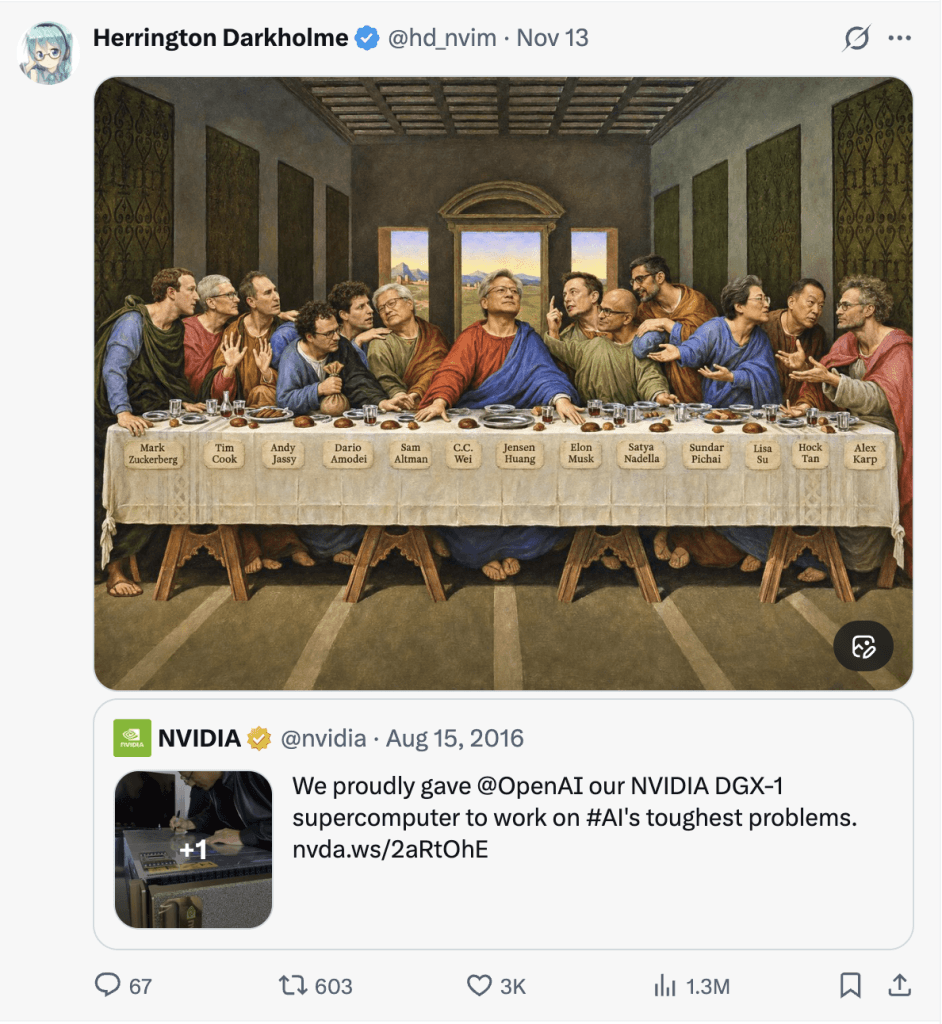
Tech Titans at the Renaissance Table. AI-generated satire, recreated by the author. Original by @hd_nvim on X.
A version of this has been making the rounds, so I made my own. The question everyone asks about it is the right one: is that Dario? Yes. Da Vinci’s seating chart is intact. The figure labeled Dario Amodei sits fourth from the left, in Judas’s seat, clutching the purse. The one labeled Elon Musk raises Thomas’s finger. The one labeled C.C. Wei sits in John’s place, closest to the master. @hd_nvim, who made the original, knew exactly who she was casting. I kept the seating chart.
Why him? The feud is on the record. In June 2025 Jensen said he disagreed with “almost everything” Dario says. Dario called Jensen’s version of his views “the most outrageous lie I’ve ever heard” [28]. Anthropic backs the chip bills and gave $40 million to Public First Action, a group pushing AI safeguards and export controls [16][29].
Then there’s the tip. On The Daily, Times reporter Tripp Mickle said that in August 2025 “a tech industry contact” told him and Ana Swanson to “drop everything and look at this company called Megaspeed” [27]. He didn’t name the contact. One widely shared post filled in the blank: “Dario might be behind this whole Jensen Huang thing.” A viral Chinese-language post named an Anthropic co-founder, citing only “open-source intelligence” [29].
Now the part the painting leaves out. Nobody has named the tipster. Anthropic says its donations can’t be used to influence an election [29]. And Anthropic’s amended IPO filing, dated November 10, shows Nvidia committing $10 billion to a private placement alongside the offering [30]. In Da Vinci’s version, Judas takes the silver. In this one, the man in the middle seat wrote the check two days before he left the table.
The painting answers who the internet blames. It doesn’t answer who made the call. “A tech industry contact” is a very long table.
From a pin on a map to a hand on the switch
Here’s the part nobody is saying out loud. The fix for smuggling and the machinery of control are the same machinery. Only the paperwork changes.
Watch the ladder.
- Location verification. The Chip Security Act makes Commerce require it on export-controlled AI chips. It cleared House Foreign Affairs 42 to 0 in March. As written, it mandates location checks, not remote disablement [18].
- Telemetry. Chamath’s warning on the pod: the leak gives officials an opening to propose telemetry and a kill switch that the government owns [4]. A chip that reports where it is can be asked to report what it’s doing.
- Remote disable. Some drafts of the bill already carried one [19]. Nvidia’s own position, last year, was that its chips have no kill switches or backdoors, and that building them would hand a gift to hackers and hostile states [20].
Every rung is sold as anti-smuggling. Every rung also works on a customer who paid in full, in Frankfurt, Tel Aviv or Riyadh. Once a government holds the key, “export control” and “surveillance” are the same API with different paperwork. That’s the Orwellian part, and it doesn’t need a villain. It only needs a precedent.
Europe has already tasted it. In June, access to Anthropic’s most advanced models was cut off outside the US for national security reasons, then restored within weeks. Two EPP lawmakers, Christophe Grudler and Aura Salla, warned the US holds “a real ‘kill-switch’ over essential technologies” [19]. EU finance ministers pushed for guaranteed access. Austria offered to host the models on European soil [19]. Now the CEO who personally sold sovereign AI to Europe, Saudi Arabia and Korea is gone, and every one of those buyers is staring at how much of its national plan rests on one American vendor [21].
Washington’s answer came in a cable dated July 16. It told US diplomats to push back on the kill-switch idea. Its line: “There is no government ‘magic button.'” The same cable told envoys to discourage “so-called ‘digital sovereignty'” initiatives and sell American AI instead [19].
The cable went out over Marco Rubio’s name. The memo that just turbocharged the push for chip tracking came from Marco Rubio’s desk [5][19]. I’m not calling that hypocrisy. I’m calling it a roadmap.
Run the thought exercise to the end. If one leaked memo can remove the CEO who was fighting the switch, the switch doesn’t need to exist yet to work. The fear of it already does the job.
The 5 Pillars, from a European rack
Same test I run on every vendor. This week the vendor is a US-origin accelerator under a mandated verification regime, with a disable switch one amendment away. The buyer is a European enterprise that paid in full. I’m grading the dependency, not the company.
Territorial: holds on concrete, leaks on location
The question. Where do your data and compute physically reside, at rest and in motion?
The story. Your racks sit in Frankfurt. Under location verification, they also report that fact to someone who isn’t you [18].
Under pressure. A verification ping fails because of a network change. Who decides whether that’s a misconfiguration or a diversion?
Verdict. Partial. Your servers are in Europe. Washington knows exactly which ones.
Operational: breaks
The question. Who runs it, who holds the keys, who gets paged, and who can pull the plug?
The story. Today, you. With telemetry and a remote disable, a party outside your org chart joins the on-call rotation, and it doesn’t take pages [4][19].
Under pressure. An export letter lands at 5:21pm Eastern. Your ops team finds out from the dashboard going dark.
Verdict. Breaks. You run the cluster. Someone else runs the off button.
Technological: breaks
The question. Can you audit it, fork it, self-host it?
The story. You can fork the model. You can’t fork the firmware. Verification and telemetry live below any layer you can inspect.
Under pressure. Your security team asks to audit the attestation code. The answer is a white paper.
Verdict. Breaks. Open weights on a closed switch are still on a closed switch.
Legal: breaks
The question. Which court can compel whoever holds your data, your keys or your model?
The story. US export rules follow the chip after it ships. Contracts lose to statutes. In both directions.
Under pressure. Your vendor wants to honor your contract. Its general counsel reads the statute first.
Verdict. Breaks. Your contract is a promise. Their law is an order.
Financial: the loudest break on the board
The question. Can you leave? On your timeline, at a survivable cost?
The story. You paid capex for an asset that a foreign government can now locate, and soon maybe throttle or switch off. The one CEO who fought hardest against that just left the building [2][8].
Under pressure. A licensing change turns your GPU fleet into a stranded asset mid-depreciation.
Verdict. Breaks. Your capex just became someone else’s option.
Score: one partial, four breaks. And not one of them depends on whether Alice Huang is a spy.
The executive TCO
Three line items, none of which show up on the invoice:
- The switch premium. Price the day your fleet is prohibited, not down. Put a number on it.
- The second silicon path. Dual-sourcing accelerators costs money. Being single-sourced on hardware someone else can revoke costs more.
- The compliance tax. Verification and telemetry mean attestation, logging and audits on your side of the line, paid in your engineers’ hours.
Same baseline-and-burst strategy as always, one layer down. Baseline on infrastructure you can keep running under a prohibition. Burst to the best silicon on the market when the work pays for it. Own the crown jewels. Rent the edges.
What to do Monday
- Inventory every accelerator by origin, and by whether it ships with location or telemetry features turned on.
- Add a clause: the vendor tells you within 72 hours of any government request to locate, throttle or disable your hardware. Then ask whether their lawyers will let them sign it.
- Run the 72-hour “prohibited, not down” drill. On hardware this time, not just on models.
- Get the weights on your disk. While that’s still a thing nobody has put in a queue.
- Write it into the risk register: “compute revocable by a foreign government.” The worst posture available is the ostrich.
What would break this theory
A thought exercise that can’t lose isn’t an exercise. Here’s what cuts against it, on the record.
- The timing runs backwards on open source. The memo circulated in spring, months before the open-weights letter and the Hugging Face deal [6]. Open source can explain the momentum. It can’t explain the memo.
- There’s a boring business story. The Journal reports Nvidia ran a program of credit guarantees to help AI clouds buy its chips, pushed by Jensen’s son-in-law. Kress questioned how those guarantees were valued, and Jensen reportedly dismissed her as “a deer in the headlights” [22]. Boards have fired founders over less.
- The top of the administration backed him. The President called Jensen “a fine person” on November 8 and said he should stay [1].
- The safety-camp version has a hole. One sharp skeptic notes that theory can’t explain why Jensen and the board folded so fast [23].
And the big one. If the CIA concludes Alice Huang knowingly passed information to Beijing, this edition reads very differently. I’ll write that one too.
Sovereignty wars, round one
So who wanted Jensen out? I don’t know. Neither does anyone writing about it with confidence, me included.
What I do know is what his exit made possible. The loudest voice against chip tracking is gone. The loudest voice for open weights is gone. A Congress that just changed hands has a scandal to legislate on and three bills ready for the defense package [8][17]. Whoever leaked that memo, the sovereignty wars just found their first casualty. They won’t find their last. Round two is already booked: Jensen has agreed to testify to Congress before Thanksgiving [1].
Washington says there is no magic button. Fine. Then put it in writing, in the statute, before the button ships.
Until then, if someone in another capital can locate your hardware, read its logs and switch it off, you don’t own a data center. You own a very expensive lease.
Don’t get caught with your pants down.
Amit
Amit Eyal Govrin is lead analyst for sovereign AI at theCUBE Research and CEO of Agentcy Labs, which designs and builds sovereign AI platforms for enterprises and governments. His research for theCUBE Research is conducted under theCUBE Research’s editorial standards and is not sponsored or directed by Agentcy Labs. Agentcy Labs may hold commercial relationships with vendors covered in this research.
References
- TechCrunch, “The unfolding Jensen Huang scandal: a timeline,” Nov 13, 2026. Link
- NVIDIA, Form 8-K, “NVIDIA Announces CEO Transition,” Nov 12, 2026. Link
- All-In Podcast, “Jensen Ousted as Nvidia CEO: ‘Spy’ Scandal, Export Restrictions, Market Impact,” YouTube, Nov 2026. Link
- BigGo Finance, third-party summary of the All-In episode in [3], Nov 2026. Link
- Dealroom, “Rubio recast a CIA report in the memo that set off Huang’s fall, WaPo reports,” Nov 13, 2026. Link
- Dejan, “The evidence on the Jensen Huang leak points to a chip-export fight,” Nov 14, 2026. Link
- CNN, “Jensen Huang summoned to testify before Congress after resigning as Nvidia CEO,” Nov 13, 2026. Link
- Reuters (Karen Freifeld), “Nvidia spy allegations likely to spur laws to tighten China’s access to AI chips,” Nov 9, 2026, via WSAU. Link
- MLQ, “Nvidia privately told a congressman it could track chips to fight smuggling, MIT Technology Review reports,” Nov 12, 2026. Link
- Atlantic Council, “Beyond the spy scandal: What the Nvidia-Megaspeed case reveals about export controls,” Nov 2026. Link
- Reuters, “Nvidia builds location verification tech that could help fight chip smuggling,” Dec 10, 2025. Link
- TechSpot, “Nvidia’s Jensen Huang defends Chinese AI and open source,” Jul 2026. Link
- Decrypt, “Nvidia, Meta, and Microsoft Tell Washington: Don’t Kill Open-Source AI,” Jul 24, 2026. Link
- Startup Fortune, “Trump Administration Weighs a Ban on Chinese AI Models Like Kimi K3,” Jul 21, 2026. Link
- Advanced Television, “Nvidia acquires Hugging Face for $12.9bn,” Sep 4, 2026. Link
- Dealroom, “OpenAI goes quiet on China chip curbs, siding with Nvidia and Trump as Anthropic keeps fighting for them,” Oct 2026. Link
- South China Morning Post, “US lawmakers push tougher China export controls in defence bill amid Nvidia scrutiny,” Nov 2026. Link
- Robert Castellano, “I Called for an AI Chip Kill Switch in July 2025. The Nvidia Spy Scandal Shows Why,” Nov 2026. Link
- The Next Web, “Marco Rubio tells US diplomats to play down fears of a tech ‘kill switch’,” Jul 2026. Link
- Seeking Alpha, “Nvidia reiterates its AI chips don’t have backdoors or kill switches,” Aug 6, 2025. Link
- Forbes, “Jensen Huang’s Exit From Nvidia Puts The Sovereign AI Race To The Test,” Nov 12, 2026. Link
- The Decoder, “Jensen Huang’s ouster likely traces back to Nvidia’s risky business practices more than his personal life,” Nov 13, 2026. Link
- Erik on Tech, “Reasons For Which Jensen Huang Was Not Fired,” Nov 2026. Link
- Fortune, “Jensen Huang is out at Nvidia. Elon Musk says hiring him would be ‘an honor’,” Nov 13, 2026. Link
- The New Stack, “Anthropic wants tests, not bans, as OpenAI and Google back open weights,” Jul 2026. Link
- Sovereign Magazine, “The Memo That Led to Jensen Huang’s Fall Was Reportedly Marco Rubio’s Stronger Version of a CIA Report,” citing The New York Times’ The Daily, Nov 2026. Link
- Business Insider via AOL, “Anthropic CEO Dario Amodei fires back at Nvidia CEO Jensen Huang’s criticism, calling it a ‘bad faith distortion’,” Aug 2025. Link
- Economic Collapse Report, “Who Whacked Jensen Huang? The CIA Wasn’t Convinced,” Nov 2026. Link
- Crypto Briefing, “Nvidia and Alphabet commit $10 billion each alongside Anthropic’s IPO,” Nov 2026. Link
- Taiwan News, on the New York Times report that Rubio warned officials about Jensen Huang’s ties to an alleged Chinese operative, Nov 9, 2026. Link