Enterprise resource planning systems were never designed for the operational tempo that modern businesses now demand. Built for stability over decades, these platforms have become the operational backbone for finance, supply chain, inventory, and HR functions. But that backbone increasingly constrains the organizations it supports. The problem is not the data inside these systems. The problem is the architecture surrounding it.
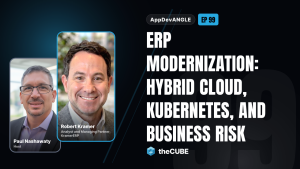
In this episode of AppDevANGLE, I spoke with Robert Kramer, Managing Partner of Kramer ERP, about the intersection of ERP evolution, containerization strategy, and the emerging governance requirements that come with AI-enabled enterprise systems. Kramer brings more than thirty years of ERP experience across manufacturing and supply chain, and also teaches marketing technology at the university level.
Our conversation explored five interconnected themes: why scalability in ERP is fundamentally a business demand problem rather than a container count problem; how microservices decomposition must be sequenced at the edge before touching the core; why resilience requires business process continuity rather than just infrastructure recovery; how hybrid cloud complexity is consistently underestimated; and why technical debt does not disappear with containerization—it relocates.
The broader signal is that ERP modernization has entered a phase where the conversation has to shift from deployment patterns to business governance. Organizations that frame modernization purely as an infrastructure project will replicate their existing problems in a more complex architectural environment.
Scalability Is a Business Demand Problem, Not a Container Count Problem
The appeal of containerization for ERP workloads is real, but the framing often goes wrong before the architecture work begins. Organizations frequently position containerization as a technical achievement rather than a business capability, and that misalignment sets modernization programs up for mismatched expectations.
Kramer was direct about where this framing breaks down: “Customers really don’t care how many containers are running; they care if they can process more orders, keep production moving, and handle peaks without growing costs at the same rate.” This is a consequential distinction. Infrastructure teams optimizing container density metrics and business stakeholders expecting order throughput improvements are frequently not measuring the same thing, and that gap creates friction throughout the program.
The practical starting point, according to Kramer, is variable-demand services at the edge (intake integration APIs, reporting workers, and e-commerce connections) rather than attempting to independently scale the core ERP database. This sequencing matters because it delivers measurable early returns in the services where demand is most predictable and performance improvement is most visible to business users. It also avoids the technical risk of prematurely decomposing tightly coupled core processes before the organization has built the operational competency to manage that complexity.
The implication for enterprise technology leaders is straightforward: the business case for ERP containerization should be built around peak load economics, shared resource contention costs, and idle capacity expense, not around cloud-native architecture principles that may resonate with platform engineers but do not translate into CFO or COO scorecards.
Microservices Decomposition Requires Sequencing, Not Fashion
One of the most persistent frustrations in ERP modernization is the gap between vendor promises of agility and the operational reality of change management. Updating one module creates risk across three others, and that pattern has caused organizations to defer enhancements for months or years at a time. Microservices architecture is a structural response to this problem, but decomposing a monolithic ERP is not a lift-and-shift exercise.
Kramer identified the most common failure mode precisely: “The most common mistake is creating many services that still share one database. It must be released together — a distributed monolith.” This is not a marginal problem. Distributed monoliths retain all the coupling constraints of the original architecture while adding the operational complexity of distributed systems management. Organizations get the worst of both models.
The correct entry point is the edge of the ERP: business capabilities with a clear owner, a defined interface, and measurable outcomes. A shipping integration or a report service qualifies. A tightly coupled finance process does not, regardless of how much pressure the business is placing on the finance team to move faster. “Avoid decomposing a tightly coupled finance process just because microservices are fashionable,” Kramer advised.
This reflects a broader truth about ERP modernization: the organizational change is as significant as the technical change. Teams must own discrete services with authority to deploy independently. When ownership is diffuse or when release dependencies persist across service boundaries, the architecture has changed but the problem has not. Independent deployability is the actual outcome that modernization programs need to demonstrate.
Infrastructure Recovery and Business Recovery Are Not the Same Thing
Kubernetes has become central to enterprise resilience conversations, and for good reason. Its automation of container recovery, workload redistribution, and self-healing behavior represents a genuine shift from the expensive, manually managed infrastructure that ERP high availability required historically. But Kubernetes-level resilience and ERP-level resilience are different problems, and conflating them produces dangerous gaps.
Kramer framed this distinction with operational clarity: “Kubernetes may restart the service, but did the order complete? Did inventory update? Did the shipment go out? That’s the difference between recovering infrastructure and recovering the business.” Business failures, such as an order accepted but not shipped, an inventory record that did not update, or an invoice that was duplicated, can occur within technically healthy infrastructure. The ERP system appears to be running while the business process has silently failed.
Genuine ERP resilience requires redundant capacity, database failover, tested backup and restoration, retry logic, transaction reconciliation, end-to-end monitoring, and clear recovery objectives. It also requires rehearsing partial failures, not just deploying high-availability clusters. The data supports the urgency here: 40.1% of respondents report that completely modernizing a single high-priority legacy application takes 13 to 24 months. During that transition window, legacy and modern components coexist, and transaction integrity across that boundary is a significant operational risk.
The takeaway for enterprise architects is that monitoring strategy must be extended from infrastructure metrics to business process continuity metrics. Recovery time objectives need to be defined not just by container restart times, but also by order fulfillment, inventory accuracy, and financial close cycles.
Hybrid Cloud Is Where ERP Modernization Actually Lands
The public narrative around cloud ERP often assumes a migration endpoint that most organizations are nowhere near reaching. Data sovereignty requirements, existing on-premises infrastructure investments, integration dependencies with legacy downstream systems, and procurement constraints collectively make full cloud migration a multi-year commitment at minimum. Containerization and Kubernetes earn their value in this hybrid context as a mechanism for consistency across deployment environments.
Kramer emphasized that the architectural decisions with the greatest downstream impact in hybrid environments involve identity, shared security policy, data resiliency, integration contracts, network connectivity, and operational visibility. These are not technology choices that can be deferred. “Organizations underestimate how difficult it is to maintain context across older on-premises applications, multiple clouds, and external partners,” he observed.
The governance dimension becomes even more critical as AI enters ERP workflows. An AI agent may have technical access to a service, but that access must be bounded by business authority decisions such as approving a payment, releasing an order, changing a supplier record. “ERP is becoming the execution layer. But the workflows cross systems and clouds with Kubernetes to run the services. It doesn’t tell us whether the data is trusted or whether an agent is allowed to act. That’s the business governance question.” Kubernetes handles workload orchestration. It does not handle business authorization, and organizations that treat these as equivalent will create security and compliance exposures that are difficult to audit after the fact.
Technical Debt Relocates; It Does Not Disappear
Containerizing an ERP environment creates a different kind of complexity, not a simpler one. The tightly coupled monolithic code that previously concentrated risk in the core now distributes that risk across service mesh configuration, API governance, observability tooling, and DevOps pipelines. For organizations that have not built platform engineering competencies, this trade can increase operational burden rather than reduce it.
Our data puts the investment context in stark relief: 40.1% of respondents report that modernizing a single high-priority legacy application takes 13 to 24 months on average, while 46.9% cite the sheer complexity of regulatory logic embedded in legacy code as the primary reason organizations choose to keep those systems rather than modernize them. These figures together describe an environment where modernization is expensive, slow, and constrained by the very systems it aims to replace.
Kramer’s investment framework is grounded in this reality. “The investment should be staged and include far more than containers—DevOps, platform engineering, security, observability, API governance, data migration, training, dual run costs, and ongoing operations.” The first benchmark, he argues, is the cost of keeping the legacy environment running. From that baseline, organizations should select one service or integration where a measurable improvement can fund the next step. “‘Done’ means a dependency is retired or a business result is achieved, not that Kubernetes is installed.”
Analyst Take
ERP modernization has reached an inflection point where the conversation must mature beyond infrastructure patterns. The organizations making the most durable progress are those that have stopped asking whether to containerize their ERP and started asking which business process outcome they are funding with each architectural investment. That shift in framing changes everything about how programs are scoped, governed, and measured.
The traditional approach of treating ERP modernization as a platform migration project owned primarily by IT is becoming insufficient as AI agents, hybrid cloud architectures, and real-time business expectations converge on these systems simultaneously. When AI begins executing against ERP data and workflows, the absence of clear business governance at the infrastructure layer is not a technical gap. It is an operational control failure.
Enterprises should recognize that the architectural complexity of containerized ERP does not reduce total effort. It redirects that effort from maintaining monolithic code toward managing service boundaries, API contracts, security policy, and observability coverage. Organizations without platform engineering capability will find that they have traded one form of technical debt for another, and potentially for a more expensive one, because distributed system failures are harder to diagnose than monolithic failures.
The next phase of this market will be defined less by which organizations adopt containers and more by which organizations build the governance layer that makes containerized ERP safe to operate at speed. That means identity-aware service access, business process continuity monitoring, staged hybrid cloud adoption, and investment frameworks that connect infrastructure metrics to CFO and COO scorecards. The organizations that build that governance foundation now will be positioned to introduce AI-driven automation into their ERP workflows with confidence. Those that skip it will find that the architecture they modernized is still not fast enough to trust.