How AI is Rewriting the Economics of Company-creation
This research brief explores why AI is compressing innovation cycles, how venture studios such as Nobody Studios are adapting to this new reality by creating innovation factories, and why enterprise leaders should rethink how innovation will be sourced during the next decade. Collectively, these trends are changing the very nature of the economics of company-building. This brief makes the case that it may be time to stop chasing unicorns, as the new innovation playbook is acquisition, not build it all yourself.
Watch the Podcast
Executive Brief
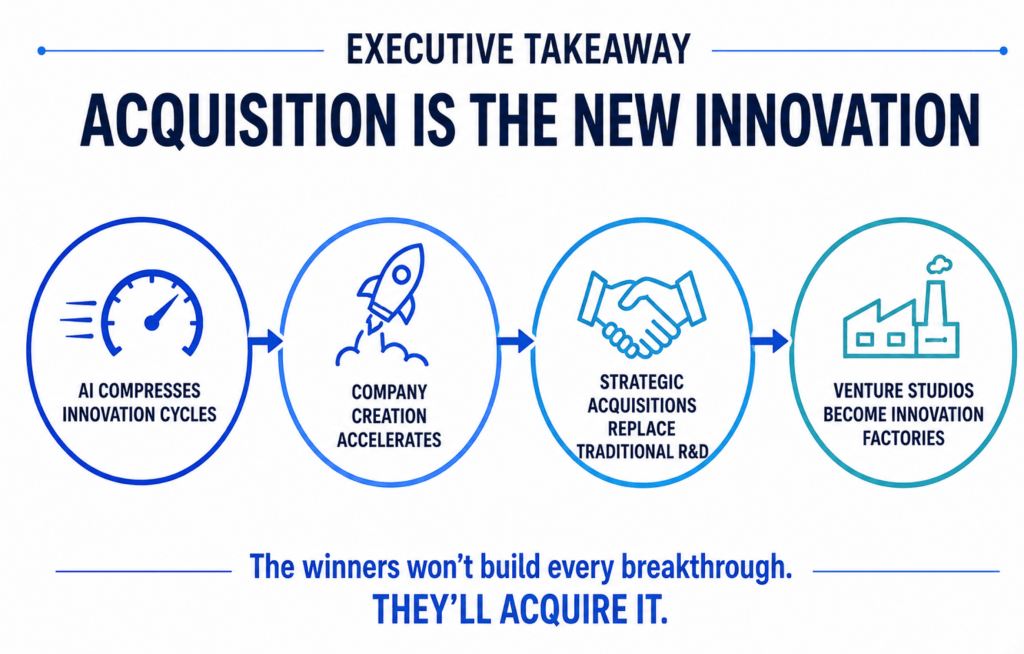
AI is changing not just how products are built, but the economics of innovation itself. As innovation cycles compress, the rules for creating, scaling, and commercializing companies are being rewritten.
AI is compressing the economics of company creation: Agentic AI, cloud infrastructure, and reusable software have dramatically reduced the cost, talent, and time required to launch software businesses.
The startup end game is changing: Rather than pursuing long journeys toward IPOs, many AI-native companies are intentionally building highly differentiated capabilities designed for strategic acquisition.
Strategic differentiation now commands premium value: The market is not buying significantly more startups. It is paying substantially more for AI companies that solve strategic problems.
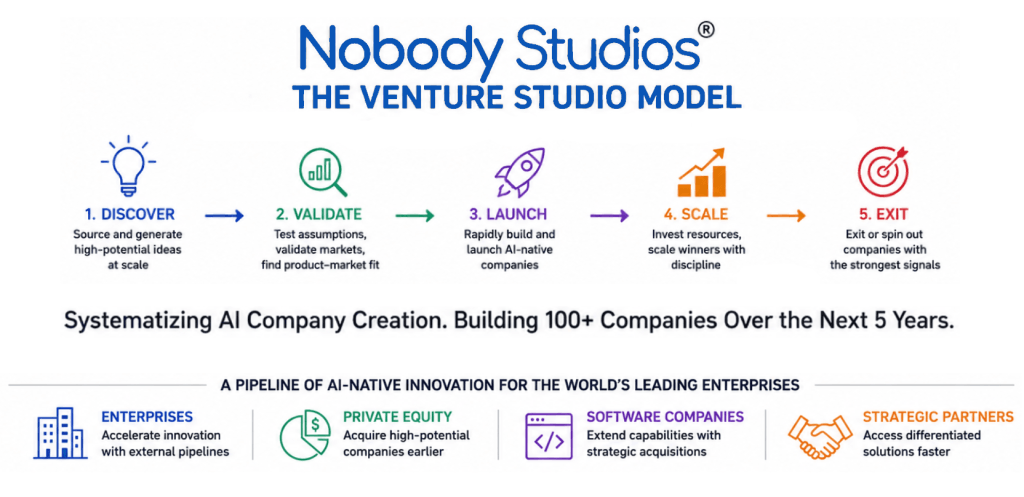
Venture studios are becoming the innovation factories of the AI era: they discover opportunities, validate markets, and launch companies through a repeatable company-creation engine.
Nobody Studios exemplifies this new innovation model: by treating company creation as a repeatable system rather than a one-time event, they are transforming the commercialization process.
The broader implication extends well beyond startups. Enterprise innovation itself is being redefined, while founders will increasingly optimize for strategic importance rather than headline valuations.
The next era of innovation will not be defined by who builds the biggest companies. It will be defined by whoever builds the most indispensable ones.
The End of the Old Innovation Playbook
Artificial intelligence is doing far more than accelerating software development. It is fundamentally reshaping the economics of innovation.
For decades, large enterprises relied on internal R&D, product roadmaps, and occasional acquisitions to stay competitive. Meanwhile, startups pursued billion-dollar valuations, assuming IPOs were the ultimate measure of success. That playbook is rapidly changing.
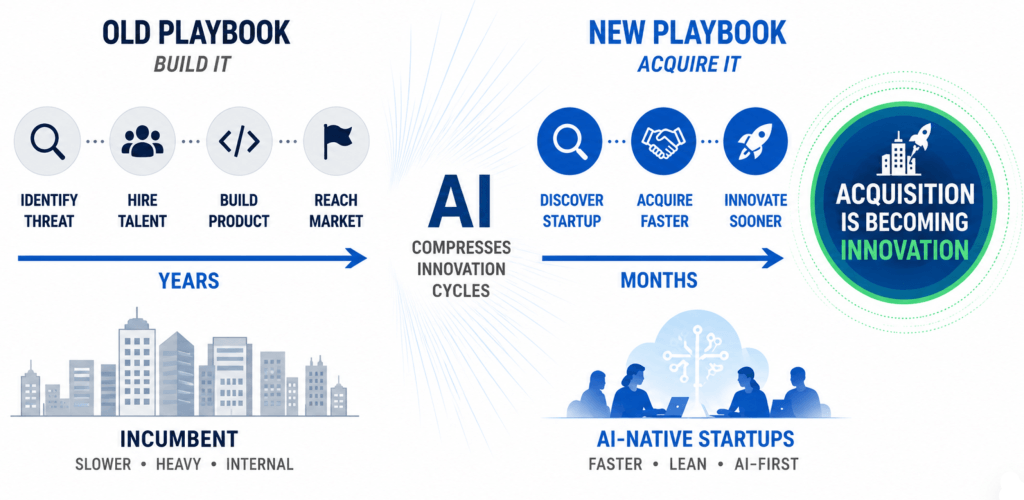
AI-native startups can now build sophisticated products in months instead of years. Small teams equipped with AI development tools, reusable cloud infrastructure, and digital labor can reach product-market fit faster than ever before. By the time an incumbent identifies a competitive threat, hires engineering talent, secures funding, and develops a new product, an AI-native startup may already own the market.
The result is a fundamental shift in innovation economics.
Increasingly, established companies are discovering that the fastest path to innovation is not to build every capability internally, but to acquire differentiated AI companies before competitors do. Cisco pioneered this strategy during the networking revolution. AI is now accelerating that model across virtually every software category.
For entrepreneurs, this also changes the startup equation. Instead of building companies exclusively for billion-dollar IPOs, founders increasingly have an opportunity to create highly differentiated AI businesses designed for earlier strategic acquisition. Many investors are no longer chasing unicorns.
The implication is profound: Acquisition is becoming innovation.
The Changing Economics of Innovation
For decades, large enterprises enjoyed a structural advantage. They had the engineering talent, financial resources, global reach, customer relationships, and research budgets needed to out-innovate smaller competitors. While startups often introduced disruptive ideas, turning those ideas into market-leading businesses required years of development, large engineering organizations, and enormous capital. Innovation was largely a function of scale.
That equation is rapidly changing as AI democratizes innovation.
Agentic AI software development, foundation models, cloud-native infrastructure, and open-source AI frameworks have dramatically lowered the cost, complexity, and time required to build sophisticated software products. Small, AI-native teams can now accomplish what previously required hundreds of engineers and years of development, allowing startups to move from concept to product-market fit with unprecedented speed and capital efficiency.
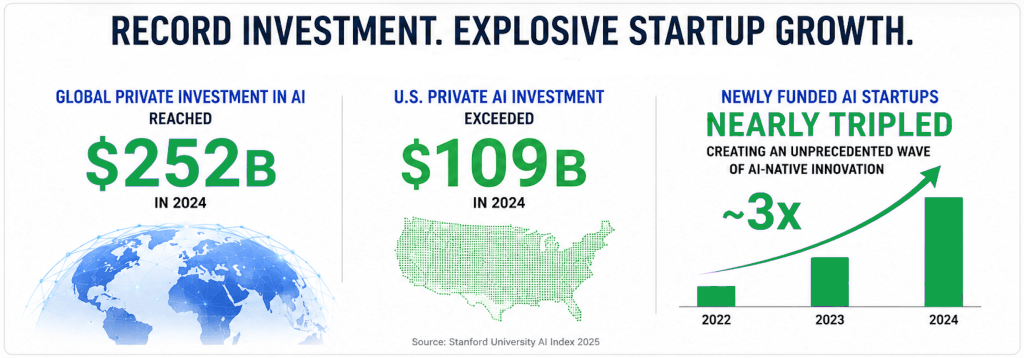
At the same time, investment capital is accelerating this transformation. According to Stanford University’s AI Index, global private investment in AI has reached more than $252 billion, while U.S. private AI investment alone exceeded $109 billion. Even more telling, the number of newly funded AI startups nearly tripled, creating an unprecedented wave of AI-native companies attacking highly specialized business problems across virtually every industry.
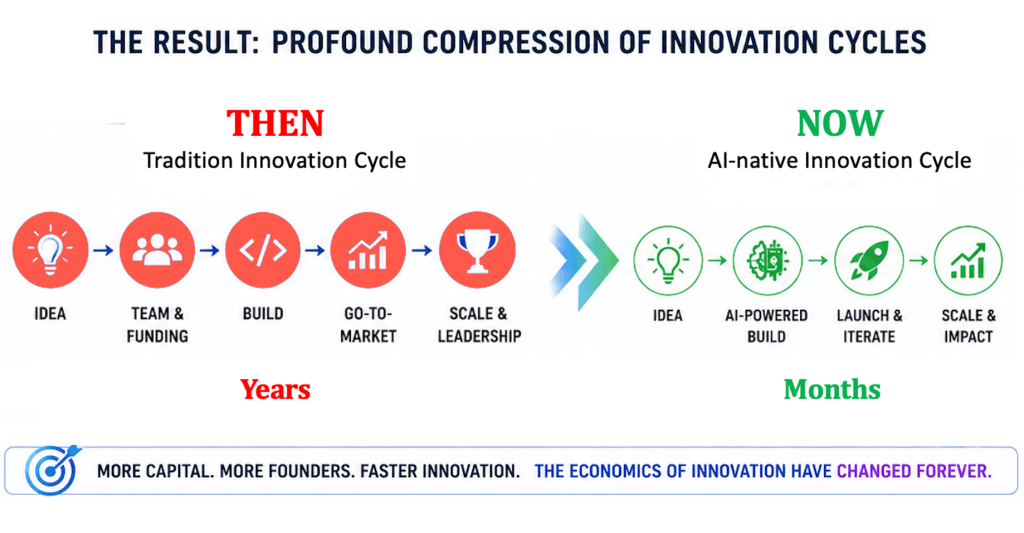
The result is a dramatic compression of innovation cycles.
Markets that once evolved over five to ten years can now shift in months. Product differentiation is increasingly short-lived. New competitors emerge faster, iterate faster, and often establish meaningful customer traction before established vendors have completed annual planning cycles, assembled engineering teams, or finalized internal product roadmaps.
This acceleration fundamentally reshapes the competitive landscape for incumbent companies. By the time many organizations identify an emerging opportunity, secure funding, hire engineering talent, and develop a competing product, an AI-native startup may already have achieved product-market fit, built a loyal customer base, and become the recognized innovator in that category.
Perhaps even more significantly, AI is changing the economics of entrepreneurship itself.
Founders no longer need to raise enormous amounts of capital simply to build an initial product. Lean teams can validate markets earlier, iterate continuously, and scale with dramatically greater capital efficiency. The barriers to company creation continue to fall, enabling thousands of entrepreneurs to pursue narrow, domain-specific opportunities that would have been economically impractical only a few years ago. Innovation is no longer concentrated within a handful of technology giants. It is becoming decentralized across thousands of AI-native startups, simultaneously experimenting in every corner of the economy.
This shift is also redefining how value is created.
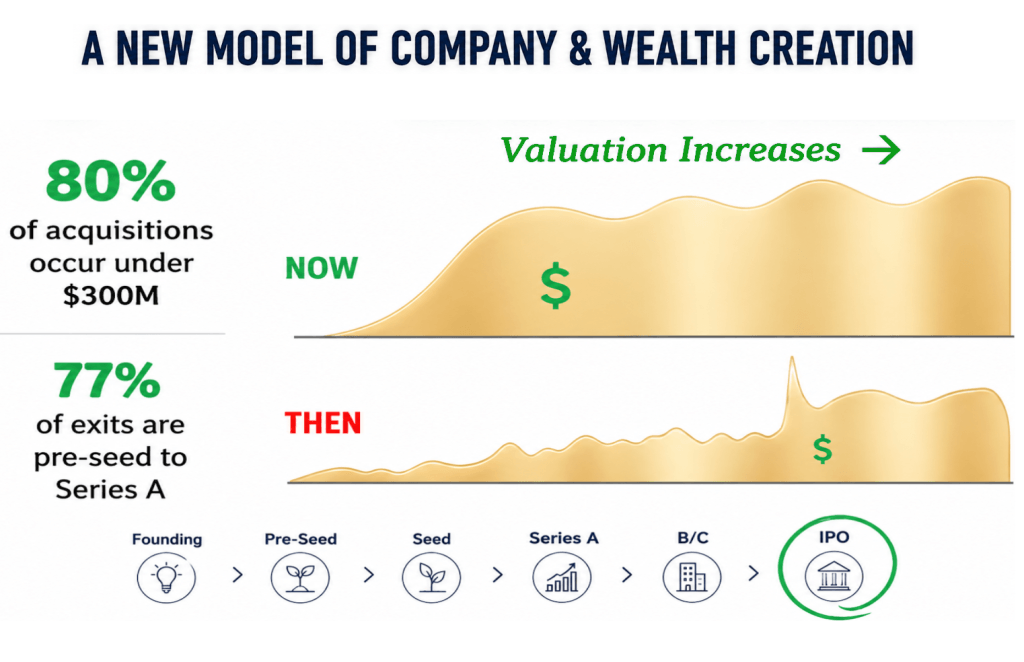
For decades, the prevailing startup philosophy centered on a single destination: build a billion-dollar company, complete an IPO, and realize the greatest value in the public markets. Today, that assumption is increasingly being challenged. During our discussion, Mark McNally, Founder and “Chief Nobody” of Nobody Studios, noted that nearly 80% of acquisitions occur below $300 million, while approximately 77% of successful startup exits happen between the pre-seed and Series A stages. Rather than maximizing value after an IPO, many founders are realizing significant value much earlier by building highly differentiated businesses that become strategically indispensable to larger organizations.
During our Next Frontiers of AI podcast discussion, Mark used this data to reinforce the idea that the new wealth-creation model isn’t about chasing rare unicorns. It’s about building strategically valuable companies that become attractive acquisition targets much earlier:
“People are missing the thousands of successful exits out there where people were below that radar, and I think that’s where the sweet spot is.”
Clearly, the economics of innovation have fundamentally changed. The strategic question is no longer whether organizations should acquire innovation. It is whether they can identify, evaluate, and acquire the next breakthrough before someone else does.
Rethinking the Startup End Game
The AI era is quietly rewriting one of the most fundamental assumptions in entrepreneurship: that success requires building the next billion-dollar company, the so-called unicorn.
For the last two decades, venture capital celebrated unicorns. Founders were encouraged to raise increasingly larger funding rounds, pursue hyper-growth at all costs, and ultimately seek IPO-scale outcomes. That model produced some of the world’s largest technology companies, but it was built on an economic reality that no longer exists.
AI has dramatically compressed the cost, time, and talent required to build meaningful companies. Small teams can now reach product-market fit in months instead of years. Infrastructure that once required tens of millions of dollars can now be rented by the hour. AI agents increasingly replace work that once demanded entire engineering organizations.
Ironically, these same forces also shorten competitive advantage. When products can be replicated quickly, waiting years to build an independent category leader becomes increasingly risky. The value of innovation is realized earlier in the lifecycle, often before companies reach traditional venture milestones.
The result is a new exit model.
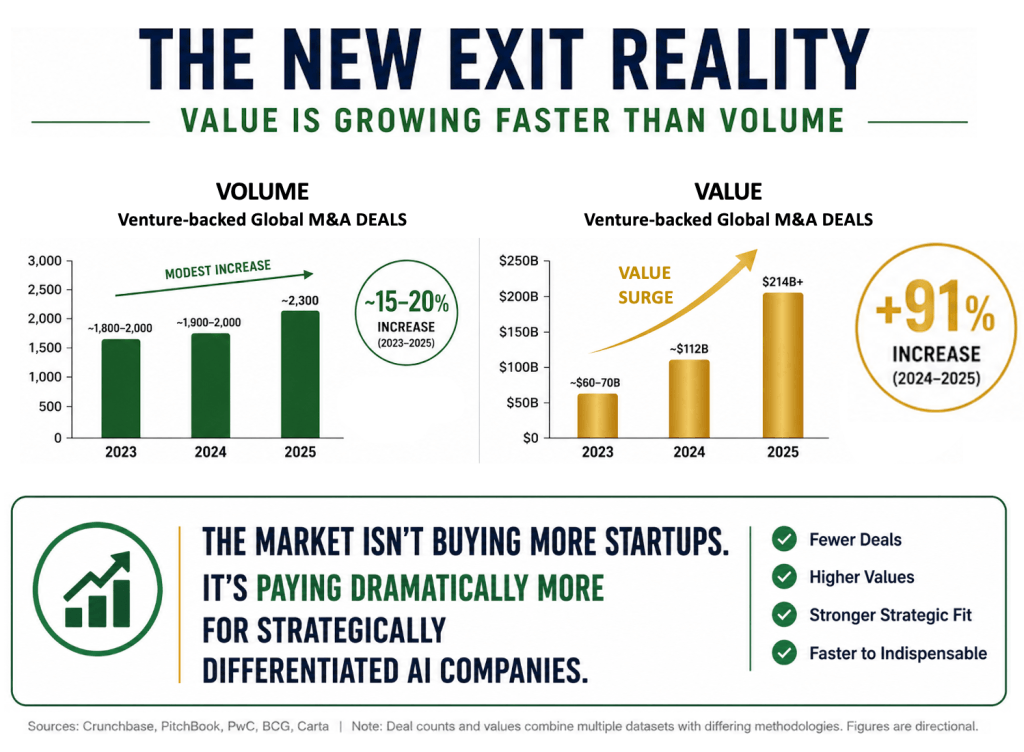
Recent acquisition trends reinforce this shift. Following the venture market reset in 2023, acquisition activity has become increasingly selective. Yet while overall deal volumes have recovered only modestly at around 15-20% YoY, the value of venture-backed acquisitions has surged. In 2025, the total value of venture-backed M&A transactions increased by 91% YoY, despite only a modest increase in the number of acquisitions.
This is a profound market signal.
Buyers are not simply acquiring more startups. They are paying significantly more for the few AI-native companies that achieve meaningful strategic differentiation.
As AI compresses the time required to build valuable technology, companies are reaching acquisition-worthy milestones much earlier in their lifecycle. The market is placing a premium on startups that solve highly specialized problems, demonstrate rapid customer adoption, or possess intellectual property that accelerates an acquirer’s own AI strategy.
In many ways, AI is compressing the lifecycle of company creation itself. Instead of spending a decade building toward an IPO, founders can now create substantial enterprise value in just a few years. Success is increasingly measured not by how long a company remains independent, but by how quickly it becomes strategically indispensable.
Instead of chasing unicorns and IPOs, many founders are intentionally building companies designed for strategic acquisition within two to five years. These businesses solve highly specific problems, achieve rapid customer adoption, and become valuable innovation assets for larger software vendors, hyper-scalers, vertical SaaS providers, and private equity firms seeking to accelerate their AI strategies.
This helps explain why the vast majority of AI acquisitions never make headlines. While billion-dollar acquisitions capture public attention, thousands of smaller transactions quietly reshape the technology landscape every year. These acquisitions represent not failure, but successful execution of a fundamentally different business model.
In many ways, acquisition has become the new commercialization strategy.
Rather than asking, “Can we build the next Salesforce?” founders increasingly ask, “Can we build something indispensable to Salesforce?”
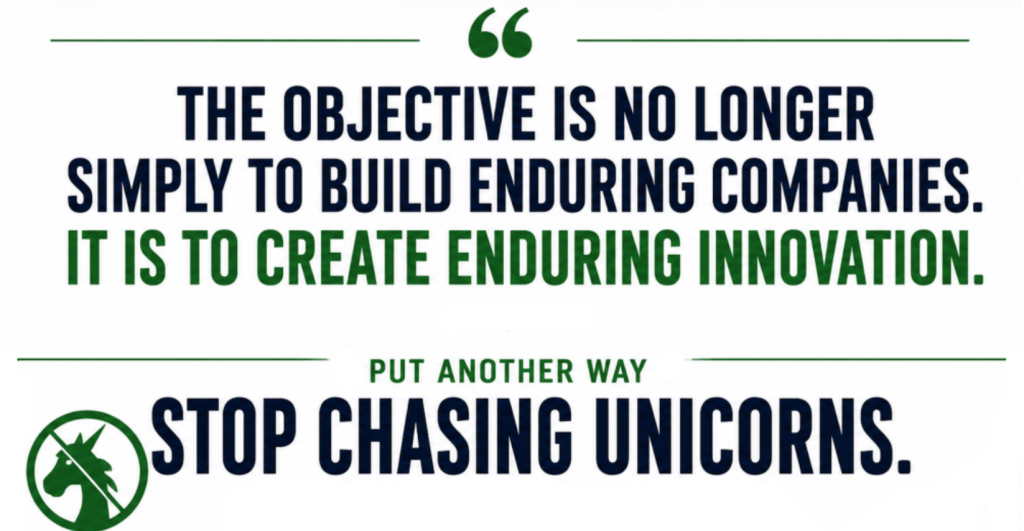
The objective is no longer simply to build enduring companies. It is to create enduring innovation.
Or, put another way:
Stop chasing unicorns. Start building companies someone can’t afford not to buy.
Venture Studios: The Next Innovation Factories
If building companies has become dramatically faster, cheaper, and more iterative, the obvious question becomes: Who is best positioned to build them? In the AI era, the answer is not the traditional startup accelerator, incubator, or even the corporate innovation lab.
It is the venture studio.
The venture studio model was already gaining traction before generative AI, but AI has fundamentally changed its economics. When launching a software company no longer requires dozens of engineers, years of development, and tens of millions of dollars, the bottleneck shifts from capital and coding to ideas, market validation, and execution.
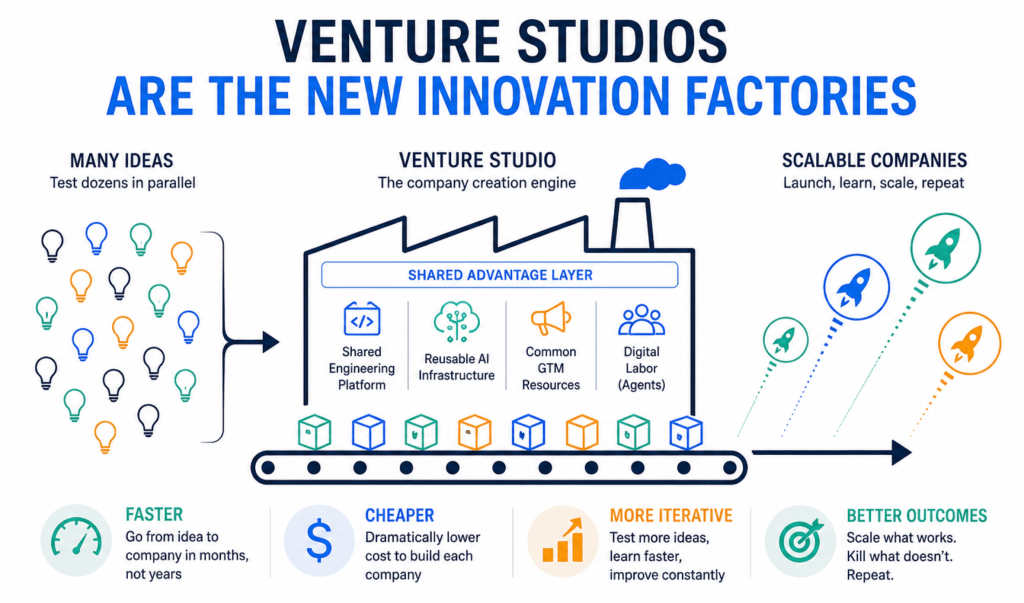
Instead of placing a handful of expensive bets, venture studios can now test dozens of AI-native business concepts in parallel. Shared engineering platforms, reusable AI infrastructure, common GTM resources, and rapidly deployable digital labor dramatically reduce the cost of creating each new company while increasing the number of opportunities that can be explored.
In many ways, venture studios are becoming the innovation factories of the AI era.
Just as manufacturing transformed from custom craftsmanship to assembly-line production, company creation is evolving from one-off entrepreneurial efforts into repeatable innovation systems. AI allows founders to automate much of the product development, software engineering, customer support, marketing, finance, and operational work that once required entire departments. The result is a highly scalable company-building process where knowledge compounds across an expanding portfolio rather than remaining isolated within individual startups.
Nobody Studios, a widely recognized global top-10 venture studio, is an excellent example of this evolution. Rather than building a single company, the organization has engineered a repeatable process for discovering opportunities, validating markets, launching businesses, and scaling the strongest signals while quickly shutting down weaker concepts. The objective is not simply to improve startup success rates. It is to dramatically increase the number of high-quality attempts while continuously improving the underlying company creation engine.
This approach aligns remarkably well with the realities of the AI era. Innovation cycles continue to compress. Market windows open and close in months rather than years. Customer needs evolve alongside rapidly advancing foundation models. Under these conditions, organizations capable of repeatedly creating, testing, and refining new businesses gain a structural advantage over those relying on infrequent, high-risk innovation initiatives.
Ironically, the largest beneficiaries of this model may not be startups themselves. Established software companies, private equity firms, and large enterprises increasingly need a continuous pipeline of AI-native innovation that they cannot build quickly enough internally. Venture studios provide that pipeline, producing strategically differentiated companies that are acquisition-ready long before traditional internal R&D organizations could deliver comparable capabilities.
In this sense, venture studios are becoming more than startup incubators. They are emerging as the manufacturing plants for the next generation of AI companies, supplying the innovations that larger organizations will increasingly acquire rather than attempt to build themselves.
AnalystANGLE – Our Take
For nearly fifty years, the software industry has largely followed the same innovation model. Large technology companies invested heavily in R&D, launched new products, and occasionally acquired startups to fill gaps.
It’s our view that artificial intelligence is rewriting that playbook. Innovation cycles now move faster than traditional product organizations can respond. Foundation models evolve monthly. New agentic AI capabilities appear weekly. Vertical AI startups can achieve product-market fit before many large enterprises finish defining requirements for competing initiatives. The consequence is profound.
Increasingly, the competitive advantage will not belong to the organizations that invent every breakthrough internally. It will belong to those who systematically discover, validate, acquire, and integrate innovation faster than everyone else. In many respects, acquisition is becoming a new form of innovation.
Venture studios such as Nobody Studios represent an early example of this structural shift. Rather than viewing company creation as a sequence of isolated startup bets, they industrialize the innovation process itself, continuously launching, testing, refining, and retiring ideas based on real market signals. Their output is no longer simply startups. It is a repeatable innovation engine. We believe this model foreshadows where much of enterprise innovation is heading.
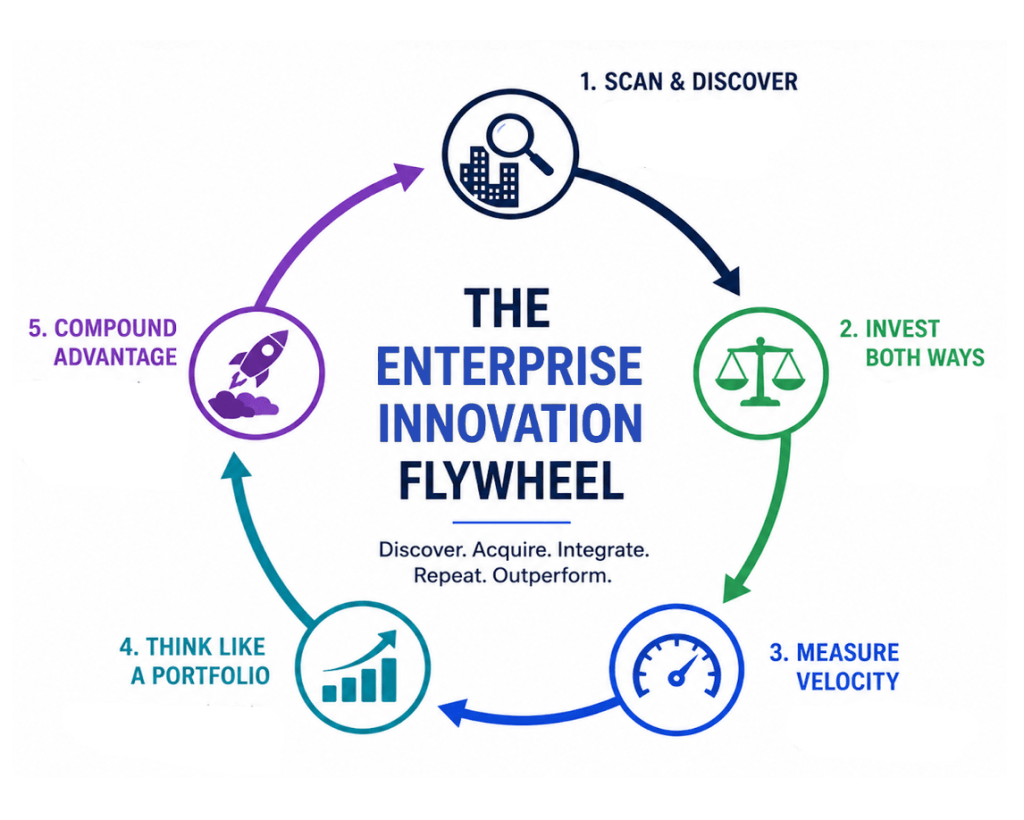
For Enterprise Leaders:
Treat corporate development as a strategic innovation capability, not simply a financial function. The ability to identify and integrate emerging AI companies may become as important as internal product development.
Expand competitive intelligence beyond traditional competitors. Thousands of AI-native startups are quietly creating capabilities that may redefine entire software categories before incumbents recognize the opportunity.
Balance internal development with external acquisition. Internal R&D remains essential, but relying exclusively on internal innovation is increasingly unlikely to keep pace with AI-native markets.
Measure innovation velocity alongside financial performance. Speed of experimentation, validation, partnership, and acquisition should become executive-level performance indicators.
Transform your portfolio thinking. Successful AI innovation will increasingly resemble venture investing, in which many experiments yield a small number of transformational winners.
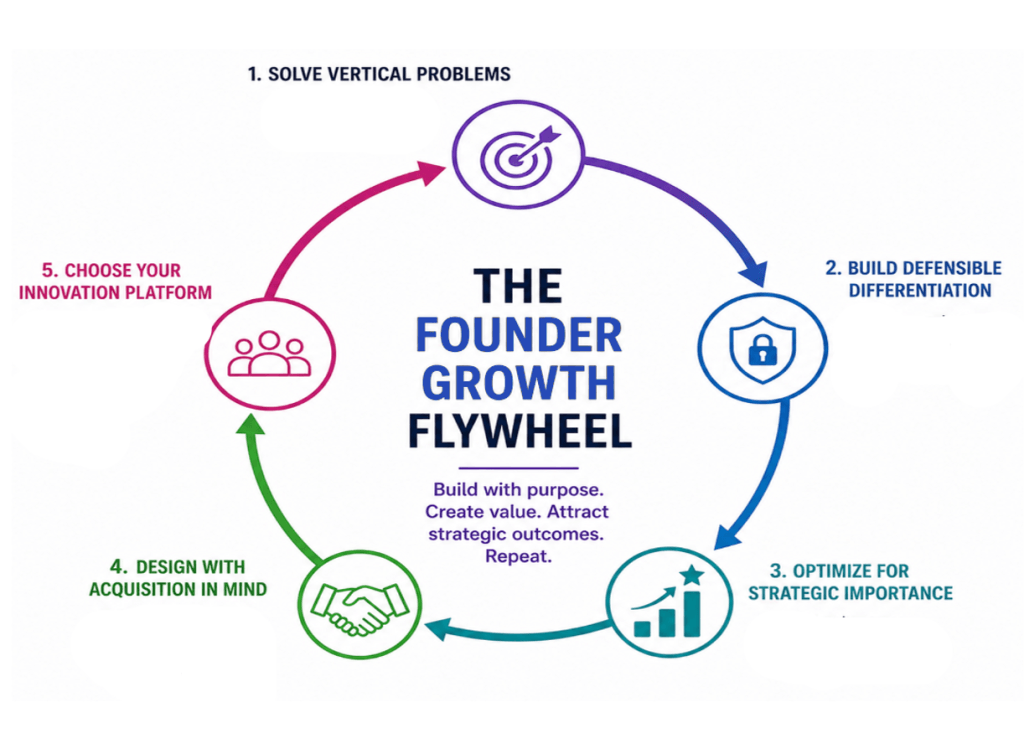
For Founders:
Solve meaningful, vertical business problems rather than building generic AI applications. Durable companies emerge from domain expertise, proprietary workflows, and measurable business outcomes.
Build defensible differentiation. Foundation models are becoming commodities. Proprietary data, operational knowledge, customer relationships, and unique execution increasingly determine long-term value.
Optimize for strategic importance rather than valuation headlines. Becoming indispensable to a larger platform company can produce exceptional outcomes for founders, customers, employees, and investors alike.
Design with acquisition in mind from the beginning. Ask not only whether customers need the company, but whether a future strategic buyer will eventually consider owning it essential.
Choose your innovation platform carefully. Just as startups once benefited from cloud platforms, tomorrow’s founders may gain a competitive advantage by building within venture studios that offer shared talent, capital, AI infrastructure, and repeatable commercialization expertise.
Our Prediction:
The next decade will likely produce fewer standalone software giants than in previous technology cycles, but significantly more AI companies. Many will never become household names.
Instead, they will quietly become part of larger software platforms through acquisition, continuously refreshing the innovation pipelines of established technology companies.
In that future, venture studios become more than startup incubators.
They become the manufacturing plants for AI innovation.
And acquisition becomes one of the most powerful innovation strategies of the AI era.
Analyst Bottom Line: The AI era changes not only how companies are built but also how innovation itself is manufactured. Organizations that continuously discover, acquire, and integrate AI-native capabilities will increasingly outperform those relying solely on traditional R&D. The innovation race is becoming a race to create companies, not products.