AI data is becoming the most valuable, the most targeted, and the least protected asset
AI is moving faster than most organizations’ ability to secure and protect what they’re building.
AI adoption is accelerating rapidly
theCUBE Research data shows that nearly three-quarters (73%) of organizations have moved beyond experimentation into maturing or fully operational AI deployments. AI is becoming embedded across workflows, decision-making, and customer-facing systems. It also introduces entirely new categories of data: training datasets, model weights, inference outputs, vector embeddings, and increasingly, continuously generated data streams.
Protection is lagging behind
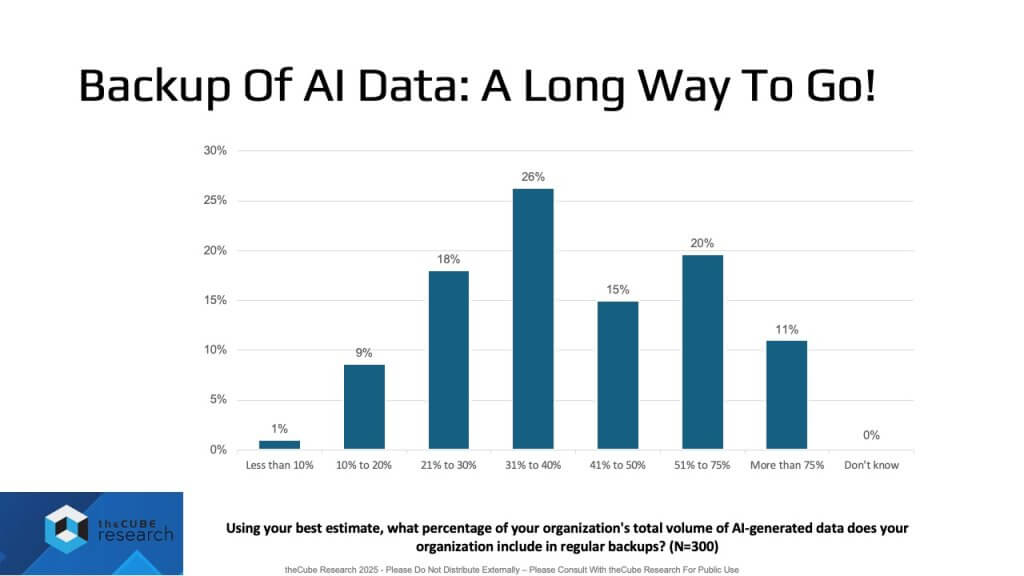
However, protection of these increasingly critical data streams is lagging significantly. Our research found that less than 1/3rd of of organizations have backed up more than half of their AI-generated data (see below).
This gap is a threat because this data is under siege.
AI data is under active attack
Organizations are already experiencing AI-specific security exposures such as data poisoning, model theft and inversion, prompt injection, and sensitive data exfiltration. Even attacks targeting AI systems are ultimately aimed at the data behind them, as reflected by Verizon’s 2025 Data Breach Investigations Report, which found that more than 50% of documented cyber incidents resulted in confirmed breaches involving unauthorized access to data.
The result is a growing unprotected AI surface area that expands every time a model is trained, a pipeline is deployed, or an application goes live.
Why AI breaks traditional protection models
Traditional data protection strategies were built around structured data, predictable workloads, and well-defined recovery points.
AI disrupts all three.
- Data is dynamic: continuously generated, transformed, and reused, at scale. In our research, organizations identify a significant increase in data creation as a common challenge associated with AI adoption.
- Workloads are distributed: spanning multiple cloud environments, on-premises infrastructures, and edge deployments. AI environments are already fragmented across these domains, and will remain so.
- Recovery is more complex: restoring a model is not the same as restoring a database
Losing AI data can mean material business disruption, including re-training models from scratch, loss of intellectual property, disruption to business-critical workflows, and increased regulatory and compliance exposure, all impacts that organizations explicitly associate with AI data loss.
Security is driving urgency, but not yet maturity
Encouragingly, these concerns are now leading drivers behind AI data protection decisions, with 33% of organizations citing security exposure, followed by data privacy (26%) and compliance (23%) as top considerations.
But recognizing the problem is not the same as being ready to address it.
Many organizations are still grappling with:
- Lack of visibility into AI data flows
- Inconsistent governance models
- Difficulty integrating protection into AI pipelines
- Skills gaps and tooling fragmentation
Closing the gap: from experimentation to operational resilience
The next phase of AI adoption will not be defined by who can build the most models.
It will be defined by who can operate them securely, reliably, and at scale.
That requires a shift in thinking:
- From backing up data to protecting AI systems and lifecycles
- From static policies to adaptive, context-aware protection
- From recovery as an afterthought to resilience by design
AI is quickly becoming a core part of the enterprise operating model.
Data protection must evolve just as quickly, or it risks becoming the weakest link in the AI stack.