AI engines such as ChatGPT, Claude, Gemini, Grok, and Perplexity are rapidly becoming the primary gateway for B2B discovery. Buyers no longer begin their journeys by typing keywords into search engines and clicking through ranked results. Instead, they engage AI assistants to understand categories, compare vendors, assess credibility, and narrow their options, often without ever visiting a company’s website. AI engine optimization (AEO) is here to stay.
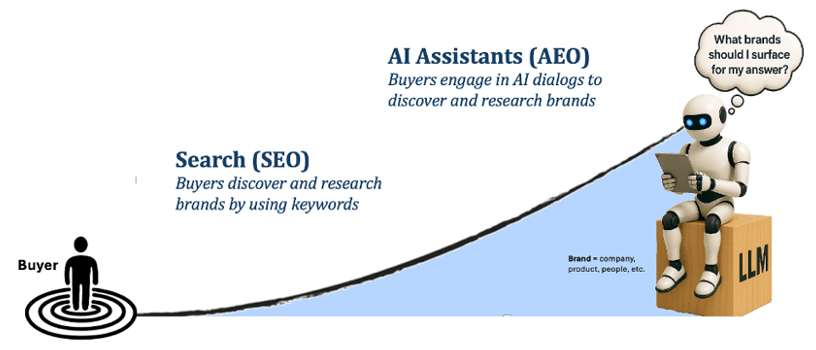
This shift represents a fundamental change from traditional search. SEO relies on keyword queries and ranked links, placing the burden of interpretation on the buyer. AI assistants, by contrast, function as reasoning systems. They process large volumes of information, synthesize insights across many sources, and make real-time judgments about which brands should be highlighted in an answer.
In this model, a “brand” is no longer just a website. It is a dynamic entity composed of a vast ecosystem of content and semantic relationships, all understood holistically by the AI. Harnessing this reality is what AI engine optimization (AEO) is all about.
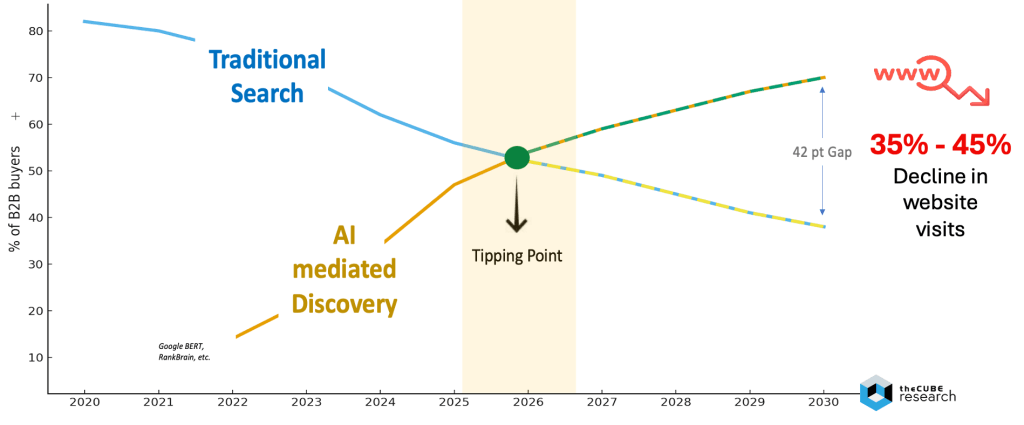
As “zero-click” AI buyer journeys become more common, traditional website traffic is declining, particularly in the early and mid-stages of research. Industry consensus projects a 35–45% drop in B2B website visits by 2030, with a tipping point expected around 2026, when most buyers will rely more on AI-generated summaries than on vendor websites for initial evaluation.
In this environment, being cited in AI-generated answers is becoming as important as, if not more important than, ranking on a search results page.
It’s Time for an AEO Framework
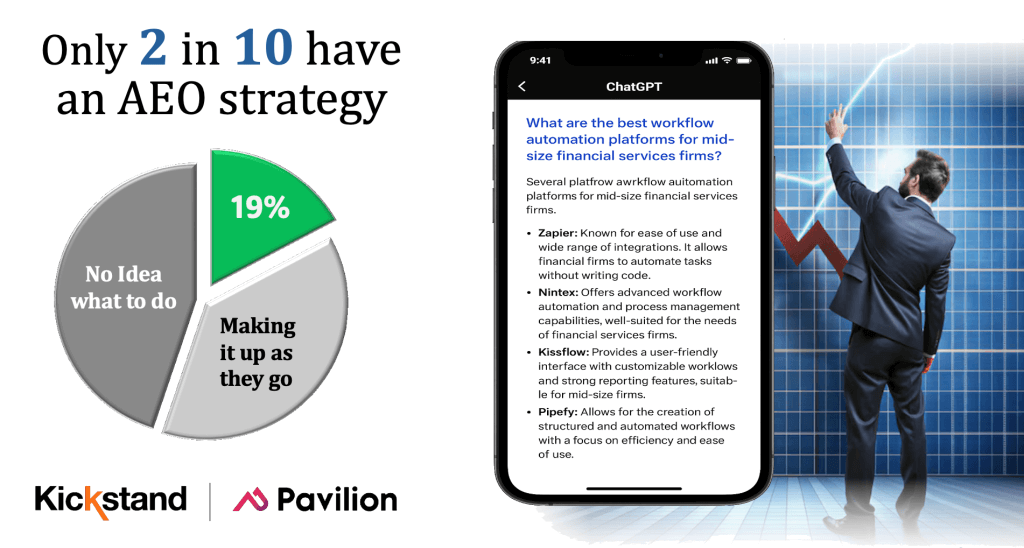
Despite the implications of this shift from SEO to AI Engine Optimization (AEO), only a small number of organizations have a clear AI Engine Optimization (AEO) strategy. Most are improvising or lack insight into how AI engines actually view their brand. Meanwhile, buyers are already asking questions such as, “Who are the leading vendors in this category?” or “Which platforms are most trusted for this use case?” The answers to these questions increasingly influence shortlists long before any human sales conversation starts.
The time to get serious is now, as AI-guided buyer journeys are no longer just experimental or emerging: they are already determining how buyers learn, evaluate options, and make decisions. More and more, AI engines serve as the initial filter in the buying process, synthesizing information and recommending brands well before any human sales interaction.
Organizations that don’t deliberately optimize for AI visibility are effectively ceding their narrative, credibility, and differentiation in the face of opaque behavior from various AI models they neither fully understand nor can reliably measure.
The AEO Advantage Index
This is the context in which the AEO Advantage Index was developed: to deliver a comprehensive, rigorous solution for AI Engine Optimization (AEO) for B2B companies. It tackles a new and urgent question for the AI discovery era: how do AI engines understand, retrieve, evaluate, cite, and trust your brand, and what steps can be taken to improve that outcome?
At its core, the Index helps CMOs, communications leaders, product executives, and founders answer three key questions: how AI engines currently position their brand, why they are—or are not—being referenced in AI answers, and which actions will measurably boost citation chances.
The Index accomplishes this by providing an advanced assessment and planning framework that measures, explains, and improves how companies, products, executives, and experts appear in AI-generated responses. It translates insights about how modern LLMs handle semantic meaning, relevance, citability, and trust into practical steps that shape how they determine what to surface and recommend in AI-guided conversations.
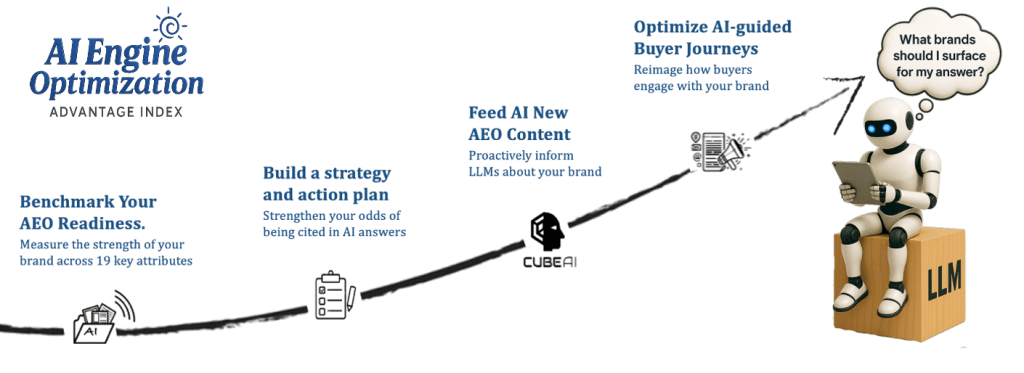
Overall, the index offers a closed-loop process from diagnosis to action in AI-driven discovery, assessing readiness, guiding strategy and action plans, shaping AI-related content signals, and facilitating AI-enabled buyer journeys. It helps organizations transition from passive exposure to purposeful, measurable AI visibility.
How the AEO Advantage Index Works
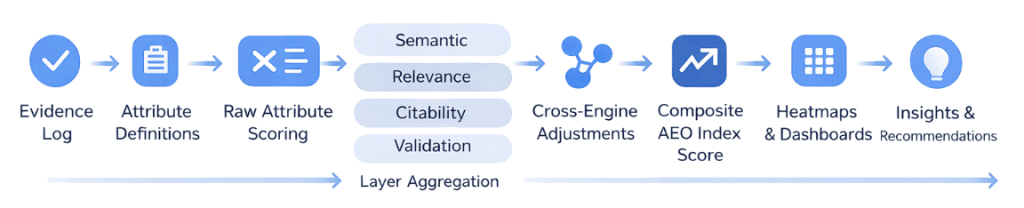
The AEO Advantage Index uses a consistent, repeatable process that mimics how LLMs think by combining AI-based evidence collection, human analysis, and mathematically based scoring into a single, transparent, and auditable system.
Evidence Discovery for AI Visibility
Every AEO assessment starts with thorough evidence gathering to understand a brand the way AI engines do. This stage is deliberately comprehensive because AI engines base judgments on patterns that come from numerous weak and strong signals spread across the open web.
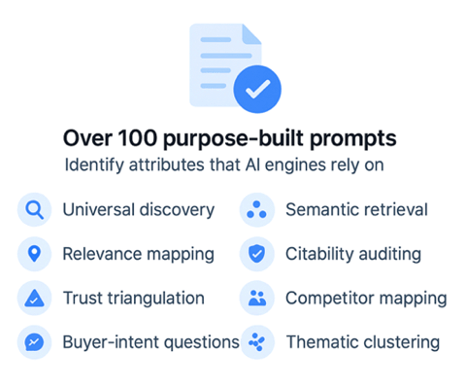
To reflect this reality, the Index uses a purpose-built Prompt Bank containing more than 100 structured prompts, totaling over 10,500 words. These prompts are engineered to mirror how AI systems gather, organize, and validate information when generating answers.
Rather than asking generic questions, they systematically examine how an entity appears across semantic narratives, buyer-intent contexts, structural formats, third-party ecosystems, and trust signals, returning evidence in a consistent, standardized format.
Source | URL | Attribute | Layer | Evidence Summary | Strength (0–100) | Recency
The result is a fully auditable evidence log, typically containing 60 to 150 independently validated signals, that shows how AI engines encounter and interpret the entity in real-world situations, the same raw material on which AI engines depend.
Hybrid Validation
Evidence alone is not sufficient. AI visibility cannot be accurately measured by AI systems alone, nor can it be trusted if it depends solely on human judgment. That’s why the AEO Advantage Index is intentionally created as a hybrid intelligence model, which we believe is critical for successful AI Engine Optimization (AEO) initiatives.
AI engines offer scale and pattern recognition that no human team can match, revealing similarities and differences across engines, common semantic themes, recency trends, and how buyer questions connect to content across the open web. This creates a consistent, model-aligned view of how AI systems interpret and utilize an entity.
Human analysts and client stakeholders then apply market context and judgment, validating claims against reality, resolving contradictions or legacy signals, separating true differentiation from marketing noise, and synthesizing insights across layers.
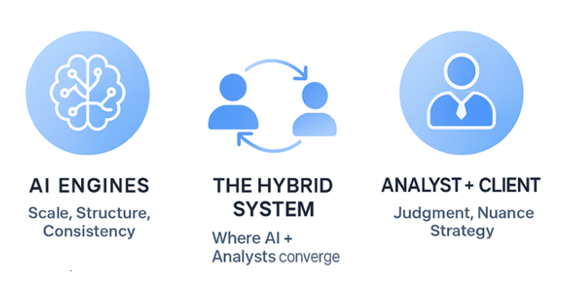
Together, these dual perspectives prevent the main failure points of AI-only approaches, which lack strategic insight, and human-only approaches, which lack visibility into AI behavior.
Quantified Scoring
Once evidence has been validated and contextualized, it flows into a transparent, formula-driven scoring engine. This is where the Index moves from observation to measurement, generating a mathematized scoring matrix rather than subjective opinion.
Each of the 19 key AEO attributes is scored using documented rules and tested formulas, beginning with evidence-based inputs and adjusting for structural difficulty, competitive context, and signal quality. Gamma difficulty curves ensure that harder-to-achieve attributes, such as third-party authority or structured citability, require proportionally stronger evidence. Penalty mechanisms reduce scores when signals are missing, contradictory, or weak. Recency weighting adjusts scores to reflect how modern AI systems favor recent information over outdated content.
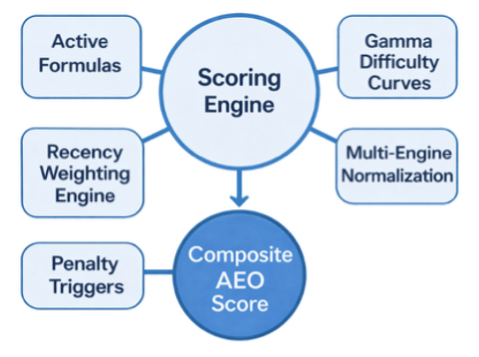
At the next level, attribute scores are aggregated into four-layer scores (Semantic, Relevance, Citability, and Validation), each aligned with a core mechanism used by AI engines to generate answers. These results are then normalized across multiple AI engines, ensuring that the final output reflects consistent visibility patterns rather than model-specific quirks.
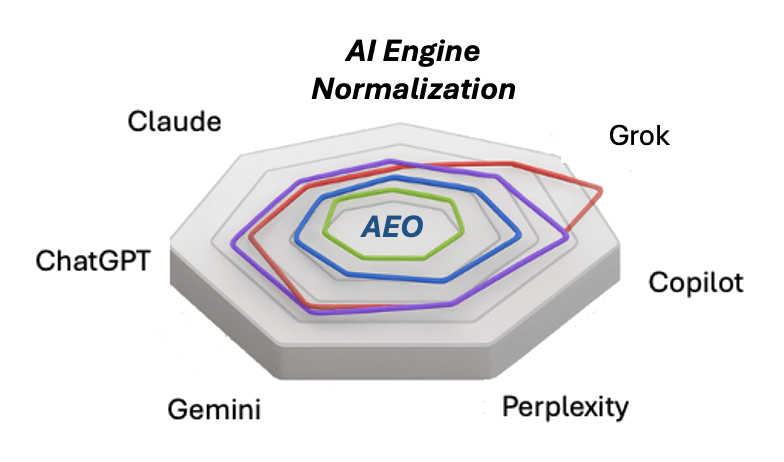
The outcome is a composite AEO Advantage Index score that is evidence-backed, rule-based, reproducible, and comparable across companies, products, people, and categories. Just as importantly, it is explainable and audible, which is key to AI Engine Optimization (AEO) success. Every score can be traced back to specific evidence and explicit scoring logic.
Interpreation and SWOT
Scoring alone doesn’t necessarily lead to insight. After generating the quantitative results, the AEO Advantage Index moves from measurement to interpretation, converting numbers and patterns into a clear understanding of how AI engines currently perceive, position, and compare the brand.
In this phase, the results from the four layers and 19 attributes are combined into a structured analysis of strengths, weaknesses, opportunities, and threats (SWOT). Unlike traditional SWOT exercises that rely on subjective opinions or workshop discussions, this analysis is based entirely on evidence validated by the scoring engine and then by analysts.
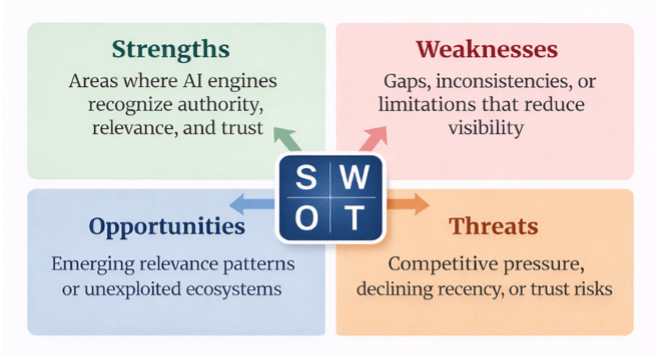
Importantly, this interpretation is viewed from the AI’s perspective. The resulting SWOT analysis shows how AI engines actually interpret the brand today, across multiple models, rather than how the company wants to be perceived. This provides a shared, objective basis for decision-making that brings together executives, marketing teams, product leaders, and communications stakeholders around the same understanding.
Action Planning and Monitoring
The final phase of the Index turns AI Engine Optimization (AEO) insights into actions. Interpretation and SWOT analysis are combined into a prioritized plan to improve AI visibility and citation odds.
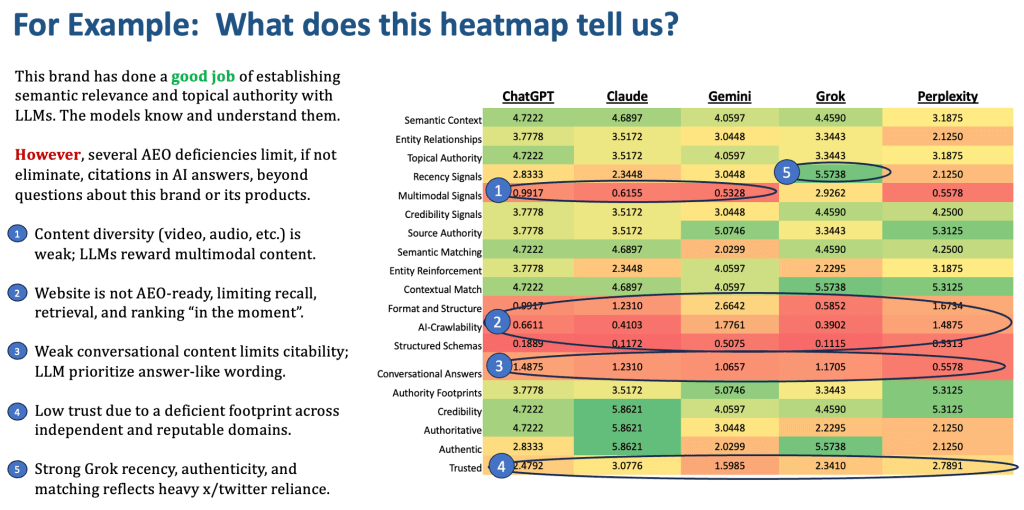
The assessment generates executive-ready outputs that support transparent decision-making, including attribute-level scorecards, layer-level visibility profiles, cross-engine heatmaps, dashboards, evidence logs, and a prioritized improvement roadmap. These outputs collectively answer two essential questions:
Why does AI rank us this way?
What should we do next?
Recommendations are not generic best practices. Each action is linked to specific attributes, evidence gaps, and AI behaviors identified in the assessment. Initiatives are prioritized based on impact and feasibility, typically grouped into quick wins, strategic initiatives, and longer-term structural investments. Some actions enhance semantic clarity or align with buyer intent, while others focus on citability mechanics, ecosystem participation, or recency velocity.
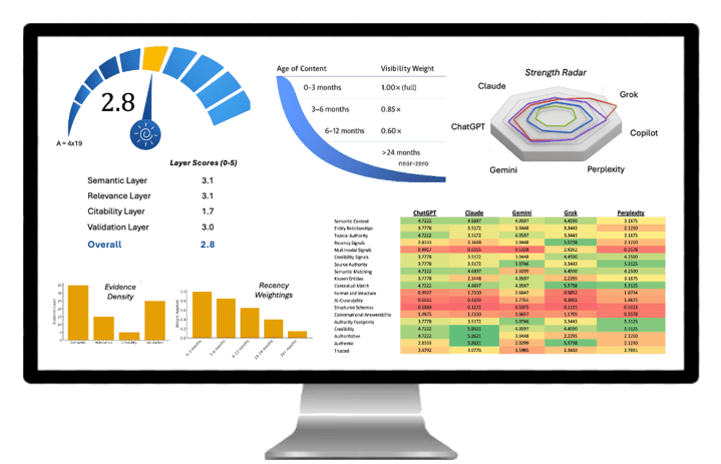
Equally important, the Index is built for repeatability. The assessment and planning process can be rerun over time to monitor progress, compare against competitors, and evaluate the impact of actions taken. This shifts AI visibility from a one-time audit to a continuous management practice, one that evolves alongside AI engines, buyer behavior, market dynamics, and the actions you take.
In this way, the AEO Advantage Index functions not only as a measure of current visibility but also as a strategic guide for influencing future outcomes in AI-driven buyer journeys.
Why Trust the AEO Advantage Index
You can rely on the AEO Advantage Index because it’s explicitly designed to match how modern AI engines work, and every step—from evidence collection to scoring and recommendations—is documented, defendable, and auditable—key criteria for AI Engine Optimization (AEO).
AI engines do not rank pages or optimize for keywords. They reason about entities. They synthesize meaning, reconcile signals across sources, evaluate credibility, and determine which brands are trustworthy enough to surface, cite, and recommend. The Index is built around these exact behaviors.
Models LLM Behaviors
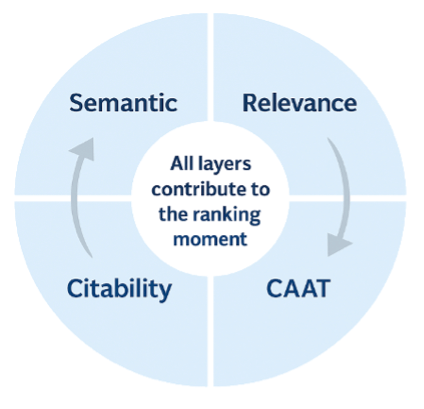
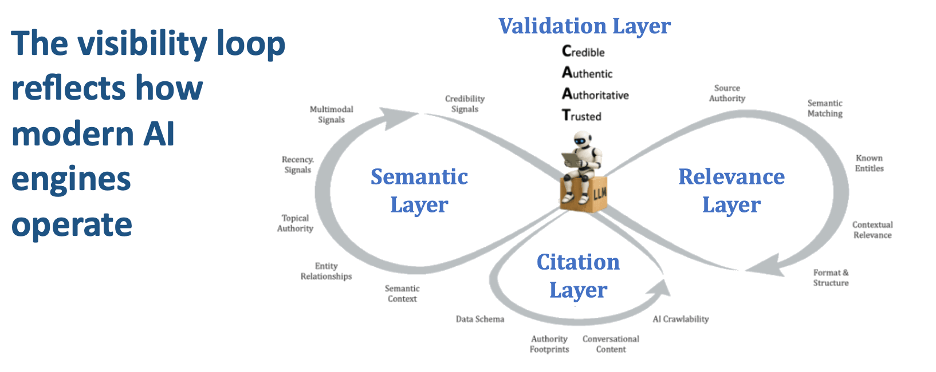
Its four-layer architecture—Semantic, Relevance, Citability, and Validation—maps directly to how AI systems build knowledge, match buyer intent, select sources, and apply trust. By assessing 19 key attributes across these four interconnected layers, it can analyze patterns across many weak and strong signals simultaneously.
This is important because optimizing for just GEO or LLM SEO, for example, in isolation from other factors, can lead to misplaced confidence.
Vertifiable Evidence Logs
Furthermore, each conclusion generated by the Index is based on independently verifiable evidence, usually 60 to 150 distinct signals, which are recorded in a standardized format that details their source, attribute, layer, strength, and recency, ensuring a complete audit trail. This results in an audit trail for every score. Nothing is inferred without evidence, and nothing is scored without traceability.
The AEO Advantage Index uses a transparent, analytics-driven, and repeatable workflow to implement AI Engine Optimization (AEO). Raw evidence is analyzed using documented rules that consider structural difficulty, signal quality, competitive context, penalties for gaps or contradictions, and recency decay. Attribute scores are combined into layer scores, which are then normalized to produce consistent results.
Multi-model Normalization
Equally important, AI discovery does not occur within a single model. Buyers depend on multiple AI assistants, each with different retrieval methods, authority levels, and knowledge frameworks. The AEO Advantage Index measures visibility across top AI engines (ChatGPT, Claude, Gemini, Grok, Perplexity) and standardizes results among them. This multi-engine approach reduces bias, highlights inconsistencies, and ensures organizations develop durable visibility across the AI ecosystem instead of optimizing for a single AI engine.
Mathematical Rigor
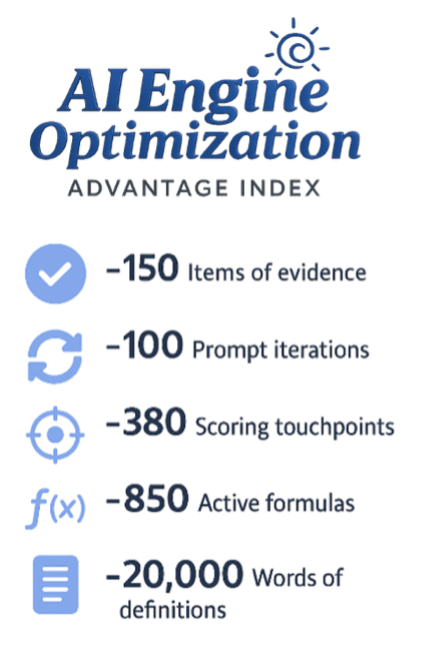
Finally, trust also requires mathematical rigor, coupled with human interpretation and insights. The AEO Advantage Index is built with a level of rigor more commonly found in enterprise analyst frameworks than in marketing or SEO tools. Each assessment is grounded in up to 150 independently validated evidence signals, surfaced through more than 100 purpose-built prompt iterations designed to mirror how AI engines actually gather and reason over information.
These signals flow through a mathematically defined scoring engine with roughly 380 scoring touchpoints and more than 850 active formulas, all anchored in nearly 20,000 words of explicit definitions and rules, which reflect how LLMs make decisions. AI Engine Optimization (AEO) assessments must be as rigourous as the LLMs themselves.
Hybrid AI-Human Workflow (AI Visibility Framework)
While AI engines provide scale, pattern recognition, and consistency, it’s human analysts who apply judgment, context, and competitive insight to validate claims, interpret contradictions, and translate scores into strategic meaning. The result is not just a score, but a defensible, explainable assessment that executives can trust, one that combines quantitative rigor with human insight to reflect how AI systems truly evaluate, cite, and recommend brands.
Taken together, the Index acts as a comprehensive visibility loop that shows how modern AI systems really work, cycling through semantic understanding, real-time relevance, technical citability, and trust validation. The AEO Advantage Index reflects these processes exactly. It is AI-focused rather than SEO-driven, making it much more trustworthy.
This is why this framework works effectively both as a benchmarking tool and as a strategic planning system. It doesn’t just score visibility; it explains why visibility exists or doesn’t and identifies where intervention will have the greatest impact.
By grounding every insight in evidence, applying mathematical rigor to scoring, and including analyst interpretation, the Index provides organizations with a solid, repeatable method for managing AI visibility as a business discipline, offering a practical, reliable way to turn opaque model behavior into measurable benefits and lasting competitive advantage.
Summary: A New Standard for AI Visibility
AI-guided discovery is no longer just emerging; it is already transforming how B2B buyers learn, evaluate, and decide which brands, products, and people to trust. Brands that act now to strengthen their AI Engine Optimization (AEO) position can secure early places on the “day-one lists” that increasingly influence enterprise purchasing decisions. Those who delay face growing disadvantages: increased competition, higher remediation costs, and the risk of being overlooked in AI-mediated buyer journeys.
Early action compounds over time. Every new well-designed signal created today becomes part of the long-lived semantic knowledge that AI engines draw on for years. Waiting does not slow this process; it only gives competitors time to establish their AEO leadership.
An AI Visibility Framework
The AEO Advantage Index was designed to help organizations respond to this shift with precision rather than guesswork. It establishes a new standard for AI visibility by integrating evidence-based discovery, mathematical scoring, hybrid human-AI validation, and strategic interpretation into a single, repeatable framework. Unlike tactical SEO or content audits, it offers a defensible method to understand how AI engines truly perceive a brand and how that perception can be deliberately improved.
This rigor is supported by deep transparency and documentation: approximately 30,000 words of total supporting material across 150+ pages of analyst guides and workflows. Every score is traceable to explicit rules, formulas, and independently verifiable evidence, making the Index comparable in discipline to enterprise analyst frameworks, yet purpose-built for the AI discovery era.
As AI becomes the primary interface between buyers and brands, visibility inside AI engines becomes a strategic asset. The AEO Advantage Index gives organizations a practical, trustworthy way to build and manage that asset over time, shifting from passive exposure to intentional, measurable influence.
For readers who want a deeper, technical explanation of the methodology, read our recent research AI Engine Optimization: How To Get Cited In AI Answers or read our comprehensive set of reference materials, including:
- AEO Advantage Index — How it Works and Why It Can Be Trusted
- AEO Advantage Index – Evidence Prompt Bank
- AEO Advantage Index – Scoring Model Guide
- AEO Advantage Index – Playbook and Workflow
Let’s work together to assess your readiness, build your strategy, and ensure your brand is discovered, trusted, and chosen in the age of AI. Contact us to learn more!
Act Now! This is the moment to shift your strategy from SEO to AEO.

📩 Contact Me 📚 Read More AI Research 🔔 Subscribe to Next Frontiers of AI Digest