I had the good fortune to attend the Cisco AI Summit 2026 in San Francisco this week. The event brought together policymakers, technologists, investors, and enterprise leaders to examine how artificial intelligence is moving from experimentation to large-scale operational impact. Unlike many AI-focused events centered on model performance or speculative futures, this summit emphasized execution, governance, infrastructure readiness, and workforce transformation.
Across sessions, a consistent message emerged: AI is no longer constrained by innovation velocity, but by organizational readiness, security posture, and the ability to translate capability into measurable outcomes. From geopolitics and cybersecurity to enterprise workflows, science, and workforce enablement, the discussions reflected an industry entering its first phase of AI normalization.
While early use cases were highlighted, such as coding or product management, it was clear that it is still in the early innings and that there is more work to be done on new 3D-4D World Models, knowledge-based use cases, whether the industry should have open or proprietary solutions and even AI data centers in space.
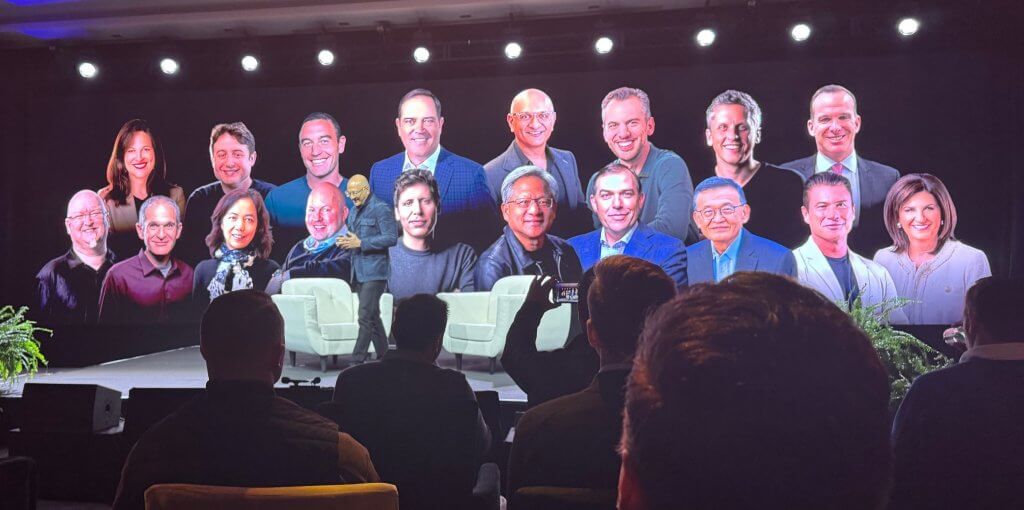
The sessions were crisp, at approximately 20 minutes each throughout the day. Sam Altman and Jensen Huang bookended the event, which provided a tremendous amount of insight and information to digest. I strongly recommend watching the replays if you have time. Below is a brief analysis of some of the sessions and my takeaways from the event.
Chuck Robbins, Chair and CEO, Cisco and Jeetu Patel, President and CPO, Cisco, kicked off the event to provide context and quickly highlight how Cisco is enabling an AI environment. They also hosted all the event sessions and wrapped up the event. Given that the Super Bowl was less than a week away, just down the road in Santa Clara, it reinforced the sense that this event was AI’s Super Bowl for thought leaders and innovators. Some of the sessions are covered below.
Frontier Models and AI: Sam Altman, CEO and Co-Founder, OpenAI
Altman positioned AI as a general-purpose capability entering its first phase of real-world normalization, where success will be determined less by novelty and more by execution, integration, and long-term stewardship. Altman framed the current moment in AI not as a breakthrough in raw capability, but as a shift in consequenceand responsibility. Rather than focusing on model benchmarks or short-term competitive dynamics, Altman emphasized how rapidly AI systems are becoming embedded in real economic, scientific, and societal workflows, and how that changes the stakes for builders and deployers alike.
Altman underscored that the challenge is no longer whether AI will work, but whether organizations can absorb and govern it responsibly at scale.
He also highlighted that the most durable value from AI will come from enabling people to operate at a higher level of abstraction, rather than replacing them outright. This places pressure on enterprises to rethink workflows, incentives, and trust models, not just tooling.
As Altman noted during the discussion, “The big change isn’t just that the models are getting smarter, it’s that they’re starting to change how work actually gets done, and that forces all of us to rethink how we build, deploy, and govern technology.”
Silicon and AI: Lip-Bu Tan, CEO, Intel
In his discussion at the Cisco AI Summit, Lip-Bu Tan approached AI from a distinctly systems- and silicon-first perspective, emphasizing that the next phase of AI progress will be constrained less by algorithms and more by compute efficiency, architecture, and supply chain execution. Rather than framing AI as purely software-driven, Tan emphasized that sustainable AI innovation depends on tight coupling among hardware, software, manufacturing, and ecosystem partnerships.
A central theme of his remarks was that the industry is exiting a period of abstraction and re-entering one where fundamental engineering discipline matters again. As AI workloads scale, inefficiencies in silicon design, memory hierarchies, interconnects, and power delivery are no longer tolerable. Tan stressed that leadership in AI will increasingly favor companies that can optimize across the full stack. Tan stated, “AI performance going forward is not just about better models, it’s about how efficiently you can deliver compute, memory, and interconnect at scale. The winners will be the ones who can engineer the entire system together.” This is a good reminder, as no one company can do it all, and for AI, enterprises are looking for reference architectures that span multiple ecosystem partners to accelerate adoption.
He also highlighted the strategic importance of resilient and diversified semiconductor supply chains, noting that geopolitical realities and AI-driven demand growth are forcing a rethinking of where and how advanced silicon is designed and manufactured.
In the context of the summit, his discussion reinforced a broader takeaway: while AI innovation may be led by software breakthroughs, AI outcomes will ultimately be delivered, or constrained, by the physical realities of silicon, networking, and energy.
3D and AI: Dr. Fei-Fei Li, CEO and Co-Founder, World Labs
In her conversation with Jeetu Patel, Dr. Fei-Fei Li underscored that the future of AI will be shaped less by larger language models alone and more by the development of world models, AI systems that can understand, predict, and reason about the physical world, not just generate text or code. She emphasized that true intelligence requires grounding in reality: perception, causality, and interaction with dynamic environments.
Dr. Li framed world models as foundational for progress in robotics, science, healthcare, and any domain where AI must operate safely and autonomously alongside humans. Without this grounding, she warned that AI systems risk remaining powerful but brittle, highly capable in digital domains yet unreliable in real-world settings.
As she noted during the discussion: “World models are essential because intelligence isn’t just about language or pattern matching—it’s about understanding how the world works, how actions lead to outcomes, and how systems can reason and learn in physical, human environments.”
Dr. Li’s focus on world models highlights a critical inflection point for enterprise and industrial AI. As organizations look to deploy AI into robotics, automation, digital twins, and physical operations, the ability for AI systems to model reality, anticipate consequences, and operate under uncertainty becomes a prerequisite for scale.
Content and AI: Aaron Levie, CEO and Co-Founder, Box
While you might not expect to hear from BOX at an AI summit, this session highlighted some solid practical questions. This session addressed a core enterprise challenge: why AI adoption outside of engineering remains uneven. The answer, repeatedly reinforced, is that most enterprise workflows were never designed for agent-based execution.
Aarron summarized the issue succinctly: “Agents won’t adapt to how we work; we’ll have to adapt how we work to make agents effective.” Coding benefits from verifiable outputs and clean inputs; knowledge work does not. As a result, successful deployments are increasingly tied to targeted workflow reinvention rather than blanket AI rollouts.
The implication for business leaders is that ROI from AI will come from process-level transformation, not generalized productivity claims.
Systems and AI: Kevin Scott, CTO, Microsoft
Kevin Scott’s discussion highlighted how AI platforms are advancing faster than enterprises are absorbing them. He noted that while scaling laws continue to hold, “the models are already far more capable than what most organizations are using them for.”
In software development, AI has fundamentally changed productivity dynamics. According to Scott, “The bottleneck is no longer writing code—it’s review, judgment, and understanding what value you’re creating.” This shift places renewed emphasis on architectural thinking, problem decomposition, and domain expertise rather than syntax or implementation mechanics.
For enterprises, this signals a transition where AI augments engineering capacity, but only organizations that adapt workflows and governance models will capture sustained advantage.
Cloud and AI: Matt Garman, CEO, AWS
Infrastructure discussions emphasized that AI scale is now constrained by physical realities: power, permitting, supply chains, and silicon cycles. While AI development moves at software speed, data centers still move at construction speed.
Matt Garman Speakers highlighted the emergence of AI-first cloud architectures, vertically integrated silicon strategies, and sovereign infrastructure models. One executive observed, “There won’t be AI applications and non-AI applications, there will just be applications.”
For enterprises, this reinforces the need to align AI strategy with long-term infrastructure planning, not short-term experimentation.
One of the more interesting, but forward-looking topics discussed was placing data centers in space. Garman highlighted that AWS approached space data centers through a pragmatic lens, positioning them as a theoretical response to current constraints around power availability, construction timelines, and permitting for Earth-based facilities.
Garman acknowledged the conceptual appeal of orbital infrastructure, particularly around power and cooling, but emphasized that launch costs, payload weight, and the lack of permanent large-scale structures in space make the model economically and operationally impractical today. From the AWS viewpoint, space-based data centers remain a long-term possibility rather than a planning assumption, reinforcing that hyperscaler investment and execution will continue to focus on scaling terrestrial data center capacity for the foreseeable future.
Geopolitics and AI: Brett McGurk, Special Advisor for International Affairs, Cisco, & Venture Partner, Lux Capital. Anne Neuberger, Strategic Advisor, Cisco
This session discussed AI as a strategic national asset, with cybersecurity now inseparable from geopolitics. The panel highlighted how AI has accelerated both the scale and sophistication of cyber threats, while simultaneously becoming the primary tool for defense.
Brett McGurk underscored how cyber conflict increasingly precedes kinetic conflict, noting that “the night before Russia invaded Ukraine, cyber operations targeted commercial satellite infrastructure supporting secure communications.” Anne Neuberger emphasized that AI has turned cybersecurity into a machine-versus-machine domain, stating, “Human defenders simply can’t operate at the speed required anymore.”
From an enterprise perspective, the takeaway is clear: AI-driven security is no longer optional. Organizations must assume adversaries are already using AI offensively and design security architectures that leverage global telemetry, anomaly detection, and automated response at scale.
Venture and AI: Marc Andreessen, Co-Founder and General Partner, Andreessen Horowitz
This discussion explored the macroeconomic implications of AI, particularly its potential to reverse decades of declining productivity growth. Andreessen argued that if AI delivers even a fraction of its projected gains, productivity acceleration is inevitable, but regulation will determine the slope.
Andreessen noted, “If either the AI optimists or the AI doomsayers are right, productivity growth is about to go through the roof.” However, he cautioned that regulatory frameworks designed for slower technological eras risk suppressing adoption and fragmenting global competitiveness.
For enterprises operating across jurisdictions, regulatory fluency and architectural flexibility will become strategic differentiators.
Enterprise and AI: Mike Krieger, Lead of Anthropic Labs, Anthropic
Mike Krieger describes how AI is fundamentally redefining software creation, shifting development from human-authored code to AI-generated systems overseen by humans. At Anthropic, Claude now produces the vast majority, and in many cases nearly all, production code, forcing teams to rethink software development life cycles. The primary constraints are no longer writing code, but reviewing, auditing, integrating, and aligning on architectural intent and product direction.
Despite rapid automation, Krieger strongly rejects the notion that design and product craft are becoming obsolete. He stated, “There is still the difference between software you use and software you love … the demise of thoughtful design in software is overstated.” Instead, he argues that product sensibility, clarity of purpose, and user trust matter more than ever as AI accelerates implementation. He emphasizes experimentation over static planning, advocating building prototypes before models are fully developed to stay aligned with fast-moving research breakthroughs.
For enterprises, Krieger advises against cautious, low-impact pilots. Successful adoption, he argues, comes from tackling meaningful, business-critical workflows, paired with guardrails such as sandboxing, permissions, and observability. In this model, AI becomes not just a coding accelerator, but a catalyst for rethinking how organizations build products, manage change, and unlock value from underutilized data.
Infrastructure and AI: Amin Vahdat, Chief Technologist, for AI Infrastructure, Google
Amin Vahdat describes AI infrastructure as a full-stack optimization problem, in which velocity, specialization, and power efficiency now define competitive advantage. He highlights Google’s ability to co-design silicon (TPUs), systems software, data centers, and models such as Gemini as a critical differentiator, allowing infrastructure and AI research teams to evolve in lockstep rather than in isolation.
Vahdat emphasizes the industry’s transition away from one-size-fits-all computing toward workload-specific accelerators, noting that specialization can deliver order-of-magnitude gains in efficiency. However, he also points to hardware development timelines as a limiting factor, arguing that faster design-to-deployment cycles would unlock even greater gains in performance and sustainability.
Vahdat offered, “The more we can specialize, the more efficiency we can deliver … specialization can deliver at least a factor of ten.” However, Vahdat cautions that efficiency gains alone will not solve scaling challenges, as increasing model capabilities and agentic systems quickly consume any improvements.
Rather than focusing on AI-generated originality, Vahdat sees the most immediate impact in dramatically accelerating research and learning, giving individuals near-instant access to expert-level insight across domains. In his view, this shift, combined with advances in infrastructure, energy, and personalization, marks a transformation on par with, and likely larger than, the rise of the internet.
There was another interesting discussion on data centers in space in this discussion. Vahdat raised space-based data centers as a serious long-term area of exploration rather than a speculative concept. Framed around first-principles constraints facing terrestrial AI infrastructure, the discussion highlighted potential advantages, including continuous solar power, improved power efficiency, novel cooling models, and reduced latency through inter-satellite networking. At the same time, Vahdat was clear about the significant challenges, including cooling, maintenance, hardware failure rates, robotics-based servicing, and the economics of launching and sustaining large-scale infrastructure in orbit. His perspective positioned space data centers as a research-driven effort worth pursuing to advance infrastructure design, but one that remains well beyond near-term deployment horizons.
Discovery and AI: Kevin Weil, VP OpenAI for Science
AI’s impact on science is expanding, as OpenAI’s Kevin Weil highlighted the progress AI is making in the field. Weil described AI as a “hypothesis accelerator,” capable of narrowing experimental search spaces and enabling parallel exploration at unprecedented scale.
Weil posited, “If we can do the next 25 years of science in five years, that fundamentally changes how society progresses.” Examples spanned mathematics, material science, biology, and physics, with AI systems already contributing to solutions for problems that had resisted human efforts for years.
For enterprises, this reinforces that AI’s long-term value extends beyond efficiency as it reshapes innovation cycles themselves.
Workforce and AI Session: Fran Katsoudas, EVP and Chief People, Policy and Purpose Office, Cisco
The workforce session reframed AI adoption as a leadership and cultural issue rather than a skills shortage alone. Research Cisco conducted and shared during the session revealed that AI “power users” often emerge outside traditional high-visibility roles, challenging conventional talent models.
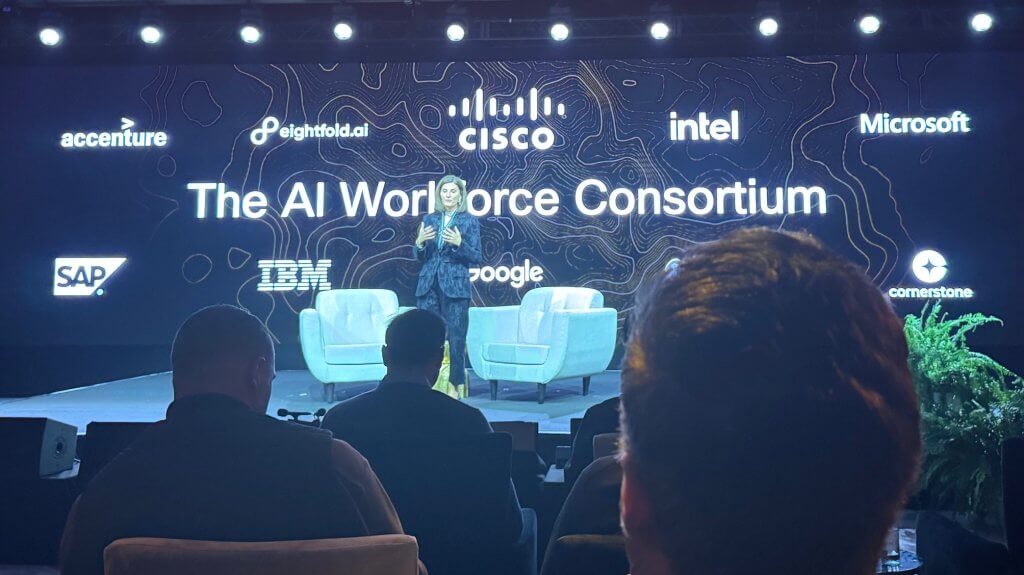
Fran highlighted one insight that resonated strongly: “AI Adoption doesn’t follow an email, it follows leadership.” Teams led by managers who actively use AI adopt it at twice the rate of others. At the same time, high-performing AI users sometimes report lower team trust, highlighting the need for new collaboration norms.
The broader takeaway is that AI readiness is as much about trust, communication, and organizational design as it is about technology. To learn more about this research, go to The AI Workforce Consortium – Cisco
The AI Factory: Jensen Huang, Founder and CEO, NVIDIA
Jensen Huang’s discussion with Chuck Robbins framed the current AI moment as a once-in-60-years reinvention of computing, driven by the shift from explicit programming to implicit programming. Rather than writing deterministic code, organizations now express intent, and AI systems reason, plan, use tools, and generate solutions dynamically. This transition, he argues, requires a full reinvention of the computing stack, not just processors, but storage, networking, and security, giving rise to what he calls AI factories. He stated, “We’re reinventing computing for the first time in 60 years … from explicit programming to implicit programming.”
Huang emphasizes that early generative AI systems were interesting, but not yet useful. Real value emerges when models become agentic, capable of reasoning, planning, using tools, retrieving information, and grounding outputs in facts and memory. This evolution fundamentally changes enterprise readiness: companies can no longer afford to wait on the sidelines as competitors apply AI to their most critical work.
On enterprise adoption, Huang cautions against demanding early ROI proofs. Instead, he advocates broad experimentation paired with focused application on core business functions. Innovation, in his view, is inherently messy and cannot be tightly controlled in its early stages. Huang stated, “Let a thousand flowers bloom … innovation is not always in control, and control is an illusion.”
A recurring theme is abundance; AI radically reduces the cost of intelligence, compressing tasks that once took years into hours or real time. Huang encourages enterprises to rethink problem-solving with an “infinite compute” mindset, applying AI to the hardest, most impactful challenges rather than incremental optimizations. He reinforced that, “AI reduces the cost of intelligence by orders of magnitude … what used to take a year can take an hour, or real time.”
Huang also highlights the importance of tool use and physical AI, arguing that advanced AI systems should leverage existing digital and physical tools rather than replace them. Looking ahead, he positions augmented labor, digital agents, and physical AI as a transformational economic force, expanding the total addressable market far beyond traditional IT.
Finally, Huang stresses that AI must be embedded into the fabric of the enterprise itself, with AI systems continuously learning from employees and capturing institutional knowledge. He finished the session with “The idea that AI should always have a human in the loop is backwards, every company should have AI in the loop.”
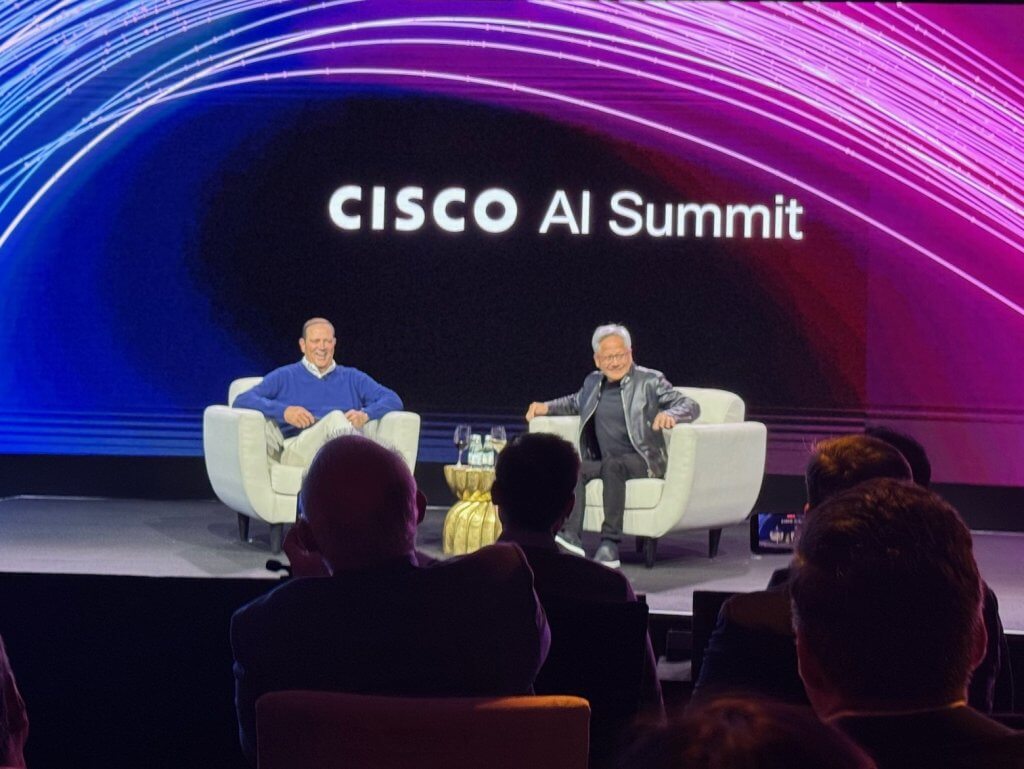
Taken together, Huang’s message is clear: AI is not a feature upgrade but a structural shift. Enterprises that treat AI as a core capability, technology first, domain second, will redefine productivity, competitiveness, and long-term value creation in the AI era.
OurANGLE
The overarching takeaway from Cisco AI Summit 2026 is that the industry is transitioning from AI momentum to AI maturity. The technical breakthroughs are real and accelerating, but they are no longer the primary bottleneck. Power, silicon supply chains, data center capacity, security, governance, and workforce adoption now define the pace of progress. Whether discussing AI factories, agentic systems, world models, sovereign infrastructure, or even long-horizon concepts such as space-based data centers, the message was consistent: AI success will be shaped by systems thinking and long-term architectural decisions, not isolated tools or short-term pilots.
For enterprises, the implications are significant. AI advantage will accrue to organizations that align technology strategy with infrastructure planning, redesign workflows for agent-based execution, invest in AI-driven security, and cultivate leadership behaviors that normalize AI usage across teams. This is no longer about proving AI works—it clearly does. The challenge now is operationalizing AI responsibly, at scale, and in a way that delivers durable business and societal value.
Cisco AI Summit 2026 made it clear that AI is moving from possibility to reality. The next phase belongs to those willing to move beyond experimentation and commit to the hard work of execution. A huge thank you to Cisco for producing this and opening it up to anyone, and to Chuck Robbins and Jeetu Patel for hosting the event.
While the in-person attendance was limited, it was streamed live to an audience that would likely solidify it as the Super Bowl of AI. If you missed it and would like to watch the event in full, please go to Cisco AI Summit 2026 | The builders of the AI economy.