Professional services automation is entering a new phase. AI innovation is accelerating at an extraordinary speed, but the winners in this next era will not be defined by automation alone. They will be defined by trustworthy decision automation. That is, whether they can bring governance, trust, and operational control to AI systems in the area of digital labor designed to speed how work is staffed, managed, and delivered. That shift is especially important as agentic AI moves beyond automating repeatable tasks and begins to support knowledge-worker use cases inside services organizations.
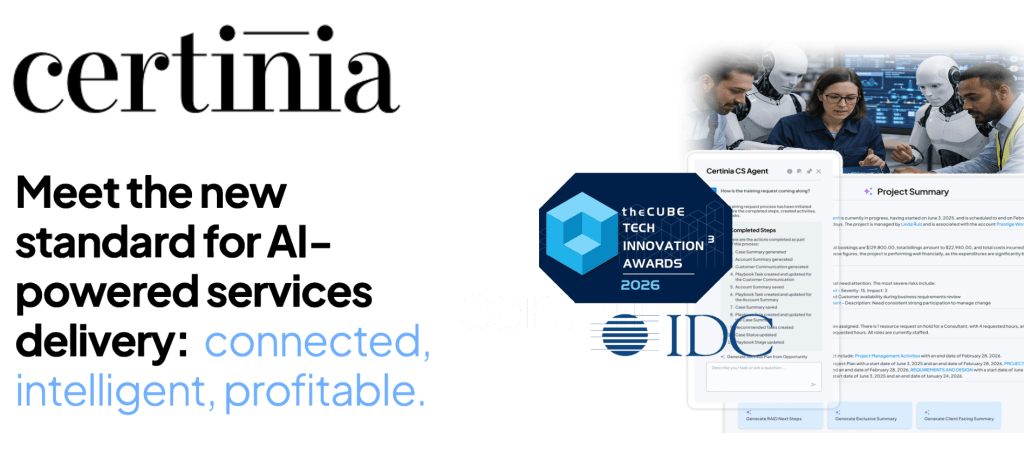
Against that backdrop, Certinia is emerging as a differentiated leader in the PSA market. So far in 2026, Certinia’s most notable external recognitions are its 2026 Tech Innovation CUBEd Award and its leadership positions in two IDC MarketScape assessments: AI-Enabled PSA Applications and AI-Enabled PSA ERP Applications. These recognitions matter because they validate more than product momentum. They reinforce a broader market view that Certinia is aligning PSA to the next operating model for services organizations: unified, AI-enabled, and governed for trust.
Certinia’s differentiation stems from five interlocking strengths:
- It is built around a unified customer and services record on Salesforce.
- It brings domain depth in professional services rather than generic horizontal AI claims.
- It is applying agentic AI where operational pain and business value are most acute.
- It links AI value to predictable outcomes, permissions, and human oversight.
- And it frames PSA as the operating backbone for profitability and customer satisfaction.
Delivering Trust in Outcomes
Innovation in enterprise software is moving at warp speed. But speed alone no longer sets companies apart. The market is starting to split into two groups: vendors competing in AI-driven automation as a feature race, and those establishing the guardrails, governance, and trustworthy foundational frameworks needed for AI to be effectively deployed in production.
That distinction matters acutely in professional services automation. PSA has historically been associated with resource scheduling, time capture, project oversight, and financial management. But that definition is becoming too narrow. As agentic AI begins to augment higher-order service work, PSA is evolving into a strategic control point for how services organizations allocate talent, coordinate delivery, protect margins, manage client commitments, and sustain long-term customer outcomes.
This is the context in which Certinia should be evaluated. The company is not simply layering AI onto legacy service workflows. It is repositioning PSA as the operating system for a hybrid workforce of humans and digital agents, with an unwavering focus on trust. That is a materially different ambition and, if executed well, a more strategically significant one.
The Market Recognizes Differentiation
Certinia’s recent recognition should be read as a market signal, not just an awards narrative.
So far in 2026, Certinia’s most notable external recognitions include its 2026 Tech Innovation CUBEd Award and leadership positions in two IDC MarketScape assessments: AI-Enabled PSA Applications and AI-Enabled PSA ERP Applications. These awards confirm both product innovation and category importance as services organizations reconsider how AI should be integrated into delivery operations.
The significance is not simply that Certinia has won industry acknowledgment. It is that the basis for that acknowledgment lines up with where the PSA market is going. The market is rewarding platforms that can unify services execution, embed AI into consequential workflows, and do so in a way that strengthens operational trust. That combination is increasingly difficult to fake.
Together, these proof points reinforce the same thesis: Certinia’s differentiation is not that it simply added AI to PSA. Its differentiation is that it rethinks PSA as the governed operating model for trusted, modern service organizations.
Establishing Architectural Advantage
The Certinia story starts with architecture.
On its website and in Raju Malhotra’s interview, the company consistently returns to a central idea: services organizations perform better when sales, delivery, customer success, and finance operate from the same source of operational truth. That matters because one of the PSA market’s longest-standing problems is fragmentation. Sales often commits to one version of an engagement, delivery inherits another, finance manages against a different reality, and customer success is left to manage the downstream consequences.
Certinia’s architectural position is that those disconnects are not peripheral workflow issues. They are structural barriers to margin performance, delivery predictability, and customer satisfaction.
Because Certinia is built natively on Salesforce, it can anchor services operations to a unified customer and project context rather than forcing work across disconnected systems. That is a significant advantage in a market where many vendors still rely on integrations to simulate unity rather than delivering it natively.
Malhotra makes this point in practical terms. He describes services as “really a team sport” and points to the lack of “a single source of truth” as a root problem.
“Services business, as many businesses are, but because services business is such a human-centric business, is very collaboration-focused at its roots. So, it’s really a team sport all the way from selling the services that are available to be delivered, that can be delivered, to managing the staffing of those projects to actually driving the financials. So, I think that’s really a key advantage of what Certinia delivers. It operates on the customer relationship management, the single source of truth.”
That framing is important because it elevates the conversation beyond collaboration as messaging. In Certinia’s view, collaboration is coordinated execution across the service lifecycle. That is a more operational and more valuable definition.
This is one of Certinia’s clearest differentiators. Many PSA vendors talk about visibility. Certinia is arguing for operational coherence. If all functions work from a common customer and engagement record, handoffs improve, staffing becomes more context-aware, financial management becomes more accurate, and customer success is better positioned to expand relationships after delivery. In practical terms, Certinia is not just selling PSA. It is selling alignment.
Domain Depth Over AI Theater
A second Certinia differentiator is domain specificity.
The PSA market is not a generic workflow market. It revolves around a specific set of operational disciplines: staffing, skills matching, utilization, project economics, revenue predictability, services margin, and customer delivery outcomes. AI that is not grounded in those disciplines risks becoming cosmetic.
Certinia appears to understand that. Malhotra describes the company as serving both pure-play services firms and the services organizations within large technology businesses, helping them sell, deliver, and manage their services business. That positioning matters because it shows the company is not approaching services from the outside. It is organizing its value proposition around the actual mechanics of how services organizations make money and maintain customer trust.
That is strategically important in today’s market. Enterprise buyers are becoming more skeptical of broad AI claims that are disconnected from actual domain implementation. Vendors that succeed in this environment will be those that integrate intelligence directly into operational workflows where business tradeoffs happen.
In other words, Certinia is not trying to be a general-purpose AI platform that happens to touch PSA. It is trying to be the operating platform for services businesses in the AI era. That is a stronger, narrower, and more defensible position.
Agentic AI Staffing and Execution
A third area of differentiation is where Certinia is applying agentic AI first.
Instead of emphasizing a broad productivity story, Certinia has concentrated on staffing and project execution, two areas where operational friction is high, and the business impact is immediate. This is a strategic move. Staffing is one of the most complex and economically significant workflows in professional services. It involves balancing demand, skills, geography, availability, cost, timing, and project change dynamics under constant pressure.
Malhotra captures this complexity clearly. He describes staffing managers as juggling projects being proposed, projects already sold, changing resource availability, skill requirements, time zones, and shifting project needs. He also points to the practical impact of Certinia’s AI approach, noting:
“Restaffing that would have taken hours can be brought down to literally minutes.”
This is exactly where agentic AI can create meaningful enterprise value. The advantage is not that AI produces more language. The advantage is that it compresses decision cycles around scarce expertise and dynamic operational conditions. In services organizations, that translates directly into utilization, speed to revenue, less delivery disruption, and better customer continuity.
Certinia’s early focus here suggests a mature view of agentic AI adoption. It is going after workflows where the value can be measured and where AI can act as an operational amplifier, not a novelty layer.
Trust as a Consequential Differentiator
As AI becomes more integrated into enterprise operations, the market’s focus is shifting. Fluency and coherence are no longer sufficient. Buyers increasingly want to know whether AI-driven recommendations are reliable, whether the system respects permissions, whether outcomes are sufficiently explainable to implement, and whether humans remain properly in control.
This is especially true in PSA. Service organizations don’t just need AI that can suggest; they need AI they can trust to influence staffing, project oversight, customer workflows, and financial execution without creating unmanaged risk.
Certinia’s message here is stronger than many competitors’. The company explicitly emphasizes enterprise AI “you can trust” and ties that trust to operating on a “single, trusted source of data.” That is important because it links trust to system design rather than to branding language.
Malhotra reinforces the same idea in concrete terms. He argues that trust is built through “predictable outcomes,” compliance-based permissions alignment with company policies, and human oversight. He noted:
“Ensuring execution within the guardrails requires a number of things that we take extreme care of. First part really is about security, privacy, making sure the role-based permissions for that agent are consistent with the corporate policy for what they’re supposed to be doing, what they have access to, what they don’t have access to.”
This point needs to be emphasized. Many vendors discuss AI assistance, but fewer explain what makes AI practically governable. Certinia’s language indicates that the company recognizes the importance of governance as the key to AI ROI in PSA. In a climate where enterprises are becoming more wary of autonomous systems, governance is not a secondary matter; it is essential for adoption.
From Efficiency to Relationship Economics
Another strength in Certinia’s positioning is that it does not frame value narrowly.
Malhotra highlights outcomes such as top-line growth, stronger margins, improved utilization, more predictable cash flows, and better long-term customer relationships. This is important because it broadens the PSA discussion beyond just task efficiency. It positions Certinia as a partner that helps organizations turn strong service delivery into better customer economics.
This is a significant strategic move. Services organizations are not just managing projects; they are managing customer relationships that accrue value over time. Delivery quality impacts renewals, expansion, customer advocacy, and long-term profitability. A PSA platform that enhances execution and maintains continuity between delivery and customer success becomes more strategically valuable than one focused solely on project tracking.
This broader value proposition also clarifies why Certinia’s recognition in both AI-enabled PSA and AI-enabled PSA ERP is important. It indicates that the company’s platform approach resonates not just at the project level but across the entire business system of services operations.
Watch theCUBE Conversation
Our Takeaway
Certinia’s differentiation in the PSA market lies in combining a unified operational foundation with pragmatic, governed AI. Rather than treating PSA as a disconnected point tool, Certinia positions it as a strategic system of operational truth, built natively on Salesforce to unify customer, services, and financial context. It pairs that architectural advantage with deep professional services domain expertise, then applies agentic AI where the business value is clearest, especially in high-friction workflows such as staffing and project oversight.
Just as important, Certinia anchors its AI strategy in governance, predictable outcomes, permissions, and human oversight, which strengthens its position as a trustworthy platform for AI-enabled services operations.
The result is a positioning strategy that is notably better aligned with the next phase of enterprise AI adoption. As professional services enter the agentic AI era, the market will reward vendors that can combine workflow intelligence with operational trust. That is where Certinia appears to be building real separation.
Certinia’s recent momentum should not be interpreted as a simple awards story. It is better understood as evidence that the company is aligning with a larger market shift. PSA is evolving from a transactional back-office category into a core operating layer for digital labor, knowledge-work coordination, and AI-enabled service delivery.
The winners in that environment will not be the vendors with the flashiest assistants. Instead, they will be the vendors that can unify data, work, people, and AI agents into a governed and trustworthy operating model. On that measure, Certinia is making a credible case for leadership.


📊 More Research: https://thecuberesearch.com/analysts/scott-hebner/
🔔 Next Frontiers of AI Digest: https://aibizflywheel.substack.com/welcome