Digital labor transformation is no longer a future idea; it is becoming the defining operating model of modern businesses. Agentic AI systems that can perceive, reason, and act with increasing autonomy are quickly moving from pilot projects to full deployment, changing how organizations work and make decisions. As companies reach this point, many are reconsidering the very structure of their workforce, expanding it beyond human employees to include AI-powered digital coworkers embedded across business functions and workflows. The goal? A hybrid human-digital workforce.
However, the path forward is far from easy. Fragmented strategies, weak governance, limited cross-functional ownership, and trust gaps threaten to halt progress and confine organizations to isolated pockets of automation instead of enabling true, enterprise-grade digital labor. The stakes are high: leaders must shift from tactical experimentation to a unified approach for building, deploying, and governing digital labor at scale.
To measure this shift with evidence rather than hype, theCUBE Research created the Digital Labor Transformation Index, one of five indices in the Agentic AI Futures program. The fall 2025 Index evaluates organizational maturity and exposes a sizable gap between aspiration and execution.

Key findings from the Index reveal both accelerating momentum and structural fragility:
- Digital labor is now seen as inevitable: 90% of leaders believe AI agents will become core members of the future workforce, with confidence rising sharply among experienced adopters.
- Knowledge collaborators represent the next frontier: 65% now involve HR in planning, underscoring that this transformation is as much about people, culture, and skills as it is about technology.
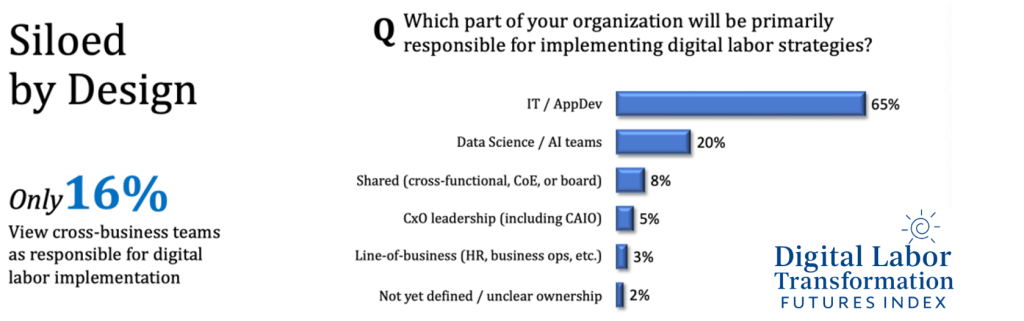
- Organizations remain siloed by design: Only 16% believe responsibility for digital labor spans the enterprise—one of the clearest indicators of why execution lags.
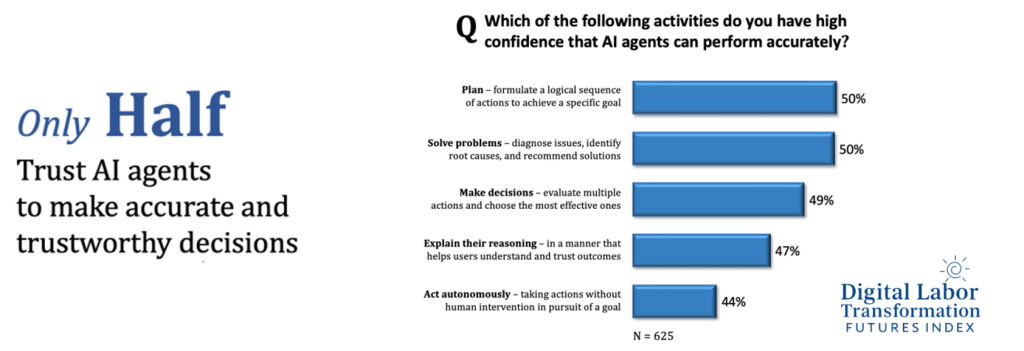
- Trust is the determining factor for ROI: While automation confidence is high, only half strongly trust AI agents to operate autonomously. As our research shows, no trust means no scale and no ROI.
The following sections explore what the Index reveals about the scope, maturity, and constraints of digital labor transformation, and offer a guide for what enterprises need to succeed in the coming decade.
What is Digital Labor Transformation?
Digital Labor Transformation is the enterprise-wide shift from task-based automation to AI-powered, knowledge-centric work performed by “digital coworkers” alongside human teams. It involves deploying agentic AI systems that can perceive context, reason about goals, take action across workflows, and continuously learn, fundamentally redefining how organizations execute work, make decisions, and deliver value.
Unlike traditional automation, digital labor transformation:
- Expands the workforce model to include AI agents as operational teammates.
- Elevates work from repetitive tasks to higher-order decision flows.
- Requires new governance and organizational structures to ensure transparency and scalability.
- Demands tight integration of people, process, and intelligent systems, not just technology deployment.
Digital labor provides tangible, measurable benefits to businesses by enhancing human teams with AI agents that work alongside employees, accelerate processes, and improve service quality. Digital coworkers take on repetitive, time-consuming tasks; operate 24/7 without breaks; and continually learn to manage more complex work over time.
This allows employees to focus on higher-value activities, such as growth, relationship building, and problem-solving. Organizations that adopt digital labor see faster, more precise output, higher customer satisfaction, better retention, and scalable operations that don’t need a proportional increase in staff. In essence, digital labor boosts performance, resilience, and profitability while enabling human teams to work at their full potential.
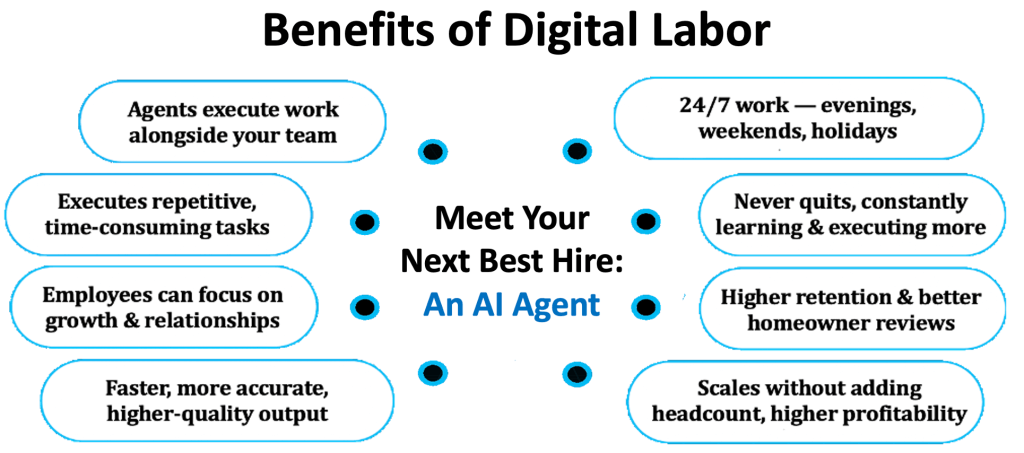
In short, digital labor transformation is not about replacing humans with automation; it is about rearchitecting the enterprise around hybrid human–AI work, where digital coworkers augment human capacity, accelerate outcomes, and unlock entirely new operating models. In essence, they’re giving knowledge workers new “superpowers” to accomplish much more meaningful and impactful work.
Why Digital Labor Matters Now
Digital labor is not emerging in a vacuum; it is advancing at the exact moment when enterprises are under historic pressure to increase productivity, modernize operations, and close widening talent and capability gaps. The economic signals are unmistakable: organizations that do not integrate AI-powered digital coworkers into their operating models will fall behind competitors that do.
Industry benchmarks underscore both the scale of the opportunity and the urgency of acting now. McKinsey estimates that generative AI could boost global productivity by up to 3.4% annually, a transformational gain that rivals that of past industrial revolutions. But this upside depends entirely on whether organizations can overcome the governance, cultural, and operating-model barriers that have stalled previous technology transitions. In parallel, the World Economic Forum projects that 39% of core skills will shift by 2030, meaning enterprises must simultaneously deploy digital coworkers and reskill human teams to operate in hybrid human–AI environments. And according to PwC, 88% of executives plan to increase AI investments in 2026, signaling that strategic urgency is already surpassing organizational readiness.
In other words, the race is on. Businesses need to choose: lead, lag, or potentially fail.
These forces collectively indicate an early but rapidly maturing market, one where ambition is high, use cases are clear, and the competitive implications are becoming impossible to ignore. Yet, as with every technological shift of this magnitude, execution is lagging behind aspiration. Many organizations are experimenting with automation and agentic AI, but few have the governance, cross-functional ownership, trust mechanisms, or workforce strategies required to operationalize digital labor at scale.
The result is a widening execution gap between companies that are methodically building digital labor programs and those still dabbling at the edges. The former are already redesigning workflows, elevating human work, and laying the foundation for AI-driven productivity gains. The latter risk is a structural disadvantage as markets consolidate around organizations that can deliver faster outcomes, better decisions, and more scalable operations.
The transformation is real and accelerating, but so are the risks of falling behind. For leaders, the imperative is clear: understanding where vision, strategy, and organizational maturity diverge is now essential. Those that establish trusted, scalable, and well-governed digital labor programs will define the competitive landscape of the next decade. Those who wait will struggle to catch up.
What the Digital Labor Transformation Index Reveals
Drawing on data from 625 pre-qualified AI and business leaders across 13 industries and 61 diagnostic questions, the Index reveals the following insights, summarized in this section.
Digital Labor is Inevitable
When it comes to aspirations, enterprise leaders are clear: digital labor is no longer a fringe idea; it is seen as inevitable. The survey data reveal that 71% of business leaders believe this generation will be the last to manage a human-only workforce. That is a striking statement, one that highlights how deeply the concept of hybrid organizations, where humans and AI agents work side by side, has taken hold in the executive mindset. In fact, only 10% show any level of disagreement.
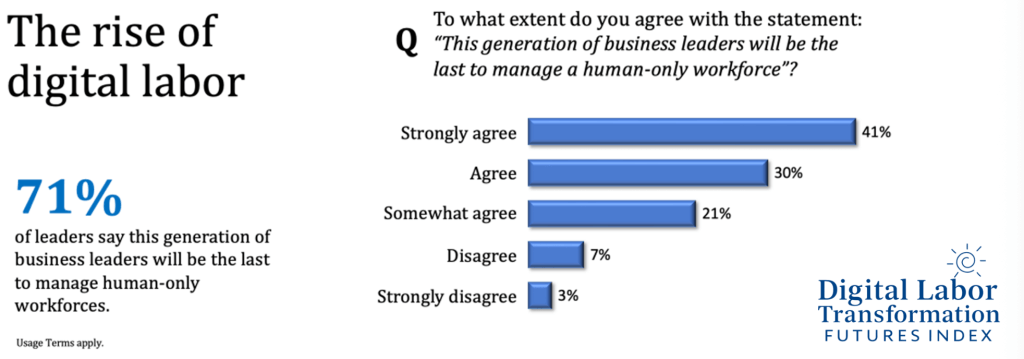
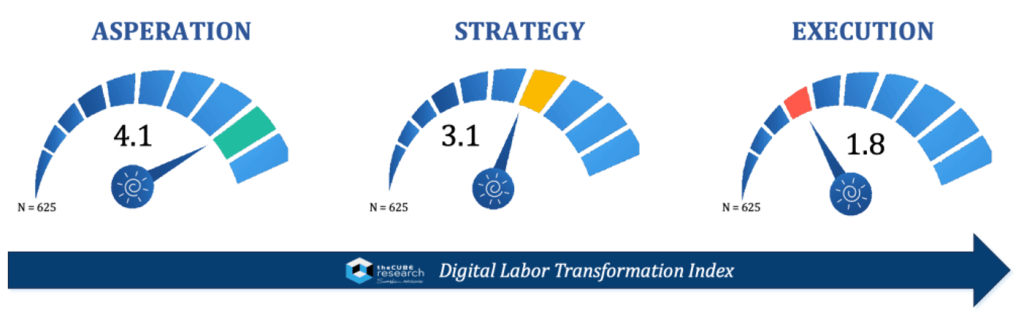
This conviction explains why the Digital Labor Transformation Index scores aspirations at 4.1. Leaders are not simply curious about digital coworkers; they expect them to be central to how work is defined in the years to come.
Part of this belief is rooted in competitive reality. Business leaders understand that organizations that can combine human and digital capabilities will gain structural advantages, including shorter cycle times, lower error rates, greater adaptability, and the ability to scale expertise more quickly than those relying solely on human workers.
Importantly, the data also shows that familiarity leads to conviction. Those with the most direct experience implementing AI and agentic workflows are the most likely to believe in the inevitability of digital labor. Larger enterprises also tend to be more confident, reflecting the scale-driven pressures they face to find new ways to boost labor productivity.
The aspiration data makes clear that enterprises are leaning in and that the conversation has shifted decisively from “if” digital labor will happen to “how fast” it will become mainstream. And, perhaps, even more importantly, the agentic AI technology strategy is giving way to a digital labor transformation strategy.
The Rise of Knowledge-powered Digital Co-workers
If aspiration is about inevitability, strategy is about what organizations expect digital labor to actually do and how to make it happen. The survey reveals a decisive shift: digital coworkers are no longer viewed solely as tools for simple automation. Instead, enterprises increasingly envision them as knowledge workers, capable of solving problems, supporting decisions, and even pursuing goals with limited guidance.
The most common strategic use case remains automating routine or repetitive tasks (67%), showing continuity with earlier waves of robotic process automation (RPA) and enterprise workflow software. However, the true story lies just beneath the surface. Nearly as many leaders expect digital coworkers to help make better decisions (62%) and assist in diagnosing and solving business problems (60%). More than half (58%) believe agents will pursue goals with minimal human guidance, and 53% foresee them eventually acting autonomously on behalf of workers.
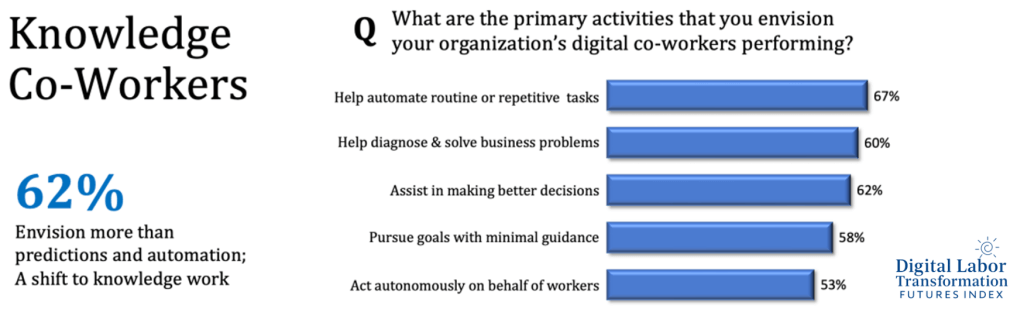
This vision signals a move away from thinking of AI purely as a back-office productivity booster and toward a more profound redefinition of knowledge work itself. Rather than simply processing transactions or crunching datasets, digital labor is being positioned to analyze, recommend, and act within the core workflows that drive competitiveness.
As Scott Hebner emphasized on the podcast,
“We’re moving from automation and analytics into knowledge work, where digital coworkers can reason, pursue goals, and collaborate alongside humans. This is becoming more real by the month.”
Strategically, this reimagining of digital labor aligns with broader workforce and business priorities. Leaders recognize that while automation reduces cost, it is augmented decision-making and problem-solving that generate competitive advantage.
Aspirations are Outpacing Execution Readiness
One of the most striking findings of the Digital Labor Transformation Index is the sharp decline in maturity as organizations shift from aspiration to execution, supporting the notion that digital labor matters as a strategic competitive advantage. The data also confirms that an agentic AI strategy is not viewed as the same as a digital labor transformation strategy.
- Aspirations are high (4.1 score): On paper, leaders are enthusiastic in aggregate, with those with the most experience in AI and greatest familiarity with agentic AI leading the way.
- Strategy maturity is lower (3.1 score): This suggests that concrete plans are in place backed by real investment, but these efforts remain fragmented and uneven.
- Execution barriers are real (1.8 score): The notable decline emphasizes the implementation challenges related to cultural, technological, and trustworthiness factors.
This highlights a clear Vision-to-Value gap. As Scott Hebner, principal analyst for AI at theCUBE Research, stated:
“A strategy without execution is hallucination.”
From which Christophe Bertrand, also a principal analyst at theCUBE Research, concluded:
“These are the signs of initiatives in their infancy. We’re still putting the foundations in place, and we’re years from where we want to be.”
Trust is the New Bottleneck
No matter how advanced digital coworkers become, the biggest barrier to digital labor transformation is not technology; it is human trust. Our research reveals a clear disconnect: while confidence in automation remains high, only 50% of leaders strongly trust AI agents to act independently. The message is straightforward. Organizations are ready to automate tasks but hesitate to delegate judgment, decision-making, and cross-functional responsibilities to AI-powered digital coworkers. Without trust, digital labor remains stuck in experimentation and never achieves scale.
Trust breaks down for three core reasons:
- Insufficient explainability and transparency: Workers and leaders find it hard to trust systems they can’t understand or question. Traditional black-box models give outputs without explanations, making it tough to validate decisions or evaluate risk. Digital coworkers will need to think aloud, show their work, and explain how they reached their conclusions. The more AI agents reveal their assumptions, constraints, and confidence levels, the faster trust will build.
- Lack of interactive problem solving: Human coworkers build trust by collaborating—asking clarifying questions, proposing options, identifying exceptions, and working through uncertainty. Digital coworkers must do the same. Trust deepens when AI agents can participate in interactive reasoning loops, request missing information, reconcile conflicting goals, and solve problems iteratively with human partners. This transforms AI from an opaque executor into a collaborative decision-making partner.
- Insufficient human involvement in design and deployment: Trust can’t be simply added; it has to be built together. Our Index shows that organizations involving cross-functional teams, such as HR, operations, finance, and frontline users, in designing, testing, and refining digital labor workflows see much higher trust scores. When people help shape how digital coworkers act, the rules they follow, and how decisions are escalated, they end up trusting the systems more.
- Weak metrics for accountability and performance: Unlike human employees, digital coworkers often lack transparent “job descriptions,” performance benchmarks, and structures. Without metrics that define what good performance looks like, such as accuracy, completeness, timeliness, safety, and escalation quality, leaders find it hard to grant autonomy. Trust increases when AI agents are integrated into clear governance frameworks with measurable results, auditability, and ongoing improvement processes. accountability
Taken together, these gaps make trust the defining constraint in digital labor transformation. Organizations cannot scale digital labor without giving digital coworkers real responsibility—yet cannot give responsibility without trust. Breaking this stalemate requires moving beyond automation mindsets toward explainable, governed, co-created, and measurable digital labor programs.
Enterprises that close the trust gap will unlock the productivity gains forecast by McKinsey and others, while those that ignore it will remain trapped in isolated pilots. In digital labor transformation, trust is not a soft concept; it’s the currency of AI innovation. No trust, no ROI.
Organizational, Cultural, and Governance Implications are Real
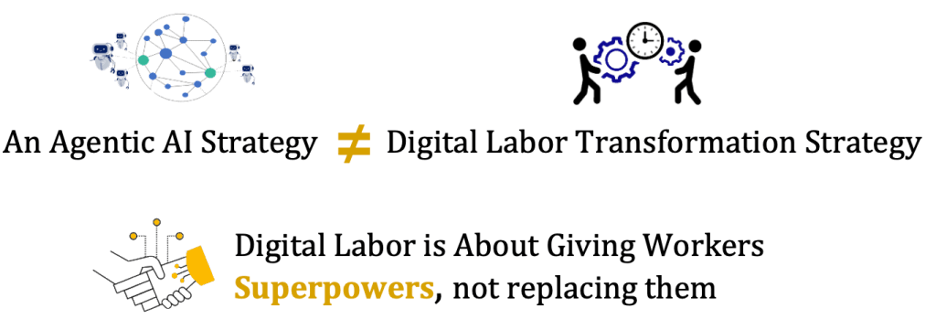
Another key finding is that an agentic AI strategy is NOT the same as a digital workforce transformation strategy. The data separates technology roadmaps (agents, orchestration, models, guardrails) from workforce roadmaps (roles, headcount models, new operating constructs with HR).
Ownership of execution must include cross-functional stewardship, yet only a small number report true cross-organizational structures (e.g., centers of excellence with HR, business, data, and compliance involved). This is why a strong Agentic AI plan does not automatically become a digital labor plan; they are related but distinct strategies serving different goals and owners.
Furthermore, the research indicates that digital labor is not about replacing human workers, but about augmenting them with new “superpowers”, helping people become more productive, make better decisions, and improve organizational collaboration in ways that were not possible before. In this model, humans and digital coworkers complement each other, creating a workforce that is greater than the sum of its parts.
Outside-in, this divergence shows up organizationally in the rise of the Chief AI Officer (CAIO), a role that, when done right, coordinates AI adoption and guardrails across business, technology, and risk, presenting a single plan to the CEO and the board. They are essentially becoming Digital HR leaders. Concurrently, 64% of organizations say their CHRO plays a strategic or significant role in fusing workforce strategies with Agentic AI. They oversee the strategy’s workforce productivity aspect, emphasizing the people-systems side of transformation. Per Scott Hebner:
“ [Agentic AI Strategy] is very different from the business strategy around your workforce. That’s where the real impact will be, bringing technology, business, and HR together.”
Christophe Bertrand, appropriately, added a note of caution:
“Yes, the expectations are high, but can you trust them? Can you trust that an agent making a decision is doing it correctly, securely, and in compliance with policies?
Ultimately, the Index shows that organizations are not content with digital coworkers as simple automators. The strategy is to empower them as knowledge partners, a shift that, if executed well, will redefine not just productivity metrics but the very nature of enterprise value creation.
Digital Labor is More Than Just a Technology Strategy
The Digital Labor Transformation Index revealed the sobering truth: most enterprises are falling short in creating more holistic, end-to-end labor transformation strategies. With an average maturity score of just 1.8, it is clear that the collaborative strength needed to turn strategy into a scalable reality has not yet been developed.
The primary issue is ownership, specifically the lack of shared ownership. The survey indicates that 65% of organizations assign responsibility for digital labor implementation primarily to IT or application development teams, with an additional 20% pointing to data science or AI functions. While these groups offer vital technical expertise, implementation is mainly viewed as an engineering task rather than an organization-wide transformation.
By contrast, only 16% of respondents cite cross-functional teams, centers of excellence, or shared boards as the primary owners of digital labor execution. Even fewer report leadership by CxO-level executives (5%) or line-of-business units such as HR and operations (3%). A small minority (2%) admits ownership remains undefined. This lack of collaboration across business, HR, technology, and governance explains why execution maturity lags so far behind aspiration and strategy.
It’s the result of a “siloed by design” approach.
As Christophe Bertrand noted during the podcast discussion,
“Right now it’s still considered a technical implementation, but this is really a business play. Without cross-organization collaboration, things can head to the wall very quickly because there’s only so much you can ask IT to do for you.”
His point highlights the collaborative gap: while digital labor requires coordinated input from across the enterprise, most organizations are leaving execution in silos.
Bridging the collaboration gap requires more than just investing in technology. Companies need cross-functional centers of excellence that bring together IT, HR, business leaders, and compliance officers. Support from top executives, including the emerging Chief AI Officer role, must raise a technical project to a board-level workforce transformation strategy. Only then can organizations create the collaboration needed to turn today’s goals into future benefits.
The message is clear: execution is not just about technology, it’s about teamwork. Without it, digital labor stays isolated; with it, the true potential of a hybrid workforce can finally be achieved.
The Maturity Journey: Automation to Agentic Work
For years, enterprises have viewed AI as an extension of automation, focusing on streamlining repetitive tasks, speeding up manual workflows, and cutting operational costs. However, digital labor transformation requires a fundamentally different approach. Automation enhances efficiency, but agentic work changes the very nature of labor.
Traditional automation is narrow by design. It executes predefined tasks, follows deterministic rules, and stays within strict boundaries. It makes a worker’s day easier by eliminating repetitive steps—but it doesn’t enhance the work. Automation is useful, but it stops at execution; it doesn’t understand context, resolve ambiguity, or make decisions.
Digital Labor Begins where Automation Ends
Agentic AI systems can perceive complex situations, interpret goals, reason through trade-offs, ask clarifying questions, plan multi-step actions, and adapt when conditions change. These capabilities shift AI from a tool that helps workers to a partner that collaborates with them. Instead of automating tasks for humans, organizations begin redesigning workflows with hybrid human–AI teams, each contributing distinct strengths.
The maturity journey follows a predictable evolution:
- Stage 1: Task Automation: Streamlining manual steps to reduce workload, errors, and cycle time.
- Stage 2: Workflow Automation: Orchestrating sequences of tasks, integrations, and handoffs.
- Stage 3: Assisted Intelligence: AI generates insights while humans retain full judgment and control.
- Stage 4: Agentic Work: Digital coworkers take on portions of knowledge work and decision-making.
At this stage, AI is no longer an efficiency layer; it is an interactive teammate that augments human capability. The goal shifts from “automating what we already do” to redefining how work gets done altogether.
Organizations that advance into agentic work see higher ROI, better employee experience, faster cycle times, and more scalable operations. Those stuck in automation mindsets experience diminishing returns as automation reaches its limits and more complex tasks slow down human capacity.
Digital labor transformation ultimately marks a shift from doing work faster to doing work differently. And understanding this maturity path is essential for leaders preparing to operationalize digital labor at scale.
What Leaders Must Do Next
The Digital Labor Transformation Index clearly shows that strategic intent is accelerating, while execution maturity is lagging. The gap between goals and readiness is widening, and the next two years will determine which organizations progress toward scalable digital labor and which fall further behind as hybrid human-AI workforces become the new competitive standard.
Closing this execution gap requires leaders to move beyond isolated automation pilots and begin architecting digital labor as a company-wide operating system. Based on the data and analysis, and discussions with dozens of industry pioneers, we recommend five strategic imperatives:
- Separate, but tightly connect, technology and workforce strategies: A roadmap for agentic AI, workflows, and automation is not the same as a workforce strategy for roles, policy, reskilling, and change management. Both must advance in parallel, guided by a shared vision but executed through distinct plans. Treat them as two sides of the same transformation coin.
- Build a collaborative organizational engine: Digital labor cannot be owned by IT, nor can it be delegated to individual business units. Organizations that scale digital labor establish cross-functional councils or centers of excellence, co-led by HR, business leadership, operational leaders, and a CAIO. These governing bodies ensure that strategy, design, governance, and ROI are aligned and continuously reinforced
- Climb the value curve quickly: Automation remains essential, but it is no longer sufficient. The real value emerges when digital coworkers begin supporting knowledge work: contextual decision-making, exception handling, planning, and explainable judgment. Leaders should accelerate movement from task automation to agentic workflows that meaningfully augment human expertise.
- Double down on trust as a strategic prerequisite: Automation confidence is high, but trust in digital coworkers performing higher-order work remains limited. Trust must be engineered through user involvement, transparent design, explainability, strong governance, clear guardrails, and performance metrics. Without trust, digital labor cannot achieve autonomy. And without autonomy, ROI remains trapped in pockets of automation.
- Communicate relentlessly: Aspirations are surpassing execution, and this mismatch can erode internal confidence. Leaders must communicate transparently about goals, progress, risks, and required shifts in roles and skills, ringing workers into the transformation rather than presenting it to them. In digital labor, communication is not a courtesy; it is a core design principle.
Looking ahead to 2025–2027, budgets will continue to increase, particularly in large enterprises, driven by the need to standardize platforms, formalize AI roles, and operationalize governance. Execution maturity will hinge on the emergence of cross-functional operating structures, explainable workflows, trusted autonomy models, and new leadership roles, including CAIOs, AI risk managers, and HR transformation leaders. The talent market will shift accordingly.
Those who act now will gain resilience, agility, and competitive differentiation through hybrid human–AI workforces. Those who delay risk stagnating in fragmented automation, unable to capture the productivity, quality, and innovation advantages unlocked by digital labor.
About the Digital Labor Transformation Index
This Index is part of the broader 2025 Agentic AI Futures Index, a five-part benchmark that surveyed 625 enterprises with 61 questions across the USA, Canada, and the United Kingdom to evaluate enterprise Agentic AI readiness. From this data, there are five core indices:
- Digital Labor Transformation
- Agentic AI Technology
- Trust & Governance
- Reasoning & Decision Intelligence
- Causal AI Innovation
Together, these indices provide one of the first comprehensive roadmaps for leaders navigating the shift to agentic AI. To explore industry-specific insights, co-develop a digital labor roadmap, or leverage the full survey for product, strategy, or go-to-market planning, feel free to connect with me on LinkedIn or reach out directly. We can turn vision into action—and digital labor into measurable business value.
In the coming weeks, we’ll continue releasing new insights on theCUBE Research portal and via new episodes of The Next Frontiers of AI Podcast will also unpack these findings with industry leaders and practitioners.
Stay tuned for more survey data, expert perspectives, and analysis.
Watch the Podcast Discussion
Join Scott Hebner and Christophe Bertrand, both Principal Analysts at theCUBE Research, as they unpack fresh primary research data on the state of digital labor transformation on a recent Next Frontiers of AI Podcast. We analyze a striking workforce evolution underway where business leaders are no longer viewing agentic AI as simply a software automation or analytics paradigm shift, but as a genuine labor market phenomenon that promises to fundamentally change how work gets done.

📩 Contact Me 📚 Read More AI Research 🔔 Subscribe to Next Frontiers of AI Digest