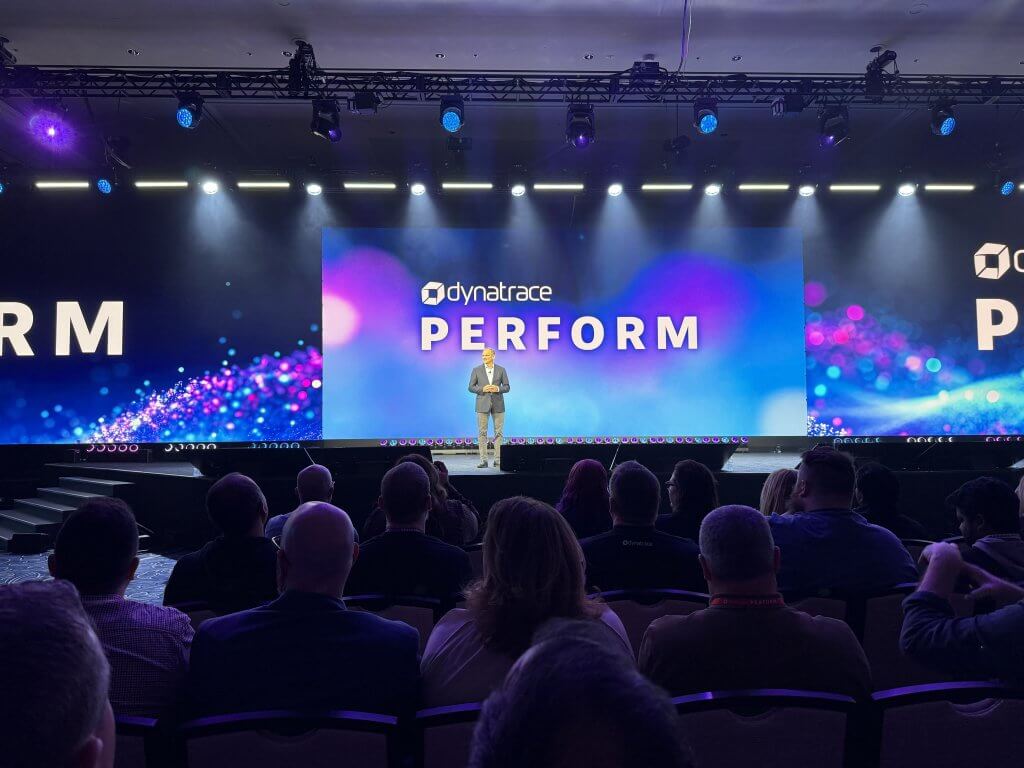
Dynatrace’s Perform 2026 keynote reflects a broader inflection point in enterprise IT: observability is no longer being positioned as a visibility layer, but as an operational control plane for increasingly autonomous, AI-driven systems. While the event showcased product momentum across data unification, AI analytics, and ecosystem integrations, the more consequential signal was strategic: reliability in the AI era is becoming inseparable from trusted, action-oriented observability.
Rather than emphasizing raw feature velocity, Dynatrace framed its roadmap around a single gating issue facing the market: enterprises cannot safely operationalize agentic AI without deterministic understanding of system behavior. In this framing, observability evolves from “monitoring what happened” to “deciding what should happen next.”
From Observability as Insight to Observability as Decision Infrastructure
Across cloud-native, Kubernetes, and AI-augmented environments, enterprises are facing a structural problem: telemetry volume is exploding, while human capacity to interpret and act on that data is not. Traditional observability tools helped teams detect and diagnose issues faster, but they still assumed human decision-making as the final arbiter.
Dynatrace’s Perform 2026 messaging makes a clear argument that this model no longer scales. The company is advocating for observability systems that can:
- Produce high-confidence diagnoses (root cause, blast radius, impact),
- Persist that understanding as contextual data, and
- Trigger controlled, automated actions across operational systems.
This shift reframes observability as a prerequisite for autonomy, not a parallel concern. In effect, Dynatrace is positioning observability as the decision substrate upon which agentic systems can safely operate.
Trust, Not Automation, Is the Real Bottleneck
One of the more pragmatic aspects of the keynote was its rejection of “full autonomy” as an immediate or even necessary goal. Dynatrace leadership emphasized that partial autonomy, applied to well-understood scenarios, can deliver material business value. This aligns with theCUBE Research’s observations across regulated and large-scale enterprises: automation adoption accelerates only when risk is bounded, and outcomes are predictable.
The implication is important. Agentic AI does not fail in enterprises because of insufficient intelligence, but because of insufficient trust in diagnoses, in execution paths, and in governance controls. Dynatrace’s repeated emphasis on “answers, not guesses” underscores an understanding that explainability, consistency, and auditability are foundational to any autonomous operating model.
From a market perspective, this places deterministic analytics (causal inference, dependency awareness, and predictive modeling) ahead of generative capabilities in the autonomy stack.
Unified Data Is Necessary, but Not Differentiating
Dynatrace continues to invest heavily in unifying telemetry across logs, metrics, traces, user experience, and business signals within its Grail data platform. While necessary, this alone is no longer sufficient to differentiate in the observability market. Most large platforms now claim some form of unified data model.
Where Dynatrace is attempting to move the conversation forward is in how that data is operationalized. The emphasis on making dependency graphs queryable, exposing topology through analytics, and correlating user behavior with backend causality suggests a recognition that context must be actionable, not just visible.
This is particularly relevant as enterprises adopt AI workloads, where traditional troubleshooting heuristics break down. Variability introduced by LLMs and agentic workflows makes static dashboards less useful; teams need systems that can reason across changing execution paths and surface implications automatically.
AI Observability Is Becoming a First-Class Requirement
A notable portion of the Perform narrative focused on AI workloads themselves, not just the infrastructure they run on. Dynatrace is treating LLMs and agents as observable entities, with attention to model versions, interaction patterns, and end-to-end context from prompt to infrastructure.
This reflects a broader market reality: AI systems behave probabilistically, and their failure modes are often non-deterministic. As AI moves from experimentation to production, organizations will require observability tools that can explain why an AI-driven outcome occurred, not just whether a system was up or down.
From theCUBE Research’s perspective, this marks an early but important transition: AI observability is converging with application observability, rather than emerging as a separate category.
Ecosystem Execution Will Determine Whether Autonomy Scales
Perhaps the most strategically important signal from Perform 2026 was Dynatrace’s emphasis on ecosystem integration, particularly with ServiceNow. Autonomous operations, as framed by Dynatrace, are not about replacing enterprise workflows, but about augmenting them with higher-quality signals and safer automation.
Change management, incident response, and remediation workflows are where enterprise governance already exists. By embedding deterministic observability insights into these systems of action, Dynatrace is aligning autonomy with how enterprises actually operate today.
However, this also introduces execution risk. Success depends not just on integrations, but on shared semantics, trust boundaries, and feedback loops between platforms. Autonomous outcomes will only scale if enterprises can measure effectiveness, limit blast radius, and retain human oversight where required.
Market Challenges and Strategic Implications
- Trust and governance remain the primary blockers to agentic adoption, not model capability.
- Manual correlation is now a structural inefficiency, increasingly incompatible with AI-driven architectures.
- AI workloads demand new observability primitives, particularly around behavior explanation and variability management.
- Telemetry cost discipline is becoming strategic, as signal overload undermines both budgets and insight quality.
What theCUBE Research Will Be Watching
Dynatrace’s vision is directionally aligned with where the market is heading, but execution will determine impact. Key indicators to watch include:
- Evidence that deterministic insights measurably improve MTTR, change success rates, and incident prevention.
- Adoption of incremental autonomy patterns with clear governance and rollback mechanisms.
- Depth and maturity of ecosystem workflows that move beyond integrations to true co-execution models.
If Dynatrace can translate observability from insight into trusted action at scale, it may help define how enterprises operationalize AI safely, not as an experiment, but as a core operating capability.