ZEDEDA used GTC 2026 to introduce its Edge Intelligence Platform, positioning it as a unified solution for creating, deploying, securing, and operating AI at scale across distributed edge environments. Building on its existing edge orchestration foundation, which already manages tens of thousands of nodes globally, the platform extends into full lifecycle management of edge AI, including model deployment, agent orchestration, and infrastructure control through a single API-driven control plane.
At the same time, ZEDEDA announced a strategic partnership with Submer to deliver modular, liquid-cooled, high-density AI infrastructure capable of running GPU-intensive inference workloads in environments where traditional data centers are impractical.
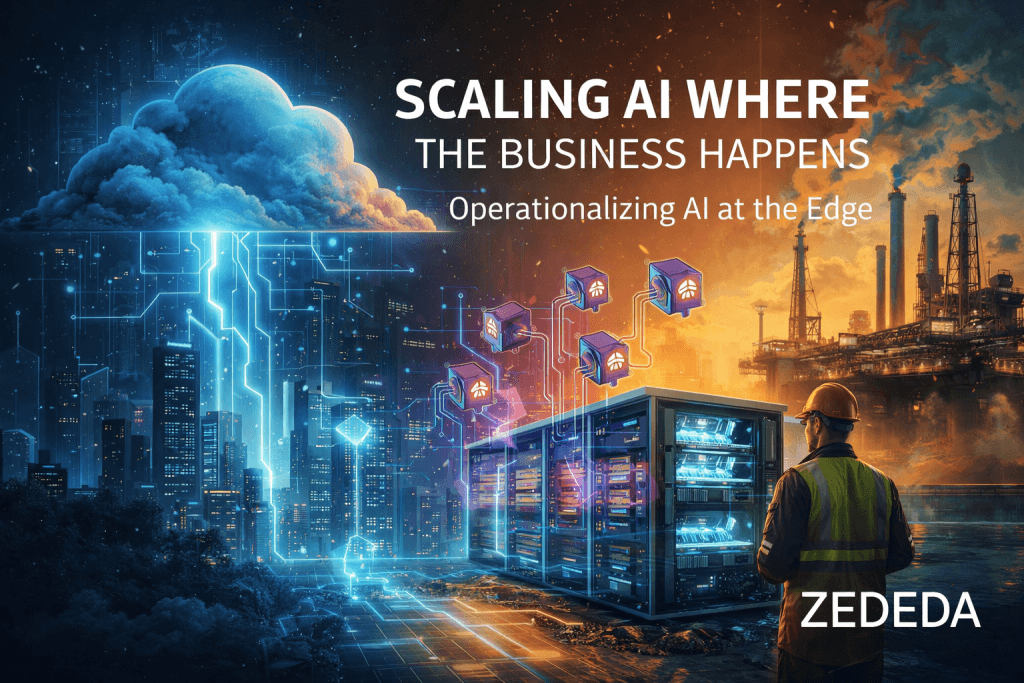
Taken together, these announcements reflect a broader industry shift: AI is no longer confined to centralized cloud environments. Instead, it is increasingly moving into physical operations, retail locations, factories, energy grids, transportation systems, and telco networks, where real-time decision-making and localized intelligence are critical.
Bridging the Gap Between AI Potential and Operational Reality
A consistent theme emerging across enterprise AI adoption is the gap between experimentation and production. While organizations have invested heavily in AI, operationalizing those investments, particularly at the edge, remains a challenge.
ZEDEDA’s own research[1] highlights this disconnect. While 83% of organizations consider edge AI important to their core strategy, only a fraction have achieved large-scale production deployments, with many still operating in pilot or limited-production environments.
This aligns with a broader industry observation: AI success is no longer measured by model accuracy alone, but by the ability to deploy, manage, and scale those models reliably in real-world conditions.
The challenge is particularly acute in distributed environments. According to the report, 41% of organizations find managing AI workloads across distributed edge environments challenging, citing integration complexity, security concerns, and operational overhead as key barriers.
ZEDEDA’s platform directly targets this gap by abstracting infrastructure complexity and providing a consistent operational model across heterogeneous edge environments. Capabilities such as GitOps-based governance, automated deployment workflows, and real hardware benchmarking aim to bring cloud-like operational consistency to the edge.
From a business perspective, this matters because reducing deployment friction translates directly into faster time-to-value for AI initiatives, shifting projects from stalled pilots to production systems that can drive measurable outcomes.
From Cloud-Centric AI to Distributed, Hybrid Intelligence
The architectural shift toward distributed AI is already underway. The narrative report indicates that 47% of organizations are using a hybrid model that balances cloud-based training with edge-based inference, reflecting the need to process data closer to where it is generated.
This hybrid model introduces new operational requirements. Enterprises must now manage:
- Distributed infrastructure across diverse locations
- Multiple hardware architectures (GPUs, CPUs, specialized edge devices)
- Real-time inference workloads with strict latency and reliability constraints
- Governance and security across decentralized environments
ZEDEDA’s Edge Intelligence Platform addresses this by consolidating these functions into a single control plane. The addition of Edge Inference Services further simplifies deployment by enabling consistent model validation and performance benchmarking across different edge hardware platforms.
The broader implication is that enterprises are moving toward “AI as a distributed system”, rather than a centralized service. This requires a shift in thinking, from scaling models to scaling operations.
Infrastructure Innovation: Enabling AI Anywhere
While software orchestration is critical, it is only part of the equation. As AI moves into physical environments, infrastructure constraints become a limiting factor.
The ZEDEDA–Submer partnership highlights this reality. Their joint solution introduces modular, liquid-cooled infrastructure capable of supporting high-density GPU deployments in non-traditional environments such as factories, offshore platforms, and telecom aggregation sites.
The introduction of modular form factors, ranging from small “Pods” to large containerized deployments supporting up to 800 GPUs, demonstrates a key industry trend: AI infrastructure is becoming more flexible, portable, and environment-aware.
This has several business implications:
- Reduced latency and improved performance for real-time applications such as computer vision and predictive maintenance
- Lower data transfer costs and improved data sovereignty, as processing occurs locally
- Faster deployment timelines, particularly in remote or constrained environments
- New revenue opportunities, including edge-based AI services and GPU-as-a-service models
Additionally, innovations such as liquid cooling and software-defined resilience, where workloads are dynamically redistributed in response to failures, help improve efficiency and reduce the total cost of ownership.
The Rise of Agentic and Autonomous Edge Systems
Another important dimension of ZEDEDA’s announcement is its focus on enabling autonomous AI agents at the edge. The platform supports defining agent behavior, orchestrating workflows, and managing inference at scale.
However, enterprise readiness for agentic AI remains in its early stages. The narrative report indicates that 50% of organizations are still in the exploration phase for autonomous agents, with only 15% reporting production deployments.
This suggests that while technology is advancing rapidly, organizational maturity, including governance, trust, and operational frameworks, has yet to catch up.
From an industry perspective, this reinforces a key point: Agentic AI is not just a technology challenge, it is an operational and organizational transformation.
Platforms like ZEDEDA’s that integrate governance, version control, and auditability into the AI lifecycle will have an opportunity to play a critical role in enabling enterprises to move from experimentation to trusted, autonomous operations.
Why It Matters
ZEDEDA’s announcements at GTC 2026 reflect a broader inflection point in enterprise AI:
- AI is shifting from centralized cloud environments to distributed, real-world operations
- Success is increasingly defined by operational scalability and lifecycle management, not just model performance
- Infrastructure and software must evolve together to support AI anywhere, under any conditions
- Enterprises are moving toward agent-driven systems, but require robust governance and operational frameworks
For business and IT leaders, the takeaway is clear: The next phase of AI adoption will depend on the ability to operationalize intelligence across distributed environments, securely, efficiently, and at scale.
ZEDEDA’s Edge Intelligence Platform and its ecosystem approach represent a step toward addressing these challenges. While the market is still early, particularly in areas such as autonomous agents, the direction is increasingly evident.
AI is no longer just a cloud workload. It is becoming a distributed, operational capability embedded directly into the physical world, and the platforms that enable this transition will have the opportunity to define the next wave of enterprise innovation.
For more information on ZEDEDA or to download the full research report, please visit their website
[1] Zededa Narrative Report Feb 26, 2026, Censuswide Research Consultants: all stats are from this report