New research identifies Credo AI, IBM, Holistic AI, and ModelOp as the four anchors in ChatGPT’s observed 22-brand competitive landscape, revealing how AI views the enterprise AI governance market.
As AI engines such as ChatGPT, Claude, and Gemini increasingly mediate buyer discovery and evaluation, how they understand markets, position participants, and determine who belongs is becoming strategically important for solution providers and buyers alike. This brief is the first in a series examining how AI engines represent markets, beginning with the Enterprise AI Governance market.
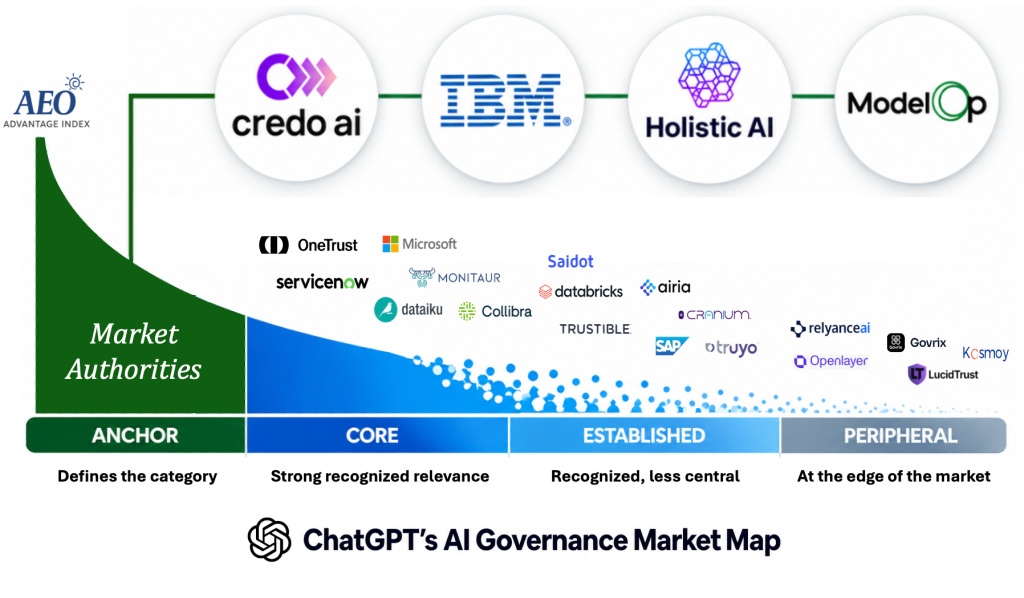
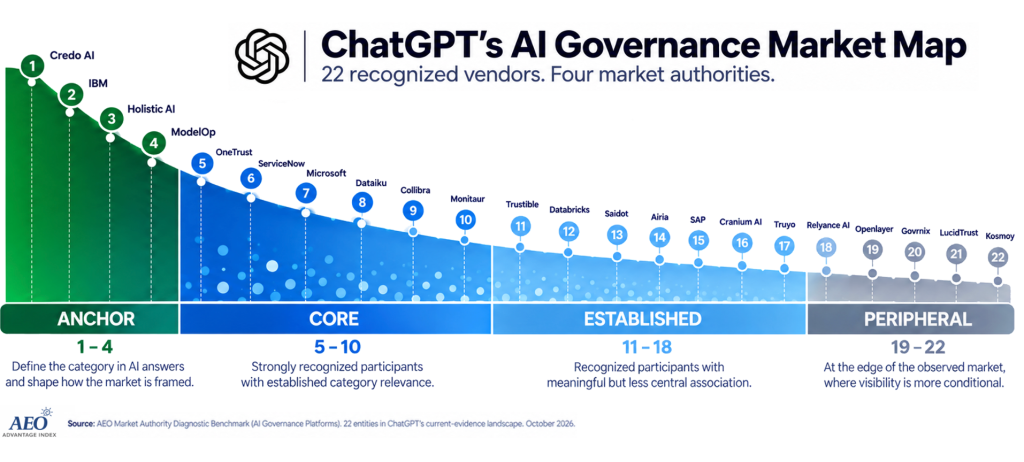
Our research identifies Credo AI, IBM, Holistic AI, and ModelOp as the four Anchor brands in ChatGPT’s observed enterprise AI governance market. These brands occupy the category-defining center of a 22-brand competitive landscape, with the remaining 18 participants extending into progressively less central positions along the market’s long tail.
The underlying AEO Advantage Index benchmark measures Market Authority: how strongly AI recognizes an entity as a credible, evidence-corroborated, and competitively relevant participant in a market category. Far beyond a handful of prompts, the research-grade methodology applies a controlled, six-stage agentic workflow combining target-blind market discovery, systematic evidence retrieval, source corroboration, validation, and algorithmic safeguards. Its workflow processed 324,000+ tokens across 23 evidence sweeps, guided by more than 25,000 words of analytical instructions.
The findings reveal three important competitive dynamics:
- AI engines construct their own representations of markets. The resulting “mental model” reflects learned market associations, corroborating evidence, and other supporting signals, with a select few Anchor brands serving as reference points for how the market is defined and dynamically shaped over time.
- AI-mediated buyer journeys compress competitive visibility. A broad universe of solution providers narrows to a select group of recognized brands, with an even smaller number occupying the category-defining center of AI’s market representation.
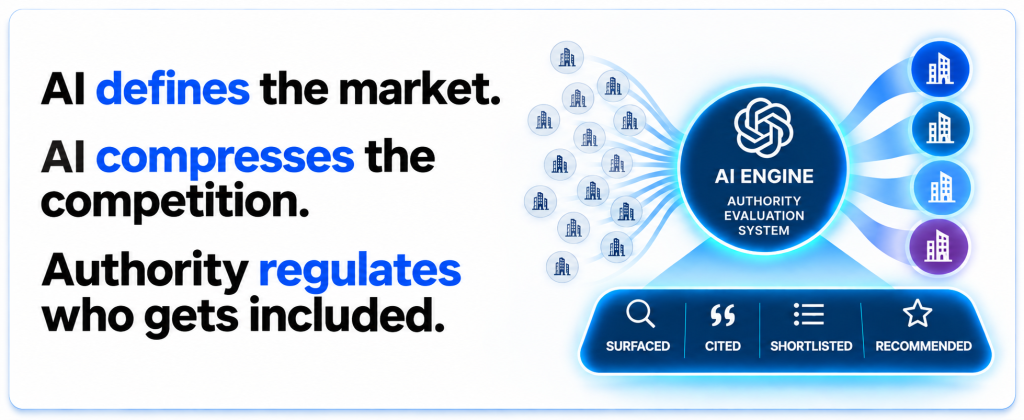
- AI engines increasingly function as authority-evaluation systems. They assess signals of relevance, credibility, and independent validation that influence which brands are surfaced, cited, shortlisted, and recommended in AI answers.
Simply put,
AI defines the market. AI compresses the competition. Authority regulates who gets included.
The following sections examine:
- How AI understands & organizes the market
- What the implications are for vendors and buyers
- Why market authority is the new competitive moat.
In our view, the emerging lesson is clear for the ~100 companies targeting buyers in this market category: brands can compete in the market yet remain largely absent from AI’s representation, and as a result risk becoming invisible to most buyers unless explicitly named.
—> Access the Full Diagnostic Assessment at the end of this brief
How AI Views the Market
Beyond identifying the four Anchor brands, the AEO Market Authority benchmark reveals six important insights into how ChatGPT understands and represents the enterprise AI governance market:
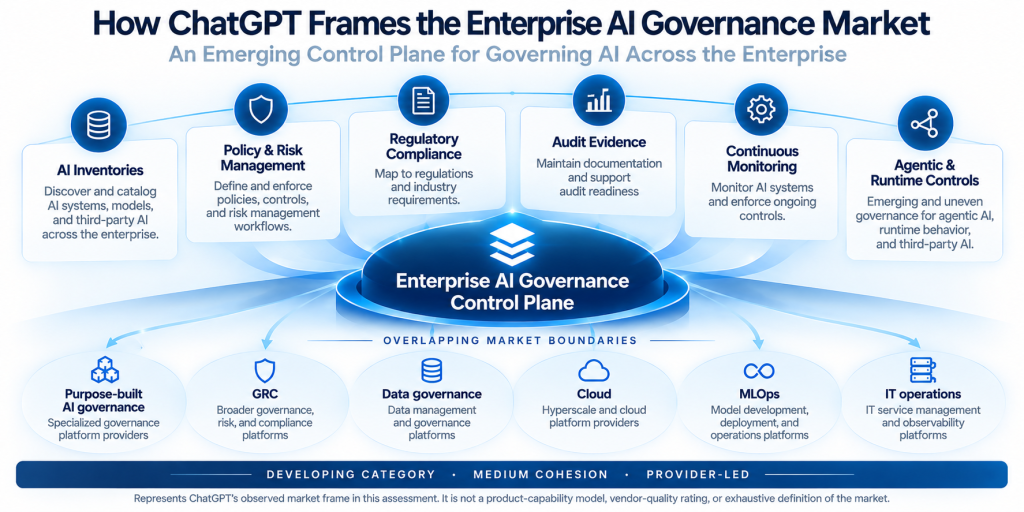
1. A RECOGNIZED, BUT STILL DEVELOPING MARKET — ChatGPT recognizes AI Governance Platforms as a distinct enterprise software category, but characterizes it as still developing, with medium cohesion. Its boundaries are fluid, encompassing specialized AI governance vendors alongside broader GRC, data governance, cloud, IT service management, and AI operations providers. This reflects a market whose participants, terminology, use cases, and competitive boundaries are still taking shape.
2. ENTERPRISE AI GOVERNANCE IS FRAMED AS AN AI CONTROL PLANE — ChatGPT’s dominant category frame centers on enterprise-wide AI inventories, policy enforcement, risk management, regulatory compliance, audit evidence, and continuous monitoring across machine learning, gen AI, and third-party systems. Emerging agentic AI and runtime controls extend that foundation. The underlying market architecture is shifting from governing individual models toward governing the enterprise AI ecosystem, although providers differ considerably in the breadth and depth of those capabilities.
3. THE AUTHORITY CENTER IS CONCENTRATED, BUT THE LONG TAIL IS EXTENSIVE — ChatGPT’s learned market landscape reached observed saturation at 37 brands, while its corresponding current-evidence calibration surfaced only 22 brands. These are different measurements, not interchangeable market counts. Together, they reveal a broad category representation organized around a relatively small authority center, with increasingly conditional associations extending into the long tail where visibility becomes increasingly probabilistic, fleeting, and context-sensitive.
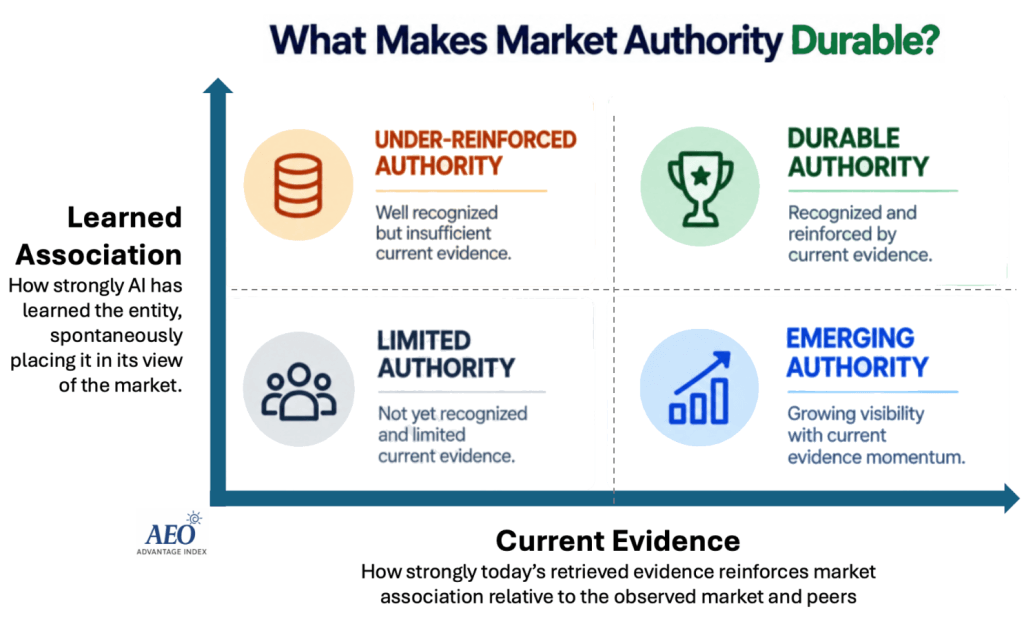
4. DURABLE AUTHORITY REQUIRES BOTH LEARNED RECOGNITION AND CURRENT EVIDENCE — ChatGPT’s representation reflects two complementary forces: what it has already learned about the market and what current evidence substantiates. Strong alignment creates more durable authority that compounds over time. Credo AI, IBM, Holistic AI, and ModelOp recur near the center of both observed landscapes, suggesting that their category associations benefit from mutual reinforcement of these perspectives. ServiceNow illustrates the opposite. They ranked #6 in current evidence authority but #15 in learned association, indicating an increasingly central role, but not yet a highly authoritative one. ValidMind, SaS, and Fiddler AI, appeared as a “core” in the models learned understanding, but were absent in the current-evidence authority cohort, indicating a less currently relevant position.
5. INDEPENDENT EVIDENCE IS UNEVENLY DISTRIBUTED — The current evidence landscape contains credible third-party validation, but vendor-authored content supplies much of the detailed product and capability information. Consequently, AI can construct authoritative-sounding market descriptions from evidence that varies considerably in independence, recency, and specificity. Being visible through retrievable content is not the same as having independently corroborated authority. This distinction becomes important as buyers rely on AI to interpret vendor claims and compare alternatives.
6. COMPANY AND PRODUCT IDENTITIES ARE NOT ALIGNED — ChatGPT’s learned landscape includes both companies and specific platforms, while the observed current-evidence cohort is company-led. ModelOp provides one illustration: ChatGPT recognizes ModelOp Center as a specific platform, yet current evidence more readily surfaces the corporate ModelOp identity. This creates potential ambiguity when AI compares corporate brands, portfolios, platforms, and renamed offerings. Which entity carries the authority matters almost as much as how much authority exists.
Collectively, these findings reveal a consequential market dynamic:
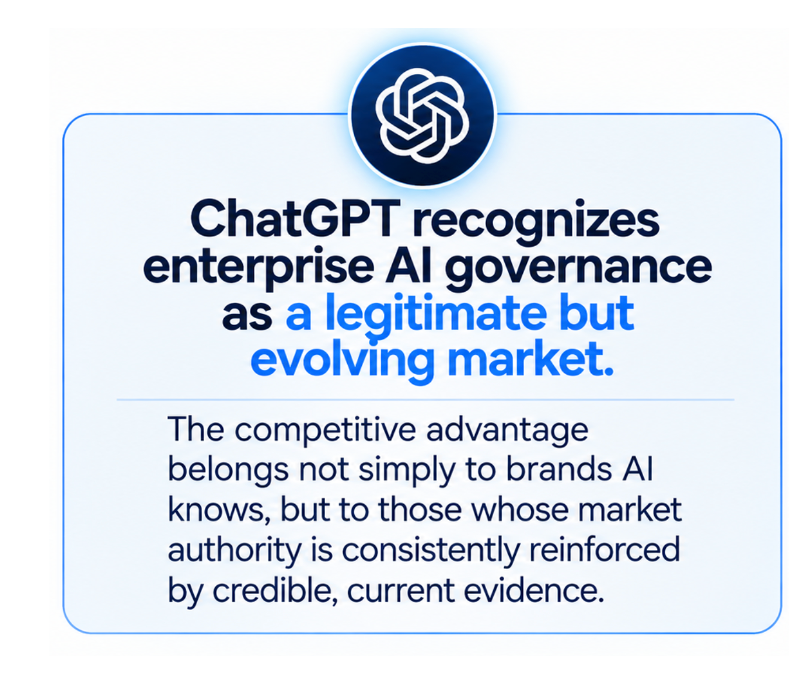
ChatGPT recognizes enterprise AI governance as a legitimate but evolving market. The competitive advantage belongs not simply to brands AI knows, but to those whose market authority is consistently reinforced by credible, current evidence.
The result is a new competitive reality: where vendors sit in AI’s market representation and how strongly their authority is reinforced can influence whether they earn a preferred position in AI-mediated buyer conversations.
Implications for Vendors
For enterprise AI governance platform vendors, the research reveals a new dimension of competitive positioning: a company’s presence in the market does not guarantee an equally strong position in AI’s representation of that market.
ChatGPT’s observed 22-brand landscape organizes providers into four Market Authority tiers, each carrying different strategic implications.
ANCHORS —
AI, IBM, Holistic AI, and ModelOp.
These four providers occupy the category-defining center of ChatGPT’s observed market representation, serving as reference points for how AI understands the market and its competitive participants. This creates a meaningful advantage in category-first AI discovery. But today’s category authority does not guarantee tomorrow’s relevance.
As enterprise AI governance expands from model oversight toward agentic AI, runtime controls, and third-party risk, the imperative is to remain aligned with the capabilities and evidence that increasingly define the category. That requires diagnostics beyond Market Authority, assessing buyer intent, competitive differentiation, content impact, and narrative fidelity, all reinforced by credible, independently corroborated evidence.
CORE —
OneTrust, ServiceNow, Microsoft, Dataiku, Collibra, Monitaur.
These vendors are consistently recognized within ChatGPT’s market representation but have not become category-defining reference points. The strategic question is why. Is the gap driven by weaker learned association, insufficient current evidence, or deficiencies in semantic clarity, contextual relevance, citability, and independent validation? Or are their capabilities and narratives misaligned with emerging buyer intent and the requirements defining the category?
Moving from Core to Anchor requires diagnosing which authority signals are holding them back, then strengthening the evidence, differentiation, and market narrative needed to establish a more central position in AI’s competitive representation of this market category.
ESTABLISHED —
Trustible, Databricks, Saidot, Airia, SAP, Cranium AI, Truyo, Relyance AI.
These providers have crossed an important threshold: ChatGPT recognizes them as credible market participants, but not as default category reference points. The competitive risk is being recognized yet overlooked during early buyer discovery, before buyers even evaluate their strengths. The strategic question is why their existing recognition has not translated into greater centrality. Is their association dependent on specific use cases, narrow evidence sources, or being explicitly named? Are weaknesses in learned association, current evidence, independent validation, content citability, brand identity, or buyer-intent alignment limiting their position? The imperative is to identify which authority signals prevent existing recognition from becoming more central, durable, and consistently reinforced.
PERIPHERAL —
Openlayer, Govrnix, LucidTrust, Kosmoy.
ChatGPT has learned enough to include these vendors in its “mental model” of the category, with enough current evidence to recognize them as legitimate market participants, but it does not yet treat them as a recurring or central reference point. This may limit your inclusion in broad, AI-mediated discovery and initial consideration. The risk is that visibility may become increasingly probabilistic and fleeting as the market evolves. The next step is to determine whether the constraint is learned recognition, current evidence, independent corroboration, product identity, category framing, buyer-intent alignment, trust, or competitive displacement.
THE INVISIBLE COHORT —
Beyond the four ranked tiers lies a potentially much larger Invisible Tier: providers with relevant AI governance capabilities that did not enter ChatGPT’s observed category-first market representation.
We estimate the broader AI governance ecosystem encompasses approximately 100 viable providers, including purpose-built platforms, adjacent enterprise software vendors, and governance technology services. ChatGPT’s learned landscape contained 37 entities, while its current-evidence assessment surfaced 22. After normalizing company and product identities, approximately 46 distinct provider families appeared in the overall market category landscape. Against our estimated market universe, roughly half were totally absent, while nearly 80% did not appear in the current-evidence cohort.
This illustrates a fundamental shift from traditional search to AI-mediated discovery. Search offered vendors numerous pages and paths to be discovered. AI answers concentrate attention on a much smaller set of providers. Companies missing from AI’s market representation risk being overlooked, as we analyzed in our recent research brief, The Corporate Graveyard of AI Invisibility.
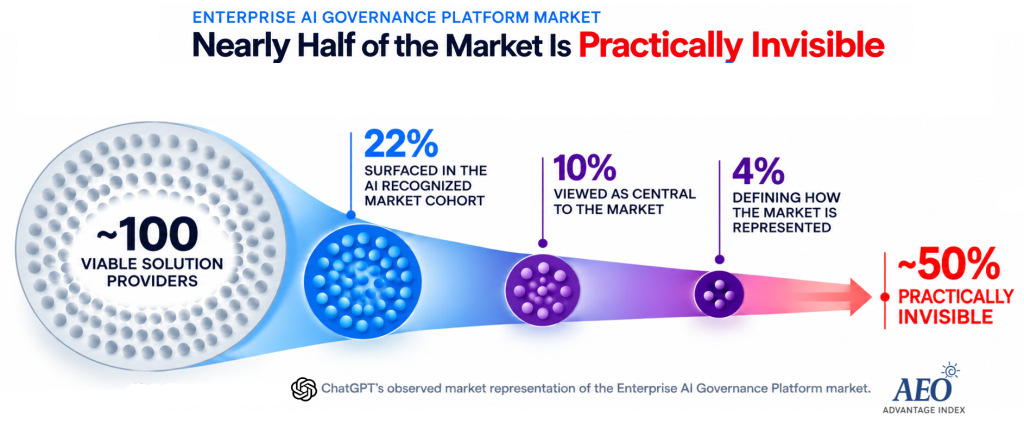
Invisibility, however, does not mean inferiority or irrelevance. Absence may reflect weak learned association, limited independent evidence, narrow specialization, adjacent-category positioning, buyer intent misalignment, or company-product identity fragmentation.
For these providers, the first strategic question is to understand why this is the case. Without understanding why (root causes), it will be difficult to know how to become increasingly competitive. That requires deeper diagnostics across market association, buyer intent, competitive differentiation, content, narrative, and the underlying AEO chain of signals.
Across the entire market landscape, the strategic lesson is clear:
The new competitive divide is not simply between market leaders and challengers. It is between brands AI readily recognizes, brands it recognizes conditionally, and brands it may never introduce into the buyer’s consideration set.
Competing in this new reality requires more than recognition. Brands must establish, reinforce, and defend their Market Authority, while strengthening the buyer-intent alignment, competitive differentiation, citable content, coherent narratives, and independent validation needed to earn lasting visibility and preference.
Implications for Buyers
AI-mediated buying has reached a critical inflection point. According to G2’s 2026 B2B software buyer research, 71% of buyers use AI chatbots during the buying journey, and 69% report choosing a different vendor than initially expected following AI guidance. Another 33% purchased from a previously unfamiliar vendor. In enterprise AI and software markets, the numbers are likely even higher given the tech-savvy buyer population.
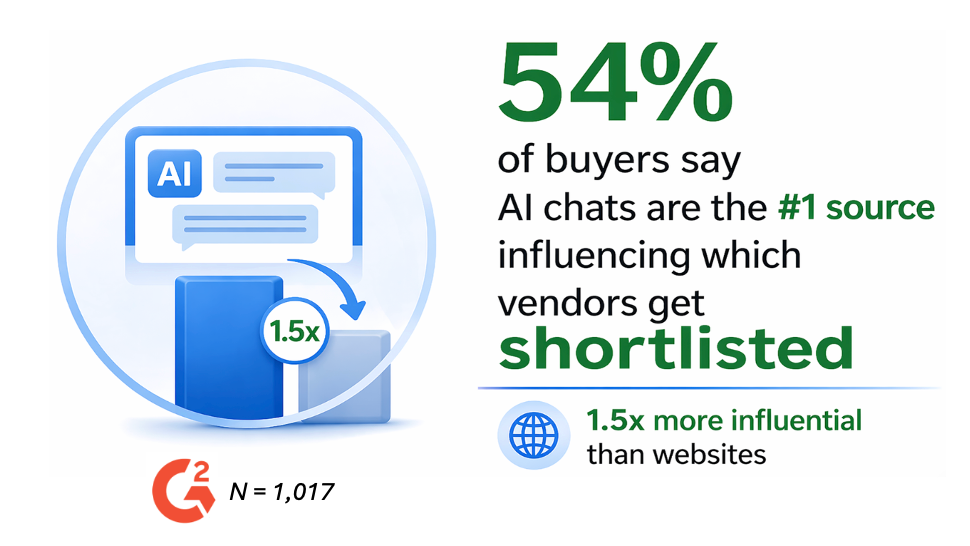
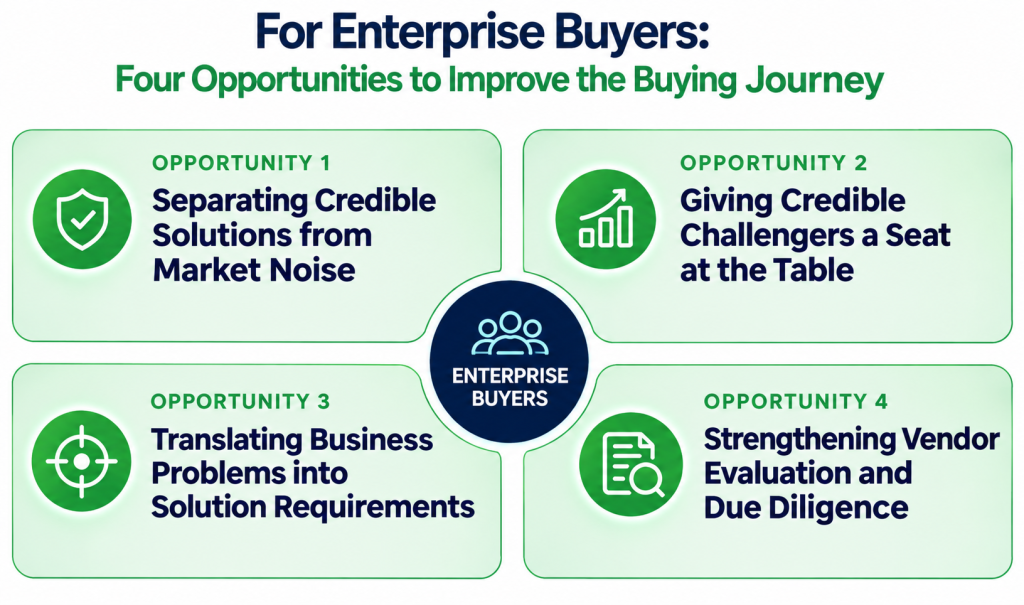
For enterprise AI governance buyers, ChatGPT’s learned market associations and current evidence synthesis create four important opportunities for enterprise buyers:
- Separate Credible Solutions from Market Noise. AI engines assess whether vendor claims are reinforced by credible, independent evidence across the broader ecosystem. In this still-developing market, vendors may promise enterprise-wide AI governance while offering materially different capabilities. A governance dashboard is not runtime policy enforcement; regulatory mapping is not audit-ready evidence; and model inventories may not cover autonomous agents or third-party AI. AI engines can help buyers assess whether vendor claims are reinforced by independent research, customer evidence, and demonstrated outcomes rather than promotional narratives alone.
- Give Credible Challengers a Seat at the Table. Credo AI, Holistic AI, and ModelOp joined IBM among ChatGPT’s four Anchor brands, demonstrating that corporate scale does not necessarily determine Market Authority. This creates opportunities for buyers to discover emerging governance platforms alongside established enterprise vendors, potentially uncovering differentiated capabilities based on merit and credible market evidence, not simply marketing spend.
- Translate Business Problems into Solution Requirements. Enterprise buyers can use AI to translate complex governance challenges into specific capabilities, architectural requirements, and potential solutions. For example, how do you enforce policies over autonomous agents, govern third-party AI, or demonstrate compliance across hundreds of AI applications? AI can connect these business challenges to requirements such as runtime controls, continuous monitoring, auditability, and human oversight. This shifts buying decisions from comparing generic feature lists to evaluating which solutions best address specific risks, environments, and outcomes.
- Strengthen Vendor Evaluation and Due Diligence. AI can compare vendor capabilities, examine supporting evidence, identify inconsistencies, and expose unanswered questions. Buyers can use these insights to evaluate product-level fit, challenge vendor assertions, and focus due diligence on the requirements, risks, and potential business outcomes that matter most. This can accelerate evaluation while improving the quality of evidence supporting purchasing decisions.
These opportunities, however, also carry risks. AI’s market representation may omit qualified specialists, reflect uneven evidence, conflate company and product identities, or emphasize capabilities that do not match a buyer’s needs. Buyers should challenge shortlists, verify critical claims, and independently assess solution fit.
They should also distinguish corporate reputation from actual product capabilities and demand independently corroborated evidence of vendor claims.
The strategic opportunity is to turn AI from a shortlist generator into an intelligent market advisor. The objective being to identify the solutions best aligned with enterprise requirements, supported by credible evidence of their ability to deliver.
AnalystANGLE
If there was one finding from the previously referenced G2 research that enterprise technology vendors should pay attention to, it’s that 69% chose a different vendor than initially expected following AI guidance. For this reason alone, AEO should be more than a marketing priority; it should become a strategic business imperative.
The top priority should be addressing the significant measurement-to-action gap most companies are facing. A 2026 Scrunch and Scribewise survey found that 73% of marketing and PR professionals have invested in AI visibility tools, but 59% struggle to confidently translate the data into action, and 56% don’t understand how AI engines work differently than SEO.
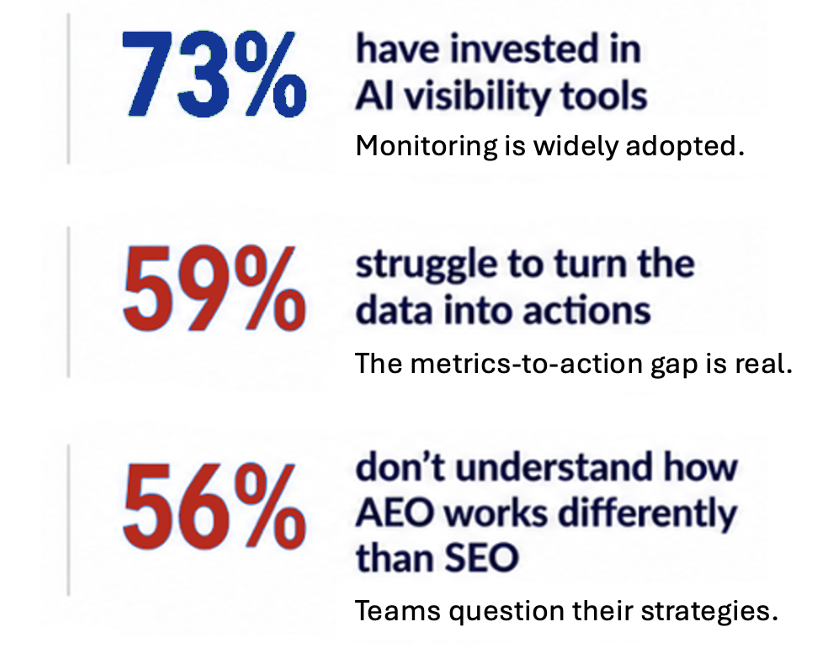
Much of today’s AEO activity measures WHAT is happening: visibility, citations, share of answer, and recommendations. But those metrics alone cannot explain WHY a brand is recognized, overlooked, or outperformed. Without understanding WHY, vendors cannot confidently determine HOW to improve their market authority and competitive position.
AEO Diagnostic Intelligence is the missing link between visibility measurement and strategic action.
AEO Advantage Index systematically diagnoses the full chain of influence:
- START WITH OUTCOMES — Measure where brands are surfaced, cited, shortlisted, and recommended across AI-mediated buyer journeys.
- BENCHMARK YOUR AUTHORITY DIMENSIONS — Identify whether Narrative, Content, Buyer, Competitive, or Market Authority is strengthening or constraining performance. Read more about why brand authority matters in the era of AI.
- DRILL DOWN TO UNDERLYING ROOT CAUSES — Examine four stages of AI evaluation, supported by 19 evidence-based diagnostic signals, to isolate consequential weaknesses in semantic clarity, contextual relevance, evidence citability, and validation/trust.
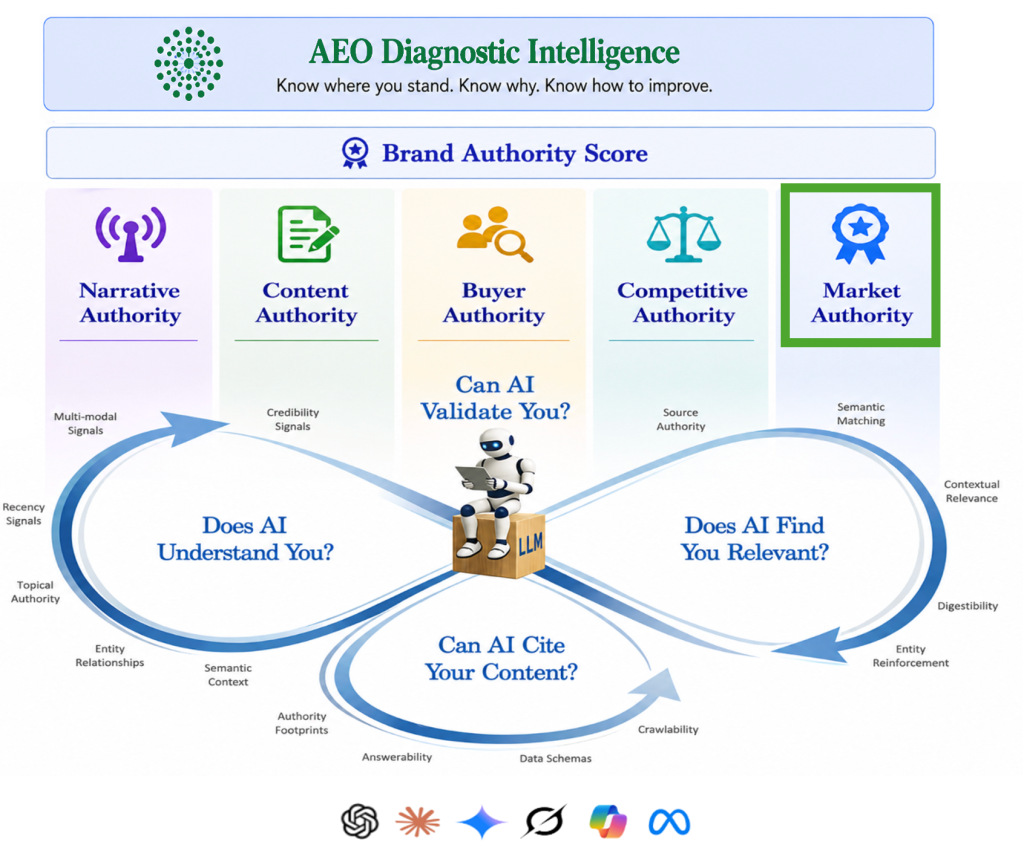
Market Authority, the focus of this research, establishes a critical baseline: whether AI recognizes and substantiates a brand’s place in its market. But it is only one part of a broader diagnostic system required to understand why brands are surfaced, cited, shortlisted, or recommended across AI engines and buyer journeys.
The strategic imperative:
- Measure WHAT.
- Diagnose WHY.
- Prioritize HOW.
- Compound the ADVANTAGE
For more details, read the full Enterprise AI Governance Market Authority Landscape Diagnostic report — If it asks for a password, please contact me.
For a deeper interpretation of the Enterprise AI Governance Platform market research, or to request a complimentary AEO Market Authority assessment for your company or product, contact me on LinkedIn or on my website.

Research scope: This October 2026 benchmark reflects ChatGPT’s observed current-evidence category landscape. The 22-brand cohort had not reached full observed saturation and is not an exhaustive market census. Market Authority positions reflect category association, not product quality, market share, or measured buyer preference.