Why Enterprise AI Needs Trust Architectures
Watch the Podcast
Executive Brief
Enterprise AI is entering a new phase. As organizations move AI into higher-consequence decisions, workflows, and digital labor initiatives, a new reality is emerging: the primary challenge is no longer model intelligence. It is trust.
This research brief explores why enterprise AI is entering what we call the Reliability Era and how competitive advantage will belong not to organizations with access to the best models, but to those that build the most reliable and trusted AI architectures. We will also explore how Openstream.ai is helping to lead this strategic shift.
Key Takeaways:
- Enterprises are trapped between capability and confidence: Only 46% of enterprises report a high level of trust in AI outcomes. This growing gap between AI capability and trust is creating what we call the Reliability Trap.
- Trust is an architectural challenge, not a model challenge: Explainability, contextual awareness, provenance, memory, and human oversight do not emerge from larger models. They emerge from architectural design.
- The market is shifting from model selection to trust architectures: Enterprise leaders are increasingly prioritizing architecture, making it a more important differentiator than foundation models.
- Multi-agent trust architectures provide a path forward: The next generation of enterprise AI systems will combine specialized agents, planning-based reasoning, knowledge grounding, contextual awareness, and human collaboration to produce outcomes that can be explained, defended, audited, and trusted.
- Openstream.ai demonstrates what reliability-first AI looks like in practice: Through its multi-agent trust architecture, the company illustrates how enterprises can improve decision quality, operational efficiency, and business outcomes by designing for reliability rather than relying on model intelligence alone.
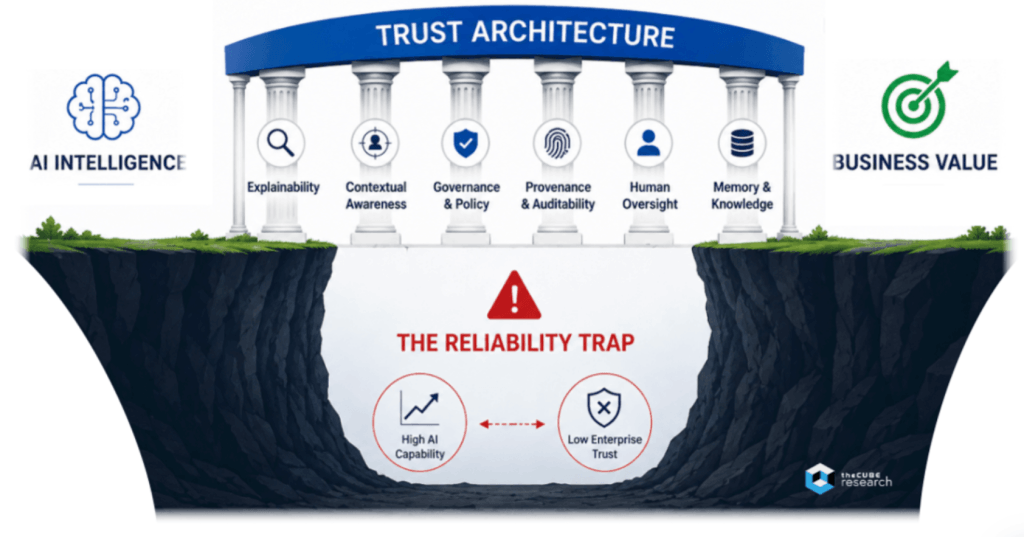
The broader implication is clear: intelligence is rapidly becoming commoditized, but reliability is not. The next frontier of enterprise AI will be defined not by who builds the smartest models, but by who builds the most trustworthy systems. Organizations that recognize reliability as an architectural discipline will unlock greater business value.
The Reliability Challenge
Signals from the marketplace, backed by growing adoption data, suggest that enterprise AI is approaching an important inflection point. For the past several years, the industry has been obsessed with large language models (LLMs): larger, smarter, faster, cheaper, and more capable models. Entire ecosystems have emerged around benchmarking, evaluating, and comparing the performance of foundation models.
The first wave of enterprise AI was largely defined by intelligence. Organizations raced to deploy LLM-centric chatbots, copilots, and assistants capable of generating content and answering questions, summarizing information, and accelerating productivity. The results have been impressive, and the ROI is creating greater aspirations.
Organizations are now attempting to move beyond these entry-level use cases into more real-world business operations, and as they do, a different reality is emerging. The primary barrier to enterprise AI adoption is no longer intelligence (that is, model selection).
It is trust.
The reason is simple. Most enterprise AI deployments have stopped at retrieval-grounded LLMs and have yet to evolve into true agentic architectures where models operate alongside semantic, contextual, reasoning, governance, and memory layers. Those architectural layers—not the model itself—are where trust and reliability are ultimately established.
Across industries, organizations are exploring how AI can now support decision-making, coordinate workflows, solve problems, and serve as digital workers alongside human employees. This transition fundamentally changes the requirements as outcomes become far more consequential to the business. As a result, enterprise leaders are asking new questions:
- Can the system explain its recommendations?
- Can it identify the data used to reach a decision?
- Can decisions be defended and audited?
- Can AI understand the context of our policies?
- Can humans challenge assumptions?
- Can AI be trusted to operate autonomously?
These questions signal a fundamental shift in enterprise priorities. The conversation is shifting from model performance to outcome reliability.
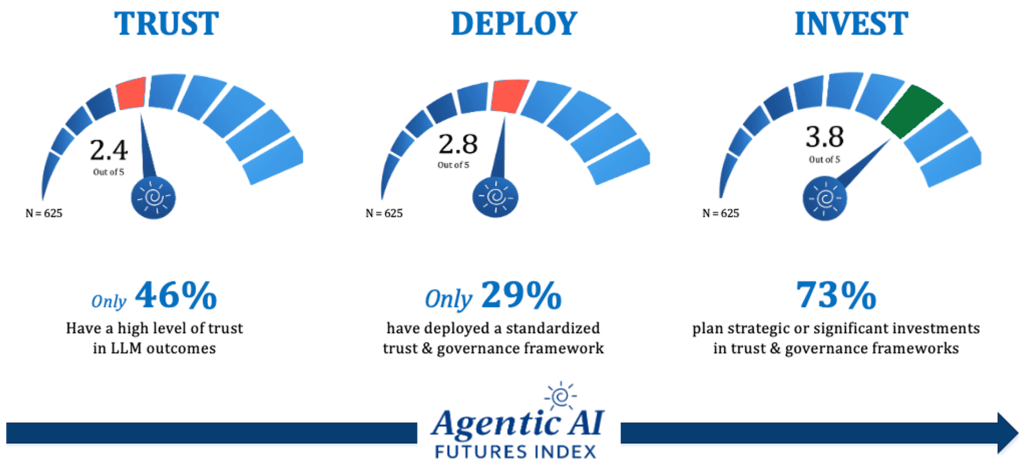
Our Agentic AI Futures Index clearly reflects this challenge: only 46% of enterprise AI leaders report having a high level of trust in LLM-generated outcomes.
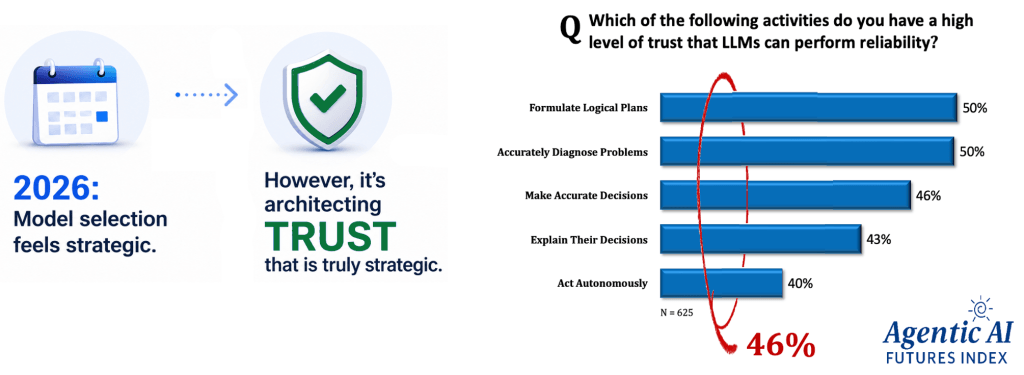
This creates what we call the Reliability Trap.
The reliability trap occurs when organizations have AI systems that are intelligent enough to demonstrate value, automate repeatable tasks, and generate productivity gains, but not reliable enough to earn the trust required for higher-order agentic use cases.
The result is an expanding gap between AI capability and enterprise confidence and business impact.
Many systems perform exceptionally well under controlled conditions yet struggle when confronted with the ambiguity, complexity, governance requirements, and dynamic conditions of real-world business environments.
This distinction is critical.
Trust is not primarily a model challenge. It is an architectural challenge.
Foundation models remain essential building blocks and gateways into the world of AI. However, they were never designed to provide the explainability, governance, accountability, contextual awareness, and operational controls required for consequential business decisions.
As organizations move toward higher-stakes use cases, they are discovering a new reality: architecture matters more than models. For that reason, the next frontier of enterprise AI will be defined by a different question.
Not:
“What is the smartest, fastest, or cheapest model?”
But:
“What is the most reliable and trustworthy architecture?”
The future winners in enterprise AI will not necessarily build the most intelligent systems. They will build the systems enterprises trust most.
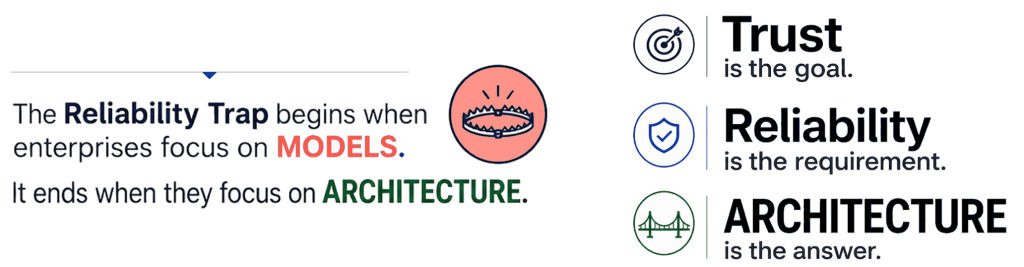
This is why a new generation of trust-oriented, multi-agent architectures may provide a path forward. Openstream.ai, for example, is addressing this challenge through a reliability-first architectural approach designed to improve explainability, governance, transparency, and enterprise trust.
They understand that ultimately, reliability is an architectural challenge, not a model challenge.
Organizations that fail to recognize this reality risk seeing their AI initiatives stall precisely where the greatest business value begins.
Escaping the Reliability Trap
The encouraging news is that enterprises increasingly recognize the problem. The “Reliability Trap” is no longer hidden. Organizations may differ in their AI strategies, technology choices, and deployment priorities, but they are arriving at a common conclusion: scaling AI requires more than intelligence alone. It requires trust.
This realization is becoming one of the most important shifts in the enterprise AI market.
As enterprises attempt to expand AI initiatives into higher-value use cases such as decision support, process orchestration, customer interactions, operational optimization, and autonomous execution, they are discovering a new reality: value is defined by whether organizations can participate in and trust AI outcomes and act on them with confidence. Our Agentic AI Futures Index reveals a market that is both optimistic and concerned.
While organizations continue to invest aggressively in AI transformation, only 29% report having formal trust and governance frameworks in place today. At the same time, nearly 80% plan to increase investments in trust, governance, and oversight capabilities over the next twelve months.As the maturity index indicates, they know they must address this trust barrier ASAP.
Despite most organizations believing that digital labor is inevitable, most have not established the controls, oversight mechanisms, and architectural foundations required to confidently deploy it in higher-stakes environments.
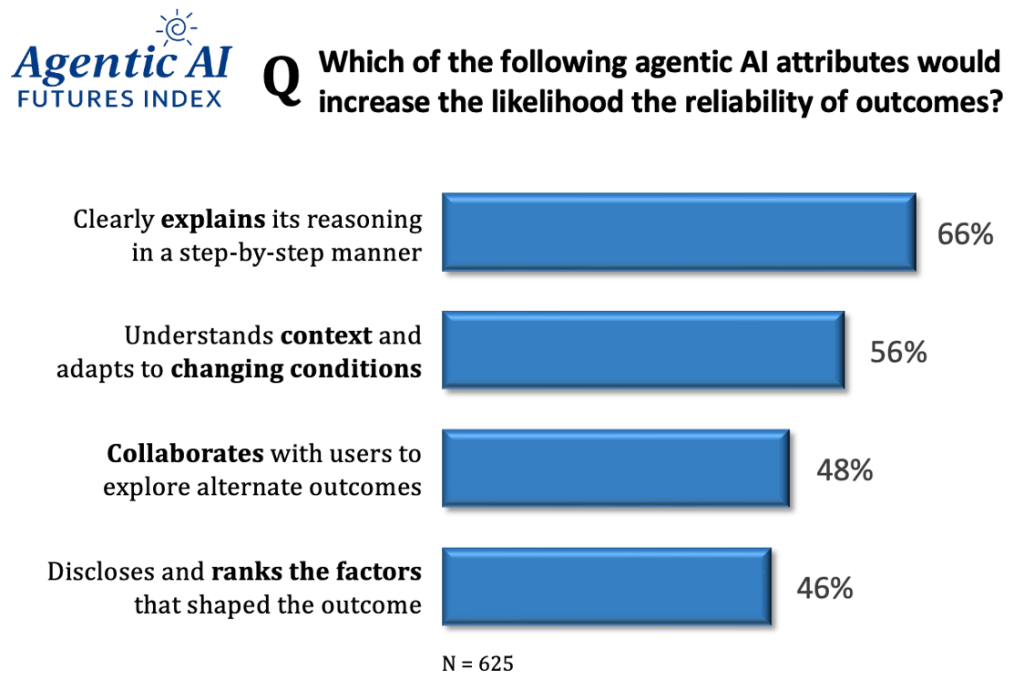
The Agentic AI Futures Index also provides important clues on what must be done. As shown, AI leaders consistently point to capabilities that extend well beyond model performance: 66% cite explainability, 56% cite evolving context, 48% cite “what if” simulations, and 46% cite influence rankings.
This reveals an important market shift. Enterprises are not asking for bigger models. They are asking for more transparent, contextual, collaborative, and explainable systems. In other words, they are describing architectural capabilities rather than model capabilities.
Trust and reliability are ultimately a function of architecture and must be engineered.
Organizations that recognize this and successfully operationalize trust and reliability will unlock significantly greater returns from their AI investments,
Those that fail to do so risk becoming trapped in a cycle of pilots, proofs of concept, and narrowly scoped deployments and de-deployments that never achieve transformative business impact.
Why Architecture Matters
If trust and reliability are ultimately engineering and architectural challenges, then what kind of architecture is required? This question is becoming increasingly mainstream in industry discourse. The answer begins with recognizing that foundation models, while essential, represent only one layer of a much broader enterprise AI architecture. Large language models (LLMs) are the foundation layer of modern AI systems, essentially the gateways in the world of artificial intelligence.
However, intelligence alone does not create trust. Trust emerges from the layers surrounding the model. Just as enterprises would never deploy a mission-critical application without governance, workflow controls, and operational oversight, they cannot rely on a foundation model alone to support consequential business decisions.
This is where layered architectures become essential. Knowledge graphs provide trusted knowledge and provenance. Contextual spaces create situational awareness. Agent memory preserves continuity and learning across interactions. Together, these layers transform foundation models from intelligent assistants into trustworthy systems capable of supporting higher-stakes decisions.
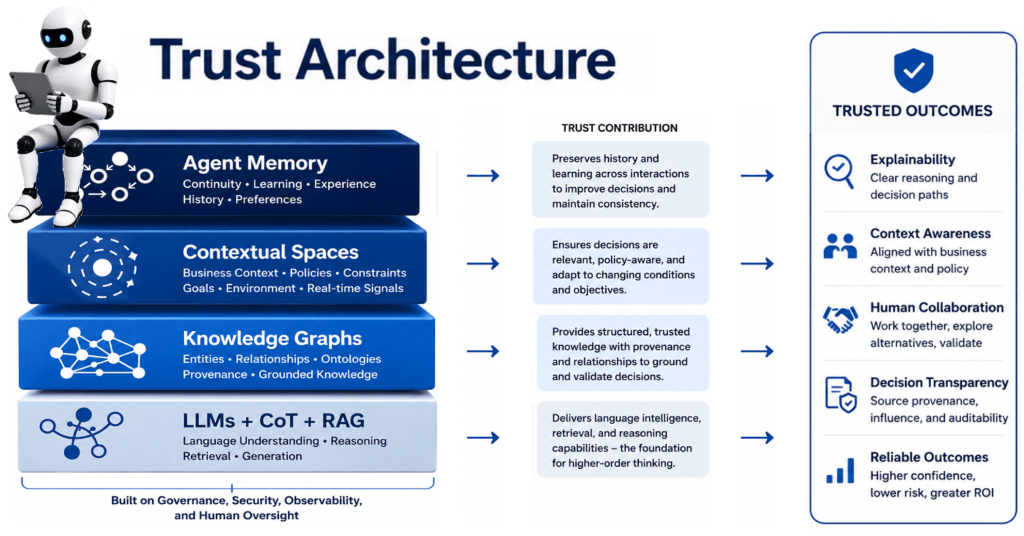
We refer to this emerging architectural pattern as a Trust Architecture—an architecture designed not simply to generate answers, but to produce outcomes that organizations can explain, govern, validate, and trust.
What makes this architectural shift particularly important is that each layer directly addresses the reliability requirements identified by enterprise AI leaders. Explainability emerges through structured reasoning and transparent decision paths. Contextual awareness comes from continuously adapting decisions to changing business conditions. Human collaborationis enabled through architectures that allow users to challenge assumptions, explore alternatives, and participate in decision-making. Knowledge provenanceprovides visibility into the sources, relationships, and evidence that support a recommendation. Memory enables continuity, learning, and consistency across interactions. Collectively, these capabilities move AI beyond simple prediction and response generation toward a more disciplined model of enterprise decision support.
The bottom line: The objective is no longer to generate the most likely answer. It is to generate a reliable answer that can be explained, defended, audited, and relied on to make more consequential business decisions. The principles of a trust architecture reveal important truths:
- Trust & reliability do not emerge from a larger model.
- Trust & reliability do not emerge from more parameters.
- Trust & reliability do not emerge from faster inference.
Trust emerges when explainability, context, knowledge governance, human judgment, and specialized intelligence work together within a coherent architectural framework.
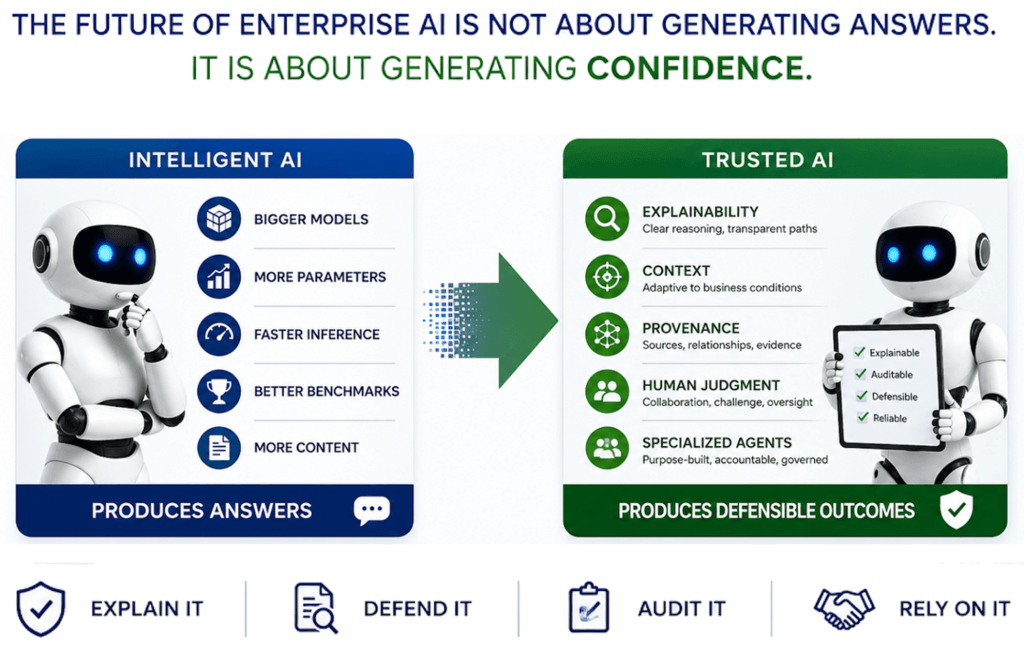
The implication is a fundamental shift in enterprise AI design. Organizations are beginning to move away from viewing AI as a standalone model and toward viewing it as a coordinated system of specialized agents that mirrors how organizations themselves operate.
Complex outcomes are rarely produced by a single individual acting alone. They emerge through collaboration among specialists with different expertise, responsibilities, accountability, and perspectives. When multi-agent systems operate within a trust architecture, specialized agents can focus on planning, reasoning, execution, compliance, knowledge retrieval, customer engagement, or other functions while operating within clearly defined boundaries and governance frameworks. Furthermore, as AI systems become more consequential, human judgment becomes increasingly important. The most reliable systems are not designed to replace human expertise. They are designed to augment it through specialization, which not only improves performance but can also significantly improve reliability.
As enterprises seek to escape the Reliability Trap, the conversation is therefore shifting from model selection to architectural design. The question is no longer, “Which model should we deploy?” Increasingly, the more important question becomes, “What architecture can we trust?”
This will become the defining question of the next frontier of enterprise AI.
Which then begs the question: “How do we operationalize these principles in production environments?”
This is where companies such as Openstream.ai are beginning to distinguish themselves by building architectures specifically designed around reliability, explainability, and enterprise trust.
Leadership in Trust Architectures
This shift is real and already in production across many use cases. A leading example is Openstream.ai, which has established a highly differentiated position among mass enterprise AI solution providers.
Rather than treating trust as a governance layer bolted onto an LLM, Openstream.ai treats trust as an architectural design principle. The company’s EVA platform is built around specialized multi-agent systems, planning-based reasoning, knowledge provenance, and human-agent collaboration.
The objective is straightforward: create AI systems that are not only intelligent but also explainable, defensible, and reliable. As Magnus Revang, Chief Product Officer at Openstream.ai, explained during our discussion: “Black-box AI is not enterprise AI.”
That simple statement captures one of the most important shifts occurring across the industry. While much of the market remains focused on prompt-driven assistants and conversational interfaces, Openstream.ai is focused on a different challenge: how to operationalize AI when outcomes carry significant business consequences.
The first challenge involves output quality, which is not binary. Traditional software systems operate within deterministic boundaries. Outputs are either correct or incorrect. AI systems operate differently. Outcomes exist on a spectrum of quality, confidence, completeness, and usefulness. This creates a challenge for organizations attempting to deploy AI into critical workflows where ambiguity carries risk. Openstream.ai addresses this challenge through planning-based reasoning and specialized multi-agent architectures that decompose tasks into a collection of specialized agents designed to perform distinct functions. Agents gather information, validate findings, apply policies, evaluate alternatives, and review outcomes before producing recommendations.
As Revang described:
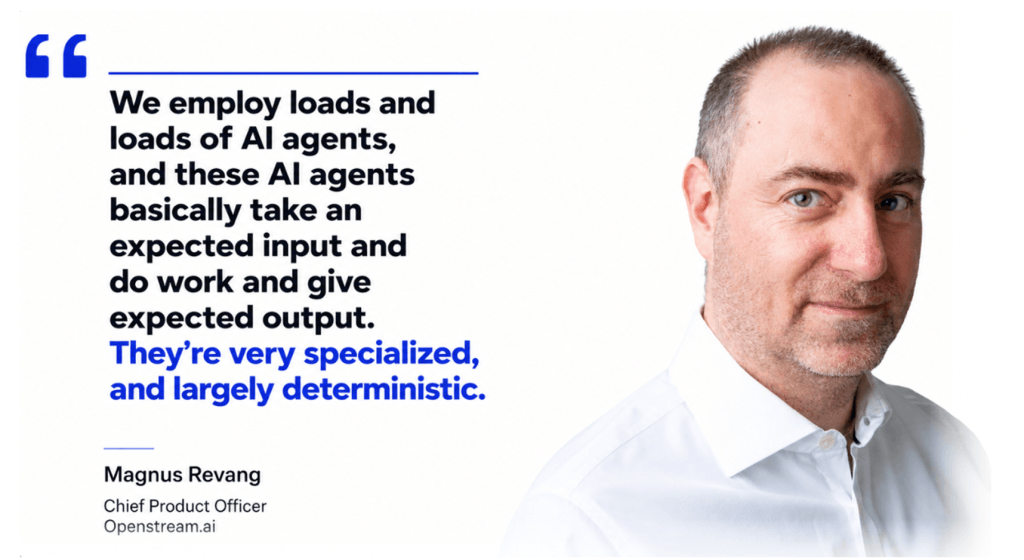
“We employ loads and loads of AI agents, and these AI agents basically take an expected input and do work and give expected output. They’re very specialized, and largely deterministic.”
This approach introduces checks and balances into the reasoning process. Instead of assuming the first answer is correct, the architecture is designed to challenge and refine outcomes.
The result is a system optimized not simply for answer generation, but for decision quality.
A second challenge is domain expertise. A persistent problem in enterprise AI is that the individuals building AI systems often lack deep expertise in the business domains those systems are intended to support. Conversely, subject-matter experts frequently lack sufficient understanding of AI’s capabilities and limitations. This creates a structural disconnect between technology teams and business experts. Openstream.ai views this gap as one of the primary barriers to successful AI deployment. According to Revang: “You need to involve your domain experts early because you have to understand what the AI is supposed to do.”
This philosophy extends throughout Openstream.ai’s implementation approach. Rather than relying on the generalized world knowledge embedded in foundation models, Openstream focuses on acquiring, validating, and operationalizing domain-specific knowledge. Knowledge extraction, provenance tracking, policy alignment, and contextual understanding become core architectural functions rather than secondary implementation details.
A third challenge involves the compounding nature of AI failures. Hallucinations, incomplete context, poor source data, weak grounding, policy violations, and process exceptions rarely occur in isolation. Instead, they accumulate across complex workflows. While individual errors may seem insignificant, their combination can undermine confidence in the entire system.
Openstream.ai addresses this challenge through layered validation mechanisms and multi-agent collaboration. Rather than asking a single model to determine the correct classification, multiple specialized agents evaluate company information, available classifications, governing rules, and validation requirements before arriving at a recommendation. They are architecting the principle that reliable outcomes emerge when multiple perspectives contribute to a decision process. The architecture mirrors how organizations themselves operate. Important decisions are rarely made by a single individual. They emerge through collaboration among specialists with different expertise, responsibilities, and viewpoints.
Perhaps the most important aspect of Openstream.ai’s strategy is its distinction between prompt-driven AI and event-driven AI. Much of today’s AI market remains focused on low-control environments where users interact directly with models through prompts and conversational interfaces. These systems can provide significant productivity benefits, but they often struggle to satisfy the reliability requirements associated with core business operations.
Openstream.ai focuses on what Revang calls “high-control, event-triggered” environments. These are workflows initiated by business events rather than user prompts and governed by compliance requirements, policies, risk controls, and operational objectives. Examples include investment research, claims processing, risk analysis, compliance workflows, and other forms of knowledge-intensive work. According to Revang:
“The enterprise value is in high-control event-triggered mechanisms.”
This distinction is important because it highlights where many organizations ultimately expect digital labor transformation to occur. The greatest economic value is unlikely to come from generating meeting notes, analyzing information, or automating tasks. It will come from improving the quality, speed, consistency, and reliability of decisions embedded within core business processes.
What makes .ai particularly interesting is not any individual technology component. Many vendors now claim to offer knowledge graphs, agent orchestration, reasoning engines, governance frameworks, or multimodal interfaces. Openstream.ai’s differentiation lies in how these capabilities are combined into a coherent trust architecture designed for environments where decisions, actions, and outcomes must be explainable, auditable, and reliable.
Our view of the architecture depicted above is structured around several integrated layers:
- Trust Architecture Foundation serves as the operational bedrock, embedding security, privacy, compliance, reliability, and observability into the environment where agents operate.
- Knowledge Layer begins establishing the enterprise’s organizational context and memory through knowledge graphs, ontologies, enterprise data, and provenance.
- Symbolic Reasoning & Planning introduces explicit logic, planning, and inference capabilities that enable explainable reasoning paths based on relationships, constraints, policies, and more.
- Neural / LLM Component provides language understanding, generation, and interaction capabilities, with LLMs as a component of the architecture rather than its center.
- Plan-based Collaborative Reasoning Engine that orchestrates specialized agents, manages goals, evaluates alternatives, and guides decision-making processes before actions are taken.
- Multimodal Interaction enables collaboration across speech, text, documents, and visual information, allowing humans and AI systems to naturally interact.
- Governance & Oversight spans the entire architecture, providing explainability, policy enforcement, grounding mechanisms, and human supervision.
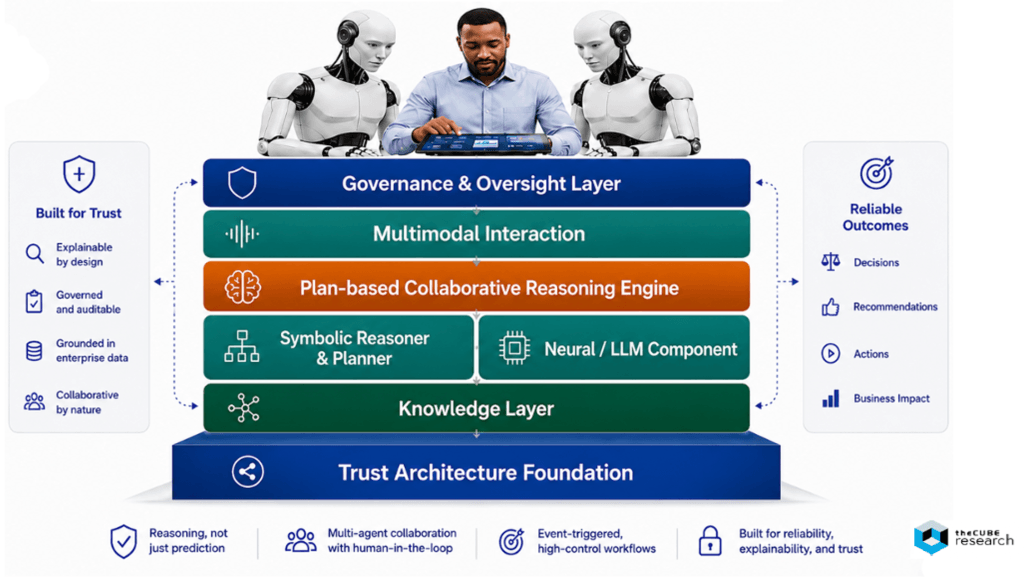
What makes this architecture noteworthy is that it directly addresses many of the reliability requirements identified by enterprise AI leaders in the Agentic AI Futures index survey: Explainability, Contextual Awareness, Knowledge Provenance, and Human Collaboration. Collectively, these capabilities move AI beyond simple prediction and response generation toward a more disciplined model of enterprise decision support.
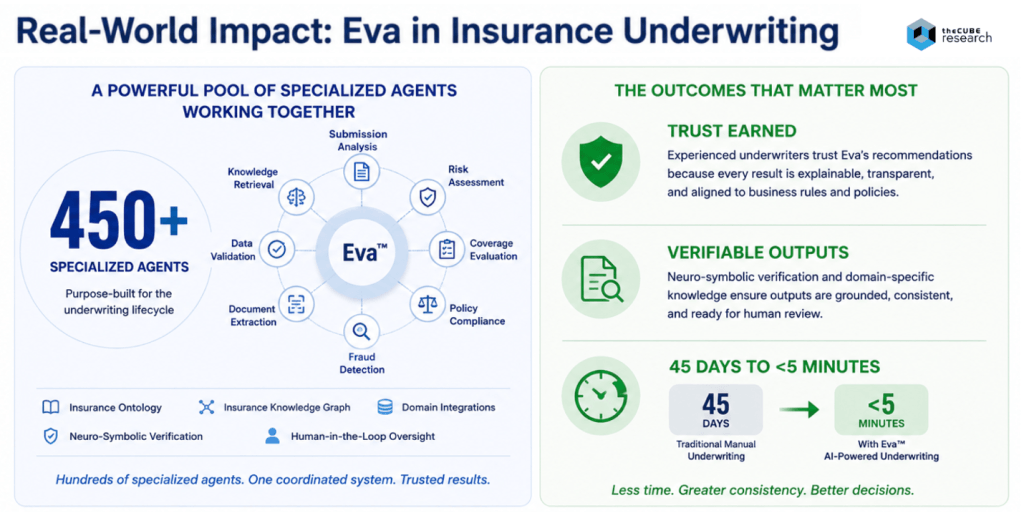
The value of Openstream.ai’s architecture comes to life in their insurance underwriting solution, where accuracy, judgment, regulatory compliance, and risk assessment matter far more than raw automation. Built on the Eva platform, this solution combines hundreds of highly specialized AI agents, insurance-specific ontologies, knowledge graphs, expert knowledge capture, and neuro-symbolic verification into a coordinated underwriting system that supports the full underwriting lifecycle.
By automating labor-intensive tasks leveraging specialized insurance knowledge and domain-specific integrations, Eva agents assemble comprehensive underwriting recommendations across property, liability, workers’ compensation, and operational risk factors, incorporating human feedback and expert oversight.
The headline metric is striking: underwriting cycles that historically required about 45 days can now be completed in less than five minutes. Yet the more important story is not speed. It is trust.
The underwriting community is traditionally conservative, and for good reason. Decisions directly affect risk exposure, profitability, regulatory compliance, and customer outcomes. The significance of this deployment is that experienced underwriters have developed confidence in a system powered by hundreds of specialized agents working together within a governed framework. While deterministic and verifiable outputs can be engineered, trust must be earned through consistent performance, explainability, and demonstrated reliability over time.
This example reinforces a broader lesson.
The greatest value from enterprise AI will not come from generating more content or better automation. It will come from improving the quality, speed, consistency, and reliability of decisions embedded within core business processes. That is precisely where trust architectures have the greatest potential to create impact.
For organizations seeking to escape the Reliability Trap, Openstream.ai offers an important market signal. The future of enterprise AI may not belong to the systems that generate the most impressive answers. It may belong to the systems that generate the most trustworthy actions.
AnalystANGLE – Our Take
The enterprise AI market is entering a new phase of maturity. The evidence clearly indicates a shift from the obsession model selection to something far more important: trust and reliability. This shift is already underway. This is necessary to achieve transformative outcomes in higher-consequence business use cases characterized by knowledge work and decision-making. In short, trust & reliability have become the currency of AI ROI.
This is why we believe the next major battleground in enterprise AI will not be model selection. It will be architecture. The winners will not necessarily be those with access to the largest models or the most parameters. They will be the organizations that build architectures capable of transforming intelligence into reliable outcomes.
For enterprise leaders, three priorities stand out:
- Shift the conversation from models to outcomes. The objective is not to generate the most likely answer. It is to generate answers that can be trusted, defended, and audited.
- Invest in trust architectures before autonomy. Explainability, provenance, contextual grounding, human oversight, and governance should be treated as prerequisites for scaled autonomy.
- Design AI systems the way enterprises operate. Multi-agent architectures that combine specialized intelligence with human judgment will prove more reliable than monolithic approaches based on just models.
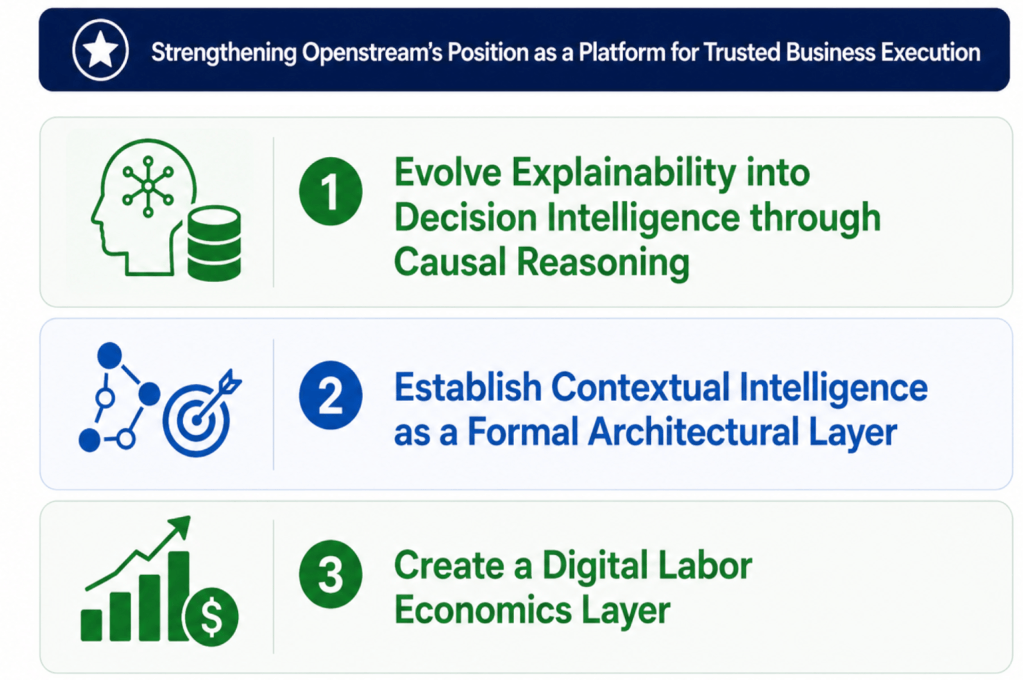
As for Openstream.ai, three opportunities could further extend its leadership position as the market evolves:
- Evolve explainability into decision intelligence with causal reasoning. Help users understand not only why a decision was made but also the factors that led to the outcome, the alternatives that existed, and which interventions are most likely to yield better results.
- Establish contextual intelligence as a formal architectural layer. Enable agents to have dynamic awareness of organizational priorities, operational state, user roles, business objectives, and changing conditions.
- Create a digital labor economics layer. Connect agent activities to productivity gains, decision quality, risk reduction, cost savings, and ROI/revenue generation.
Collectively, these investments would strengthen Openstream.ai’s position not simply as a provider of trustworthy AI, but as a platform for trusted business execution and decision intelligence at enterprise scale.
Collectively, these investments would strengthen Openstream.ai’s position not simply as a provider of trustworthy AI, but also as a platform for trusted business execution and decision intelligence at enterprise scale. The broader lesson is clear. The future of enterprise AI will not be determined by who builds the most intelligent systems. It will be determined by who builds the most trustworthy ones. That is the defining challenge of the next frontier of AI is to escape the Reliability Trap.

📩 Contact Me 📚 Read More AI Research 🔔 Subscribe to Next Frontiers of AI Digest