Artificial intelligence is accelerating enterprise transformation, opening new opportunities for productivity, automation, and business growth. It is also lowering barriers to attack, changing the economics of cyber offense.
According to Darktrace’s 2026 State of AI Cybersecurity report, 92% of security leaders say AI threats are forcing them to upgrade their defenses. Nearly half report feeling inadequately prepared. Those numbers reflect the concrete shift in attack economics: capabilities that once required highly skilled experts and weeks of manual effort are now fast, automated, and widely accessible. AI allows adversaries to rapidly exploit applications and databases, compressing the window between vulnerability discovery and active exploitation in ways that traditional enterprise security architectures were not designed to handle.
Oracle’s response to this challenge is organized around three principles: Secure at Source, Secure at Speed, and Secure through Resilience. Secure at Source embeds security controls at the data layer so that policy enforcement travels with the data itself, regardless of which application, agent, or model initiates the request. Secure at Speed addresses the automation gap between attacker velocity and defender response through lifecycle management, continuous patching, and estate-wide monitoring. Secure through Resilience extends recovery beyond infrastructure restoration to include business state, operational context, and the governance structures AI systems depend on. In addition, to accelerate customers’ journey to securing data in this new threat landscape, Oracle is offering some of its security, patching, and testing tools at no cost to Oracle AI Database customers.
At theCUBE Research, we believe this framework reflects a larger architectural shift underway across the industry. The central security question is no longer who can access the network. It is what AI systems are authorized to do with enterprise data, and whether those boundaries hold at speed and scale.
The Clock Is Collapsing, and the Control Point Is Shifting
AI has radically compressed the timeline between vulnerability discovery and exploitation. Modern AI systems can analyze software changes, identify potential weaknesses, and generate exploit paths at a pace that was previously impractical. Even low-severity vulnerabilities become meaningful when AI helps attackers chain them into larger attack sequences. Patch cycles measured in months are no longer a viable compensating control.
The architectural problem runs deeper, though. For decades, applications have enforced authorization policies determining who could access information, what actions were permitted, and how business rules were applied. AI agents work differently. They reason, invoke tools, access multiple systems, and execute actions across workflows in ways that traditional software never could. When the application itself is an AI system, application-layer controls lose their reliability as a security foundation.
Oracle’s first principle, Secure at Source, addresses both problems at once by enforcing access control at the data layer.
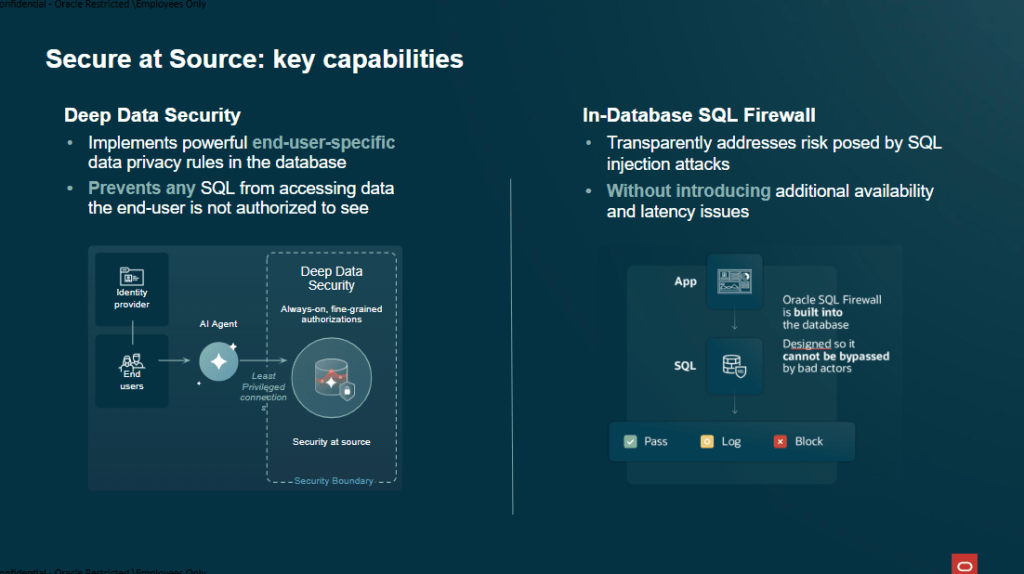
Deep Data Security implements end-user-specific privacy rules inside the database, preventing any SQL query from accessing data a given user is not authorized to see, regardless of which application or agent initiates the request. The In-Database SQL Firewall addresses SQL injection risk at the database layer and is designed so it cannot be bypassed, with no additional latency or availability overhead. As intelligence increasingly separates from applications and concentrates in AI services and frontier models, these controls ensure enforcement authority travels with the data.
Security Must Operate at Machine Speed
Oracle’s second principle, Secure at Speed, highlights the fact that, while attackers are automating, many defenders are lagging behind.
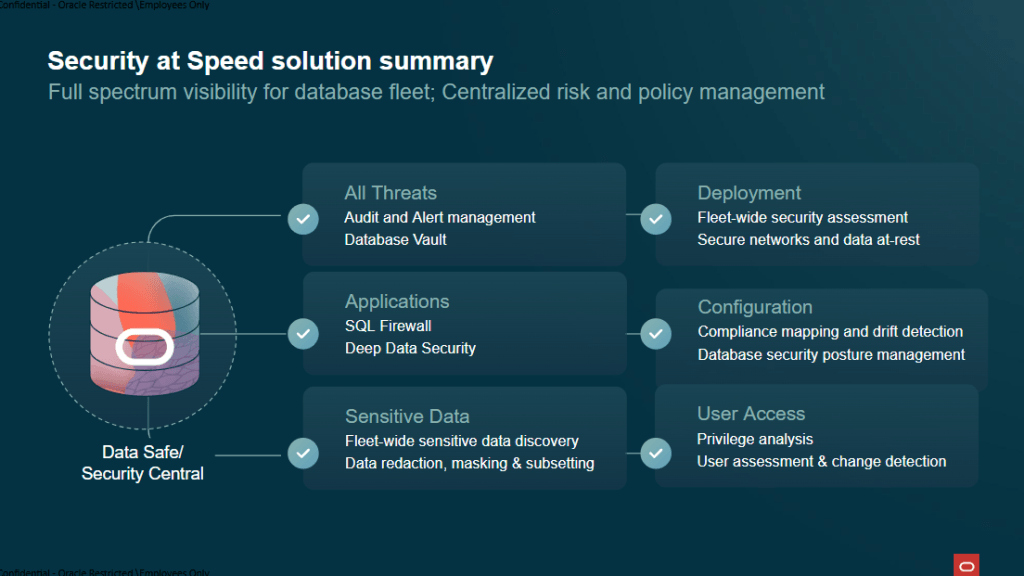
Known vulnerabilities, configuration drift, excessive privileges, stale permissions, and audit gaps have always existed. AI dramatically increases the likelihood that those weaknesses will be discovered and exploited before teams can respond. As a result, patching, risk assessment, prevention, monitoring, and recovery function at machine speed as components of a continuous control system.
Oracle’s approach to this problem is estate-wide automation organized around four functions: discovering patch gaps across the database fleet, including Exadata environments, automating lifecycle management to reduce manual steps and operational drag, standardizing patch and upgrade workflows so processes are repeatable across environments, and giving security and executive stakeholders continuous visibility into compliance status and remediation progress. Supporting tools include the Database Lifecycle Management Pack, Exadata Management Pack, Real Application Testing, GoldenGate, and GoldenGate Veridata.
Notably, Oracle is treating patching debt across enterprise database estates as severe enough to subsidize remediation, enabling customers to get patching up to date faster. Oracle is making its security and patching tools available at no cost through February 28, 2027, for customers with current paid support, with GoldenGate, GoldenGate Veridata, and Real Application Testing available at a 90% discount through May 2027. For security leaders who have deferred upgrades due to cost or operational complexity, this offer removes two of the most common barriers simultaneously.
Resilience Means Restoring Trusted Operations
The third pillar of Oracle’s framework focuses on resilience, and the scope is worth examining carefully.
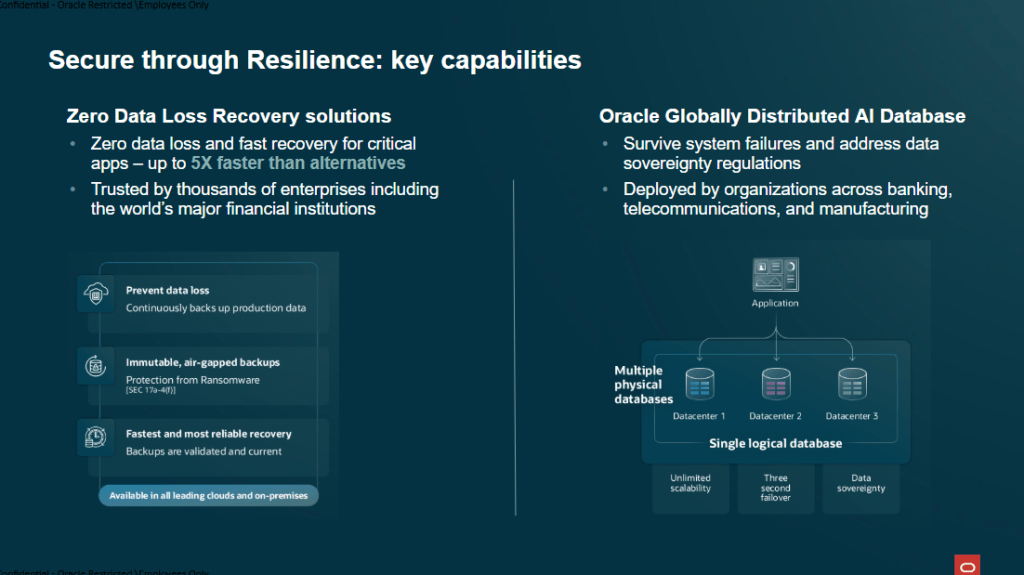
Traditional resilience centered on restoring systems and recovering data. Oracle addresses this with two distinct capability sets. Zero Data Loss Recovery solutions deliver fast recovery for critical databases with immutable, air-gapped backups that meet SEC 17a-4(f) compliance requirements, a detail especially relevant to security leaders in regulated industries managing ransomware exposure. The Oracle Globally Distributed AI Database supports continuous operations across system failures while addressing data sovereignty requirements and is deployed across banking, telecommunications, and manufacturing environments.
What Oracle is protecting here is data integrity and availability. At theCUBE Research, we would argue the next frontier extends further. As enterprises build AI operating models on systems of agency and automated workflows, the recovery requirement will expand beyond data to include the policies, permissions, and operational context those systems depend on. Oracle’s current capabilities address the foundation. The harder architectural question, restoring trusted AI operations rather than just trusted data, remains an open problem for the industry.
What Practitioners Should Do Next
The most significant element of Oracle’s announcement is its recognition that AI is changing the operating assumptions of enterprise security itself. For practitioners, that recognition translates into a set of concrete questions worth pressing against your current architecture.
Where do your security controls actually live? If policy enforcement resides primarily at the application layer, you have a gap that agentic AI will expose. Controls need to travel with the data, not depend on any particular application applying data access policies consistently.
How automated is your patch and upgrade cycle? If your team is still treating patching as a once-a-quarter project rather than a continuous operational discipline, you are operating on a timeline that cannot keep up with AI-accelerated adversaries
What does recovery actually restore? If your resilience plan stops at infrastructure, it may not be sufficient for an environment where AI systems depend on data integrity, policy state, application state, and operational context to function correctly. That gap is worth closing before it becomes a crisis.
Oracle’s framework is ultimately a useful pressure test. Run your current security architecture against Secure at Source, Secure at Speed, and Secure through Resilience, and identify where the gaps are. The framework is most useful as a diagnostic tool, revealing important gaps to be addressed. Oracle AI Database customers should take advantage of the security and lifecycle management tools that are available at no cost for a limited time. With the increased prevalence and sophistication of AI-driven threats, it’s never too soon to get started on securing data.