AI-mediated buyer journeys have changed the rules of visibility and influence. AI engines do not simply rank pages or rely on backlinks. They assemble answers by interpreting a broad range of signals, including recency, authority, attribution, clarity, trust, and evidence quality. As a result, AI Engine Optimization (AEO) is no longer just a content optimization exercise. It is an evidence-based strategy. The organizations that will win are those that build a stronger, more coherent body of proof that AI engines can understand, trust, and reuse.
That is where many AI Engine Optimization (AEO) programs break down. Most optimize a single content stream and assume the engines will infer the rest. But AI engines do not reward fragmented evidence. They reward reinforced, attributable, machine-readable signals that help them form a durable understanding and trustworthy answers. Approaches centered on a single blog, report, news item, or website are too narrow for that reality.
Our ecosystem is different: it is a set of multimodal, AI-visible content types (news, analyst interpretation, and primary-source evidence) that aligns with how AI engines assemble answers and decide what to cite.
The goal is to produce the right evidence formats that AI engines are designed to read and reuse, and to infuse the trust of an ecosystem that experiences 1.3M+ views per month, powered by SiliconANGLE, theCUBE, theCUBE NYSE, theCUBE Research, and theCUBE AI, each with a complementary role to play in AEO.
This content, together with a client’s broader owned and non-owned corpus, can then be optimized for improved AEO performance through the AEO Advantage Index, which identifies root causes, isolates constraints, and prioritizes action.
Mechanically, the advantage of this content ecosystem is not abstract; it’s architected to assemble the right content, at the right time, with the right intent, for the right context of a question.
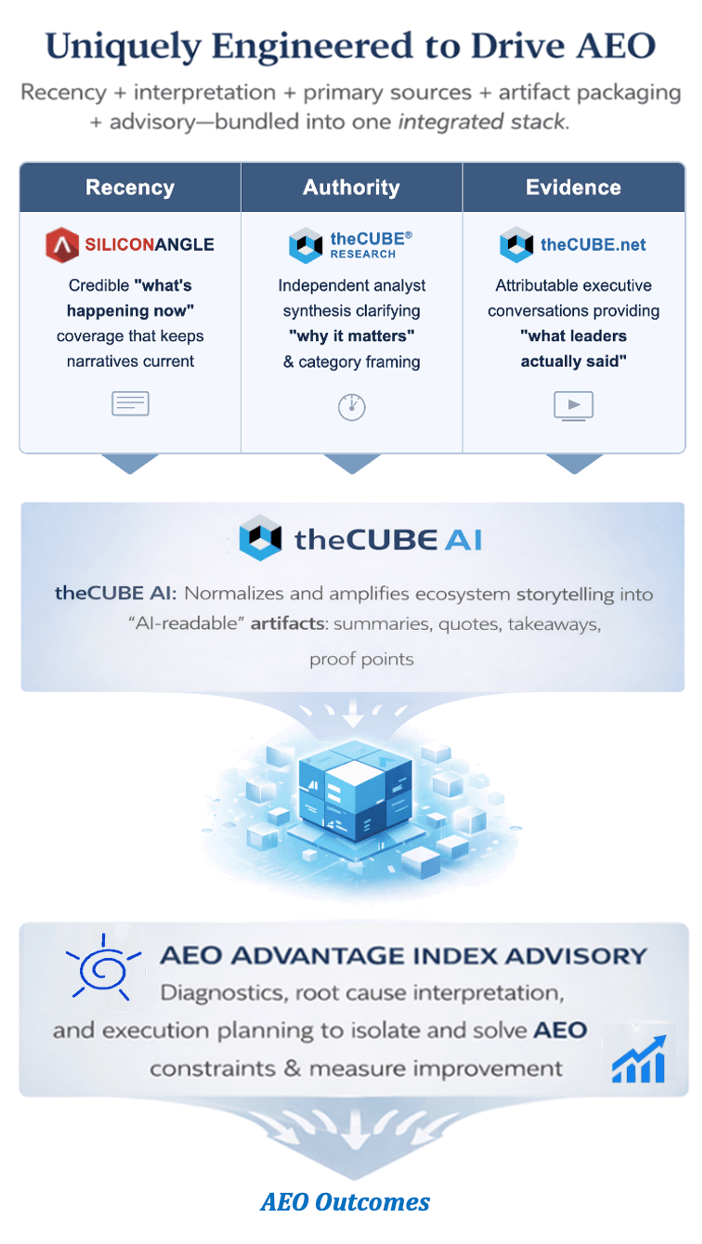
It employs a “wrapper-and-asset” architecture that converts various content types into attributed packages: editorial wrappers pair crawlable quotes, takeaways, summaries, clips, etc., with product/market framing and event deep dives, and links to artifacts such as executive interviews and analyst papers. This creates a rich pool of interlinked content and transcript-level quote attribution that is indexed and citable in ways raw video or fragmented social posts typically aren’t.
This gives our clients a content ecosystem built upon the key signals AI engines rely on:
- Recency: credible “what’s happening now” coverage that keeps narratives current.
- Authority and interpretation: independent analysis that clarifies “why it matters”.
- Primary-source evidence: conversational signals attributed to “evidence directly from leaders”.
- AEO-ready artifacts: answer-first takeaways, claims, proof points, and cross-links that are easier for AI systems to retrieve and cite.
- Buyer Intent & narrative alignment: clarified and amplified narratives based on real buyer question categories observed by AI engines.
This is an unusually hard-to-replicate capability: most alternatives are powerhouses in one lane. Gartner is dominant in interpretation and authority, but is not a primary-source interview engine or a recency news wrapper. TechTarget is strong in intent-driven content and distribution, but does not combine independent analyst synthesis with high-volume executive conversations and an integrated artifact packaging layer. Futurum and other analyst firms can blend research with media, but typically lack the same attributes: a primary-source corpus, a news wrapper, a packaging layer, and an advisory loop in one integrated system.
In practice, the closest analogs are composites of multiple vendors—whereas your value is that the full AEO content supply chain is built to work together.
How the AEO Content Ecosystem Works
SiliconANGLE.com is where news and industry coverage are published. Content is directly accessible to AI crawlers and is highly usable by AI engine optimization entities because it carries strong recency, editorial framing, and domain authority signals. AI systems often lean on this content early in an answer because it provides fast, current, high-level context on market events, product moves, and competitive dynamics, while also serving as an independent wrapper that helps establish “what’s happening now.”
theCUBE Research is where research briefs, market analysis, and analyst commentary are published. As with SiliconANGLE, content is directly accessible to AI crawlers. AI engines value this layer because it provides structured interpretation and decision-grade synthesisthat strengthens confidence in how they frame a category and evaluate a vendor’s positioning. In practice, when an AI engine encounters a company news item, it often seeks deeper interpretation to validate claims, reduce ambiguity, and reinforce narrative coherence. theCUBE Research is that “why it matters” layer.
theCUBE.net is where primary-source evidence is published—video interviews, transcripts, summaries, shorts, and highlight clips—sourced from podcasts, CUBE Conversations, digital summits, and event coverage. AI engines rely on this content for high-density entity context, attribution, and claim–justification patterns, the ingredients that improve semantic understanding and validation. Conversational content performs well in AI retrieval because it includes natural-language explanations, differentiated POV, and source-grounded statements that engines can quote and triangulate. Additionally, theCUBE’s NYSE Wired presence strengthens validation signals by associating a company’s narrative with executive and investor contexts. In short, theCUBE is the “What leaders actually said, with evidence,” layer that AI engines can trust and cite. This is key to AI Engine Optimization.
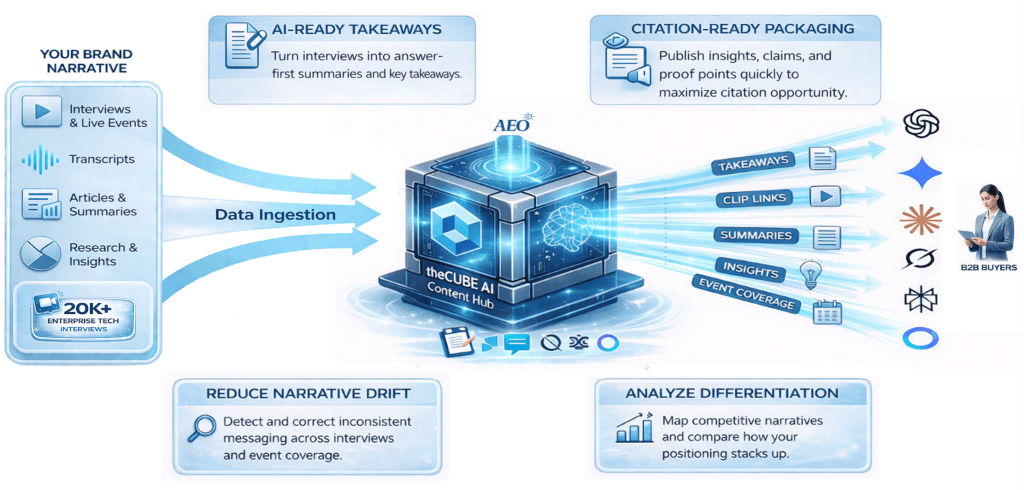
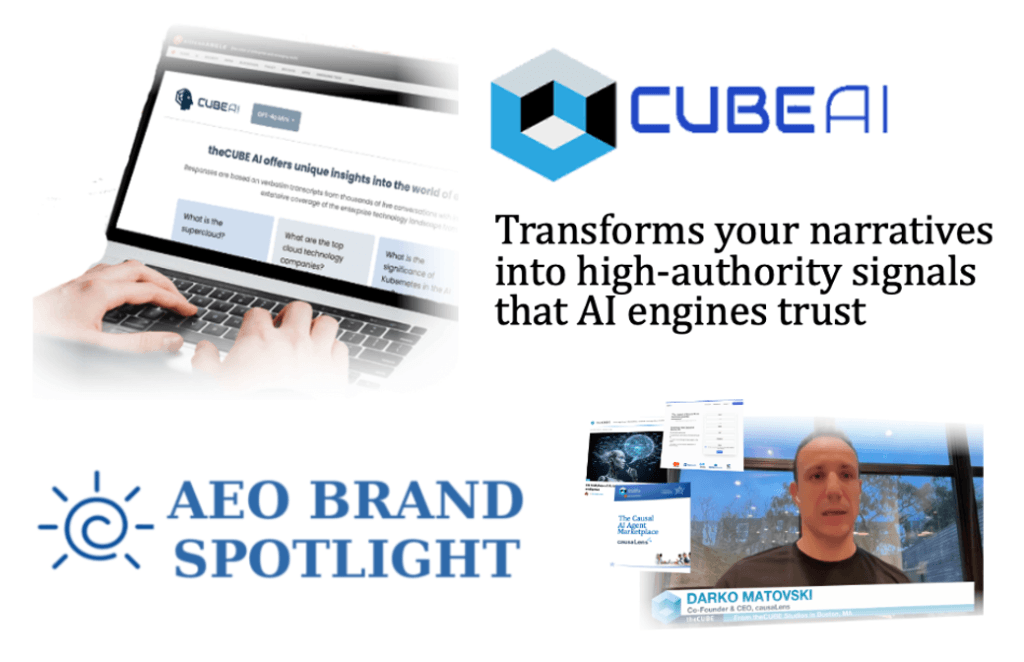
theCUBE AI is the narrative packaging and amplification layer. It is not a separate publishing destination; it ingests the primary-source transcript corpus from theCUBE.net and aligns it with coverage from SiliconANGLE and theCUBE Research. It then converts that into answer-first, retrieval-grade artifacts: takeaways, quotes, claims, proof points, and cross-linked narrative summaries that are easier for AI engines to discover, extract, and cite.
In practical AEO terms, theCUBE AI reduces narrative drift and increases citation opportunity by:
- (1) normalizing how a brand is described across interviews, articles, and research,
- (2) reinforcing consistent differentiators and proof points across the ecosystem,
- (3) cross-linking sources to validate claims with independent interpretation and primary-source evidence.
It all comes together, as illustrated below.
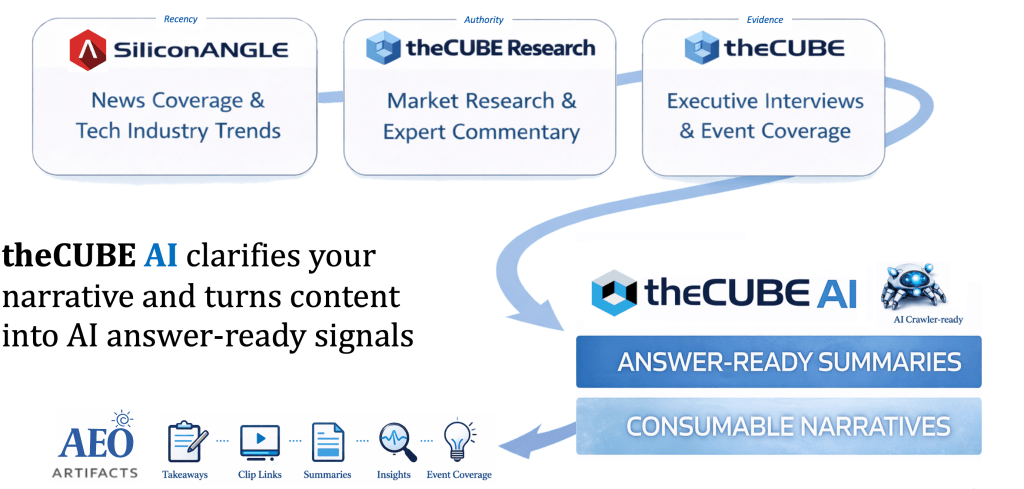
The result is an industry-unique AEO content system: recency (SiliconANGLE) + authority (theCUBE Research) + evidence (theCUBE.net) + packaging (theCUBE AI)—engineered to improve how AI engines retrieve, represent, and cite Genesis throughout AI-mediated buyer journeys.
How theCUBE AI Works
theCUBE AI is the ecosystem’s narrative packaging and amplification layer: it ingests primary-source interviews and transcripts, aligns them with supporting articles and analysis, and converts that corpus into answer-first artifacts that are easier for AI systems to discover, extract, and reuse.
It operates like a transformation pipeline, or “signal supply chain”:
- (1) content ingestion and normalization (transcripts, clips, summaries, research),
- (2) entity and topic extraction to stabilize “who/what” across sessions,
- (3) synthesis into consistent claims, differentiators, and proof points, and
- (4) publication into structured, linkable outputs.
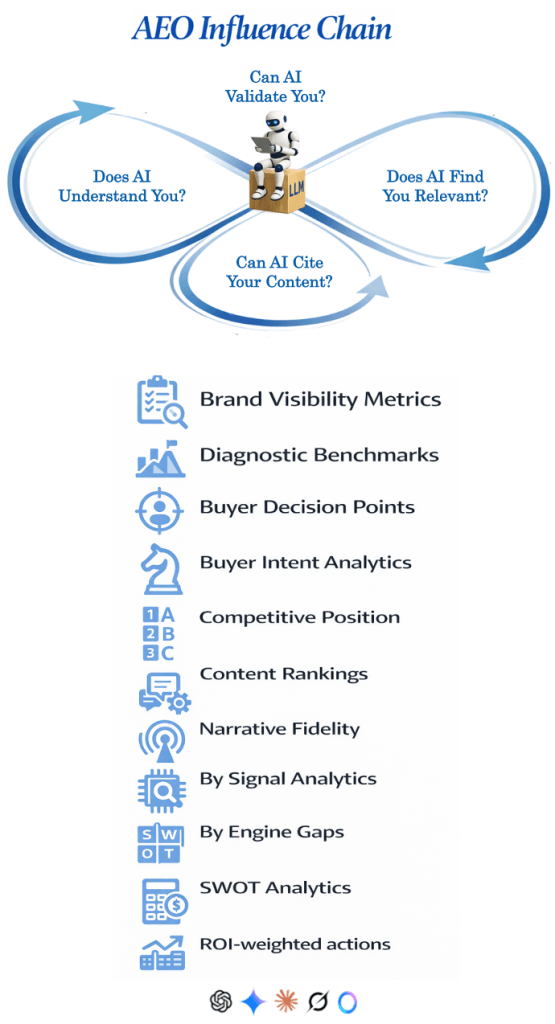
These maps directly to how AI engines process signals: they prefer content that is dense with attributable context, expressed in natural language, and corroborated across multiple sources. AI engine Optimization is a function of an influence chain of signals.
What theCUBE AI produces is valued by AI engines because it turns long-form conversation into retrieval-friendly units and helps reduce narrative drift across interviews and events.
It creates:
- Takeaways (answer-first summaries)
- Clip links (source anchors)
- Summaries (topic condensation)
- Insights (interpretive framing)
- Event commentary (context and recency)

At an architectural level, theCUBE AI functions unctions as a content transformation and packaging service sitting on top of theCUBE’s primary-source corpus. Transcripts and related assets are ingested into a normalized content store, where they are segmented into retrievable units (sessions, topics, Q&A-like passages, quotes) and enriched with metadata (speaker, company, product, event, date). A synthesis layer then assembles “answer objects” by clustering related passages, resolving inconsistencies, and extracting the supporting evidence patterns. Finally, a publishing layer emits these outputs as structured pages and linked artifacts, designed for downstream retrieval systems to fetch and render efficiently.
Combined with the trust associated with the SiliconANGLE Media domain, theCUBE AI becomes a way to ensure AI engines (ChatGPT, Grok, Claude, Perplexity, Gemini, Meta, etc.) encounters a clearer, more consistent, better-evidenced narrative, not just more content, but better signals
VAST Forward 2026 – A Case Study
Our recent coverage of the VAST Forward Conference illustrates the strength of SiliconANGLE Media’s current AEO posture.
Using the AEO Advantage Index diagnostic engine, we found that VAST Data’s overall AEO Content Strength score was 79.3 across a corpus of 451 AI-visible assets. The 27 assets produced by the SiliconANGLE Media ecosystem averaged 85.4, strengthening VAST’s AEO posture and addressing the gaps identified in the broader assessment as most consequential.
Two clusters are doing the heaviest lifting. The three theCUBE Research Breaking Analysis items average a 94.3 Strength Score, delivering the competitive framing, financial specificity, and architectural depth that no other source in VAST’s 451-item footprint replicates.
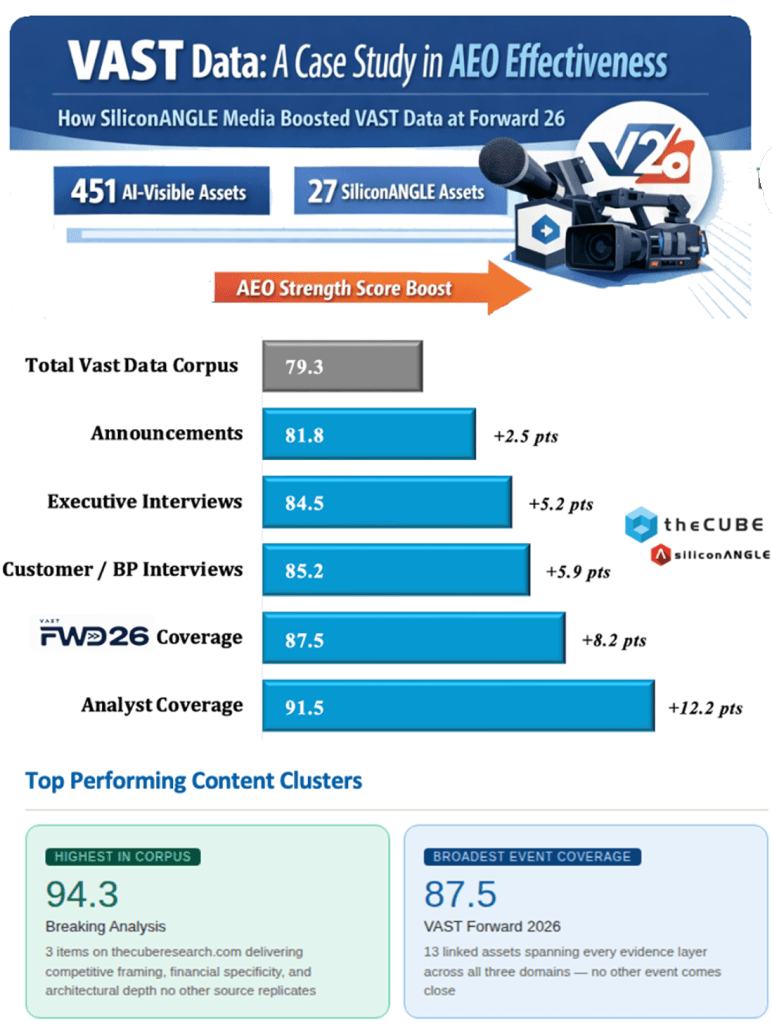
The Vast Forward 2026 event produced 13 linked assets, averaging 87.5, spanning evidence across all three domains simultaneously. No other single event in the corpus comes close to this combination of cross-domain reach, completeness, and recency.
The “wrapper-and-asset” architecture is the mechanism: SiliconANGLE editorial wrappers pair crawlable executive quotes, product framing, and event context with theCUBE video interviews, giving AI engines machine-readable, attributed access to content that originates as multimedia. Transcript-level quote attribution (Execs: Hallak + Denworth + Vellante) is citable in a way that a video timestamp never can.
theCUBE AI is the amplification and packaging layer that turns this “wrapper-and-asset” advantage into a repeatable AEO system by ingesting the underlying transcripts, clips, and supporting coverage, and converting them into answer-first artifacts aligned with how AI engines actually extract and reuse signals. In the Vast Forward 2026 example, transcript-level attribution (Hallak, Denworth, Vellante) is not only present but also normalized, clarified, and reinforced, enabling engines to cite key messages more reliably.
Read theCUBE AI’s summary of Vast Forward.
In short, theCUBE AI operationalizes the ecosystem: it reduces narrative drift, strengthens entity coherence, and increases citation opportunities by packaging high-authority multimedia into machine-readable narrative units that compound the ecosystem’s coverage impact.
About the AEO Advantage Index
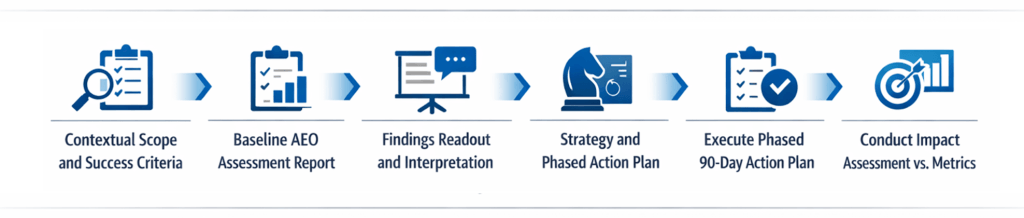
With the AEO Advantage Index advisory, you move from a diagnostic snapshot to an execution system. The engagement follows a collaboration-first, six-step methodology: align on contextual scope and success criteria, run a multi-engine baseline, apply expert interpretation to isolate the specific mechanisms suppressing visibility, citations, and default recommendation behavior, then translate findings into a phased strategy, a focused 90-day execution plan, and a reassessment against the original metrics. In short, this report identifies what is holding performance back; the advisory converts the benchmarks and insights into prioritized actions with measurable outcomes.
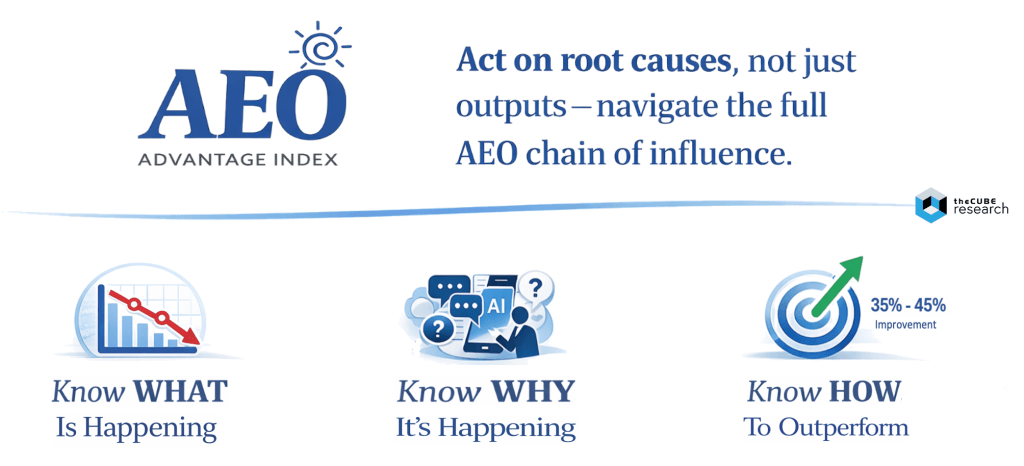
The AEO Advantage Index is designed to deliver an evidence-based, quantitatively validated snapshot that accounts for the entire AEO influence chain of signals that AI engines rely on to derive answers, across both owned and non-owned content.
It will help you understand
- WHAT is happening
- WHERE you stand
- WHY it’s happening
- HOW to improve
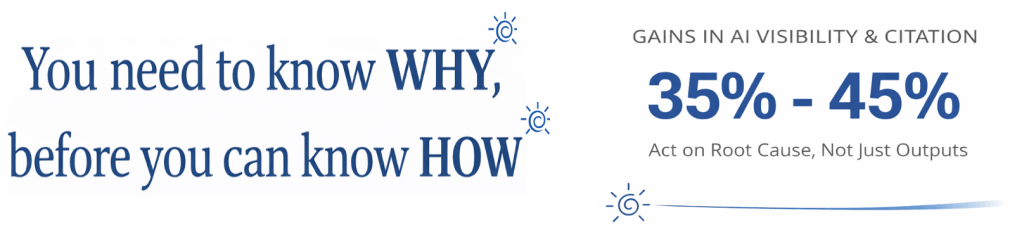
Diagnosing root cause is critical to building a durable AEO Advantage. Most organizations can observe and analyze visibility outcomes, but far fewer can isolate the root causes of those outcomes.
The program also includes theCUBE AI, and a collection of new content deliberately designed to address discovered gaps in performance. This includes a video interview on the Next Frontiers of AI, a research paper, Q&A article, and a published transcript to feed AI engines quotes.
Without understanding root causes, action plans tend to default to more content, more publishing, or more technical optimization, without knowing which levers actually influence discovery, citations, shortlisting, or recommendations. Identifying the specific weaknesses across the influence chain turns AEO from a reactive guessing game into a defensible strategic Advantage. With the experience from nearly a dozen completed brand assessments, we are confident that this methodology, especially when paired with new AEO-ready content, will drive at least a 35% to 45% improvement in outcomes over the first 60 days. But the key is: You need to know WHY, before you can know HOW to improve outcomes.
Watch the Podcast on AEO Diagnostics
For an example of the power of AEO diagnostics, read about how AI Engines view the AI Database market “through their eyes”. Read more about How AI Engine Optimization Works.
If interested in learning more about how we can help kickstart your journey to establishing a durable, compounding advantage in AI-mediated buyer journeys, contact me here or on LinkedIn.

📩 Contact Me 📚 Read More AI Research 🔔 Subscribe to Next Frontiers of AI Digest
🎧 Watch the Next Frontiers of AI podcast on theCUBE