
For years, the conversation around enterprise wireless has centered on faster standards. Each new generation of Wi-Fi has promised higher throughput, lower latency, and support for more connected devices. Those advancements have undoubtedly improved the user experience, but they have also created an assumption that the next wireless challenge can always be solved by deploying a newer access point or upgrading to the latest standard.
Large venues are beginning to demonstrate that this assumption no longer holds true. Consider a sold-out professional football game. Before kickoff, tens of thousands of fans enter the stadium carrying multiple connected devices. Within minutes, the wireless network is supporting mobile ticket validation, cashless concessions, sports betting, social media sharing, HD video uploads, team applications, and replay streaming. At the same time, the network is connecting point-of-sale systems, security cameras, digital signage, media production equipment, building automation systems, and an expanding array of IoT sensors.
In these environments, providing wireless coverage is no longer the primary challenge. The greater challenge is delivering sufficient capacity while maintaining a consistent user experience across tens of thousands of simultaneously connected devices. As venues continue investing in AI-powered services, immersive fan experiences, and operational analytics, wireless design itself may be entering its next phase of evolution.
Capacity Has Become the New Battleground
The role of connectivity inside modern stadiums has changed dramatically over the past decade. Initially, venue Wi-Fi focused primarily on guest internet access. Today, wireless networks have become foundational business platforms supporting virtually every aspect of stadium operations. Ticketing, concessions, merchandising, security, broadcast production, premium fan experiences, and operational workflows increasingly depend on reliable, high-performance wireless connectivity.
At the same time, fan expectations continue to rise. Attendees expect the same seamless digital experience inside a packed stadium that they enjoy at home or in the office. They want to stream video, upload content, place food orders, receive personalized notifications, and interact with team applications without delay.
Meeting these expectations requires far more than blanket wireless coverage. Every additional application competes for the same finite wireless spectrum, making efficient spectrum utilization just as important as the capabilities of the access points themselves. Simply adding more radios is not always the answer.
Traditional High-Density Designs Are Approaching Practical Limits
Modern stadium deployments frequently use combinations of under-seat access points, handrail installations, overhead directional antennas, and carefully engineered RF plans to maximize coverage while minimizing interference. These designs have enabled many of today’s largest venues to deliver excellent wireless performance despite extraordinary user densities.
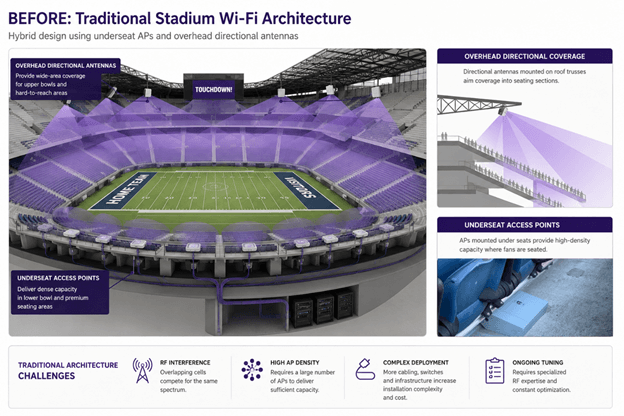
However, scaling these architectures becomes increasingly complex. This is especially true as new stadium roofing systems exceed 150 feet, rendering traditional directional APs ineffective. As access point density increases, so does the challenge of managing co-channel interference, channel reuse, and RF overlap. Additional access points also require more cabling, switching infrastructure, installation labor, and ongoing maintenance, driving up costs. Designing and optimizing these environments demands significant RF expertise, particularly as user expectations continue to grow.
Eventually, organizations reach a point where adding additional radios provides diminishing returns because those radios continue competing for the same spectrum. This raises an important question. Rather than continuing to increase access point density, could the industry benefit from rethinking how wireless coverage itself is created?
A Different Way to Think About Wireless
That question sits at the center of a recent announcement from Extreme Networks. Working with antenna specialist MatSing, Extreme introduced its Multi-Beam WirelessTM architecture, an approach that applies MatSing’s RF Lens technology to enterprise Wi-Fi. Rather than relying on a single access point to serve a large seating section, the design creates multiple focused wireless sectors, each supported by dedicated Wi-Fi 7 access points.
The concept is easier to understand using a lighting analogy. Traditional wireless coverage is similar to illuminating a large area with a floodlight. Multi-Beam Wireless instead resembles multiple precisely aimed spotlights, each serving a smaller portion of the audience.
By creating smaller, more controlled RF sectors, the architecture seeks to reduce interference, improve spectrum reuse, and deliver more predictable performance across high-density environments.
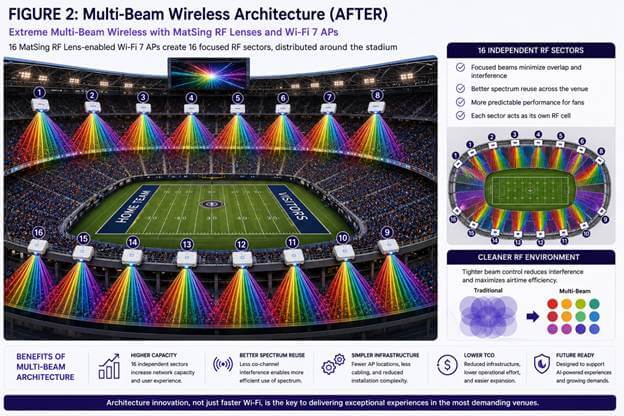
The first announced deployment will be the new Nissan Stadium, home of the Tennessee Titans, providing the industry with an important real-world opportunity to evaluate the approach at scale. While it remains early, the announcement represents more than the introduction of another wireless product. It suggests that innovation in enterprise Wi-Fi may increasingly focus on RF architecture rather than simply deploying newer radios.
Why Wi-Fi 7 Is Only Part of the Story
Wi-Fi 7 represents a significant advancement in wireless technology. Capabilities such as Multi-Link Operation (MLO), wider 320 MHz channels, higher modulation rates, and improved latency all contribute to greater theoretical network performance.
However, standards alone cannot overcome poor RF conditions. If interference limits airtime efficiency or neighboring cells compete for the same spectrum, organizations may never realize the full potential of the latest Wi-Fi technologies.
This highlights an important distinction. Wi-Fi standards determine what the radios can achieve. RF architecture largely determines how much of that capability can actually be delivered in real-world deployments. As wireless standards continue to mature, physical network design may become an increasingly important competitive differentiator.
Business Value Extends Beyond Better Wi-Fi
The implications extend well beyond faster internet access for fans. Reliable, high-capacity wireless directly supports business outcomes that venue operators increasingly depend upon. More specifically,
- For fans, improved connectivity enables smoother ticket validation, faster mobile ordering, reliable streaming, social engagement, and personalized digital experiences throughout an event.
- For venue operators, wireless infrastructure supports revenue-generating services including concessions, merchandise sales, sponsorship activation, premium digital experiences, and mobile commerce.
Operationally, wireless networks increasingly connect security systems, environmental monitoring, digital signage, staff communications, and AI-driven analytics platforms that improve operational efficiency and situational awareness. If emerging wireless architectures can simplify deployment while improving spectrum efficiency, they may also reduce infrastructure complexity and long-term operating costs. That combination is becoming increasingly attractive as venues continue expanding both digital services and operational technology.
Looking Beyond Stadiums
Although stadiums represent one of the most demanding wireless environments, they are unlikely to be the only beneficiaries of architectural innovation. Airports, convention centers, concert venues, transportation hubs, theme parks, university campuses, manufacturing facilities, and large distribution centers all face similar challenges: high user density, expanding device populations, and growing demands for predictable wireless performance.
As AI-driven applications continue to proliferate, these environments will place even greater demands on wireless infrastructure. Computer vision, autonomous operations, digital twins, robotics, and real-time analytics all require networks capable of supporting large numbers of concurrent connections with consistent performance. The same architectural principles emerging in stadiums today may ultimately influence enterprise wireless design across many industries.
OurANGLE
Extreme Networks’ Multi-Beam Wireless announcement should not be viewed simply as another Wi-Fi product introduction. Instead, it reflects a broader shift in how the industry is beginning to think about high-density wireless networking.
For many years, innovation has been centered on faster radios and new wireless standards. Those advances remain essential, but they may not be sufficient on their own. As connected devices proliferate and AI-powered applications increase network demands, the efficiency of the underlying RF architecture becomes equally important.
Coverage is rapidly giving way to capacity as the defining design objective. At the same time, RF engineering is re-emerging as a strategic differentiator capable of influencing both user experience and operational efficiency.
Whether Extreme Multi-Beam Wireless ultimately becomes a widely adopted architectural model remains to be seen. Real-world deployments, like the one at the Titans’ stadium, and operational experience will determine its long-term impact. However, the announcement highlights an important industry trend: the future of enterprise wireless will likely be shaped not only by faster Wi-Fi standards, but also by smarter ways to design, deploy, and manage the radio environment itself.
For IT leaders responsible for supporting increasingly digital, AI-enabled venues, that may prove to be one of the most significant wireless developments to watch over the next several years.