Formerly known as Wikibon

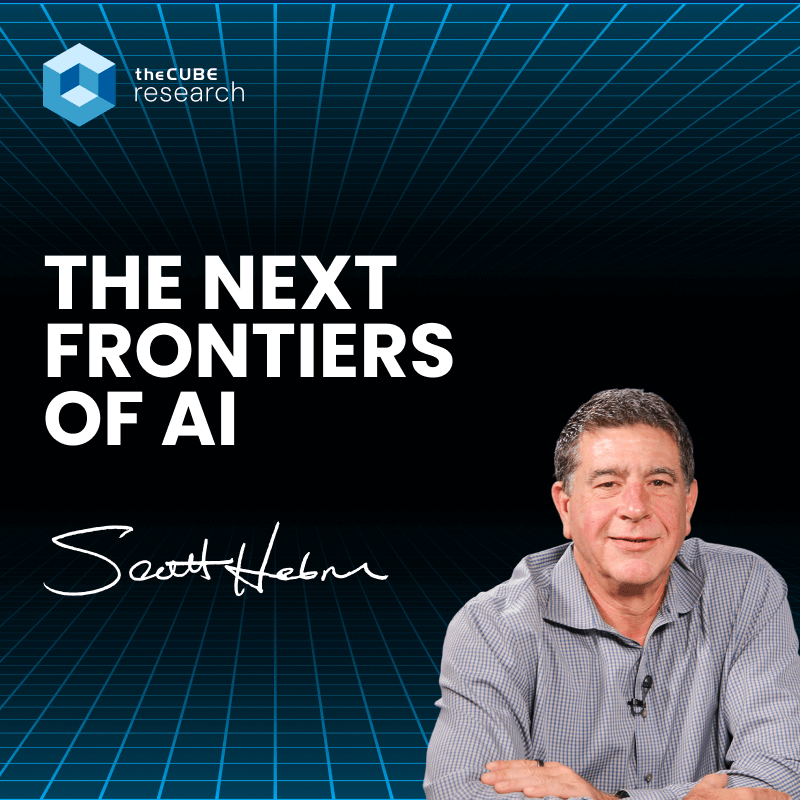
The Next Frontiers of AI

with Scott Hebner

About the podcast

AI is still in its infancy, but innovation cycles and the pursuit of high-value ROI are advancing at warp speed. The ability to keep up will determine who leads, who lags, and who fails.
Join theCUBE Research principal analyst Scott Hebner and industry pioneers and experts to explore the latest advancements shaping the future of AI and how to prepare today.

episodes

Cisco AI Summit 2026: Making agentic systems real, breaking physical barriers and operationalizing AI 

The Cisco AI Summit 2026 was a gift to the industry. There was no registration page, no product announcements, only very subtle Cisco marketing and some really excellent and unscripted conversations. All open. All free. A huge shoutout to Jeetu Patel, Cisco’s President & Chief Product Officer, CEO Chuck Robbins and the Cisco team behind them. Jeetu in particular did an outstanding job moderating the AI Summit 2026 and grinding through the day. Jeetu and Chuck Robbins elevated the entire event with their preparation, sharp insights and ability to draw out candid perspectives from an all-star lineup.

How To Build Decision-grade AI Agents You Can Trust and Audit

Enterprises are pushing agentic AI beyond copilots into diagnosis, problem-solving, and decision-making—but trust is now the ROI limiter. In this episode of Next Frontiers of AI, Scott Hebner and George Gilbert explain why LLM-only architectures are reliability traps and outline a practical, three-layer blueprint—LLM+CoT, semantic layers (knowledge graphs), and causal reasoning—to deliver decisions you can verify, defend, and audit.

Will 2026 Be The Year AI Decision Intelligence Goes Mainstream? 

In this episode of Next Frontiers of AI, Scott Hebner and Joel Sherlock, CEO of Causify, argue that 2026 will be the year AI Decision Intelligence goes mainstream. Following GenAI and the rise of AI agents and agentic workflows, enterprises are facing a reality check, as a recent Carnegie Mellon study found — AI agents can act, but they often cannot justify, explain, or audit the decisions that matter most. Scott and Joel unpack why causal AI and knowledge graphs are emerging as the enabling layer for decision-grade AI.

How Agentic AI Rewires a SaaS Business: Lessons from a Unicorn

Digital labor is no longer emerging — it is becoming the defining operating model of modern service businesses. According to the Digital Labor Transformation Index, over 61% of enterprises believe the rise of digital labor is now inevitable, and the organizations seeing the highest ROI are those that shift from basic automation to knowledge-centered, agentic work. Few companies embody this shift as clearly as Vantaca, the newly minted $1.25B unicorn redefining community management through an AI-first architecture.

In this episode of The Next Frontiers of AI, Scott Hebner is joined by CEO Ben Currin to unpack how Vantaca rewired itself around a “UI, API, and AI-first” model, and how its platform now operationalizes millions of agentic workflows that free humans from low-value tasks and elevate their capacity for real community-building work.

The Agentic AI Masquerade: How to Tell What’s Real vs. Marketing

The industry is racing to claim “agentic AI,” but the reality looks very different. Scott Hebner and David Linthicum reveal why only 17% of enterprises are actually building real AI agents, what distinguishes assistants from agents, and why reasoning—not prompting—defines the next frontier of autonomous intelligence.

Why AI Chooses Your Brand: Demystifying How AI Discovery and Digital Buyer Journeys Work

AI discovery and AEO are reshaping how B2B buyers find and trust brands — here’s how to ensure yours shows up in AI search. As generative AI assistants like ChatGPT, Claude, Gemini, Grok, and Perplexity replace traditional search, brand visibility now depends on how large language models (LLMs) learn, rank, and recommend. Together, they unpack a 19-attribute framework across four categories that explain how LLMs discover, learn, and select brands to include in AI-generated answers.
.

The Widening AI Value Gap: How to Close the Gap Before It’s Too Late

In this episode of The Next Frontiers of AI, host Scott Hebner, Principal Analyst for AI at theCUBE Research, sits down with Vladimir Lukic, Global Leader of the Tech & Digital Advantage Practice at Boston Consulting Group (BCG) to explore one of the most urgent questions in enterprise AI today: Why are only 5% of companies realizing real value from AI, while the rest are falling further behind? And more importantly, what can companies do to remedy this problem before it’s too late.

Agentic AI ROI: From Automation to Decisions

n this episode of Next Frontiers of AI, host Scott Hebner is joined by Paul Chada, CEO of Doozer AI, to explore one of the most urgent questions in enterprise AI: What is the real state of agentic AI ROI, and where is it headed? As companies shift from foundational Generative AI to the ”golden age of AI Agents” and the super cycle of innovation it promises, the stakes are rising. Digital coworkers are no longer just creating content or automating repetitive tasks, but are actively involved in workflows, knowledge work, and decision-making processes. In this discussion, we share real-world lessons from AI agent deployments and present new findings from the Agentic AI Futures Index survey to illustrate how adoption is progressing, where plans are accelerating, and what the journey toward decision intelligence entails. 

The State of Digital Labor Transformation:

In this episode of Next Frontiers of AI, Scott Hebner and Christophe Bertrand, both Principal Analysts at theCUBE Research, unpack fresh primary research data on the state of digital labor transformation. The new Digital Labor Transformation Index reveals a striking workforce evolution underway: business leaders are no longer viewing agentic AI as simply a software automation or analytics paradigm shift, but as a genuine labor market phenomenon that promises to fundamentally change how work gets done.

The data shows more than 70% of AI and business professionals believe this generation of leaders will be the last to manage human-only workforces, underscoring a conviction that digital labor is inevitable. With an aggregate maturity score of 3.1 across 13 dimensions on a 0–5 scale, enterprises are moving steadily from experimentation into structured adoption—but the journey remains uneven and trust in autonomous roles is fragile. The research highlights the pivotal role that Chief HR Officers (CHROs) will play as co-architects of this transformation, and how the emerging role of Chief AI Officers (CAIOs) is destined to expand into a powerful intersection of business strategy, technology leadership, and digital workforce design.

The conclusion: success in digital labor transformation will require cross-functional ownership, new models of trust, and bold leadership from both CHROs and emerging Chief AI Officers. #DigitalLabor #AgenticAI #FutureOfWork

Digital Labor @ Work: How AI Agents Are Transforming Community Management

Explore how agentic AI and digital workers are transforming the operations of community association management companies. What began as a vision to eliminate inefficiencies in community management has grown into a platform that manages more than a million homes, delivering measurable ROI for management companies while achieving higher satisfaction for homeowners and board members.

The conversation examines how HOAi’s agentic AI platform addresses persistent challenges, including growing homeowner demands, hiring and retaining talent, rising operational costs, low margins, and effective communication with homeowners and board members.

By introducing digital workers tailored for domain-specific complexity, HOAi streamlines core functions like accounts payable, accounts receivable, customer service, management tasks, and more. This leads to more efficient operations, the ability to expand without hiring more staff, working smarter and faster with improved quality, freeing up time for the team, and gaining a competitive edge.

Navigating the AI Talent Crisis: Act Now Before It’s Too Late!

In this episode of Next Frontiers of AI, host Scott Hebner is joined by Justice Erolin, Chief Technology Officer at BairesDev, to confront one of the defining challenges of 2025: the AI talent crisis. The demand for AI-skilled professionals is already outpacing supply by a factor of 2.3 times, with job openings growing 10 times faster than the number of new entrants into the field. Seventy percent of enterprises report struggling to find qualified AI talent, while 40% of existing AI-skilled employees are considering leaving their jobs. The result is a spiraling competition for scarce talent, with companies paying salary premiums of 47% to 200% in an unsustainable arms race.
This episode examines what lies beneath that crisis—and why the solution isn’t just about pursuing human capital. A key shift is happening as software developers become data scientists and AI engineers, broadening their skills while using agentic AI systems that allow them to design and deploy models without requiring deep expertise. Simultaneously, AI talent augmentation is becoming inevitable, as enterprises blend flexible outsourcing with AI agents serving as virtual specialists.

Decoding NVIDIA’s AI Factory Product Maze

NVIDIA’s Q2 FY26 earnings call underscored once again that the company is not just a GPU vendor, rather it is an AI infrastructure company supporting the buildout of AI Factories. With revenue hitting $46.7B for the quarter and data center sales accelerating, the product portfolio is expanding so quickly that even seasoned observers struggle to keep the names straight. To help make sense of the landscape, we’ve compiled a cheat sheet mapping NVIDIA’s sprawling platforms, where they sit in the roadmap, and how much revenue they’re driving.

From PoC to Product: Scaling Agentic AI in Financial Services

In this episode of Next Frontiers of AI, host Scott Hebner is joined by Peyman Parsi, Senior Principal for Financial Services at MongoDB, to examine a critical industry challenge: why roughly two‑thirds of AI projects in financial services stall before reaching production, and why those that do often fail to scale with the business. With the advent of agentic AI and its higher‑stakes use cases, this challenge is only becoming more pressing. 

The conversation examines the organizational, technical, and trust barriers that prevent promising proofs-of-concept from scaling, ranging from legacy infrastructure and governance gaps to rising costs, bias, and unclear ROI. Scott and Peyman discuss how financial institutions can overcome these obstacles by adopting trusted, agentic architectures built on strong data foundations.

Why Brand Matters in the Age of AI Discovery

In this episode of Next Frontiers of AI, host Scott Hebner is joined by Mick Hollison, founder and CEO of Redline Advisors, former CMO of CrowdStrike and Cloudera, and one of the industry’s leading voices on strategic messaging and brand elevation. Together, they unpack a pressing question: in an AI-first world where algorithms increasingly shape buyer discovery and decision-making, does brand still matter?  The answer is a resounding YES, but not in the way it used to. The days of traditional “search and click” are numbered, being replaced by AI-guided discovery and engagement. 

AI Meets Psychology: How to Build Agents that Understand People

In this episode of Next Frontiers of AI, we talk with Jonathan Kreindler, President and Co-Founder of Receptiviti, about the emerging science of psychologically aware AI. Jonathan explains how psychological signals—often hidden in filler words that LLMs overlook—are vital for turning AI agents from simple responders into emotionally intelligent and human-aware coworkers. His team is developing new technologies that provide AI with a validated, research-backed layer of human insight, enabling agents to detect stress, mindset, and decision-making style from natural language in real time.

Governance and Compliance in the Age of AI

In this episode of Next Frontiers of AI, Scott Hebner is joined by Christophe Bertrand, the Principal Analyst for Cyber Resiliency and Data Protection at theCUBE Research, to unpack a growing reality across the enterprise landscape: AI progress is hitting a wall—not because of technology limitations, but because of trust, transparency, and compliance shortfalls. While the promise of data-driven, AI-guided decision-making transforms strategy in every industry, many organizations are now pausing deployments due to inadequate data governance frameworks and a rapidly evolving regulatory environment.   Together, they preview the upcoming Governance and Compliance in the Age of Data & AI Summit, hosted by theCUBE on September 27, 2025—a high-impact digital event designed to help enterprises confront today’s most urgent compliance challenges while enabling future-ready AI strategies. They’ll introduce the summit’s four foundational pillars: From explainability gaps and “what-if” reasoning frameworks, to federated governance, causal AI, and policy-as-code architectures, this episode offers a strategic preview into

Are the Agile & SaaS Models Dead with the Rise of Agentic AI? (#15)

In this episode of The Next Frontiers of AI, we’re joined by Arun Varadarajan, CRO of Ascendion, to explore a provocative question reshaping the future of software engineering and the software marketplace:  Is Agile development dead?  And as a result, will the SaaS model become a relic of the past?  As AI agents begin to play an active role, not just assisting but actually engineering software, will Agentic AI-driven software engineering become the norm?  And when?  Arun discusses why traditional methodologies like Agile, which were built for human-centric development cycles, are giving way to a new model that is faster, leaner, and increasingly autonomous. 

Agentic AI – What is Hype, Myth, and Truth (#14)

In one of our most clarifying episodes yet, we sit down with Satya Nitta—renowned AI innovator and CEO of Emergence AI—to separate fact from fiction in today’s rapidly evolving Agentic AI landscape. The enterprise world is awash in buzzwords, bold claims, and conflicting narratives, from predictive, generative, and agentic AI, onward to an AGI future.  It’s never been harder to know what matters—and what doesn’t.  Satya helps us decode the signal from the noise. He shares what agentic AI really is (and isn’t), how enterprises should think beyond AI assistants to intelligent systems that can reason, act, and collaborate, and where the real frontiers lie.

EY: Charting the Agentic AI Adoption Curve

In episode #13 of The Next Frontiers of AI, host Scott Hebner sits down with Ken Englund, Americas’ Technology Sector Growth Leader at EY, to unpack the results of the latest EY Technology Pulse Poll—a revealing snapshot of how tech leaders are embracing agentic AI.

More than two years into the GenAI era, technology companies are setting the pace of rapid Agentic AI adoption, with 48% already deploying agentic AI in some capacity and over half expecting the majority of their AI deployments to be autonomous within two years. Furthermore, 81% are optimistic about the potential of Agentic AI. But what’s driving this momentum? And are these early movers securing a real competitive edge, or simply moving faster into uncharted territory?

Ken and Scott explore what motivates tech executives to pursue agentic AI, how organizations manage their investments and risks, what this shift means for the future of tech jobs, and whether this innovation curve will soon extend beyond the tech sector into other industries.

The Future of Marketing: Causal AI Agents That Think Strategically

In this episode, we sit down with Michelle Killebrew, founder of Pegasus Strategy Co, to explore the future of causal marketing agents—a game-changing opportunity for marketers. Michelle, a seasoned marketing executive renowned for her AI-driven approach to growth and innovation, shares insights gained from over two decades of experience leading marketing transformations at companies like IBM and NTT and now advises organizations on leveraging AI to drive go-to-market success.

We delve into the transformative potential of causal AI in marketing. Unlike traditional predictive and generative AI, causal AI uncovers the “why” behind customer behaviors, even as conditions change. Michelle shares how causal AI empowers marketers to think more strategically.

Join us in this enlightening conversation about how the advent of causal AI is reshaping the marketing profession, enabling businesses to move beyond surface-level insights and make data-informed decisions that drive meaningful results.

Agentic AI – Why Architecture Matters

In this episode of the Next Frontiers of AI, we delve into the array of new technologies fueling Agentic AI and why architecture matters more than ever. I am joined by George Gilbert, the principal analyst at theCUBE Research, who covers data platforms, intelligent apps, and agentic frameworks, to dissect the approaches that industry pioneers are taking. As enterprises seek to harness AI’s full potential, the focus shifts from GenAI and LLMs to sophisticated AI agents capable of autonomous decision-making and continuous learning. We’ll share our insights about the importance of building a multi-layered architecture of AI agents.

Join us as we explore the future of AI agents and their role in enhancing workflows and driving innovation in enterprise technology. We will discuss how agentic AI fundamentally changes the nature of what software can do and how it is built. It is a must-watch conversation for anyone just getting started with agentic AI.

A Blueprint for Scaling a New Agentic AI Business

What does it take to build — and rapidly scale — a successful company in the era of Agentic AI?  In this episode, we explore that question with Haoyu Zha, the Y-Combinator founder of HOAi, a fast-growing startup harnessing AI agents as digital workers to transform how homeowner associations (HOAs) operate, create value, and engage their communities.  Founded in 2023, it turned real-world frustrations into an AI solution now adopted by major HOAs such as EJF Real Estate Services, Tyco Property Management, and CAMCO.

With the Agentic AI market projected to grow by nearly 45% CAGR through 2030, HOAi offers a rare case study on how to capitalize early on a breakout category. Their platform enables AI agents and human supervisors to partner, speeding up workflows and improving decision-making, making their solution fundamentally different from traditional business automation solutions.

Whether you’re a founder, investor, or tech strategist, this is your front-row seat to the blueprint for scaling a business in one of AI’s fastest-growing frontiers.

The Role of AppDev SDLC Platforms in the Era of Agentic AI

As enterprises rapidly embrace AI agents and agentic systems to revolutionize decision-making and automation, the question arises: Are Software Development Lifecycle (SDLC) solutions critical to the future of Agentic AI? 

As Agentic AI increasingly becomes central to business innovation, understanding how Software Development Lifecycle (SDLC) platforms intersect with AI development is becoming mission-critical for business and technology leaders. This market brief, informed by discussions with industry expert Paul Nashawaty on theCUBE Research’s “Next Frontiers of AI” podcast, explores the significance of SDLC methodologies within AI workflows, highlights potential challenges, and examines how software developer roles adapt to widespread AI adoption. We also explore the evolving role of software developers in the era of AI.

History’s Guide To The Future Of AI

“In episode #8 of the Next Frontiers of AI Podcast, I’m joined by Irving Wladawsky-Berger—MIT research affiliate, legendary IBM executive, and influential technology innovator. We explore how 50 years of transformative tech provides valuable insights for AI’s future. Drawing from Irving’s experiences shaping mainframes, PCs, client-server systems, e-business, cloud, IoT, and AI, we ask: are we watching the same movie again with new characters? Tune in!”

The Anatomy of a Decision-Making Agent

In this episode of the Next Frontiers of AI Podcast, I go solo to address an array of questions I have received about how to build decision intelligence capabilities in AI Agents and agentic systems.  As the market quickly realizes, generative AI and LLMs are insufficient to fuel these AI Agents, and businesses must build an extended ecosystem of specialized AI models. You’ll learn my point-of-view, which has been informed by dozens of AI experts and pioneering companies. I am eager to hear your views!

Create Resilient Supply Chains with Causal AI

In the latest episode of the Next Frontiers of AI Podcast, hear from Ishansh Gupta, the lead data scientist for quality management at BMW Group. We discuss how advancements in AI are being used to create more resilient and trustworthy supply chains and manufacturing processes.

You’ll also learn more about the power of Causal AI, why Ishansh became an early Ph.D. in the rapidly expanding field, how he earned his management’s trust, and how he is now nurturing the next generation of AI and data science talent. 
 

AI That Knows Why

In this episode of the Next Frontiers of AI Podcast, I am joined by Stuart Frost, the CEO and founder of Geminos. We discuss the future of AI-powered business decision-making, which understands why outcomes occur. You’ll learn how this industry pioneer has delivered next-generation AI platforms that incorporate new innovations in Causal Knowledge Graphs. By integrating causal relationships, Causal Knowledge Graphs transform knowledge graphs from passive repositories into dynamic, self-reinforcing systems that provide a foundation for more intelligent decision-making AI agents.

Next-Generation AI in Financial Services

n this episode of the Next Frontiers of AI Podcast, I am joined by Jayeeta Putatunda, the director of the AI Center of Excellence at the Fitch Ratings, to discuss the unique needs of financial services organizations and how institutions are addressing the limitations of today’s AI. You’ll learn about the power of advanced RAG frameworks, agent-based architectures, and knowledge graphs and how Causal AI combined with RAG represents the next frontier for actionable, interpretable, and reliable AI decision-making.

Making AI Decisions Explainable

In this episode of the Next Frontiers of AI Podcast, I am joined by Marc Le Maitre, the CTO of Scanbuy, to discuss how his organization achieved a 10x ROI in digital advertising campaigns by creating fully explainable and transparent AI models through the emerging innovation of causal AI. Listen in and discover why Scanbuy is “flying their flag on Causal AI” to transform the world of programmatic advertising. You’ll also learn why causal AI will become a critical component in future Agentic AI systems and is rapidly being democratized for the masses to achieve similar business outcomes.

The Ladder to Agentic AI

The AI landscape is evolving fast, and 2025 is shaping up to be the year of Agentic AI—where AI moves beyond task automation and prediction to goal-driven decision-making. But here’s the challenge: 90% of enterprises want to embark on this journey, yet only one in three know where to start.

On the latest Next Frontiers of AI podcast, we broke down the roadmap to Agentic AI adoption with a simple framework—the Ladder to Agentic AI

#1 – Predictions for AI in 2025

In this first episode of The Next Frontiers of AI Podcast, I am joined by my industry colleague Tim Sanders, VP of Research Insights at G2, to debate theCUBE Research’s predictions for AI in 2025.   We begin 2025 grounded in the consensus that will see the rise of agentic AI. In our predictions, we won’t restate that widely held belief; instead, we will focus on what will shape Agentic AI. We foresee a year of advancements that will tackle various real-world barriers to AI adoption and elevate the playing field for enterprises to achieve higher ROI use cases. Join us for this informative conversation, and chime in to let us know what YOU think!

The On-Premises AI Challenge for Startups

Today’s AI startups are overly reliant on public clouds and risk missing the opportunity to bring AI to data that resides on-premises. Organizations increasingly want to bring intelligence to their proprietary data that resides on-prem, to do training and inference under their own control. Startups’ primary route to market is either through hyperscaler marketplaces, which typically de-emphasize on-prem deployments, or via direct sources. When going direct, startups lack the credibility and go to market breadth to scale efficiently. As such we believe an opportunity exists for startups to partner with infrastructure leaders that have a strong on-premises installed base and both the talent and go to market expertise to penetrate traditional enterprises. 

From Youtube

In this episode of Next Frontiers of AI, Scott Hebner is joined by George
Gilbert to confront a growing enterprise reality: AI trust is becoming the
limiting factor in achieving ROI from agentic AI. As organizations move beyond
copilots and task automation into higher-value use cases anchored in reliable
decision-making, tolerance for “confident but wrong” outcomes collapses. Recent
studies from Carnegie Mellon, Johns Hopkins, Oxford, MIT, and Northwestern
underscore the point: even when LLMs appear to “reason” and “explain”, outputs
remain unreliable, unfaithful, and difficult to defend in audits, compliance
reviews, and post-incident analysis. The episode outlines a practical
architectural shift now underway across leading enterprises: moving from “LLMs
are the AI architecture” to “LLMs are a component of the AI architecture.” Scott
and George describe an enterprise-grade stack with three layers: an LLM
Chain-of-Thought layer (fluency and coherence), a Semantic Layer (governed
meaning and context), and a Causal Reasoning layer (cause-and-effect dynamics)
that separates true business drivers from statistical noise to support
defensible diagnosis and action. Together, these layers unlock new agentic AI
use cases—including root-cause remediation, counterfactual planning, and policy-
and compliance-defensible decisions. Enterprise AI leaders will not want to miss
this discussion on why LLM-only architectures are reliability traps that
struggle to generate verifiable, defensible, and trustworthy outcomes, and on
how to create a practical blueprint for moving from fluent-but-fragile agents to
decision-grade agentic systems that can be deployed with confidence in
high-stakes business domains. Chapters 05:71 – Survey data on what enterprises
plan to enable AI agents to perform over the next 18 months 12:02 – Why LLM
chain-of-thought cannot be trusted (Carnegie Mellon, Oxford, MIT, etc. studies)
17:03 – Need for a three-layer enterprise AI architecture – LLM Layer, Semantic
Layer, Causal Layer 21:09 – Game-changing nature of the semantic layer
(knowledge graphs) in agentic AI 37:27 – New higher-ROI use cases enabled by
semantic and causal AI layers More Research:
https://thecuberesearch.com/analysts/scott-hebner/ Next Frontiers of AI Digest:
https://aibizflywheel.substack.com/welcome


00:00 - Intro
00:04 - Navigating the Landscape of Trustworthy and Enterprise AI
02:48 - Exploring Innovations and Concepts in LLMs: Insights from George Gilbert
05:45 - Collaborative Enterprise Strategies for Semantic Layer Integration
08:51 - Exploring the Complexity and Implementation of AI Agents
11:43 - Analyzing Cognitive Assumptions and Semantic Depth in AI
14:09 - Building Foundations: The Role of Causal Layers and Knowledge Graphs
16:59 - Advancing AI: Architectures and Applications in the Semantic Era
21:30 - Practical Advice for Building Semantic Layers
24:05 - Closing Remarks and Conclusion

In this episode of Next Frontiers of AI, Scott Hebner is joined by George
Gilbert to confront a growing enterprise reality: AI trust is becoming the
limiting factor in achieving ROI from agentic AI. As organizations move beyond
copilots and task automation into higher-value use cases anchored in reliable
decision-making, tolerance for “confident but wrong” outcomes collapses. Recent
studies from Carnegie Mellon, Johns Hopkins, Oxford, MIT, and Northwestern
underscore the point: even when LLMs appear to “reason” and “explain”, outputs
remain unreliable, unfaithful, and difficult to defend in audits, compliance
reviews, and post-incident analysis. The episode outlines a practical
architectural shift now underway across leading enterprises: moving from “LLMs
are the AI architecture” to “LLMs are a component of the AI architecture.” Scott
and George describe an enterprise-grade stack with three layers: an LLM
Chain-of-Thought layer (fluency and coherence), a Semantic Layer (governed
meaning and context), and a Causal Reasoning layer (cause-and-effect dynamics)
that separates true business drivers from statistical noise to support
defensible diagnosis and action. Together, these layers unlock new agentic AI
use cases—including root-cause remediation, counterfactual planning, and policy-
and compliance-defensible decisions. Enterprise AI leaders will not want to miss
this discussion on why LLM-only architectures are reliability traps that
struggle to generate verifiable, defensible, and trustworthy outcomes, and on
how to create a practical blueprint for moving from fluent-but-fragile agents to
decision-grade agentic systems that can be deployed with confidence in
high-stakes business domains. Chapters 05:71 – Survey data on what enterprises
plan to enable AI agents to perform over the next 18 months 12:02 – Why LLM
chain-of-thought cannot be trusted (Carnegie Mellon, Oxford, MIT, etc. studies)
17:03 – Need for a three-layer enterprise AI architecture – LLM Layer, Semantic
Layer, Causal Layer 21:09 – Game-changing nature of the semantic layer
(knowledge graphs) in agentic AI 37:27 – New higher-ROI use cases enabled by
semantic and causal AI layers More Research:
https://thecuberesearch.com/analysts/scott-hebner/ Next Frontiers of AI Digest:
https://aibizflywheel.substack.com/welcome


00:00 - Intro
00:04 - Navigating the Landscape of Trustworthy and Enterprise AI
02:48 - Exploring Innovations and Concepts in LLMs: Insights from George Gilbert
05:45 - Collaborative Enterprise Strategies for Semantic Layer Integration
08:51 - Exploring the Complexity and Implementation of AI Agents
11:43 - Analyzing Cognitive Assumptions and Semantic Depth in AI
14:09 - Building Foundations: The Role of Causal Layers and Knowledge Graphs
16:59 - Advancing AI: Architectures and Applications in the Semantic Era
21:30 - Practical Advice for Building Semantic Layers
24:05 - Closing Remarks and Conclusion

19 1

YouTube Video UExlbmgyMTNsbG1jWVFSbm5aWUpBRkNuczNCYUtrQTdkdi4zRDBDOEZDOUM0MDY5NEEz

29. How to Build AI Agents That Make Decisions You Can Trust, Verify, and Audit

SiliconANGLE theCUBE January 30, 2026 3:04 pm

In this episode of Next Frontiers of AI, Scott Hebner sits down with Joel
Sherlock, CEO of Causify, to make a forward-looking call: 2026 will be the year
AI Decision Intelligence goes mainstream. After the generative AI surge
(2022–2024) and the rise of agents and agentic workflows (2025), enterprises are
hitting a hard wall: fluent systems can act, but they often cannot justify or
defend consequential decisions. This “wall” is highlighted by a new Carnegie
Mellon study on how well LLMs and RAG answered over 1,600 questions using
~15,000 =retrieved documents. The results were sobering. Today’s models struggle
to deliver accurate, explainable, and trustworthy answers, especially when
evidence conflicts. Most concerning, the study found a 74% “faithfulness gap”
where the model’s explanation does not match what actually drove its conclusion.
In this podcast, we’ll discuss how enterprises are investing to address these
challenges and why knowledge graphs and Causal AI are the key enablers to
delivering decision-grade AI. Joel and Scott explore how causal discovery and
counterfactual “what-if” testing turn agent outputs into defensible, auditable
interventions, and why this is the missing layer for trustworthy AI agents in
2026. Chapters 08:43 – The emerging need for decisions to pass audit and
compliance policies 12:02 – Why LLMs alone cannot produce reliable decisions
15:04 – The principles of causality and causal AI 21:09 – Carnegie Mellon
University Study on why LLM can’t make reliable decisions 26:55 – Technical
reasons LLMs are poor at decision-making cases for causal AI 39:18 – How the barriers to casual AI adoption are being
addressed Learn more Causify: https://causify.ai More Research:
https://thecuberesearch.com/analysts/scott-hebner/ Next Frontiers of AI Digest:
https://aibizflywheel.substack.com/welcome


00:00 - Intro
00:04 - Navigating the Landscape of AI: Insights and Challenges
03:17 - Causify and Causal AI Explained
06:20 - The Transition from Prediction to Decision
12:43 - Trust and Explainability in AI
16:39 - LLMs vs. Causal Systems
25:07 - Real-World Applications and Limitations of LLMs
32:38 - The Role of Causal AI in Business
36:52 - Causal AI in Industry Use Cases
41:46 - Advancing Causal AI: Final Reflections and Enterprise Democratization

In this episode of Next Frontiers of AI, Scott Hebner sits down with Joel
Sherlock, CEO of Causify, to make a forward-looking call: 2026 will be the year
AI Decision Intelligence goes mainstream. After the generative AI surge
(2022–2024) and the rise of agents and agentic workflows (2025), enterprises are
hitting a hard wall: fluent systems can act, but they often cannot justify or
defend consequential decisions. This “wall” is highlighted by a new Carnegie
Mellon study on how well LLMs and RAG answered over 1,600 questions using
~15,000 =retrieved documents. The results were sobering. Today’s models struggle
to deliver accurate, explainable, and trustworthy answers, especially when
evidence conflicts. Most concerning, the study found a 74% “faithfulness gap”
where the model’s explanation does not match what actually drove its conclusion.
In this podcast, we’ll discuss how enterprises are investing to address these
challenges and why knowledge graphs and Causal AI are the key enablers to
delivering decision-grade AI. Joel and Scott explore how causal discovery and
counterfactual “what-if” testing turn agent outputs into defensible, auditable
interventions, and why this is the missing layer for trustworthy AI agents in
2026. Chapters 08:43 – The emerging need for decisions to pass audit and
compliance policies 12:02 – Why LLMs alone cannot produce reliable decisions
15:04 – The principles of causality and causal AI 21:09 – Carnegie Mellon
University Study on why LLM can’t make reliable decisions 26:55 – Technical
reasons LLMs are poor at decision-making cases for causal AI 39:18 – How the barriers to casual AI adoption are being
addressed Learn more Causify: https://causify.ai More Research:
https://thecuberesearch.com/analysts/scott-hebner/ Next Frontiers of AI Digest:
https://aibizflywheel.substack.com/welcome


00:00 - Intro
00:04 - Navigating the Landscape of AI: Insights and Challenges
03:17 - Causify and Causal AI Explained
06:20 - The Transition from Prediction to Decision
12:43 - Trust and Explainability in AI
16:39 - LLMs vs. Causal Systems
25:07 - Real-World Applications and Limitations of LLMs
32:38 - The Role of Causal AI in Business
36:52 - Causal AI in Industry Use Cases
41:46 - Advancing Causal AI: Final Reflections and Enterprise Democratization

18 3

YouTube Video UExlbmgyMTNsbG1jWVFSbm5aWUpBRkNuczNCYUtrQTdkdi41QUZGQTY5OTE4QTREQUU4

28. Will 2026 Be The Year AI Decision Intelligence Goes Mainstream?

SiliconANGLE theCUBE January 16, 2026 12:38 pm

Digital labor is no longer emerging — it is becoming the defining operating
model of modern service businesses. According to the Digital Labor
Transformation Index, over 61% of enterprises believe the rise of digital labor
is now inevitable, and the organizations seeing the highest ROI are those that
shift from basic automation to knowledge-centered, agentic work. Few companies
embody this shift as clearly as Vantaca newly minted $1.25B unicorn redefining
community management through an AI-first architecture. In this episode of The
Next Frontiers of AI, Scott Hebner is joined by CEO Ben Currin , the to unpack
how Vantaca rewired itself around a “UI, API, and AI-first” model, and how its
platform now operationalizes millions of agentic workflows that free humans from
low-value tasks and elevate their capacity for real community-building work. Ben
reveals the tactical playbook behind Vantaca’s valuation surge, including how
digital coworkers, decision intelligence, and proactive AI orchestration deliver
measurable financial and customer impact. For SaaS leaders, investors, and AI
strategists, this conversation offers a grounded look at how to build an agentic
business—and why the future belongs to companies that treat AI not just as
automation, but as scalable digital knowledge work.


00:00 - Intro
00:04 - Exploring the Evolution and Impact of Digital Labor: Insights and Innovations
03:19 - Vantaca's Background and CEO's Journey
05:28 - Drivers of Vantaca's Valuation Surge
07:38 - Vantaca Vision Conference Highlights
10:44 - The Evolving Landscape of Labor: AI, Automation, and Productivity
16:41 - Potential Consequences for Non-Adopters of AI
19:38 - Current Impact and Statistics in HOA Management
25:02 - Vantaca's Approach to Agentic AI Advantage
30:27 - Digital Coworkers: Future Implications and Concluding Insights

Digital labor is no longer emerging — it is becoming the defining operating
model of modern service businesses. According to the Digital Labor
Transformation Index, over 61% of enterprises believe the rise of digital labor
is now inevitable, and the organizations seeing the highest ROI are those that
shift from basic automation to knowledge-centered, agentic work. Few companies
embody this shift as clearly as Vantaca newly minted $1.25B unicorn redefining
community management through an AI-first architecture. In this episode of The
Next Frontiers of AI, Scott Hebner is joined by CEO Ben Currin , the to unpack
how Vantaca rewired itself around a “UI, API, and AI-first” model, and how its
platform now operationalizes millions of agentic workflows that free humans from
low-value tasks and elevate their capacity for real community-building work. Ben
reveals the tactical playbook behind Vantaca’s valuation surge, including how
digital coworkers, decision intelligence, and proactive AI orchestration deliver
measurable financial and customer impact. For SaaS leaders, investors, and AI
strategists, this conversation offers a grounded look at how to build an agentic
business—and why the future belongs to companies that treat AI not just as
automation, but as scalable digital knowledge work.


00:00 - Intro
00:04 - Exploring the Evolution and Impact of Digital Labor: Insights and Innovations
03:19 - Vantaca's Background and CEO's Journey
05:28 - Drivers of Vantaca's Valuation Surge
07:38 - Vantaca Vision Conference Highlights
10:44 - The Evolving Landscape of Labor: AI, Automation, and Productivity
16:41 - Potential Consequences for Non-Adopters of AI
19:38 - Current Impact and Statistics in HOA Management
25:02 - Vantaca's Approach to Agentic AI Advantage
30:27 - Digital Coworkers: Future Implications and Concluding Insights

9 0

YouTube Video UExlbmgyMTNsbG1jWVFSbm5aWUpBRkNuczNCYUtrQTdkdi43NDhFRTgwOTRERTU4Rjg3

27. How Agentic AI Rewires a SaaS Business: Lessons from a Unicorn Pioneer

SiliconANGLE theCUBE December 5, 2025 11:47 am

In this episode of The Next Frontiers of AI, Scott Hebner check on the state of
“agentic AI.” is joined by internationally respected technologist and author
David Linthicum for a much-needed reality Across the industry, companies are
loudly proclaiming that they have “AI agents” and “agentic workflows”, yet most
of what is marketed as agentic intelligence is little more than repackaged GenAI
assistants based on foundational LLMs —prompt chains, deterministic logic, and
RAG pipelines dressed up as autonomy. The result is an industry-wide masquerade
obscuring what true agentic systems are supposed to be: software that can plan,
reason, adapt, and act with measurable independence. Scott and David examine the
widening gap between rhetoric and reality, drawing on new industry
evidence—including the Boston Consulting Group’s finding that only 17% of 1,265
enterprises are actually implementing agentic AI. They unpack the three systemic
mistakes fueling this confusion: • Agentic in name only: rebranding old
architectures as “agents.” • Centralized control miscast as autonomy: labeling
modular components as agents despite no self-direction. • Misallocated
investment: building costly autonomy for use cases that don’t require it.
Together, they define what authentic agentic AI looks like, why definitions
matter, and how leaders can distinguish meaningful progress from marketing hype.
The conversation provides an unfiltered, pragmatic guide for executives seeking
to invest wisely, avoid unnecessary complexity and confusion, and prepare for
the “golden age of AI Agents’ as the foundation of digital labor transformation
strategies. It’s true agents — not assistants — will reshape digital labor and
enterprise workflows, and surely the next frontier of AI.


00:00 - Intro
00:04 - Unveiling Agentic AI: Past, Present, and Perceptions
02:45 - The Hype vs. Reality
05:30 - Agentic AI Survey Insights
09:58 - Reality Check with Industry Surveys
18:12 - Facing the Ramifications of Hype
27:25 - Defining and Differentiating AI Types
36:08 - The Future of Agentic AI
39:48 - Reflections on AI Progress and Future Perspectives

In this episode of The Next Frontiers of AI, Scott Hebner check on the state of
“agentic AI.” is joined by internationally respected technologist and author
David Linthicum for a much-needed reality Across the industry, companies are
loudly proclaiming that they have “AI agents” and “agentic workflows”, yet most
of what is marketed as agentic intelligence is little more than repackaged GenAI
assistants based on foundational LLMs —prompt chains, deterministic logic, and
RAG pipelines dressed up as autonomy. The result is an industry-wide masquerade
obscuring what true agentic systems are supposed to be: software that can plan,
reason, adapt, and act with measurable independence. Scott and David examine the
widening gap between rhetoric and reality, drawing on new industry
evidence—including the Boston Consulting Group’s finding that only 17% of 1,265
enterprises are actually implementing agentic AI. They unpack the three systemic
mistakes fueling this confusion: • Agentic in name only: rebranding old
architectures as “agents.” • Centralized control miscast as autonomy: labeling
modular components as agents despite no self-direction. • Misallocated
investment: building costly autonomy for use cases that don’t require it.
Together, they define what authentic agentic AI looks like, why definitions
matter, and how leaders can distinguish meaningful progress from marketing hype.
The conversation provides an unfiltered, pragmatic guide for executives seeking
to invest wisely, avoid unnecessary complexity and confusion, and prepare for
the “golden age of AI Agents’ as the foundation of digital labor transformation
strategies. It’s true agents — not assistants — will reshape digital labor and
enterprise workflows, and surely the next frontier of AI.


00:00 - Intro
00:04 - Unveiling Agentic AI: Past, Present, and Perceptions
02:45 - The Hype vs. Reality
05:30 - Agentic AI Survey Insights
09:58 - Reality Check with Industry Surveys
18:12 - Facing the Ramifications of Hype
27:25 - Defining and Differentiating AI Types
36:08 - The Future of Agentic AI
39:48 - Reflections on AI Progress and Future Perspectives

21 1

YouTube Video UExlbmgyMTNsbG1jWVFSbm5aWUpBRkNuczNCYUtrQTdkdi44Mjc5REFBRUE2MTdFRDU0

26. The Great Agentic AI Masquerade: How to Tell What’s Real vs. Marketing

SiliconANGLE theCUBE November 21, 2025 2:14 pm

AI discovery and AEO are reshaping how B2B buyers find and trust brands — here’s
how to ensure yours shows up in AI search. As generative AI assistants like
ChatGPT, Claude, Gemini, Grok, and Perplexity replace traditional search, brand
visibility now depends on how large language models (LLMs) learn, rank, and
recommend. In this episode of The Next Frontiers of AI, Scott Hebner , Principal
Analyst for AI at theCUBE Research, sits down with Stas Levitan discovery really
works — and how to ensure your brand is visible in the era of AI-mediated buyer
journeys. , CEO of LightSite.ai , to demystify how AI Together, they unpack a
19-attribute framework across four categories that explain how LLMs discover,
learn, and select brands to include in AI-generated answers. You’ll learn how to
optimize for credibility, context, and confidence using CAAT principles —
Credibility, Authority, Authenticity, and Trust — and what every CMO and
communications leader can do to make their brand AI-ready. The takeaway: The
days of optimizing for clicks are giving way to an era of optimizing for trust.
If your brand isn’t visible to AI, it isn’t visible to buyers. 

Chapters 
00:00 – Intro: Why it’s critical to demystify how AI discovers your brand 
04:00 – The Shift from SEO to AEO: What zero-click search means for visibility 
12:15 – Inside the Machine: How LLMs learn, retrieve, and rank brands for AI discovery
14:40 – The CAAT Principles: Building credibility, authority, authenticity, and trust 
31:00 – Optimization Deep Dive: Enhancing AI knowledge, retrieval, and
website readiness 
40:10 – Advice for CMOs: How to get started with AI Engine Optimization (AEO) 

Learn more 
https://LightSite.ai
https://thecuberesearch.com/analysts/scott-hebner/
https://aibizflywheel.substack.com/welcome

AI discovery and AEO are reshaping how B2B buyers find and trust brands — here’s
how to ensure yours shows up in AI search. As generative AI assistants like
ChatGPT, Claude, Gemini, Grok, and Perplexity replace traditional search, brand
visibility now depends on how large language models (LLMs) learn, rank, and
recommend. In this episode of The Next Frontiers of AI, Scott Hebner , Principal
Analyst for AI at theCUBE Research, sits down with Stas Levitan discovery really
works — and how to ensure your brand is visible in the era of AI-mediated buyer
journeys. , CEO of LightSite.ai , to demystify how AI Together, they unpack a
19-attribute framework across four categories that explain how LLMs discover,
learn, and select brands to include in AI-generated answers. You’ll learn how to
optimize for credibility, context, and confidence using CAAT principles —
Credibility, Authority, Authenticity, and Trust — and what every CMO and
communications leader can do to make their brand AI-ready. The takeaway: The
days of optimizing for clicks are giving way to an era of optimizing for trust.
If your brand isn’t visible to AI, it isn’t visible to buyers.

Chapters
00:00 – Intro: Why it’s critical to demystify how AI discovers your brand
04:00 – The Shift from SEO to AEO: What zero-click search means for visibility
12:15 – Inside the Machine: How LLMs learn, retrieve, and rank brands for AI discovery
14:40 – The CAAT Principles: Building credibility, authority, authenticity, and trust
31:00 – Optimization Deep Dive: Enhancing AI knowledge, retrieval, and
website readiness
40:10 – Advice for CMOs: How to get started with AI Engine Optimization (AEO)

Learn more
https://LightSite.ai
https://thecuberesearch.com/analysts/scott-hebner/
https://aibizflywheel.substack.com/welcome

6 0

YouTube Video UExlbmgyMTNsbG1jWVFSbm5aWUpBRkNuczNCYUtrQTdkdi5DMkU4NTY1QUFGQTYwMDE3

25. Why AI Chooses Your Brand: Demystifying How AI Discovery and Buyer Journeys Work

SiliconANGLE theCUBE November 3, 2025 10:09 am

In this episode of The Next Frontiers of AI, host Scott Hebner , Principal Analyst for AI at theCUBE Research, sits down with Vladimir Lukic , Global Leader of the Tech & Digital Advantage Practice at Boston Consulting Group (BCG) to explore one of the most urgent questions in enterprise AI today: Why are only 5% of companies realizing real value from AI, while the rest are falling further behind? And more importantly, what can companies do to remedy this problem before it's too late. Drawing on findings from BCG’s landmark report, The Widening AI Value Gap , Vlad reveals that the performance gap between AI leaders and laggards is widening. These “future-built” firms, which make up just 5% of the global sample, are achieving 1.7 times higher revenue growth, 3.6 times stronger shareholder returns, and 2.7 times greater ROI from AI investments. The key difference? A disciplined playbook that incorporates AI into core business functions, redefines workflows with agentic AI, and views upskilling as a strategic priority rather than just an HR initiative. Together, Scott and Vlad explore how agentic AI, which accounted for 17% of total AI value in 2025 and is expected to reach 29% by 2028, is transforming how organizations operate and compete. They talk about what makes a company “future-built" and how trust, governance, and human-AI collaboration will shape the next phase of enterprise value creation. The key message is clear: technology alone isn’t the key differentiator; operating models, talent, and leadership courage are. Enterprises that prepare for the future now will lead the next stage of competitive advantage; those that delay risk falling behind. #AgenticAI #AIValeGap #NextFrontiersOfAI #BCG


00:00 - Intro
00:04 - Pioneering the Golden Age of AI: Exploring the Next Frontiers
02:42 - Bridging Innovation: The AI Value Gap and Vladimir Lukic
04:55 - Insights from BCG's AI Study
07:03 - Understanding Generative AI and Agentic AI
09:42 - Differences Between Generative and Agentic AI
14:03 - The Importance of IT and Business Alignment
17:17 - Scaling AI in Business Workflows
20:37 - The Cultural Shift in AI Adoption
22:58 - The Role of Shared Leadership in AI Success
27:21 - Recommendations for Staying Ahead in AI
30:08 - Envisioning Tomorrow: Digital Labor and the Journey Forward

In this episode of The Next Frontiers of AI, host Scott Hebner , Principal Analyst for AI at theCUBE Research, sits down with Vladimir Lukic , Global Leader of the Tech & Digital Advantage Practice at Boston Consulting Group (BCG) to explore one of the most urgent questions in enterprise AI today: Why are only 5% of companies realizing real value from AI, while the rest are falling further behind? And more importantly, what can companies do to remedy this problem before it's too late. Drawing on findings from BCG’s landmark report, The Widening AI Value Gap , Vlad reveals that the performance gap between AI leaders and laggards is widening. These “future-built” firms, which make up just 5% of the global sample, are achieving 1.7 times higher revenue growth, 3.6 times stronger shareholder returns, and 2.7 times greater ROI from AI investments. The key difference? A disciplined playbook that incorporates AI into core business functions, redefines workflows with agentic AI, and views upskilling as a strategic priority rather than just an HR initiative. Together, Scott and Vlad explore how agentic AI, which accounted for 17% of total AI value in 2025 and is expected to reach 29% by 2028, is transforming how organizations operate and compete. They talk about what makes a company “future-built" and how trust, governance, and human-AI collaboration will shape the next phase of enterprise value creation. The key message is clear: technology alone isn’t the key differentiator; operating models, talent, and leadership courage are. Enterprises that prepare for the future now will lead the next stage of competitive advantage; those that delay risk falling behind. #AgenticAI #AIValeGap #NextFrontiersOfAI #BCG


00:00 - Intro
00:04 - Pioneering the Golden Age of AI: Exploring the Next Frontiers
02:42 - Bridging Innovation: The AI Value Gap and Vladimir Lukic
04:55 - Insights from BCG's AI Study
07:03 - Understanding Generative AI and Agentic AI
09:42 - Differences Between Generative and Agentic AI
14:03 - The Importance of IT and Business Alignment
17:17 - Scaling AI in Business Workflows
20:37 - The Cultural Shift in AI Adoption
22:58 - The Role of Shared Leadership in AI Success
27:21 - Recommendations for Staying Ahead in AI
30:08 - Envisioning Tomorrow: Digital Labor and the Journey Forward

11 0

YouTube Video UExlbmgyMTNsbG1jWVFSbm5aWUpBRkNuczNCYUtrQTdkdi4yQUE2Q0JEMTk4NTM3RTZC

25. The Widening AI Value Gap — How to Close it Before its Too Late

SiliconANGLE theCUBE October 17, 2025 1:19 pm

In this episode of Next Frontiers of AI, host Scott Hebner is joined by Paul Chada, CEO of Doozer AI , to explore one of the most urgent questions in enterprise AI: What is the real state of agentic AI ROI, and where is it headed? As companies shift from foundational Generative AI to the ”golden age of AI Agents” and the super cycle of innovation it promises, the stakes are rising. Digital coworkers are no longer just creating content or automating repetitive tasks, but are actively involved in workflows, knowledge work, and decision-making processes. In this discussion, we share real-world lessons from AI agent deployments and present new findings from the Agentic AI Futures Index are accelerating, and what the journey toward decision intelligence entails. survey to illustrate how adoption is progressing, where plans As businesses transition from simple task automation to digital labor transformation, AI agents are becoming true knowledge workers, assuming roles that involve reasoning, judgment, and decision-making. Although 90% of leaders agree that digital labor is inevitable, adoption remains inconsistent, and trust in autonomous AI is still fragile. The goal is a future where digital coworkers not only execute tasks but also help shape the very structure of work itself. Paul offers valuable insights from deploying and selling AI agents in real-world settings, where success is judged not by pilots or proofs of concept but by tangible business results. We will examine the paradoxes of this era: why implementation lags even as confidence increases, how companies are bridging the 50% “trust gap” in reasoning and planning, and what the most advanced users are doing differently to achieve ROI at scale.


00:00 - Intro
00:05 - Exploring the Evolution of AI: From Generative Beginnings to Agentic Advancements
02:52 - Meet Paul Chada from DoozerAI
06:28 - The Journey to Founding DoozerAI
11:53 - Digital Labor Transformation
16:34 - Trust and Adoption of AI Agents
20:49 - Current Trends in Agentic AI Adoption
26:52 - Investments in AI Reasoning and Decision Intelligence
32:43 - Strategic Trust-Building in AI: Guidance for New Adopters and Future Prospects

In this episode of Next Frontiers of AI, host Scott Hebner is joined by Paul Chada, CEO of Doozer AI , to explore one of the most urgent questions in enterprise AI: What is the real state of agentic AI ROI, and where is it headed? As companies shift from foundational Generative AI to the ”golden age of AI Agents” and the super cycle of innovation it promises, the stakes are rising. Digital coworkers are no longer just creating content or automating repetitive tasks, but are actively involved in workflows, knowledge work, and decision-making processes. In this discussion, we share real-world lessons from AI agent deployments and present new findings from the Agentic AI Futures Index are accelerating, and what the journey toward decision intelligence entails. survey to illustrate how adoption is progressing, where plans As businesses transition from simple task automation to digital labor transformation, AI agents are becoming true knowledge workers, assuming roles that involve reasoning, judgment, and decision-making. Although 90% of leaders agree that digital labor is inevitable, adoption remains inconsistent, and trust in autonomous AI is still fragile. The goal is a future where digital coworkers not only execute tasks but also help shape the very structure of work itself. Paul offers valuable insights from deploying and selling AI agents in real-world settings, where success is judged not by pilots or proofs of concept but by tangible business results. We will examine the paradoxes of this era: why implementation lags even as confidence increases, how companies are bridging the 50% “trust gap” in reasoning and planning, and what the most advanced users are doing differently to achieve ROI at scale.


00:00 - Intro
00:05 - Exploring the Evolution of AI: From Generative Beginnings to Agentic Advancements
02:52 - Meet Paul Chada from DoozerAI
06:28 - The Journey to Founding DoozerAI
11:53 - Digital Labor Transformation
16:34 - Trust and Adoption of AI Agents
20:49 - Current Trends in Agentic AI Adoption
26:52 - Investments in AI Reasoning and Decision Intelligence
32:43 - Strategic Trust-Building in AI: Guidance for New Adopters and Future Prospects

19 0

YouTube Video UExlbmgyMTNsbG1jWVFSbm5aWUpBRkNuczNCYUtrQTdkdi5DQ0MyQ0Y4Mzg0M0VGOEYw

23. Agentic AI ROI: From Automation to Decisions

SiliconANGLE theCUBE October 4, 2025 5:29 am

In this episode of Next Frontiers of AI, Scott Hebner and Christophe Bertrand , both Principal Analysts at theCUBE Research , unpack fresh primary research data on the state of digital labor transformation. The new Digital Labor Transformation Index reveals a striking workforce evolution underway: business leaders are no longer viewing agentic AI as simply a software automation or analytics paradigm shift, but as a genuine labor market phenomenon that promises to fundamentally change how work gets done. The data shows more than 70% of AI and business professionals believe this generation of leaders will be the last to manage human-only workforces, underscoring a conviction that digital labor is inevitable. With an aggregate maturity score of 3.1 across 13 dimensions on a 0–5 scale, enterprises are moving steadily from experimentation into structured adoption—but the journey remains uneven and trust in autonomous roles is fragile. The research highlights the pivotal role that Chief HR Officers (CHROs) will play as co-architects of this transformation, and how the emerging role of Chief AI Officers (CAIOs) is destined to expand into a powerful intersection of business strategy, technology leadership, and digital workforce design. Together, Scott and Christophe explore why digital labor is not just about efficiency but about workforce resilience, competitiveness, and the future architecture of work itself—offering critical insights for leaders preparing to manage in a hybrid era of humans and AI agents. Listeners will learn where enterprises truly stand today, what barriers are holding back progress, and which leadership roles will shape the next phase of workforce design. The conclusion: success in digital labor transformation will require cross-functional ownership, new models of trust, and bold leadership from both CHROs and emerging Chief AI Officers.  #DigitalLabor #AgenticAI #FutureOfWork


00:00 - Intro
00:04 - Navigating the AI Revolution: Insights, Impacts, and Strategies for the Future
02:50 - Survey Methodology and Key Insights
06:29 - Strategic Insights and HR's Role in AI
10:07 - Aspirations vs. Execution in Digital Labor
14:30 - Decision-making, Knowledge Work, and AI
18:34 - Challenges and Trust in AI Deployment
24:35 - Cross-Organizational Collaboration Needs
29:42 - Closing Thoughts and Contact Information

In this episode of Next Frontiers of AI, Scott Hebner and Christophe Bertrand , both Principal Analysts at theCUBE Research , unpack fresh primary research data on the state of digital labor transformation. The new Digital Labor Transformation Index reveals a striking workforce evolution underway: business leaders are no longer viewing agentic AI as simply a software automation or analytics paradigm shift, but as a genuine labor market phenomenon that promises to fundamentally change how work gets done. The data shows more than 70% of AI and business professionals believe this generation of leaders will be the last to manage human-only workforces, underscoring a conviction that digital labor is inevitable. With an aggregate maturity score of 3.1 across 13 dimensions on a 0–5 scale, enterprises are moving steadily from experimentation into structured adoption—but the journey remains uneven and trust in autonomous roles is fragile. The research highlights the pivotal role that Chief HR Officers (CHROs) will play as co-architects of this transformation, and how the emerging role of Chief AI Officers (CAIOs) is destined to expand into a powerful intersection of business strategy, technology leadership, and digital workforce design. Together, Scott and Christophe explore why digital labor is not just about efficiency but about workforce resilience, competitiveness, and the future architecture of work itself—offering critical insights for leaders preparing to manage in a hybrid era of humans and AI agents. Listeners will learn where enterprises truly stand today, what barriers are holding back progress, and which leadership roles will shape the next phase of workforce design. The conclusion: success in digital labor transformation will require cross-functional ownership, new models of trust, and bold leadership from both CHROs and emerging Chief AI Officers. #DigitalLabor #AgenticAI #FutureOfWork


00:00 - Intro
00:04 - Navigating the AI Revolution: Insights, Impacts, and Strategies for the Future
02:50 - Survey Methodology and Key Insights
06:29 - Strategic Insights and HR's Role in AI
10:07 - Aspirations vs. Execution in Digital Labor
14:30 - Decision-making, Knowledge Work, and AI
18:34 - Challenges and Trust in AI Deployment
24:35 - Cross-Organizational Collaboration Needs
29:42 - Closing Thoughts and Contact Information

7 1

YouTube Video UExlbmgyMTNsbG1jWVFSbm5aWUpBRkNuczNCYUtrQTdkdi43MTI1NDIwOTMwQjIxMzNG

22. The State of Digital Labor Transformation

SiliconANGLE theCUBE September 22, 2025 10:03 am

In this episode of Next Frontiers of AI, host Scott Hebner is joined by Haoyu Zha, founder and CEO of HOAi, to explore how agentic AI and digital workers
are transforming the operations of community association management companies. What began as a vision to eliminate inefficiencies in community
management has grown into a platform that manages more than a million homes, delivering measurable ROI for management companies while
achieving higher satisfaction for homeowners and board members.
The conversation examines how HOAi’s agentic AI platform addresses persistent challenges, including growing homeowner demands, hiring and
retaining talent, rising operational costs, low margins, and effective communication with homeowners and board members.
By introducing digital workers tailored for domain-specific complexity, HOAi streamlines core functions like accounts payable, accounts receivable,
customer service, management tasks, and more. This leads to more efficient operations, the ability to expand without hiring more staff, working
smarter and faster with improved quality, freeing up time for the team, and gaining a competitive edge.

Scott and Haoyu discuss the technology foundations that enable this, the business imperatives key to success, and demonstrate the solutions' ease of
use in collaboration with human workers. Whether you’re a community management leader, an HOA board member, or even a resident in a
homeowner’s association, this will give you a front-row seat to the blueprint that will transform community management.


00:00 - Intro
00:08 - Exploring Digital Labor: An Introduction and Its Impact on Enterprises
02:48 - Revolutionizing Community Management: The Role and Impact of HOAI
09:26 - The Core Value Proposition of HOAI
16:25 - Pain Points in Community Association Management
25:22 - Distinction Between SaaS and Agentic AI
32:06 - Introducing HOAI Voice
36:28 - Voice-Driven Futures: AI in Action and Insights

In this episode of Next Frontiers of AI, host Scott Hebner is joined by Haoyu Zha, founder and CEO of HOAi, to explore how agentic AI and digital workers
are transforming the operations of community association management companies. What began as a vision to eliminate inefficiencies in community
management has grown into a platform that manages more than a million homes, delivering measurable ROI for management companies while
achieving higher satisfaction for homeowners and board members.
The conversation examines how HOAi’s agentic AI platform addresses persistent challenges, including growing homeowner demands, hiring and
retaining talent, rising operational costs, low margins, and effective communication with homeowners and board members.
By introducing digital workers tailored for domain-specific complexity, HOAi streamlines core functions like accounts payable, accounts receivable,
customer service, management tasks, and more. This leads to more efficient operations, the ability to expand without hiring more staff, working
smarter and faster with improved quality, freeing up time for the team, and gaining a competitive edge.
Scott and Haoyu discuss the technology foundations that enable this, the business imperatives key to success, and demonstrate the solutions' ease of
use in collaboration with human workers. Whether you’re a community management leader, an HOA board member, or even a resident in a
homeowner’s association, this will give you a front-row seat to the blueprint that will transform community management.


00:00 - Intro
00:08 - Exploring Digital Labor: An Introduction and Its Impact on Enterprises
02:48 - Revolutionizing Community Management: The Role and Impact of HOAI
09:26 - The Core Value Proposition of HOAI
16:25 - Pain Points in Community Association Management
25:22 - Distinction Between SaaS and Agentic AI
32:06 - Introducing HOAI Voice
36:28 - Voice-Driven Futures: AI in Action and Insights

9 0

YouTube Video UExlbmgyMTNsbG1jWVFSbm5aWUpBRkNuczNCYUtrQTdkdi5DNzE1RjZEMUZCMjA0RDBB

Digital Labor @ Work: How AI Agents are Transforming Community Management

SiliconANGLE theCUBE September 9, 2025 5:50 am

Book A Briefing

Fill out the form , and our team will be in touch shortly.
Skip to content