| Analyst thesis: Enterprise IT is moving from infrastructure decisions to platform outcomes — and the control plane is the new battleground. This brief was prepared by theCUBE Research based on pre-conference analysis, public announcements and primary source interviews. Forward-looking statements reflect analyst opinion and market observation, not guarantees of future performance. It is intended for enterprise buyers evaluating infrastructure platforms, operators managing hybrid and multicloud environments, and investors tracking the enterprise infrastructure landscape. |
Executive summary
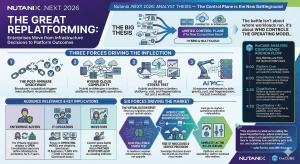
Nutanix .NEXT 2026 arrives at a moment of structural inflection for enterprise infrastructure. This is not a product refresh cycle. It is a market realignment driven by three converging forces: the post-VMware vendor shockwave, the operational failures of first-generation hybrid cloud, and the non-linear demands of enterprise AI.
The central narrative is deceptively simple: Enterprise information technology is no longer debating where workloads run. The debate has shifted to who controls the operating model. That distinction is the difference between a market event and a market inflection point — and .NEXT 2026 is the latter.
| Three forces driving the inflection1 The post-VMware shockwave: Broadcom’s acquisition of VMware has triggered enterprise-wide platform reconsideration at a scale not seen since the shift to virtualization itself.2 Hybrid cloud complexity: Hybrid won as the architecture of record. But it remains operationally broken — too many control planes, cost models, and silos.3 AI as stress test: AI is not a workload. It is an architectural audit. Every infrastructure weakness — data gravity, cost inefficiency, operational fragmentation — is now exposed. |
Audience relevance at a glance
| AUDIENCE | KEY IMPLICATION |
| Enterprise buyers | The VMware migration window is open. Platform consolidation decisions made in 2026 will define infrastructure economics for the next five to seven years. Delay is not neutral — it is a cost. |
| IT operators | The operating model matters more than the architecture. Evaluate platforms on staff-to-workload ratios and operational simplicity, not raw feature sets. Dartmouth’s 10-engineer/1,000-VM profile is the benchmark. |
| Investors | The control-plane battle is real and underpriced by markets. Nutanix is competing for a structural position in enterprise IT, not a feature race. Watch partner ecosystem depth, not product announcements, as the leading indicator. |
The big thesis: Control plane as competitive moat
The enterprise infrastructure market is undergoing a once-in-a-decade reorganization. The prior organizing principle — hypervisor selection — has been disrupted. The next organizing principle is the unified control plane: the software layer that abstracts compute, storage, networking,and AI workloads across hybrid and multicloud environments.
The winner of this cycle will not be the fastest chip or the biggest cloud. It will be the platform that makes everything else work together — invisibly, economically and at scale.
This is the lens through which .NEXT 2026 should be evaluated. Every partnership announcement, every product capability, every customer case study on the agenda maps back to a single question: Is Nutanix building a durable control-plane position — or is it executing a migration play that has a finite shelf life?
The evidence from pre-conference signals, partner announcements and customer deployments suggests the former. But the category has not yet been defined. That is what .NEXT 2026 is designed to do.
Six forces driving the market
1. The virtualization reset
The polite language in this market is “evaluation.” The accurate language is migration at scale. Broadcom’s VMware integration strategy — marked by significant pricing restructuring, support model changes and product bundling — did not merely create dissatisfaction. It triggered executive-level procurement reviews across enterprises, service providers and OEM partners.
The reset is structural, not cyclical. This is the first infrastructure disruption in which displacing the virtualization layer unlocks a full-stack reconsideration of compute, storage, networking, and management. The Dell XC partnership momentum is the clearest public signal: When an OEM of Dell’s scale accelerates a competing virtualization platform, the market has moved.
Analyst assessment: This is the largest infrastructure reset since the original shift to x86 virtualization. The question is no longer whether the market moves — it is who captures the displacement.
2. Hybrid cloud: Won architecturally, broken operationally
Hybrid cloud is the de facto enterprise architecture. No serious analyst or practitioner disputes this. What remains disputed — and largely unsolved — is the operational model. Enterprises today manage fragmented control planes, incompatible cost models and siloed operational teams across on-premises and cloud environments.
The market opportunity is not hybrid cloud deployment. It is hybrid cloud simplification. The platforms that eliminate operational friction — not just architectural complexity — will own the next generation of enterprise IT spend. The Microsoft Azure Virtual Desktop integration announced heading into .NEXT is a direct embodiment of this thesis: hybrid as a product, not a compromise.
Analyst assessment: The winners will not be the clouds. They will be the platforms that make clouds disappear from an operational standpoint.
3. Ecosystem as platform
The partnership roster at .NEXT 2026 is not coincidental. Dell, Microsoft, NetApp and MongoDB represent four distinct layers of enterprise infrastructure: distribution, cloud extension, data management and application data. No single vendor owns the full stack — and the era of pretending otherwise has ended.
The new platform model is loosely coupled technically, commercially aligned through joint go-to-market motions and operationally unified at the customer experience layer. This is a harder model to execute than a vertically integrated stack — but it is also harder to displace. Ecosystem depth is the new defensibility.
Analyst assessment: A platform strategy without partners is a product strategy. The ecosystem roster at .NEXT signals that Nutanix understands the distinction.
4. AI as full-stack stress test
AI workloads are now the most demanding test of enterprise infrastructure. They expose data gravity problems, cost inefficiencies, operational fragmentation and security gaps that were previously hidden or deferred. Every infrastructure weakness becomes visible under AI load.
The signals at .NEXT — Dell AI Factory integration, Nutanix Agentic AI capabilities, MongoDB AI data layer — are not feature announcements. They are responses to a structural demand shift. Enterprises are discovering that AI readiness requires infrastructure redesign, not infrastructure upgrade.
Analyst assessment: AI is not a workload to be placed. It is an architectural audit that reveals everything that needs to be fixed. Infrastructure platforms that pass the audit will define the next generation of enterprise compute.
5. The rise of neoclouds and service providers
One of the most underanalyzed shifts in enterprise infrastructure is the evolution of service providers into what this brief terms neoslouds: purpose-built infrastructure platforms that occupy the space between hyperscaler public clouds and traditional enterprise IT.
Neoclouds — including Expedient, CloudWave, and others in the Nutanix SP Central ecosystem — are differentiated by three capabilities: AI infrastructure delivery, sovereign cloud operations for regulated industries, and outcome-based service delivery models. They are not rebranded hosting providers. They are a structurally new category of infrastructure operator.
The economic logic is clear: Hyperscaler cost models and geographic constraints create demand for an alternative that offers cloud-like economics without cloud-scale compliance risks. Neoclouds are the pressure valve for cloud repatriation and sovereignty requirements.
Analyst assessment: Neoclouds are not niche. They represent the third cloud model — and the infrastructure platforms that power them will benefit from regulatory tailwinds across healthcare, financial services and government.
6. Simplicity as the killer feature
The Nutanix Dartmouth case study — 10 engineers managing 1,000 virtual machines and 1,000 containers — is the most important data point on the .NEXT agenda. It is not a technology story. It is an operating model story.
Healthcare deployments reinforce the same thesis: constrained staffing, elevated stakes, zero tolerance for operational complexity. The infrastructure platform that wins in these environments does not win on feature count or benchmark performance. It wins on operability — the ratio of outcomes delivered to resources consumed.
Analyst assessment: The future of enterprise infrastructure is not the most powerful stack. It is the most operable one. Simplicity, measured in staff-to-workload ratios and operational incident rates, is a primary selection criterion for infrastructure buyers in 2026.
Conference agenda: TheCUBE analysis
The .NEXT 2026 theCUBE run-of-show is structured as a layered set of interviews. Each session builds on the prior — from platform foundation through ecosystem validation to customer proof and, finally, category definition. This is not an accident. Understanding the architecture of the agenda is as important as understanding any individual announcement.
| TIME | SESSION / SEGMENT | ANALYST SIGNAL |
| 8:00 | Platform Core — VM, Kubernetes, and AI Operations Convergence | Watch for complexity reduction vs. complexity abstraction. The distinction matters for operators. |
| 8:30 | Dell Partnership — XC Platform and Joint Go-to-Market | Dell XC growth = VMware displacement. Is Dell the safe landing zone, or a new form of gravity? |
| 9:00 | Microsoft / Azure Virtual Desktop Hybrid Integration | Hybrid as product. Key tension: Who owns the customer relationship at renewal? |
| 11:30 | NetApp — Data as Control Layer | Storage evolving into intelligent data infrastructure. The control plane may shift from compute to data. |
| 1:00 | Service Providers / Neoclouds — SP Central Ecosystem | Third cloud model validation. Key question: Are SPs differentiated, or rebranded hosting? |
| 1:30 | Healthcare Vertical — Constraints as Architecture Validation | If the platform works under healthcare constraints, it works anywhere. Resilience is the product. |
| 2:30 | MongoDB — AI Data Layer and Application Platform Convergence | Database evolving into AI platform. First bottleneck at scale: data access latency, not compute. |
| 3:00 | Dartmouth Case Study — Platform-to-Productivity Proof | 10 engineers/1,000 VMs/1,000 containers. Operational efficiency as purchasing criterion. |
| 4:00 | CEO Keynote Interview — Category Definition Moment | Does Nutanix define the category — or follow it? This is the pivotal strategic signal of the event. |
| 4:30 | Cloud Native + AI — Unified Control Plane Architecture | End-state vision: VMs, containers and AI workloads under a single operational model. |
Implications by audience
For enterprise buyers
The VMware migration window is open and has an expiration date. Enterprises that defer platform decisions are not avoiding cost — they are deferring it with interest. The risk of remaining on legacy licensing structures is no longer purely financial; it is operational, as support quality and product roadmap investment follow platform economics.
Key evaluation criteria for this cycle should include: operational staffing ratios (the Dartmouth benchmark), AI workload readiness (not AI marketing), data portability and egress economics, and ecosystem alignment with existing OEM and cloud relationships.
| BUYER QUESTIONS FOR .NEXT SESSIONS• What is the realistic migration timeline and total cost of transition, including people and process?• Where are customers actually saving money — and on what time horizon?• What breaks first at scale: data, infrastructure or people?• How is this platform different from the lock-in we are trying to escape? |
For IT operators
Operators should evaluate .NEXT through an operational lens, not a feature lens. The relevant questions are staffing efficiency, incident reduction, and day-two operational complexity. The healthcare and Dartmouth sessions are the highest-signal agenda items for this audience—they reveal what the platform looks like under real-world constraints, not demo conditions.
The Kubernetes and AI operations convergence session is also critical for operators managing mixed VM and container environments. The key signal: Is the platform genuinely reducing the number of tools required, or is it adding an abstraction layer that introduces its own operational overhead?
| OPERATOR QUESTIONS FOR .NEXT SESSIONS• What did Dartmouth stop doing that changed the operational model?• Is AI operations management native to the platform, or bolted on?• What is the actual tool count reduction — not the promised one?• How is compliance handled in regulated verticals without slowing deployment velocity? |
For investors
The investment thesis for Nutanix in 2026 rests on category definition, not feature competition. The CEO keynote is the highest-priority session for investors — not for product announcements, but for how the company frames its strategic position. The question is whether Nutanix is defining a new category (unified cloud infrastructure operating system) or competing within an existing one (HCI vendor).
The ecosystem depth — Dell, Microsoft, NetApp, MongoDB — is the leading indicator of platform stickiness. Joint go-to-market commitments, co-sell revenue metrics and partner technical integration depth are more predictive of durable competitive position than any single product capability.
The neocloud/service provider opportunity is underpriced. If neoclouds represent a structurally new cloud delivery model — and the regulatory and sovereignty environment suggests they do — then the infrastructure platforms powering them have significant addressable market expansion ahead.
| INVESTOR QUESTIONS FOR .NEXT SESSIONS• What defines success in 12 months — market share, category leadership or ecosystem revenue?• Is the VMware displacement TAM a onetime event or a sustained cycle?• How is the neocloud/SP channel being monetized relative to direct enterprise?• What is the biggest risk to the category-definition strategy? |
Risks and market tensions to watch
No market inflection is unambiguous. The following tensions represent the most material risks to the thesis outlined in this brief — and the questions that onsite reporting will need to resolve.
Abstraction vs. elimination
There is a meaningful difference between simplifying complexity and hiding it. Platforms that abstract operational complexity without eliminating it create technical debt at the management layer. The signal to watch: Are customers reducing headcount and tool count, or are they shifting the complexity from infrastructure to platform management?
Microsoft partnership tension
The Azure Virtual Desktop hybrid integration is strategically valuable — but it raises a durable question about customer ownership. Microsoft has a documented history of using integration partnerships as a funnel to Azure. The terms of the commercial relationship and the customer data access model will determine whether this is a genuine co-sell or a handoff.
Neocloud differentiation risk
Service providers face a binary strategic outcome: genuine platform differentiation, or commoditization as cheaper cloud. The infrastructure platform they choose determines which outcome is possible. The sessions on SP Central will reveal whether Nutanix is enabling differentiation or packaging a resell motion.
AI readiness vs. AI marketing
Every infrastructure vendor is positioning for AI. The signal-to-noise ratio is poor. The relevant test is whether AI capabilities are native to the platform architecture — not integrated post-hoc — and whether customer deployments show measurable AI workload performance at production scale, not proof-of-concept outcomes.
Category definition risk
Category creation is the highest-return and highest-risk strategic bet in enterprise software. If Nutanix successfully defines the “unified cloud infrastructure operating system” category, the valuation expansion potential is significant. If the category definition is unclear or contested by Microsoft, Google or VMware successors, the company risks being repositioned as a premium HCI vendor with a compelling but limited total available market.
Conclusion: The great replatforming
What is unfolding at .NEXT 2026 and on theCUBE broadcast is not about Nutanix vs. VMware. It is not about cloud vs. on-premises. It is not even about AI vs. traditional workloads.
It is about who owns the control plane of modern enterprise IT.
In a world of hybrid complexity, AI-driven demand and sustained economic pressure, enterprises are no longer upgrading infrastructure. They are redefining how everything gets built, run and scaled. That is the great replatforming — and it is not a marketing frame. It is a structural market shift with measurable spending implications over the next three to five years.
The platforms that will capture this shift share three characteristics: They reduce operational complexity at the staffing layer, they provide genuine AI readiness at the architecture layer, and they build ecosystem depth that creates commercial gravity beyond any single product capability.
.NEXT 2026 is where Nutanix makes its case for all three. TheCUBE Research will be onsite, covering the sessions, conducting primary interviews and providing real-time analysis against the thesis outlined in this brief.
| NUTANIX .NEXT EVENT COVERAGE SUMMARY “This all points to what we’re calling the great replatforming — where enterprises are no longer just upgrading infrastructure, they’re redefining how everything gets built, run and scaled in an AI-driven world.”— John Furrier, theCUBE Research |
About theCUBE Research
TheCUBE Research provides independent analysis of enterprise technology markets for buyers, operators, and investors. Coverage focuses on structural market shifts, not incremental product news. John Furrier is co-founder and lead AI infrastructure analyst at SiliconANGLE Media and theCUBE. Contact: johnfurrier@siliconangle.com