
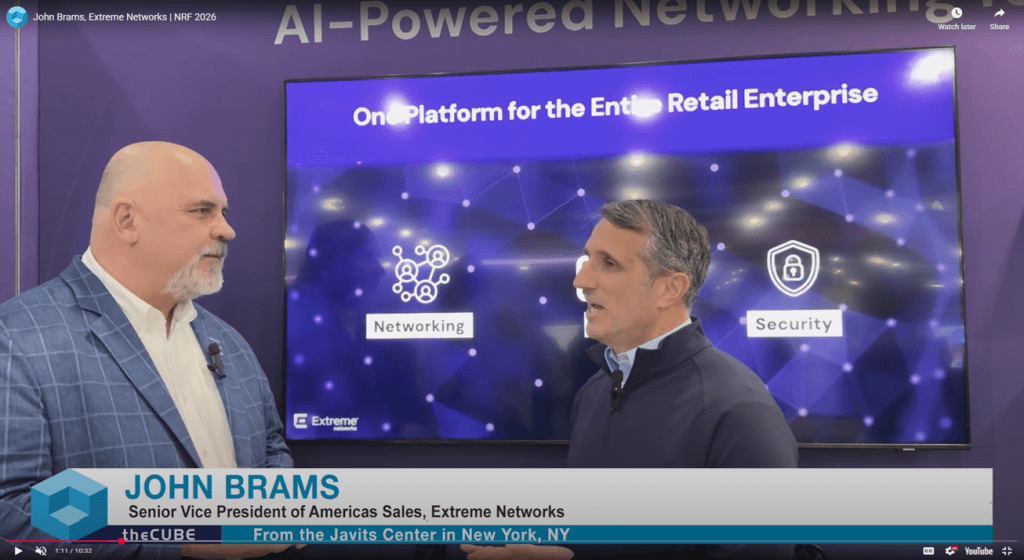
At NRF 2026, Extreme Networks outlined how retail organizations increasingly view the network not as basic infrastructure but as a strategic platform for operational efficiency, customer experience innovation, and data-driven decision-making. In a discussion with John Brams, SVP of Americas Sales, Extreme Networks, the focus centered on how modern wireless, fabric-based architectures, and AI-driven analytics are moving from concept to deployment, helping retailers translate long-discussed ideas, such as location intelligence, frictionless experiences, and IoT enablement, into measurable outcomes.
From “Plumbing” to Strategic Enablement
A recurring theme at NRF 2026 was that retail transformation is less about showcasing new technologies and more about delivering tangible outcomes. Extreme’s perspective aligns with this shift. Retailers that are seeing the most success are those rethinking the network as a foundational enabler rather than a passive utility.
As Brams noted, virtually every digital initiative in retail, whether customer-facing applications, in-store analytics, or operational automation, depends on the network. By modernizing wireless infrastructure, including adopting cleaner spectrum in the 6 GHz band and replacing legacy IoT protocols with newer technologies such as Thread (an IPv6-based, low-power mesh networking protocol), retailers are creating a more reliable and flexible foundation. These upgrades are not incremental; they materially improve RF performance, simplify device onboarding, and unlock support for new classes of applications.
Applying Proven Models from Adjacent Verticals
One of the more compelling insights from the conversation was Extreme’s application of lessons learned in large-scale venues, such as sports and entertainment, to retail environments. In both cases, organizations manage dual networks, operational back-of-house systems, and customer-facing access, while seeking to overlay analytics that improve flow, utilization, and experience.
In retail, this translates into practical use cases such as understanding customer movement patterns, optimizing store layouts, and improving queue management. These capabilities are no longer experimental. According to Brams, retailers are actively deploying them today, signaling that the industry has moved beyond pilot projects toward scaled implementations.
AI as an Operational and Business Catalyst
Artificial intelligence featured prominently at NRF 2026, though the tone across the show was notably more pragmatic than in prior years. Extreme’s approach reflects this maturity. Rather than positioning AI as a standalone feature, the company emphasizes its role in simplifying network operations across multiple domains, such as employee networks and guest access, while also contributing data to broader analytics platforms.
For retailers, the greatest strategic value lies in combining network-derived data with other systems to inform business decisions. Location services, dwell-time analysis, and flow analytics become significantly more powerful when integrated with customer engagement, merchandising, and operations platforms. In this model, the network serves as a high-quality data source, extending its relevance well beyond IT operations.
Improving Experience While Managing Cost and Complexity
The interview also highlighted how retailers are balancing improvements in the customer experience with cost control. Examples such as eliminating traditional kiosks in favor of mobile-first experiences underscore the importance of seamless, secure connectivity, particularly for diverse customer demographics. Technologies that support automatic authentication and smoother onboarding reduce friction for users while lowering operational overhead.
At the same time, retailers are prioritizing security and segmentation. Microsegmentation at the network level enables organizations to protect sensitive systems and devices without adding undue complexity for IT teams. This approach reflects a broader trend toward embedding security into the network fabric rather than layering it on afterward.
Ecosystems and Validated Integrations Matter
Finally, the discussion reinforced the importance of ecosystem partnerships in retail environments. No single vendor can address the full spectrum of retail requirements, particularly in areas such as vision analytics, location-based services, and customer insight platforms. Extreme’s emphasis on validated architectures and certified integrations reduces deployment risk and shortens time to value for retailers.
From an industry perspective, this approach aligns with the growing demand for repeatable, proven solutions over bespoke integrations. Retailers are looking for confidence that technologies will work together as intended, especially as stores become more software-defined and data-intensive.
OurANGLE
The conversation with John Brams of Extreme Networks at NRF 2026 illustrates a broader industry shift: retail networks are evolving into strategic platforms that support both operational resilience and business innovation. As AI initiatives become more targeted and outcome-driven, the network’s role as a source of reliable connectivity, actionable data, and embedded security becomes increasingly central. Retailers that approach network modernization with this strategic mindset are better positioned to turn digital investments into sustained competitive advantage.