IBM and Red Hat announced Project Lightwell, a $5 billion commitment aimed at securing open-source software in the AI era. The effort combines a trusted enterprise clearinghouse, more than 20,000 engineers and AI-driven vulnerability discovery, validation and remediation workflows to help enterprises manage open source risk across increasingly complex software supply chains.
In our view, this is a bit more than a routine open-source support announcement. It is a response to a fundamental change in the threat model. Frontier AI models are getting better at reading code, reasoning across dependencies, identifying vulnerabilities and potentially chaining exploits. As we recently discussed in our analysis of Oracle’s customer security advisory, the cost for attackers to discover weaknesses is falling rapidly. Project Lightwell is IBM and Red Hat’s attempt to front-run that shift by industrializing open-source security remediation at enterprise scale.
The announcement is also an indication that IBM sees open-source security as a new threat point in the AI era. Red Hat gives IBM a credible position in enterprise open source – a brand, innovation and ecosystem byproduct of its $34B acquisition of the company. Project Lightwell extends that posture beyond Red Hat’s traditional product portfolio and into the broader universe of open-source components that power modern applications, AI systems, data platforms and infrastructure. In our opinion, that is the most important part of the announcement.
What is Project Lightwell?
Project Lightwell is IBM and Red Hat’s proposed trusted clearinghouse for enterprise open-source software security. The goal is to create a coordinated model where enterprises can report sensitive vulnerabilities, receive validated fixes and help push remediations upstream into open-source communities. The offering will be delivered commercially through subscriptions, with IBM and Red Hat applying engineering capacity, AI tooling and release cadence discipline to open-source packages used in enterprise environments.
IBM claims the clearinghouse will use advanced AI capabilities to validate and test fixes across large volumes of open-source code, while a global force of more than 20,000 engineers will support vulnerability review, triage, secure patch development, dependency hardening and release engineering. The company also states that it already uses more than 62,000 open-source packages and has deep expertise in more than 10,000.
The importance here is that open-source risk is no longer confined to Linux distributions, middleware platforms or developer tooling. It is embedded everywhere – in AI frameworks, language runtimes, container images, data streaming platforms, CI/CD pipelines, SaaS connectors and internal other applications (e.g., custom and other COTS apps). The average enterprise does not have the staff, time or expertise to track every package, version, vulnerability, dependency and patch across the estate.
Project Lightwell is designed to sit in the middle of that problem. The idea goes beyond scanning for threats in the software bill of materials (SBOM). The goal is to act as a coordinated remediation layer that combines AI, human technical expertise, enterprise hardening and upstream community engagement.
To be more clear, IBM and Red Hat are trying to become the trusted middle layer between open-source communities and enterprise production environments.
How Frontier AI changes the economics of software vulnerability discovery
The timing is not coincidental, given Mythos and releases from other frontier model vendors.
Open-source software underpins the modern digital economy. According to the press release, more than 90% of Fortune 500 companies rely on open-source software. It also cites Anthropic’s work around Mythos/Glasswing, noting that the model identified nearly 3,900 high- or critical-severity vulnerabilities in open-source software alone.
This is IBM’s response.
For years, software vulnerability discovery required human expertise that was hard to find. Skilled researchers had to use modern tools to inspect code, understand dependencies, identify misconfigurations, test and ultimately determine whether a weakness could be exploited. Frontier models compressed that cycle and dramatically increased the speed and capabilities of adversaries.
The implication is that attackers can increasingly use AI to find weakness faster than defenders can manually remediate it.
That does not mean enterprises should panic. It does mean the old model – i.e., scan periodically, file tickets, get the attention of maintainers and patch when convenient – is far too dangerous. The volume and speed of vulnerability discovery are increasing and the defender’s response cycle has to be faster.
This is the premise behind Project Lightwell. IBM and Red Hat, along with frontier model vendors, are identifying problems at a far quicker pace. But IBM is also promising to help validate fixes, coordinate disclosure, harden dependencies, and provide lifecycle management for open source components in enterprise software supply chains. That is a much bigger ambition and is different from Oracle’s approach, which was to advise customers to upgrade to an autonomous system that would take care of the patching. Absent an upgrade to an autonomous database, Oracle is recommending changes to the security patching protocol. IBM and Red Hat are accomplishing a similar objective, but not within a single system (e.g. a database), but with a service that can span multiple systems and tools.
The bigger concept here is that AI forces a new operating model for security itself. If AI can dramatically scale discovery, defenders need AI plus engineering scale to industrialize remediation.
The real problem Project Lightwell tries to solve
In our view, the open source security problem has four key layers to consider.
- The first is visibility. Enterprises often do not know exactly what open source components they are running, where they are running, which versions are exposed, and which dependencies are linked to each other. SBOMs help, but SBOM repositories alone do not solve the operational problem; which is what to do about the vulnerabilities;
- The second is prioritization. A vulnerability in a package may be serious in theory but irrelevant in a specific deployment, or it may be catastrophic because of how that package is used in production. Enterprises need context;
- The third is remediation. Even when a fix exists, applying it across production environments is often cumbersome. Organizations must test for compatibility and avoid breaking mission-critical applications. This has to be coordinated via a firm’s change management protocols and validated to satisfy audit;
- The fourth is upstream coordination. Open source communities move at different speeds, and enterprises often need fixes before the community process has fully played out. At the same time, responsible disclosure and transparency is a must. Enterprises don’t want to fork every project or hoard fixes for themselves that never make it back to the community.
Our assessment is Project Lightwell is designed to address all four layers by creating a trusted coordination mechanism. IBM and Red Hat are effectively saying they’ll help you move from vulnerability awareness to validated remediation, while also strengthening the upstream ecosystem.
That is a well-thought-out message, especially for firms in highly regulated industries. The early adopters in the press release are Bank of America, BNY, Citi, Goldman Sachs, JPMorganChase, Mastercard, Morgan Stanley, Royal Bank of Canada, State Street, Visa and Wells Fargo. There’s a pattern, right?
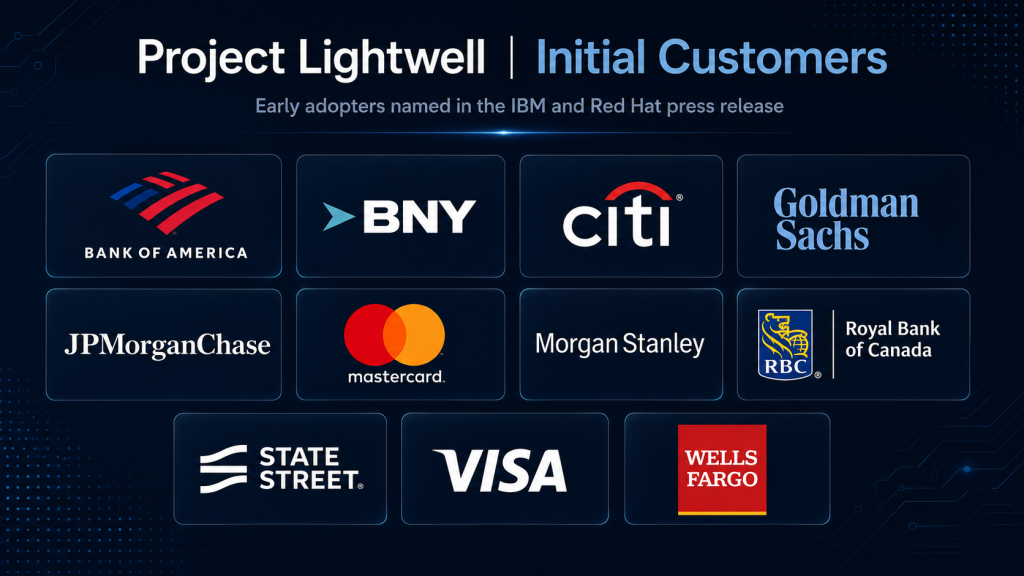
This initial customer list suggests IBM is targeting institutions where open source security is fundamental. These firms operate critical infrastructure, process massive transaction volumes, face intense regulatory scrutiny and have some of the most complex software porfolios in the world.
Ecosystem impact: IBM and Red Hat are trying to institutionalize open source trust
The ecosystem implications are worth some discussion.
Open source has always balanced community innovation and enterprise realities. Developers contribute code. Communities maintain projects. Enterprises consume and monetize them and ISVs package, support and certify portions of the stack. That model has worked remarkably well, especially for Red Hat, which invented the model. But AI brings a new dimension.
If frontier models make it easier to discover vulnerabilities at scale, open source maintainers could be overwhelmed. Many critical projects are maintained by small teams or even individuals. Enterprises may be consuming code at massive scale without contributing enough security engineering back to the ecosystem. Attackers can use AI to inspect the same code everyone else depends on.
Project Lightwell is IBM and Red Hat’s attempt to create a new institutional trust layer around open source security. If successful, it could become a kind of enterprise-grade trust fabric for open source software – a place where vulnerabilities are reported, fixes are confirmed, patches are hardened, and disclosures are made public in a coordinated fashion fashion.
This helps open source communities by pushing fixes upstream and contributing engineering brainpower for the greater good. But it could also create tension. The announcement material says the clearinghouse will be offered through commercial subscriptions. That raises important questions about access, fairness and community participation. If IBM and Red Hat become a privileged conduit for vulnerability intelligence and enterprise-grade remediation, how will benefits flow back to the broader open source ecosystem? Will smaller firms and community projects get access to the same fixes? How will disclosure timelines be governed? These are the questions we recommend participants ask.
In our view, the success of Lightwell will depend on IBM and Red Hat walking a careful line. They must provide premium enterprise value without appearing to privatize open source security. Preserving Red Hat’s credibility with the open source community is essential here.
Done well, Project Lightwell could strengthen open source. Done poorly, it could be criticized as commercializing a trust layer that should remain broadly accessible.
What it means for IBM
Strategically, this is a move that reflects a new IBM and that is a positive.
IBM has always been at its best when it combines deep technical expertise with enterprise trust. This is especially the case around mission-critical systems. Project Lightwell fits that mold. It is not a consumer AI app. It is not a point security feature. It is an enterprise trust infrastructure play.
It also reinforces why Red Hat remains one of IBM’s most important strategic assets. Red Hat gives IBM credibility in open source, hybrid cloud, containers, Linux, Kubernetes, automation and developer ecosystems. Project Lightwell extends that credibility into the next layer of enterprise concern – i.e. trusted open source operations in the AI era.
There is also a broader positioning perspective. IBM has been emphasizing hybrid cloud, AI, automation, consulting and open source as pillars of its strategy. Project Lightwell ties those core pieces together and gives IBM a way to talk about AI that differentiates it and takes the focus off attempts to compete with frontier models (e.g. Granite). For Red Hat, it shows a way to extend its open source value proposition beyond platform support. It gives IBM Consulting an entry way into software supply chain risk, modernization, AI governance and regulated industry opportunities.
In addition, this initiative complements IBM’s broader security posture. IBM has long had credibility in mainframe security, regulated workloads and more recently post-quantum cryptography. Lightwell creates another wrapper around software supply chain resilience. In the agentic AI era, where autonomous systems will increasingly depend on open source components, this becomes increasingly important.
The announcement also positions engineering talent as a premium asset. At a time when many companies are using AI to scale without technical labor, IBM and Red Hat are explicitly saying that human engineering capacity plus AI is a differentiator. The message is more positive than what we’ve heard from some experts who say “AI replaces coders.” Instead the narrative is “AI makes an expert engineering team more scalable.”
Why the financial sector is the right beachhead
The early adopter list is heavily weighted toward global financial institutions. This is of course purposeful as these are IBM’s best mainframe customers and some of the most important companies on the planet.
Banks and financial services firms have several characteristics that make them ideal early customers for Lightwell. They are heavy users of open source. They operate complex, regulated environments. They have mature security organizations. They face nation-state and criminal threats. They care deeply about software supply chain integrity. They also have the budget and operational chops to deploy subscription-based security services if the ROI is there.
Financial institutions also tend to be early adopters of governance frameworks that later spread into other industries. If IBM and Red Hat can prove the Lightwell model in banking, the approach could extend into healthcare, government, telecom, manufacturing and critical infrastructure.
In our opinion, this is the best initial market fit for IBM. If you can make this work for JPMorganChase, Citi, Goldman Sachs, Mastercard, Visa and their peers, you have exceedingly credible proof points for the rest of the enterprise market.
What’s missing
We see the announcement in a positive light, but several details remain unclear.
First, IBM needs to define the operating model more precisely. For example, what is the process for an enterprise to submit a vulnerability? How will severity be determined so that prioritization can occur accurately? Who validates exploitability? What happens when multiple customers report the same issue? What is the escalation process? How are urgent fixes distributed? How do customers integrate patches into existing DevSecOps pipelines?
And can all this happen before adversaries can act?
Second, the community governance model needs clarity in our view. IBM says fixes will be shared upstream so open source communities can include them in long-term maintenance. That is the right direction, but what are the mechanics? Open source communities are not all structured the same way. Some have mature governance. Others are fragile. IBM and Red Hat will need transparent rules for disclosure, contribution, coordination and participation.
Third, the scope of supported software needs to be made explicit. By our count, the announcement references twelve categories that are supported: Linux, Java, Kubernetes, Kafka, Ansible, Terraform, Flink, Cassandra, independent libraries, language toolchains, AI frameworks and data streaming platforms. That is very broad. Customers will want to know what is covered on day one, what is on the roadmap, what “deep expertise” means by package, and what is the pricing model.
Fourth, the AI validation process can’t be a black box. If AI is used to validate and test fixes, enterprises will want to understand how things like false positives, false negatives and hallucinations are exposed and handled. Automated security engineering is powerful, but things can go wrong and the process must be auditable. Customers will need evidence that fixes were tested, validated and ready for production.
Fifth, integration into existing tooling is critical. Enterprises today have scanners, SBOM repositories, CI/CD pipelines, ticketing systems, etc. Are these going to be incorporated or will a new operating model emerge as a result of AI? Will Lightwell become the new operating model or will Lightwell become another isolated portal? It presumably will integrate into the way software is built and operated.
Finally, IBM must clarify the liability and SLA model. If enterprises are paying for a trusted clearinghouse and validated patches, what commitments and guarantees does IBM make? What happens if a validated patch introduces instability? Who is liable? What guarantees exist around response times for critical vulnerabilities? What is the boundary between IBM responsibility, customer responsibility and upstream maintainer responsibility?
These are all addressable issues that are too many to include in a press release. But they will determine whether Project Lightwell becomes a transformational trust layer or a promising but bespoke security service.
The bigger industry implication
Project Lightwell should be viewed alongside other recent moves in the market. Oracle’s customer advisory around AI-driven vulnerability discovery, Anthropic’s Mythos/Glasswing work, OpenAI’s Trust Access for Cyber efforts, and the broader rise of agentic security all point to the conclusion that software vulnerabilities are increasing and moving into a new phase.
The industry must move toward intelligent, automated code inspection, dependency awareness, auto-configurations and deployment. This shifts the responsibilities of vendors and customers and raises new questions about liabilities.
Vendors can no longer simply ship patches on fixed cycles and assume customers will apply them at their own pace. And customers can no longer treat open source security as a loosely governed developer responsibility. The future model will require continuous improvement including DevSecOps integration, and collaboration between vendors, model providers, open source communities and enterprise customers.
Project Lightwell is an early attempt to formalize the model at scale.
Key takeaways
Project Lightwell is IBM and Red Hat’s attempt to create a trusted enterprise clearinghouse for open source security in the AI era. It combines AI-driven vulnerability validation, global engineering capabilities, enterprise lifecycle management and community coordination into a commercial subscription model.
In our view, the announcement is relevant because it addresses a real and growing problem in that frontier AI is lowering the cost of vulnerability discovery, and enterprises are not equipped to handle open source risk at the same speed.
The announcement also has meaningful ecosystem implications. It could strengthen open source by adding engineering capabilities and remediation processes. But it must be transparent, community-driven and operationally transparent to avoid the perception that enterprise open source security is becoming a layer for the privileged few.
For IBM, Project Lightwell is strategically aligned with Red Hat’s mission of better tech via open source communities. By leveraging Red Hat, it reinforces IBM’s enterprise trust posture, expands its security relevance and creates new opportunities in software supply chain management. It is exactly the kind of complex problem IBM should be trying to solve.
What remains to be seen is execution. IBM and Red Hat must prove that Lightwell is not just a bold commitment and a large dollar figure, but a deployable operating model that integrates into existing enterprise software supply chains and delivers measurable risk reduction.
Action Item
Business technology executives should treat open source security as a first-class AI-era risk. Start by identifying the open source components embedded across applications, infrastructure, data platforms and AI systems. Prioritize packages supporting mission-critical workloads, regulated data, customer-facing services and emerging AI pipelines. Push vendors for transparency on validated patches, machine-readable advisories, lifecycle support and integration into DevSecOps workflows. Do not assume community maintenance alone will keep pace with AI-accelerated vulnerability discovery. In the frontier model era, software supply chain resilience is non-optional.