An Economic Assessment of Infrastructure Modernization and AI Project Implementation
Executive Summary
This report evaluates the economics of moving from a fragmented on-premises installation to Oracle Autonomous AI Database on Multicloud over a five-year horizon. It examines two modeled use cases: infrastructure/service modernization only and one with AI projects enabled, built on that same modernization foundation. The analysis shows that infrastructure and service modernization alone produce meaningful value, while the addition of AI projects materially expands the business case by improving the speed, scale, and repeatability of execution.
The representative enterprise modeled in the underlying study is a $10 billion manufacturing division within a larger $40 billion conglomerate. The manufacturing division has an annual IT budget of $495 million. The starting environment reflects a commonplace enterprise installation with a heterogeneous on-premises estate that includes Oracle Database, SQL Server, Postgres, MongoDB, OLAP, and vector database platforms running on a variety of servers and storage systems. In environments like this, complexity itself is a source of cost and delay. Operations are harder to standardize, governance is harder to enforce consistently, and new AI-related projects are more difficult to develop and implement at scale.
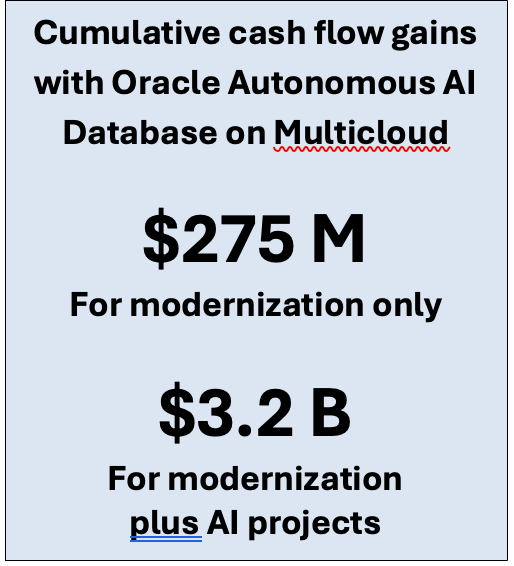
For this specific journey, the modeled economics are compelling. In the infrastructure/service modernization only case, moving to Oracle Autonomous AI Database on Multicloud delivers a five-year net present value of $223 million, an internal rate of return of 108%, break-even in 26 months, and cumulative cash flow of $275 million.
On top of the modernization gain, the AI projects case delivers dramatic results and provides a massive amount of incremental value. Our research and modelling shows a five-year net present value of $2.6 billion, an internal rate of return of 295%, break-even in 14 months, and cumulative cash flow of $3.2 billion.
The central implication is significant and we believe profound. Specifically, this journey is not just a database migration project. It is a durable platform decision that sets the foundation for an organization to thrive in the AI era. Specifically, we see the Oracle Autonomous AI Database on Multicloud data infrastructure not only as a platform to improve operating efficiency, reduce administrative burden, strengthen standardization and governance, but also a better foundation for implementing AI projects over time. In that sense, the modeled value comes from two sources: 1) the direct benefits of modernization and 2) the larger downstream value created when that modernized foundation enables AI projects at an increasingly accelerated pace.
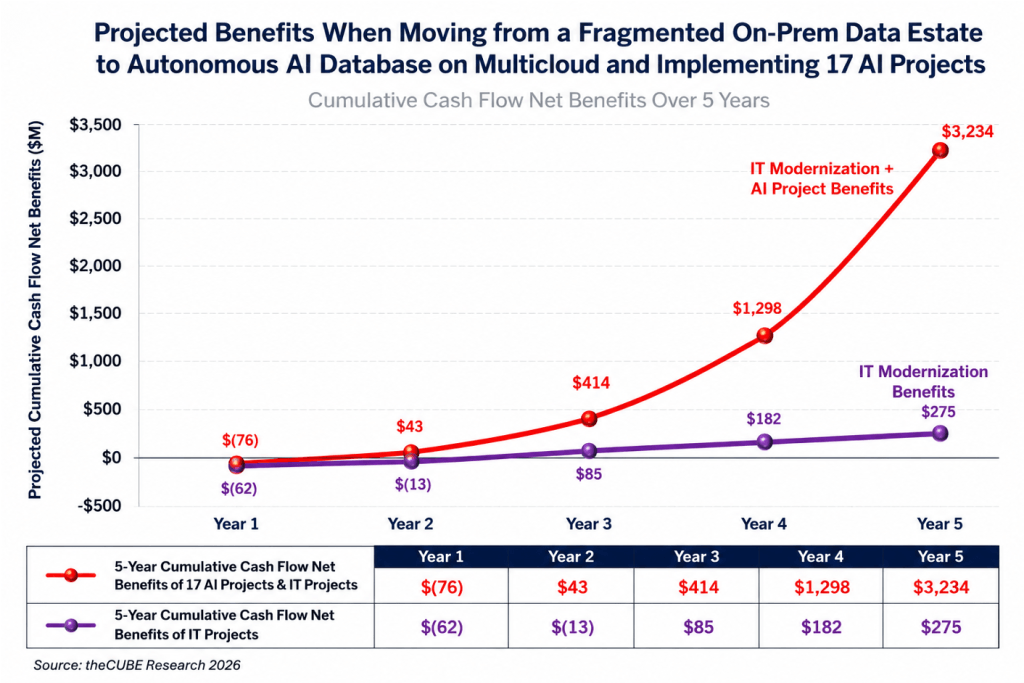
Figure 1. Comparing Business Cases: Modernizing Infrastructure Only and Enabling AI Projects on Top of Modernized Infrastructure
Why This Journey is so Relevant in Today’s AI Era
Many enterprises still operate with a fragmented, on-premises data estate built over years of application growth, acquisitions, business-unit autonomy, and changing technology preferences. The result is often a mixed environment with multiple engines, different administration teams, inconsistent tooling, uneven security practices, and separate operating models for transactional, analytical, AI, and newer application workloads. We often describe this as an “accumulated estate,” where the data platform has grown organically rather than as a designed, integrated architecture. This organic growth, which was logical at the time, now contributes substantially to the enterprise’s continuously increasing technical debt.
This type of starting point creates significant business challenges. Skilled database teams spend too much time on patching, tuning, backup, provisioning, and disaster recovery planning. Security and compliance are harder to standardize. Capacity planning and refresh cycles are slow and expensive. Most importantly, these operational constraints reduce the organization’s ability to move quickly when new digital or AI-driven initiatives require governed, trusted, production-grade data access at scale.
In this analysis, we highlight several common challenges of on-premises database environments, including DBA time consumed by infrastructure tasks, delayed capacity responses, reactive security patching, and limited access to cloud AI and ML services. Consider instead the alternative experience in the cloud and its corresponding value proposition with high degrees of automation, security, availability, performance, elasticity, and commercial efficiency.
In our view, Oracle Autonomous AI Database on Multicloud represents the most automated and standardized operating models in the marketplace today. We see it as a highly attractive platform for building a world class AI foundation that can accelerate organizational value at unprecedented rates.
This analysis specifically looks at a customer journey from a fragmented, on-premises data estate to Oracle Autonomous AI Database on Multicloud. It is a useful scenario that isolates and quantifies the economics of moving from the most operationally complex starting point to Oracle’s most automated database operating model.
In other words, this analysis takes an organization from “worst-to-first” over a five-year period.
Scenario Definition and Methodology
Oracle engaged theCUBE Research in a paid study to quantify the economic and operational impact of several alternative migration paths to help customers plan future infrastructure and database requirements. We defined a common Base Case starting point and modeled multiple “as-is → to-be” journey options to determine which paths are most advantageous from both a hard-dollar cost and business value perspective. The study is designed not only to identify the strongest economic outcomes, but to help IT leaders understand how different deployment options affect their ability to launch AI projects, operationalize AI across the enterprise and assess its economic impact.
This report draws from a methodology developed by theCUBE Research. Briefly, our work combines qualitative fieldwork with leading AI adopters, technical research, and a quantitative business model to assess deployment options and quantify economic impact. Inputs included interviews with five enterprises running leading-edge AI projects, technical working sessions with Oracle subject-matter experts, and background research assessing technical documentation and relevant case studies. The model uses a representative manufacturing enterprise context and evaluates economic outcomes over a five-year period.
This specific report focuses on a journey from a fragmented, on-premises data estate (this is the base case) to Oracle Autonomous AI Database on Multicloud, which provides customers the choice of running in Oracle Cloud Infrastructure (OCI) or on Oracle managed services in AWS, Microsoft Azure, and Google Cloud. As mentioned earlier, our first use case isolates the value of infrastructure and service modernization without AI projects while the second builds on that same modernization foundation and adds AI seventeen (17) projects.
| Modeled case | Definition |
| Infrastructure/service modernization only | Value created by moving from the fragmented on-premises data estate to Oracle Autonomous AI Database on Multicloud without including AI projects |
| AI projects use case | Infrastructure/service modernization plus developing and executing AI projects (17 in total) |
Note: The AI project use case should be read as building on the infrastructure/service modernization foundation (inclusive), not as an overlay that could run on any infrastructure.
The model quantifies value across three broad categories, including 1) direct IT cost savings; 2) operational performance improvements; and 3) business benefits. When taken together, organizations experience greater efficiencies in hardware, software, and services; reduced labor associated with standardization and automation; fewer outages and disruptions; improved IT productivity; quicker decision making; and business improvements tied to supply chain and inventory performance.
| Modeling dimension | Assumption |
| Enterprise modeled | $10B manufacturing division within a $40B company |
| Annual IT budget | $495M |
| Time horizon | 5 years |
| Starting environment | Fragmented on-premises data estate |
| Business context | Supply chain operations |
Economic Outcomes for moving from a fragmented on-premises data estate to Oracle Autonomous AI Database on Multicloud
The economic results for this specific journey are shown below.
| Modeled case | NPV | IRR | Break-even | Cumulative cash flow |
| Infrastructure/service modernization only | $223M | 108% | 26 months | $275M |
| AI projects enabled case | $2.6B | 295% | 14 months | $3.24B |
These results show that the journey stands well on its own as an IT modernization case. A five-year NPV of $223 million, break-even in 26 months, and $275M in cumulative cash flow indicate that moving from a fragmented, on-premises data estate to Oracle Autonomous AI Database on Multicloud can create significant value even without AI projects.
Our impact analysis considers the full gamut of applications running on-premises and how they benefit from using a modern cloud database. Some organizations also evaluate the direct database-platform benefits from a TCO savings perspective, and while not exact, we believe that the closest comparison from this analysis is to consider the combined benefits outlined in the “Data, Analytics & BI Platforms” and “Core Operations & Support” lines of the budget. After the migration is complete in Year 2, the yearly costs associated with Data, Analytics & BI Platforms plus those for Core Operations & Support decrease by $43.5 million, or 29.6%. As mentioned, these two cost categories are not exclusive to the database platform nor are they the only direct cost impacts that modernization will generate, but 30% is a good estimate of the database-related savings such a move can generate.

The AI projects use case considers the combined impact of database modernization and AI projects, delivering a substantially larger modeled outcome.
The kinds of AI projects envisioned in this use case are operational applications with direct, measurable manufacturing and supply-chain impact rather than speculative pilots. A typical first project is inventory management: an AI application that ingests ERP, warehouse, order, supplier, and plant data to recommend stock levels, identify excess and obsolete inventory, predict shortages, and improve allocation by SKU, plant, and channel. That type of project releases working capital by reducing buffer inventory, improves inventory turns and fulfillment by better matching supply to demand, and reduces stockouts so more orders can be filled from available product. It also creates a high-value data asset by forcing product, supplier, order, and inventory data to be cleansed and harmonized, which benefits every project that follows.
From there, organizations can extend the same foundation into adjacent use cases such as supplier-risk and supply-chain disruption management, predictive maintenance, defect detection and quality root-cause analysis, plant scheduling optimization, and planner or supervisor copilots that reduce escalations and compress time-to-decision. The 17 projects modeled over five years should be thought of as a portfolio that compounds value. Specifically, early projects create operational gains on their own, but they also improve data quality, governance, and organizational learning, making later projects faster to deploy and easier to scale. That is why the modeled benefits accrue across the categories shown in the analysis—working capital released, improved inventory turns and fulfillment, reduced stockouts and incremental revenue, and better decision productivity—rather than from one isolated AI use case alone.
When AI projects are added on top of the modernization foundation, NPV rises substantially to $2.6 billion, cumulative cash flow increases to $3.2 billion, and break-even compresses from 26 months to 14 months. In other words, getting on the AI curve delivers business value is an order of magnitude more impactful.
This result is consistent with the central conclusion of our ongoing research. Specifically, modernization is useful, but the larger source of business value comes from the platform’s ability to support more repeatable, higher-value AI projects execution over time. In this use case, the key benefit comes from an organization’s ability to leverage AI native capabilities in Autonomous AI Database on Multicloud and create a “flywheel” effect where the learnings from early projects confer value and speed to subsequent initiatives that can then be leveraged across the broader organization.
What Enables the AI Project Value in This Use Case
In our research and modeling, the most important enabler of AI project success is getting onto the AI learning curve earlier and staying on it longer. That is the central strategic and economic difference between moving directly to Oracle Autonomous AI Database on Multicloud and immediately start implementing AI projects versus first migrating to the cloud and delaying the start of AI development and deployment until after the cloud migration is complete. The data suggests that waiting pushes value farther into the future, while taking earlier action allows organizations to build experience, strengthen governance, and create a repeatable model for implementing additional AI use cases over time.
Several factors make the flywheel effect possible:
- Earlier entry onto the AI curve. Organizations that begin implementing AI projects sooner can start learning sooner. Early projects build institutional knowledge, improve execution discipline, and create momentum for subsequent deployments.
- More staff availability for higher-value work. As the platform becomes more automated and standardized, teams spend less time on routine administration, patching, provisioning, tuning, and duplicated migration effort. That frees skilled staff to focus on AI application development and deployment, governance, and operationalization.
- Stronger governance and operational consistency. A more standardized and automated operating model makes it easier to apply repeatable controls, improve oversight, reduce deployment friction, and support production-grade AI execution at scale.
- AI-assisted data improvement. In our view, enterprises should not wait until data is perfectly cleansed and harmonized before starting AI work. The stronger approach is to establish the most capable platform possible, begin implementing AI projects, and allow AI itself to help accelerate data cleansing, harmonization, standardization, and enrichment over time.
This last point is especially important. We believe the sequencing is vital. A traditional approach assumes that data cleansing must be largely completed before meaningful AI work can begin. Our research suggests the opposite. The better path is to get on the AI curve early and let AI help improve data quality as part of the journey. That allows learning, data improvement, and project delivery to compound together rather than occurring in separate phases.
In our view, that is why the AI projects use case delivers such materially greater gains. The value is not driven only by infrastructure modernization. It is driven by getting onto the AI learning curve earlier, freeing staff to focus on execution, using AI to cleanse and harmonize data as part of the process, and creating the governance and operational consistency needed to turn early projects into compounding advantage.
Business Interpretation
The practical meaning of these findings is that Oracle Autonomous AI Database on Multicloud changes both the operating model and the economic profile of the starting environment.
At the infrastructure and service modernization layer, the benefits are easy to explain. A fragmented data estate with multiple platform engines, teams, and tools tends to create duplication, delay, and operational friction. Moving to a more automated, Oracle-managed environment reduces routine administration, improves consistency, simplifies lifecycle operations, and strengthens the baseline for performance, resilience, security, and governance.
At the AI projects layer, our interpretation becomes much more strategic. Importantly, we stress that the benefit comes not only from the fact that the Oracle platform contains built-in agentic AI capabilities. Rather the more important benefit is that the destination platform enables the enterprise to implement AI projects with greater speed, lower friction, and better operational discipline than it could from a fragmented starting point. The modeled gap between the modernization-only case and the AI projects case suggests that it does, in quite dramatic fashion.
It is also important to be precise about what this report does and does not claim. It does not attempt to claim that every customer will implement the same number of AI projects or realize identical returns. It does show however, that for the representative enterprise modeled, the move from a fragmented, on-premises data estate to Oracle Autonomous AI Database on Multicloud creates meaningful value on its own and substantially greater value when the same platform also supports the development and deployment of AI projects. We believe similarly directional results will be realized by most enterprises that invest in infrastructure modernization and build AI proficiency on top.
| Modeled case | Primary source of value | Interpretation |
| Infrastructure/service modernization only | Simplification, standardization, automation, operational efficiency | Solid stand-alone business case driven by lower friction and improved operating model and IT productivity |
| AI projects use case | Modernized foundation plus AI projects | Dramatically larger value profile driven by improved ability to develop and deploy AI projects on a more automated and standardized platform |
Bottom Line
For the representative enterprise modeled in this analysis, moving from a fragmented, on-premises data estate to Oracle Autonomous AI Database on Multicloud produces a strong five-year business case in both modeled use cases. The infrastructure/service modernization only case delivers meaningful value through simplification, automation, operating-model improvement, and increased IT productivity. The AI projects case, which builds on that modernized foundation expands the economics by an order of magnitude and shortens payback.
The broader implication is that this journey should be evaluated not only as a database modernization effort, but as a platform decision. For organizations seeking to reduce operational friction while improving their ability to develop and deploy AI projects over time, Oracle Autonomous AI Database on Multicloud represents a destination model with both economic and strategic significance.
Appendix. Key Assumptions and Detailed Data Model
This appendix captures a subset of the assumptions that are important to interpret modernizing from a fragmented on-premises data estate to Oracle Autonomous AI Database on Multicloud.
| Assumption category | Assumption |
| Enterprise profile | $10B manufacturing division within a $40B company |
| Annual IT budget | $495M |
| Modeling horizon | 5 years |
| Starting environment | Fragmented on-premises data estate with Oracle Database, SQL Server, Postgres, MongoDB, and OLAP |
| Modernization case | Move to Oracle Autonomous AI Database on Multicloud without AI projects |
| AI-enabled case | Infrastructure/service modernization plus AI projects |
| AI project assumption | 17 AI projects modeled over 5 years |
| Role of AI project assumption | Critical model driver of value in the AI projects enabled case |
Note: Our study models the path from a fragmented, on-premises data estate to Autonomous AI Database on Multicloud, supporting 17 AI projects over five years. This is a critical modeling assumption and one of the most important drivers of value in the AI-enabled case. It should therefore be treated as a core assumption in evaluating the scenario, while also recognizing that actual customer environments may vary in project count, timing, and realized business impact.
The following data describes the economic model in detail for both the modernization-only business case and the AI projects enabled scenario.
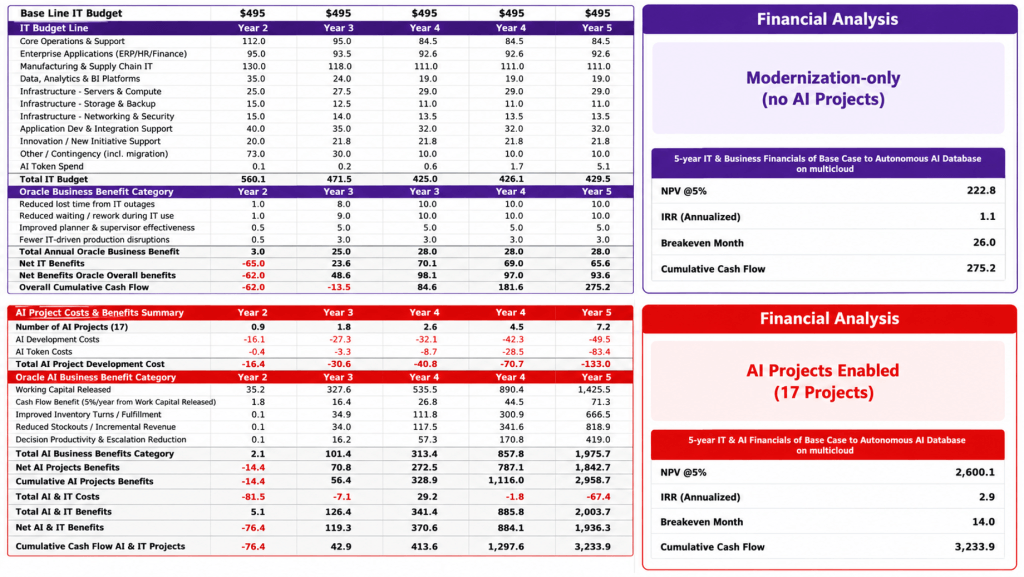
Table 6. Detailed Business Case Moving from Fragmented Data Estate to Oracle Autonomous AI Database on Multicloud