
This research note is based on four primary inputs: 1) An assessment of Snowflake’s announcements at this year’s Summit; 2) Information captured in private analyst and journalist sessions with Snowflake executives; 3) Interactions and queries with Snowflake Inquirer, a proprietary AI tool provided to journalists and analysts that contains announcement material and other current technical information; and 4) Analysis grounded in the AI maturity framework architected by our analyst George Gilbert.
Snowflake Summit 2026 is shaping up as the point at which Snowflake makes explicit what has been building for several years – i.e., the company is no longer content to be viewed as a cloud data warehouse, or even a data cloud. It is moving up the AI software stack toward the layer we have been calling the System of Intelligence – the enterprise context layer that organizes data, semantics, governance, business logic, actions, agent traces and institutional knowledge so humans and agents can ask better questions, get better answers and eventually take governed action.
Snowflake has built in many AI features. That’s not the issue. The question is whether Snowflake can become a trusted control point in the emerging AI stack before model makers, app vendors, hyperscalers and ontology players claim that territory.
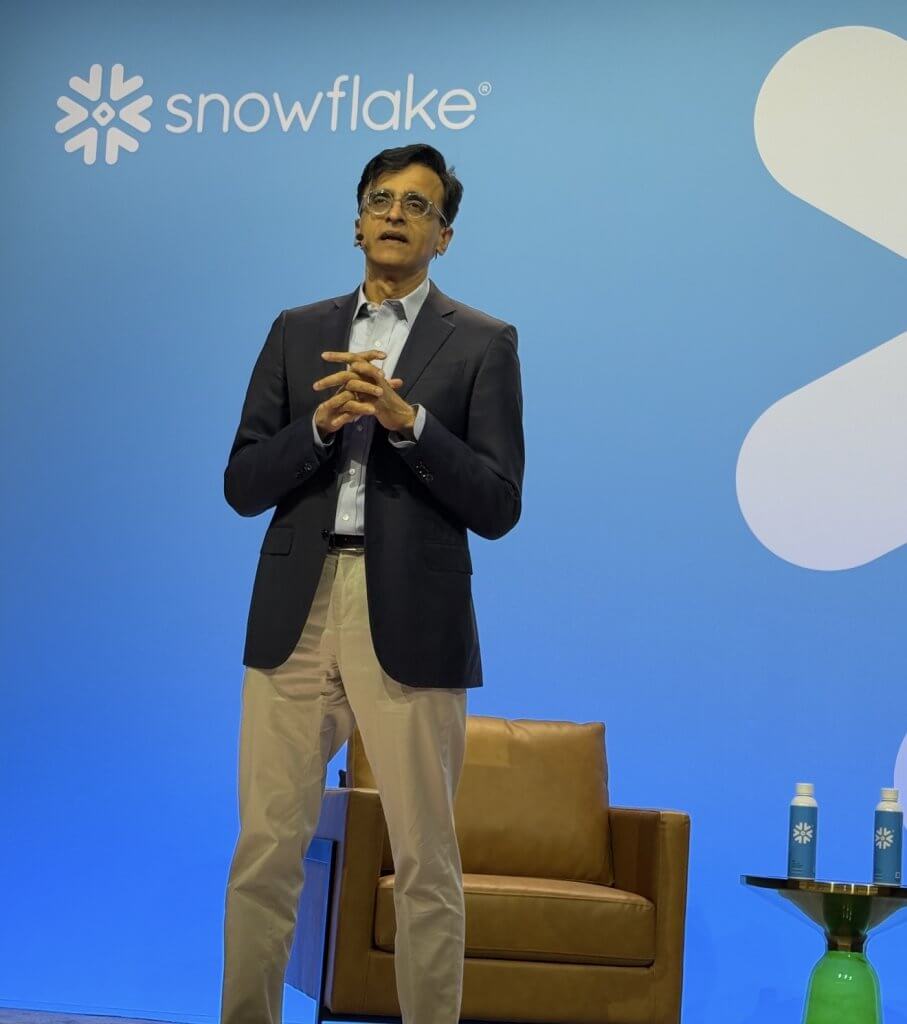
In the executive Q&A this week, Sridhar Ramaswamy gave what we think was the most honest answer of the day. The future stack is not fully knowable yet. Model providers come with frontier capability and no legacy burden. Application vendors come with deep process knowledge. Snowflake comes with data gravity, governance, context and a customer base that already trusts it with mission-critical data. History will be written later and people will say it was obvious – but right now, it is not. What matters, Sridhar emphasized, is product innovation and product-market fit. The products that people love, that make new work possible, will shape the history.
Translation: “We’ll keep innovating and trust that we’ll be able to figure it out.” We hear similar messages from visionary leaders like Marc Benioff, who is defending the viability of Salesforce. In fairness to Snowflake, its recent earnings print shows it can differentiate itself from the SaaS players, and the so-called SaaSpocolypse doesn’t actually apply to Snowflake in the same way as the market is framing Salesforce’s future.
Regardless, this sentiment underscores Snowflake’s opportunity. Snowflake is not yet what we call the full System of Intelligence – no one is. In fact, they’re not even marketing that concept, instead defaulting to the “Agentic Control Framework.” But Snowflake is now making a credible move from the data foundation into context, governance, agent control, developer tooling, observability and action. The hard part is determining how far up the stack Snowflake can go – and where it will remain a foundational layer feeding others.
Our framework: the System of Intelligence is the world agents live in
In last week’s Breaking Analysis, we argued that personal agents are lighting the fuse, but durable enterprise value will accrue to platforms that organize enterprise knowledge into a true System of Intelligence. The system of engagement becomes the new front end – where people interact with agents and get work done. The System of Intelligence becomes the back end – the layer that organizes data, rules, context, actions and business logic so information becomes human-readable, agent-readable and eventually executable.
This is the way we choose to evaluate Snowflake’s announcements. Not as a feature list. Not as “Snowflake adds AI.” The right question, in our view, is: Which parts of the System of Intelligence is Snowflake actually building, and where are the gaps?
Our framework, architected by Principal Analyst George Gilbert, breaks the SoI into five layers:
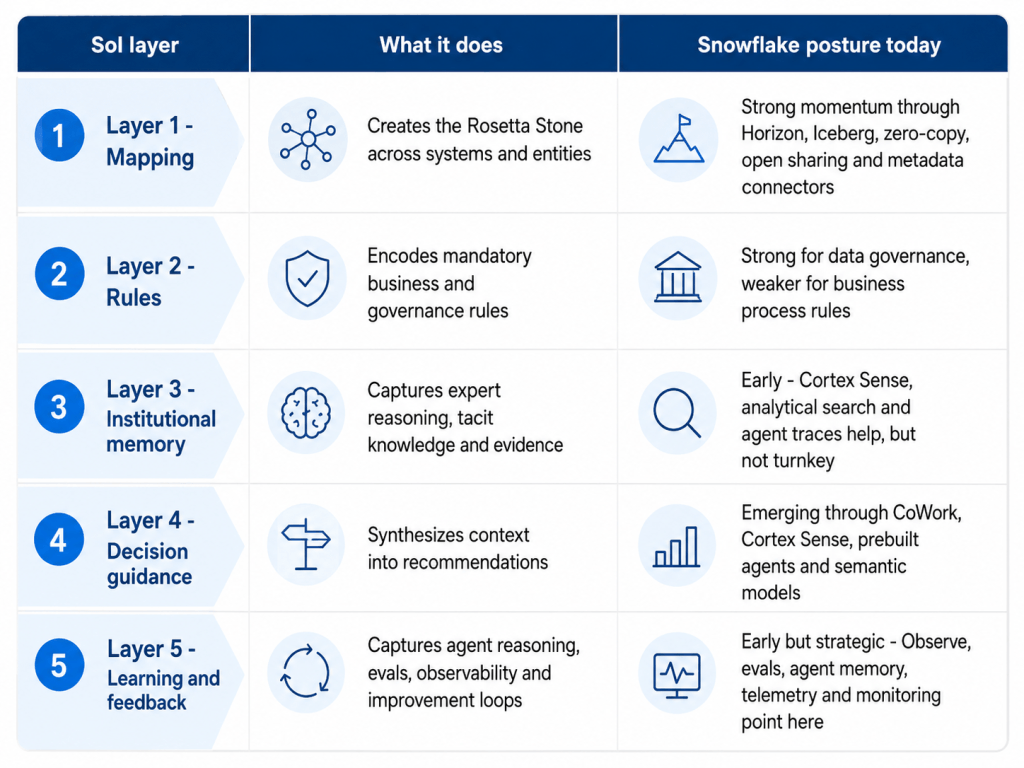
Our view is that Snowflake is strongest today in Layers 1 and parts of Layer 2, is moving aggressively into Layer 4, and is laying early groundwork for Layers 3 and 5. Snowflake has built a strong customer base that possesses clean, governed and secure data. The next piece we see as a logical ambition for Snowflake is to go after the depth of business process logic, institutional reasoning and cross-domain harmonization required to become a full enterprise digital twin.
The strategic shift from data platform to agentic control plane
Snowflake’s executive messaging is that the agentic enterprise requires four components: 1) Enterprise data and context; 2) AI models; 3) Enterprise applications; and 4) An agent control plane. Snowflake Intelligence and Cortex Code – renamed to CoWork and CoCo, respectively – are positioned as the building blocks of that agentic enterprise.
This is a significant shift. Snowflake is moving beyond data warehouses and the concept of a data cloud, signaling that the future is more than storing data, querying data or sharing data. It is about coordinating actions across data, models and applications. Here’s how that vision aligns with our emerging AI software stack:
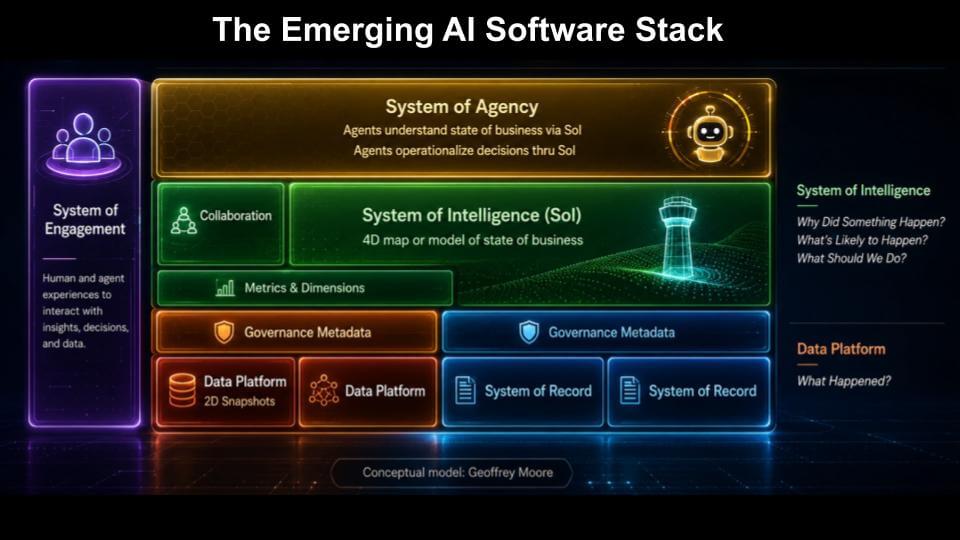
- System of engagement – Snowflake Intelligence / CoWork, CoCo, Slack, mobile and desktop experiences.
- System of agency – agents, skills, multi-agent orchestration, MCP connectivity and agent control.
- System of intelligence – Horizon, Cortex Sense, semantic models, business glossary, knowledge graph work, metadata and governance.
- Data foundation – Snowflake tables, Iceberg, open sharing, zero-copy integrations, Postgres, streaming, dynamic tables and migration tooling.
Notably, the language from Snowflake executives is now much closer to our framework than it was a year ago. They are talking about context, business semantics, model agnosticism, agent governance, agent identity, skills, memory, evals, observability and AI-driven data engineering. This goes way beyond separating compute from storage and simplifying the data warehouse. That is vocabulary more consistent with an AI software stack.
The question is whether Snowflake can assemble those pieces into a coherent platform before the market fragments into islands of intelligence.
Sridhar’s key point: it is unknowable today – products and innovation matter
We participated in a private executive session with media and analysts. The most important strategic back and forth came when Snowflake was asked to position itself against the frontier model vendors and the application vendors.
The answer was nuanced and, in our opinion, defensible.
Snowflake sees three centers of gravity:
- Model providers such as OpenAI and Anthropic – strong frontier models, no legacy and the ability to invent new interaction models.
- Application vendors such as SAP and Salesforce – deep process context and embedded workflows.
- Snowflake – data gravity, governance, context and the ability to bring data from many systems together.
Sridhar did not claim the answer was settled. He said this history will be written after the fact. Everyone will say the outcome was obvious. But today, it is unknown. He also said product innovation matters more than grand theses. Claude Code and CoCo are adopted because they are useful products, not because vendors want them adopted.
That is a defensible posture, in our opinion. The System of Intelligence will not be won by positioning alone. It will be won by products that make agentic work possible, trusted and economically viable. Snowflake’s thesis is that being close to governed data gives it an advantage. The frontier model vendors have the reasoning engines. The app vendors have workflow context. Snowflake’s bet is that enterprise context must be organized around data – and that agents will need that governed data context to act reliably.
We agree with the bet directionally. We do not think the outcome is predetermined.
Context is Snowflake’s core AI argument
Across the analyst sessions prior to the Summit Monday evening keynote, Snowflake’s strongest claim was that context determines agent quality. Baris Gultekin made the point that AI transformation depends on how deeply the AI understands the business. Without context, agents misunderstand metrics, burn tokens rediscovering schema, expose governance risk and produce low-quality answers.
The Q3 ACV example was a good illustration. A generic agent may answer that ACV was up, but the business definition requires excluding free-tier activity. Without that business definition, the agent is wrong. This is the kind of mistake that kills trust in enterprise AI.
Snowflake’s Cortex Sense is designed to address that problem. It builds a managed runtime over enterprise context by drawing from connectors, structured data, unstructured data, semantic views, business glossary work, skills, agent interactions and metadata. Snowflake shared benchmark-style figures suggesting hard structured-data questions were answered with roughly 24% accuracy by frontier coding agents alone, about 47% with a semantic model, about 73% with a heavily tuned internal semantic model and about 86% with Cortex Sense out of the box.
The point is not the precise number. What’s important is the closer the AI is to governed business context, the better and cheaper the answer becomes.
This is Snowflake’s core differentiation against generic model interfaces. A model can reason, but it has to reason over something. Snowflake wants to make that something the enterprise context layer it controls.
Horizon is becoming more than a catalog – but it is not yet a full SoI
Horizon Catalog sits at the center of Snowflake’s SoI strategy. Snowflake is expanding Horizon along three dimensions: interoperability, context and governance. The Prasana Krishnan analyst session emphasized that enterprise data and context are scattered, semantics are often embedded in opaque tribal knowledge and agents need governed context to operate safely. Horizon is Snowflake’s answer.
Key capabilities include:
- Open sharing for Iceberg tables, including tables managed by Snowflake or external catalogs.
- Fine-grained access controls enforced through Horizon even when external engines such as Spark query shared data.
- Horizon implementing Polaris APIs and extending governance beyond Snowflake-only compute.
- Select Star integration to pull metadata from tools such as Power BI, Tableau, Postgres and SQL Server.
- Horizon Context to build lineage, popularity, AI-generated descriptions and semantic views.
- Intent-driven governance that lets users express governance goals in natural language.
- AI governance to monitor agent quality, agent data access and sensitive data exposure.
We note this is serious product work and by no means diminish the work Snowflake engineers are doing. Horizon extends Snowflake’s core governance strength into a world where data may live in Iceberg, SAP, Salesforce, Workday, Postgres, Redshift, dashboards and external systems. It also makes Snowflake’s long-standing data sharing advantage more relevant in an AI world.
But we would make the following key point. Horizon is moving from catalog toward context, but it is not yet the full System of Intelligence. It helps define and govern data. It brings in metadata and lineage. It can support semantic views. It can activate context in CoWork, CoCo and agents. But it does not yet natively model end-to-end business process logic as live executable structure across the enterprise.
As well, there is a difference between a catalog and a System of Intelligence. A catalog defines nouns. A full SoI must eventually model verbs – actions, preconditions, effects, exceptions, decisions and workflows.
One added caution is the volume of data that agents will create is exploding. Just as Hadoop emerged to address the volume of big data and reduce its costs, the expense of managing exploding data volumes inside of Snowflake or within Horizon’s purview could eventually become a cost blocker for customers.
Cortex Sense is an important new SoI product
If Horizon is Snowflake’s governance and metadata substrate, Cortex Sense is the most important step toward a System of Intelligence. It is explicitly about context runtime. It attempts to infer and organize enterprise semantics so agents can answer business questions more accurately and at lower cost.
What makes Cortex Sense interesting is that Snowflake is not only collecting technical metadata. It is starting to move toward business semantics, skills, workflow context, agent interactions and knowledge graph-like representations. In the analyst session, Snowflake described business glossary and knowledge graph work, along with the ability for Cortex Sense to leverage explicit customer-provided ontology and implicit knowledge derived from data, connectors, skills and interactions.
That is the right direction, in our view, and it aligns with our belief that the SoI grows partly through specified knowledge and partly through learned knowledge.
But again, we should need to be precise. Cortex Sense appears strongest today around:
- understanding structured data;
- building and refining semantic models;
- reducing schema rediscovery and token waste;
- creating managed context for agents;
- improving the quality of structured and semi-structured business answers;
- supporting skills and agent interactions as part of context.
It is much weaker on:
- capturing deep process knowledge across apps like SAP, Salesforce, Workday and others;
- harmonizing business logic across domains;
- extracting expert reasoning traces;
- converting human judgment into reusable guidance;
- promoting observed patterns into governed process rules.
When pressed on where business logic lives, Snowflake pointed to business glossary, skills, agent interactions, connectors and evals as part of the learning and harmonization process. That is encouraging. But it is also an admission that this is early. The pieces are forming; the full digital twin is not here and won’t be for some time from any technology firm.
Snowflake’s AI stack maps well to the lower and middle SoI layers
We asked a Snowflake-provided LLM to map the company’s current capabilities against our five-layer SoI framework. The answer broadly matches our own assessment: Snowflake is strongest in connectivity, cataloging and context; it is advancing in guidance and agent experiences; it is weaker in native cross-system entity resolution, business process rules, human reasoning traces and formal expert feedback loops.
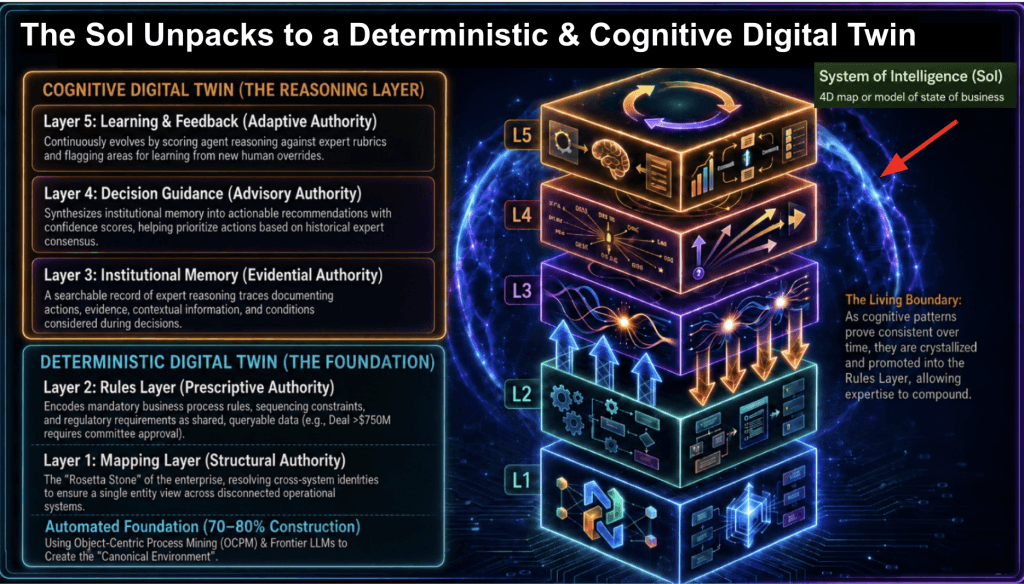
The following table lays our evaluation based on the analyst sessions, product notes and Snowflake’s own analysis out of its LLM:
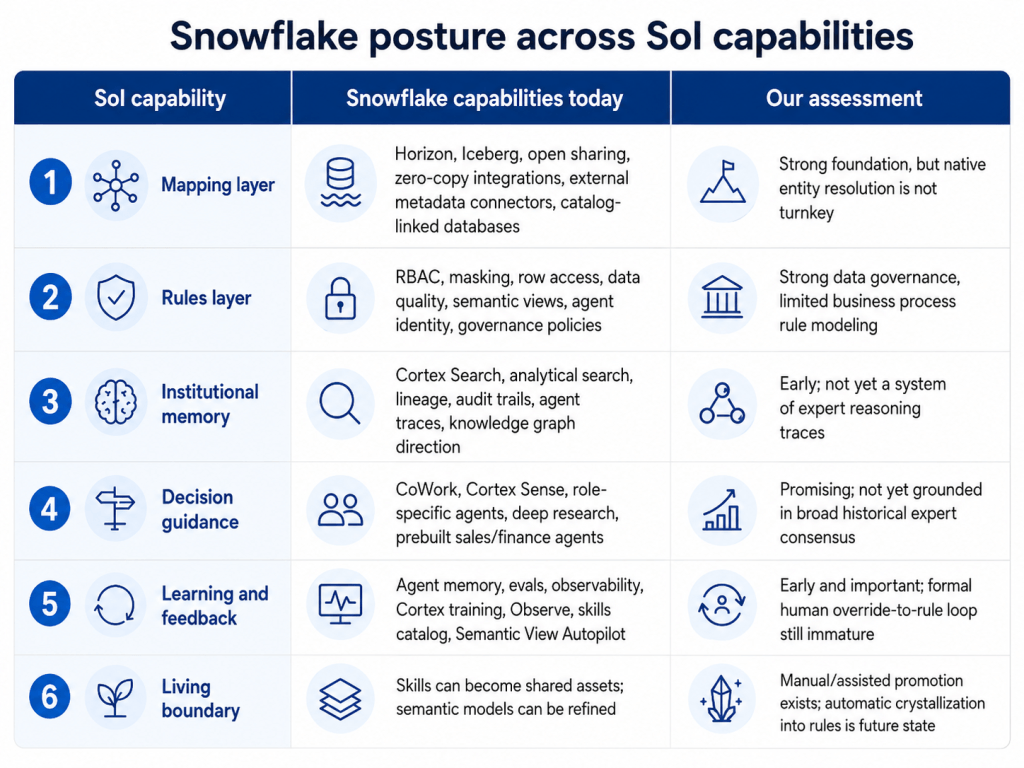
This is not a criticism so much as a maturity map. Snowflake is not claiming to be fully at full maturity. It is building credible products that move customers up from levels one through three and into parts of levels four through six. The question is whether it can keep moving upward without getting trapped as a governed data and context supplier to someone else’s agent platform.
Open table formats and zero-copy are now AI architecture, grounded in data
Snowflake’s Iceberg and interoperability announcements are more than just plumbing. In our SoI framework, they are foundational. If agents need enterprise context, and enterprise context lives across many systems, then Snowflake must make that data accessible, governable and usable without forcing all of it into a single proprietary format.
The data engineering analyst session emphasized several important points:
- Snowflake Storage for Apache Iceberg is now in GA;
- Snowflake is contributing heavily to Apache Iceberg and extending functionality, such as geospatial, lineage and other features;
- Horizon supports Iceberg and Polaris APIs so that governance can apply across engines;
- Snowflake can manage Iceberg tables in Snowflake storage or operate against Iceberg tables in customer storage;
- Zero-copy integrations with SAP, Salesforce, Workday and others allow data to be queried in analytical form without duplication.
The emerging AI stack cannot require a massive ETL rebuild before agents can work – that would be simply too slow and expensive. Snowflake is trying to become the governed plane through which data from SAP, Salesforce, Workday, Postgres, Redshift, BI tools, Iceberg tables and object storage becomes usable by agents. To do so will require customer affinity to its products and pull-through demand from its installed base, as a force to attract SaaS partners to play ball. Because Snowflake has a strong Layer 1 and Layer 2 posture in our framework, it makes the company a more credible place to build enterprise context.
But it also sets up the competition with application vendors. If Salesforce or SAP expose data into Snowflake but keep richer process context in their own data clouds, Snowflake may get access to the data without owning the process logic. That is valuable, but less so than owning the SoI.
Migration tooling is important because old systems contain the business knowledge
Snowflake AIM, the Datometry acquisition and SnowConvert expansion appear as tactical Teradata migration plays, but they are more strategic in our view. Snowflake is not just trying to migrate workloads off of legacy analytic systems. Rather, we see the company as trying to pull legacy application and analytic logic into a modern, AI-ready platform.
Snowflake’s Datometry-based virtualization layer lets customers redirect Teradata queries to Snowflake with minimal disruption. Snowflake’s AIM effort combines virtualization, deterministic code conversion, modernization and agent-assisted migration. The stated goal is to compress migrations from 18 weeks to roughly one week, using agents that work continuously, snapshot state, share progress with humans and automate assessment, planning, testing and validation.
This relates to the SoI because much of the enterprise ground truth is trapped in legacy systems. Old Teradata workloads, COBOL applications, stored procedures, BI reports and analytic logic contain business semantics and process assumptions. Moving those workloads is not just about cloud migration. It is part of extracting and modernizing the enterprise context that agents will need.
Snowflake’s approach recognizes that rewriting everything by hand will not scale. Agents can accelerate the migration and modernization path. But customers should be careful not to confuse code conversion with business model conversion. Converting old logic can also preserve old hairballs (e.g., COBOL becomes JOBOL). The opportunity is to use migration as a way to extract, rationalize and govern the business logic – not simply shift it into Snowflake’s domain.
CoCo: Snowflake’s agent for builders is an important system of engagement
Cortex Code has been renamed CoCo and is essentially Snowflake’s AI coding agent for data. Remember, the AI stack is not only for business users. Developers, data engineers, analysts and data scientists all need agents that understand Snowflake’s environment, governance, RBAC, schema, semantic context and runtime.
Snowflake described CoCo as a model-agnostic coding agent purpose-built for data work. It brings live schema into context, uses Snowflake-specific system prompts and rules, has more than 100 domain skills, understands RBAC and environment state, supports MCP, and can run against Snowflake, dbt, Airflow, AWS Glue, Postgres, Spark and other data contexts. Snowflake also said CoCo has more than 7,000 customers since launch.
That is meaningful adoption. More importantly, CoCo illustrates a critical part of our premise in that we see personal agents evolving first. Developers and data teams will use CoCo to solve immediate problems. Some of those solutions become repeatable. Once repeatable, they can become shared skills. Once shared, they need governance. Once governed, they start on the path to becoming enterprise logic.
This is how bottom-up personal productivity can turn into organizational intelligence – but only if the platform has the right roadmap. Snowflake’s skill catalog and governed skill-sharing are important in this regard. A personal skill is like a macro. A shared skill becomes an asset. A governed shared skill becomes part of the enterprise operating model.
That is the vision we see, anyway…
CoWork: Snowflake’s business-facing agent points toward the system of engagement
Snowflake Intelligence (formerly CoWork) is Snowflake’s front end for business users. It is positioned as a personal agent that knows the enterprise and personal context, can work through web, mobile and Slack, can schedule automations, generate artifacts, run deep research, interact with dashboards and connect to enterprise systems through MCP.
This is Snowflake trying to build the system of engagement. It is not just about talking to your data, although that’s how it’s marketed. Importantly, we see it as moving toward acting with your data, but within governance and context boundaries.
The product direction maps to our framework as follows:
- Personal agent – knows enterprise data and user context;
- Autonomous agent capabilities – scheduled runs, proactive checks, email/Slack/meeting summaries;
- Deep research – structured, unstructured and web;
- Artifacts – live charts, tables, dashboards and collaborative objects;
- Governance by default – RBAC, data policies and sensitive data protections.
The open question is whether CoWork becomes the primary enterprise work interface or an important data-centric agent within a broader ecosystem. Microsoft, Anthropic, OpenAI, Glean and others are all pursuing the engagement layer. Snowflake’s advantage is governed data and increasingly context. Its disadvantage is that users already live in email, office tools, Slack, Teams, browsers and app workflows. Snowflake’s answer is to bring CoWork capabilities to where users are, while also making Snowflake the high-quality governed context source.
Snowflake has the right perspective, in our view, but it’s up against a spate of other engagement platforms. Its advantage is, once again, the installed base of Snowflake users who will make CoWork their primary interface to the data.
Agent governance: Snowflake is strong on the data plane, early on intent
Snowflake’s governance story is one of its strongest assets, in our view. The company is extending governance from data to agents through agent identities, Trust Center, policy enforcement, sensitive data detection, data movement policies, backup/restore and peer review for sensitive operations.
Important capabilities explicitly cited in Snowflake material and its LLM include:
- Agent identity, so Snowflake can distinguish human sessions from agent sessions;
- Role-based access for agents;
- Masking and row access policies applied to agent access;
- Data movement policies to prevent improper unloading or exfiltration;
- Trust Center scanning for risky agent behavior;
- Agent visibility and security events;
- Potential future policy constructs, including more circuit breaker-style controls.
This is a rich set of capabilities and differentiated. But the analyst questions exposed the next layer of governance complexity. Data-level governance is necessary, but agents require intent and action governance. It is not enough to know who can see which column. The platform must know what an agent is trying to do, whether that action is permitted, what tools it can invoke, what downstream effect it may have and whether a human approval is required.
Snowflake is moving in this direction, but it is early. The strongest controls today are resource-based and identity-based. The future SoI needs policy tied to intent, action space and business state. That is a higher bar and will take time to evolve.
Observability becomes the new write-ahead log
In our framework, the learning and feedback layer is one of the most strategic areas of the AI stack. Agent traces become the new source of truth. In traditional databases, the write-ahead log was the real record of what happened. In agentic systems, the new log is the observability substrate that records what the agent knew, what it reasoned, what tools it called, what came back, what action it took, what state the business was in and why the decision was made.
Snowflake clearly understands this direction. The Observe acquisition, Cortex evals, agent monitoring, Cortex Sense, agent memory and telemetry discussions all point toward this Layer 5 substrate. But the cost and architecture implications are still unresolved.
In the analyst sessions, George Gilbert raised the point that agent observability data could be orders of magnitude larger than cloud-native observability. A cloud trace may be small. An agent trace could include prompts, documents, intermediate reasoning, tool calls, results, subagent messages, state and evaluation artifacts. That data becomes the training, evaluation, release and runtime monitoring substrate for agents. The comparison is when big data became a thing, while the work could be done in Oracle (for example), the world needed a lower-cost architecture – in that case, Hadoop – to handle the extreme volumes of data. A similar architectural rethink may be required here.
Snowflake’s answer to this push was partly cost governance, partly open telemetry, partly Cortex Sense and partly the consumption model. That is directionally reasonable, but it does not fully answer the economic question. If agentic workloads create 10x, 100x or 1,000x more deterministic compute against observability and context data, customers will need new cost controls, new value measurement, new pricing models and possibly a new architecture.
The likely answer is that AI adds so much value that the incremental cost will pay off. Enterprises will spend more on technology because they scale with less labor. That has to show up in the P&L. Snowflake’s challenge is to prove the value side of that equation, not just govern the cost side.
Snowflake’s biggest gap today: business process logic
The deepest gap in Snowflake’s SoI story remains business process logic. Snowflake is increasingly strong at metadata, semantics, data access, governance, analytical context and agent experiences. But a full System of Intelligence requires modeling how the business actually runs.
That means representing:
- business rules;
- process sequencing;
- action preconditions and effects;
- exceptions;
- approvals;
- operational constraints;
- institutional reasoning;
- business state;
- agent action traces;
- learning loops.
Snowflake executives described a spectrum of context as follows: semantics, skills, workflows, business glossary, knowledge graph, connectors, business processes and ontologies. They also acknowledged this is early.
This is precisely the issue. Snowflake can become the place where context is organized, but business process context often lives in SAP, Salesforce, Workday, ServiceNow, Oracle, industry apps and custom workflows. Those vendors will not willingly become passive feeds. They will try to own their own systems of intelligence around their domains.
That creates the islands of intelligence problem we described in last week’s Breaking Analysis. Snowflake can build a powerful horizontal data intelligence layer, but the customer will still have Salesforce intelligence, SAP intelligence, Microsoft intelligence, Glean intelligence and frontier model memory. The hard question is how these context layers connect.
Snowflake has strong answers for connecting data. It has weaker answers for connecting intelligence. They’re not alone…no one vendor has solved this problem, and it remains one of the most valuable opportunities in software.
The “no AI strategy without a data strategy” line is true – but incomplete
Snowflake’s line that “there is no AI strategy without a data strategy” is defensible. But the analyst discussions made clear that the more complete statement is:
There is no enterprise AI strategy without a data strategy, a context strategy, a governance strategy, an agent control strategy and a process intelligence strategy.
Snowflake is strongest in the first three. It is building the fourth. It is early on the fifth.
This is why Snowflake’s move is credible, but incomplete. It has, in its favor, quite a number of advantages: data gravity, governance trust, open table strategy, multi-cloud reach, data sharing, Iceberg interoperability, Cortex AI, model agnosticism and fast-growing agent products. Those are impressive.
But owning the enterprise operating context is a different problem. It requires modeling the business itself.
What this means for Snowflake
Snowflake’s opportunity, in our view, is to move from being the governed home of enterprise data to becoming the governed context layer for enterprise agents. If it succeeds, Snowflake becomes much more strategic than a data platform. It becomes one of the control points in the agentic enterprise.
The path looks like this:
- Own governed access to enterprise data – Snowflake is strong here;
- Own enterprise context and semantics – Horizon and Cortex Sense are moving here;
- Own agent experiences for data work – CoCo and CoWork are moving here;
- Own the learning loop for agents – Observe, evals, telemetry and memory point here;
- Own process-aware enterprise intelligence – this is the stretch goal and still early.
The danger is that Snowflake becomes a powerful governed data/context supplier while another platform owns the engagement layer, the agent memory, the workflow logic and the customer-visible outcome. In that world, Snowflake monetizes compute and storage, but pricing power migrates upward.
The bull case is that Snowflake’s governed data context becomes so important that every serious enterprise agent needs it. In that world, Snowflake can sit under many engagement layers and still capture enormous value because the quality, accuracy and governance of enterprise AI depend on its context runtime.
The bear case is that application vendors and model makers successfully bundle enough context, memory and workflow to push Snowflake back into the data utility role.
Sridhar’s point to analysts and journalists is fair: No one knows yet. The products will decide, meaning his focus is on innovating, moving fast as the market moves, investing in R&D and winning with product/market fit.
What to watch
The most important Snowflake signals over the next 12-24 months are the following:
| Watch item | Why it matters |
| Cortex Sense adoption and accuracy | Tests whether Snowflake can own context, not just data |
| CoWork usage beyond analysts | Tests whether Snowflake can become a true system of engagement |
| CoCo skills shared and governed | Tests the bottom-up-to-top-down skill promotion model |
| Horizon adoption outside Snowflake-native data | Tests whether Snowflake can govern heterogeneous data estates |
| Business glossary/knowledge graph depth | Tests movement from semantics to process logic |
| Agent observability and evals | Tests whether Snowflake can own the learning substrate |
| Partnerships with SAP, Salesforce, Workday and Microsoft | Tests whether islands of intelligence can connect |
| Cost transparency for agentic workloads | Tests whether customers can scale without budget shock |
| Forward-deployed AI outcomes | Tests whether Snowflake can turn platform into business transformation |
Bottom line
Snowflake is making serious and coherent moves up the AI stack, balancing its own organic innovation with ecosystem opportunities. It is no longer only defending the data platform. It is building toward an agentic enterprise platform, with Horizon as the governance and catalog foundation, Cortex Sense as the context runtime, CoWork as the business-facing system of engagement, CoCo as the builder-facing agent and Observe/evals/telemetry as the beginning of the learning layer.
But Snowflake is not yet a full System of Intelligence. It has strong pieces of the foundation and credible early moves into context and agent action. It is still early in cross-system entity resolution, business process logic, institutional memory, expert reasoning traces, intent-based governance and automatic learning loops.
Our view is that Snowflake’s strategic direction is very solid. The company understands that the AI battle is moving from who stores the data to who organizes the enterprise context agents need to reason and act. The company’s challenge is that everyone else sees the same prize. Application vendors want to own process intelligence. Model makers want to own the agent harness and memory. Hyperscalers want to own the platform substrate. Ontology players want to own the business model.
Snowflake’s advantage is governed data gravity. Its next test is whether it can turn that gravity into enterprise intelligence – before the stack around it hardens.
Action item
Chief Data & AI Officers must make System of Intelligence an enterprise architecture mandate, not a Snowflake feature adoption plan. Data execs should use Snowflake’s Summit announcements as a forcing function to map the emerging AI stack across their own enterprise: where data lives, where context is defined, where governance is enforced, where agents act, where agent traces are captured and where business process logic is encoded. Snowflake is making credible moves with Horizon, Cortex Sense, CoWork, CoCo and Observe, but it is not yet a full System of Intelligence. The job is to determine what Snowflake should own, what SAP, Salesforce, Microsoft, model providers and other platforms will own, and how those layers connect without creating another generation of intelligence silos.
The requirement is to move beyond the notion of “no AI strategy without a data strategy” and build a data + context + governance + agent control + process intelligence strategy. Start by selecting the highest-value business processes and force every useful agent, skill, semantic model and workflow into a governed path using common identity, shared ontology, business glossary, lineage, agent identity, evals, observability, cost controls and auditability. The trap is letting personal agents, app vendors or model makers define separate systems of intelligence before the enterprise architecture is set. If Chief Data & AI Officers don’t own the operating context, someone else will – and the enterprise will be left with more automation, more spend and more silos moving at machine speed.