Behind the Scenes of One of Golf’s Most Demanding Technology Environments
When fans think about the U.S. Open, they think about championship golf, iconic courses, and dramatic moments on the leaderboard. What most people never see is the sophisticated technology infrastructure operating behind the scenes to support the event.
During a recent tour of the 126th U.S. Open technology operations at Shinnecock Hills, one thing became abundantly clear: the United States Golf Association (USGA) is not simply running a golf tournament. For one week each year, it effectively builds and operates a temporary digital enterprise capable of supporting tens of thousands of fans, thousands of media members and content creators, operational staff, security personnel, retail systems, hospitality venues, and increasingly, AI-powered services. Cisco has been supporting the US Open since 2018.

What makes this challenge unique is that the infrastructure is not deployed in a permanent stadium or arena. It is built on a golf course, exposed to weather, changing terrain, heavy equipment, lawn mowers, and constantly shifting usage patterns. Yet despite those challenges, the network must perform as reliably as any modern enterprise environment.
Zeus Kerravala and I had the opportunity to meet with Anthony Santora, Managing Director, IT, USGA; Christian Rodriguez, Senior Manager, IT Operations, USGA; and Rob Neumann, Head of Sponsorship Technology, Cisco, to learn firsthand about the infrastructure that powers a US Open tournament.
The result is a compelling example of how networking, observability, security, and AI are converging to create better experiences and more resilient operations.
Building a Digital Enterprise from Scratch
Unlike a stadium, where infrastructure remains in place year-round, the U.S. Open requires a fresh deployment each year. Fiber paths change. Hospitality structures move. Media compounds are relocated. ISP connectivity differs by venue. Even the physical layout of the championship changes from course to course. As Christian Rodriguez, who helps oversee technology operations for the USGA, explained, “No championship is the same, no configurations are the same, no ISP coming in is the same.”
To support this environment, the USGA maintains an inventory of Cisco networking and other equipment that is transported, staged, deployed, tested, and ultimately dismantled after each event. The infrastructure includes dual network cores, multiple internet providers, redundant fiber paths, access-layer switching, wireless infrastructure, surveillance systems, IPTV services, credentialing systems, and operational applications.
The complexity resembles setting up a temporary enterprise campus (well, that is, if your campus spans hundreds of acres and must be fully operational when the first fans arrive — which is typically in a week or two).
Wi-Fi 7 Changes the Media Experience
One of the most visible technology improvements at this year’s championship was the deployment of Wi-Fi 7. Historically, media centers at these major sporting events often generated complaints about wireless performance. Journalists, photographers, and videographers routinely require large amounts of bandwidth to upload photos, videos, and stories in real time.
That dynamic changed significantly following USGA’s deployment of Cisco Wi-Fi 7 infrastructure. Anthony Santora, Managing Director of IT at the USGA, described the reaction from their media users: “This is the first time ever we got called into the media center for a positive reason.” Rodriguez was equally enthusiastic about the technology’s impact. “I seriously think the Wi-Fi 7 technology is definitely a game-changer this year.”

The importance extends beyond speed tests. Today’s media environment is increasingly driven by real-time content creation. Reporters are publishing directly from the course. Photographers are uploading high-resolution images within minutes. Influencers and creators are producing video content throughout the event. According to Cisco’s Rob Neumann, “There are more people now uploading content than there are downloading content at these golf events.” This includes the fan base and the media.
That observation reflects a broader shift occurring across sports venues, conferences, and live events. Networks that were once optimized primarily for content consumption must now support thousands of simultaneous content creators.
Supporting the Fan Experience
While media connectivity is important, fan experience remains equally critical. According to the team, approximately 40,000 fans attend the championship each day, many of whom rely on mobile applications for ticketing, navigation, scoring updates, and event information. As Neumann noted, “A majority of them have smart devices with them, and they need to have that constant connectivity.”
The challenge becomes even more difficult because fans are constantly moving. The technology team refers to this as the “Tiger Effect”: large crowds following popular players, creating temporary concentrations of thousands of users around a single hole. These high-density environments can shift rapidly as groups move around the course.
Maintaining connectivity under those conditions requires careful planning, high-density wireless design, and continuous monitoring throughout the tournament.
Beyond connectivity, the network supports digital ticketing, wayfinding, mobile applications, hospitality services, leaderboards, security, and nearly 500 televisions distributed throughout the venue. Together, these services create the seamless digital experience that fans increasingly expect.
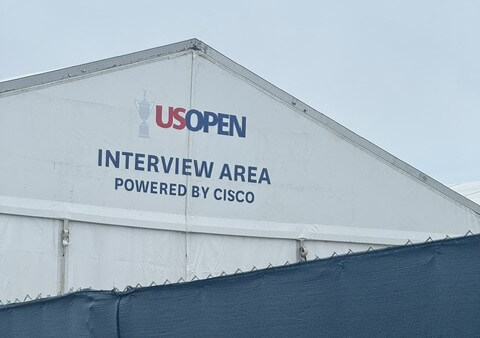
It was also interesting to see how Cisco Webex extends the reach of the U.S. Open for fans beyond the course by enabling virtual media interviews and remote engagement among players, fans, and media organizations worldwide. Originally expanded during the pandemic, the platform continues to support media operations today, allowing players to connect easily with local and international outlets regardless of location.
Digital Resilience in a Temporary Environment
Perhaps the most impressive aspect of the deployment is its focus on resiliency. Golf courses are not ideal technology environments. Infrastructure must contend with rain, wind, heat, foot traffic, maintenance equipment, and wildlife.
Yet business-critical services cannot fail. Retail transactions must continue processing. Credentialing systems must remain operational. Security systems must stay online. Fans must retain access to information and services. As Santora explained: “For us, redundancy and resiliency is absolutely key to what we do.”
The architecture reflects that philosophy. The USGA operates dual network cores, redundant fiber paths, multiple ISP connections, generator backup systems, battery backup systems, and comprehensive failover capabilities.
Rodriguez summarized the approach: “Everything from ISP redundancy, internet failover, network redundancy… we try to make it as fault-tolerant and redundant as possible.”
The network team routinely conducts failover testing to validate that critical services continue operating if a link, switch, or core component becomes unavailable. In many ways, the U.S. Open exemplifies digital resilience in action, a concept that has become increasingly important as organizations depend on technology for nearly every business process.
Turning Infrastructure into Operational Intelligence
The network also serves as a rich source of operational data. More than 100 Meraki or other cameras deployed across the venue provide visibility into crowd movement, transportation hubs, concession areas, hospitality spaces, and operational workflows. Operations and security teams use this information to identify congestion points, monitor traffic flow, improve transportation logistics, and make real-time decisions that enhance the overall fan experience.
This year, the USGA also expanded its use of observability tools, including Splunk, to gain broader visibility across the environment. The ability to correlate telemetry from network infrastructure, applications, and operational systems provides a more comprehensive view of overall event performance.
The broader lesson is that modern infrastructure is no longer simply a delivery mechanism. It is increasingly becoming a source of business intelligence.
AI Begins to Impact the Game
The USGA is also beginning to apply artificial intelligence in practical ways. One example Santora highlighted is Rules AI, a soon-to-be-released intelligent assistant designed to help golfers quickly obtain accurate answers to rules questions. The system leverages curated USGA data, historical question-and-answer pairs, multiple AI agents, and extensive governance controls to ensure reliable responses.
Importantly, the project reflects a pragmatic approach to enterprise AI adoption. Rather than pursuing AI for its own sake, the organization focused on a specific challenge: scaling access to rules expertise. As Santora explained: “It’s not about saving money, it’s not about replacing people. It’s about scale.” Cisco AI Defense is also being used to help secure the application and provide additional governance controls around the AI environment.
The initiative demonstrates how organizations are beginning to move beyond AI experimentation and toward operational deployments designed to solve real business problems.
Why It Matters
The technology infrastructure behind the U.S. Open offers a glimpse into the future of enterprise operations. While it may appear to be a temporary sporting event, the championship is a highly sophisticated digital environment that must simultaneously support fans, media, security, commerce, and operational teams within a challenging outdoor venue built, operated, and dismantled in a matter of weeks.
What makes the U.S. Open particularly interesting is how it brings together several of the most important trends shaping enterprise technology today. High-performance wireless connectivity has become essential for delivering modern digital experiences. Resilient architectures are required to ensure business continuity in environments where downtime is simply not an option. Observability and analytics are providing the operational intelligence needed to make real-time decisions. And AI is beginning to move beyond experimentation into focused applications that improve both user experiences and operational efficiency.
The evolution of Cisco’s partnership with the USGA since 2018 reflects this broader industry shift. What began as a networking deployment has expanded into a strategic technology platform encompassing networking, collaboration, security, observability, and AI. Together, these capabilities enable the USGA to deliver a world-class experience for fans, media, players, and event staff while operating one of the most complex temporary technology environments in sports.
For enterprise leaders, the lesson is clear: the greatest value no longer comes from individual technologies operating in isolation. It comes from integrating networking, security, observability, collaboration, and AI into a cohesive platform that delivers measurable business outcomes.
Many thanks to the Cisco team for the invitation and for hosting Zeus Kerravala and me during the event. Special thanks as well to the USGA technology team for providing a behind-the-scenes look at the infrastructure and operations that help make the U.S. Open possible.