Executive Summary
Agentic AI represents a fundamental structural shift in how artificial intelligence (AI) interacts with mission-critical and enterprise systems. Generative AI (GenAI) combined with large language models (LLMs) primarily provide recommendations or insights through chatbots. They’re systems that respond to prompts. In contrast, Agentic AI can reason, plan, decide, and execute actions independently without human interaction or intervention.
When Agentic AI is utilized with databases – the systems of record and trusted source of truth for enterprises’ critical business operations – that autonomy introduces problematic complexity and, more importantly, risk. While many vendors are introducing Agentic AI solutions, they are predominantly relying on architectures in which AI agents reside outside those mission-critical database platforms. These architectures by design require extensive complicated integration, pipelines, data movement, orchestration, and most importantly convoluted security that increases risk. It’s a primary reason why 75% of enterprise companies plan on investing in Agentic AI – per Deloitte’s “2026 State of AI in the Enterprise” – but only 11% have them running in production.
This research examines key Agentic AI challenges and perils with a particular focus on its interaction with databases. It outlines systemic risks, technical failure modes, and operational concerns. It then examines how Oracle AI Database’s built-in Agentic AI capabilities address those challenges and extensively mitigates Agentic AI risk.
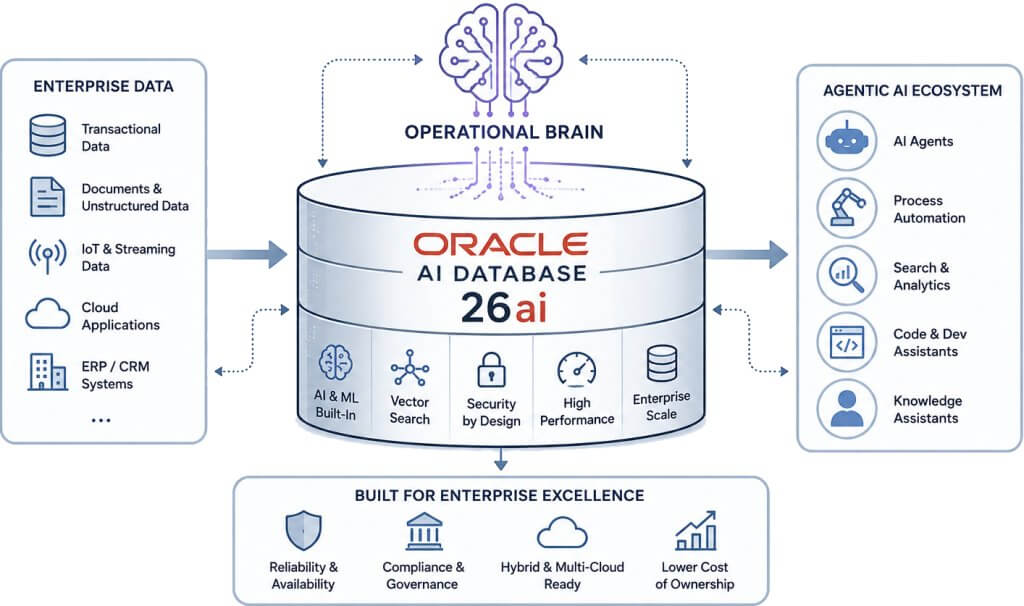
To accomplish this, Oracle is taking a fundamentally unique approach to Agentic AI. Oracle’s strategy positions the database as the operational brain of agentic systems, rather than merely a data source. By combining in‑database AI, transactional awareness, and full‑stack integration, Oracle reduces architectural complexity while enabling autonomous execution securely at enterprise scale.
Key Findings
- Agentic AI adoption is constrained more by architecture and risk than by models. Security, data movement, orchestration overhead, and governance gaps—not model capability—are the significant barriers to enterprise deployment.
- Agentic AI introduces execution risk, not just reasoning risk. Database interaction is the highest-risk integration point with autonomy and persistence amplifying the consequences.
- Oracle AI Database with built-in Agentic AI reduces latency, complexity, and risk. Native agents eliminate the need for data replication, external AI caches, trips to multiple data stores, and external AI control planes.
- Oracle’s full‑stack integration materially differentiates Oracle’s approach with its engineering control over infrastructure, database, and applications. This exclusive approach enables tighter coupling between AI execution and business processes.
- An essential aspect of Oracle’s approach is transactional awareness—a critical but underappreciated requirement. Most Agentic AI frameworks lack real‑time transactional context and agentic memory, limiting their applicability to core business and mission-critical operations. Oracle’s database‑centric approach addresses these barriers directly.
- Enterprises are more likely to trust Agentic AI architectures that inherit existing access controls than ones that require completely new controls and frameworks that are untested or lack the security they require. Oracle AI Database’s Agentic AI capabilities leverage established database-level security, auditing, and compliance, massively reducing organizational risk and adoption friction.
- Agentic AI adoption for enterprises and large organizations is primarily constrained not by model quality, but by data gravity, governance, and risk exposure. This is particularly true for those operating in regulated industries.
- Oracle’s strategy positions the database as the operational brain of agentic systems, rather than merely a data source. By combining in‑database AI, transactional awareness, agentic memory, and full‑stack integration, Oracle reduces architectural complexity while enabling autonomous execution at enterprise- scale.
- Oracle did not simply add AI agents to its enterprise software. It re‑architected Oracle AI Database, enabling autonomous agents to operate where data and its production-proven security, controls, and business logic already exist. For enterprises seeking to move beyond AI experimentation toward trusted automation, this approach represents one of the most integrated options currently available.
Methodology
Comparative analysis of common Agentic AI architectures and Oracle AI Database and how they meet enterprise requirements related to security, governance, and operational risk. This analysis focuses on the design aspects rather than marketing claims or model performance benchmarks at this time.
Key Agentic AI Issues
Security and Privacy risks
There are several security and privacy risks associated with Agentic AI. Security and cyber exposure such as prompt injection attacks that manipulate agent behavior; unauthorized data access through over-permissioned roles; autonomous execution of malicious or unintended actions; and reduced visibility into API-driven activity.
Arguably, there are security and privacy risks in GenAI and LLMs. However, Agentic AI amplifies that risk through its scalable independent actions. And these are not the only risks associated with Agentic AI.
Agents can also be unpredictable and non-deterministic because they are inherently probabilistic. Identical inputs may yield different outputs. Multi-step workflows can diverge over time. These differences compound across execution chains. This is problematic when consistency and repeatability area necessity. The problems associated with divergence are more likely to occur when there are different sources of conflicting potential truth such as when there are multiple database models.
There are several additional agent risks when it comes to databases. Consider that agents frequently require broad permissions to function effectively. This can lead to unauthorized data access, data modifications, data exfiltration – that may violate privacy laws/regulations, and exploitation via prompt injection.
Agents can also infer schema semantics rather than actually understand them. Nuanced semantics understood by humans are nearly impossible for highly literal agents to fathom. The risk of agents acting incorrectly based on ambiguous naming conventions, complex relational models, and schema evolution is real, and can potentially lead to disastrous actions and results.
Another AI agent risk comes from the lack of transparency where agent decision-making is too often opaque with limited or no explanations for the actions taken. Audit trails, particularly those that trace agents back to the end-users they are working on behalf of, are frequently limited or non-existent.
Agentic AI can also greatly increase the risk of sensitive data exposure, a major liability today with laws and regulations like the EU’s GDPR. These agents can generate arbitrary SQL and can bypass application-level controls, access limitations, and even firewalls. This enables them to access and even modify information for which they do not have permission.
All of these agent risks are amplified by system complexity. Multi-system, multi-agent interactions inflate attack vectors, expand the potential for security breakdowns, and increase the probabilities of a bad outcome.
Oracle AI Database is specifically architected to radically reduce complexity while mitigating and even eliminating many Agentic AI risks. A deeper look shows how.
Cost of Data Movement in the Vast Majority of Agentic AI Architectures
Most Agentic AI architectures require data to be copied from the databases where they reside into vector databases. Then streamed into AI services and synchronized across multiple platforms. These common steps expand security exposure while increasing latency, leading to performance degradation. They also have higher operational costs—a lot higher.
As highlighted in Chart 1, Oracle’s in‑database Agentic AI execution model eliminates these dependencies by keeping data and AI logic within a single, governed environment.
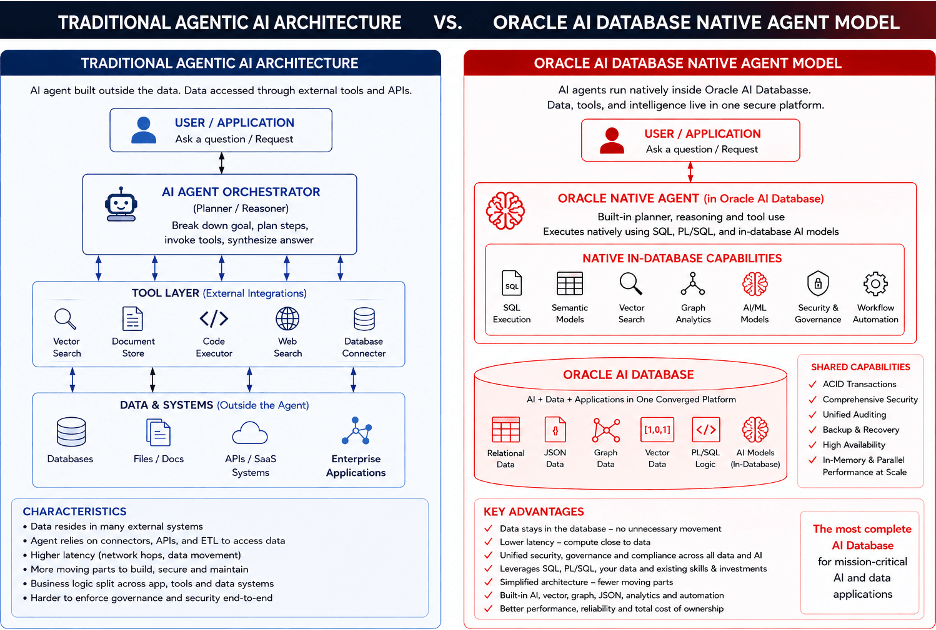
Chart 1: Comparison of Traditional Agentic AI vs. Agentic AI in Oracle AI Database.
The Memory Issue
Agent memory is foundational to enterprise-class Agentic AI. Agents need to improve, learn, and adapt over time by memorizing preferences, plans, facts, previous actions and their results as well as “other” contextual information on an ongoing basis.
Current agentic memory solutions are highly fragmented and lack consistent transactions, reliability, and security as agents must traverse across multiple sources and types of data. Sources that include vector store databases, document databases, graph databases, and external services such as Iceberg OpenTable data lakes.
The memory issue additionally increases the previously noted risks. Each of those sources vary in severity, permissions, reliability, and scalability. There is no consistency across those multiple data sources.
Oracle mitigates this issue in a unified agent memory management layer. A unified memory management layer starts with a single trusted source for all the data in Oracle AI Database. Having that unification provides well-integrated capabilities for ingestion, extraction, generalization, evolution, along with the data.
Oracle Agentic AI
Oracle embeds agentic AI directly into the database engine rather than deploying it as a peripheral service. This design allows agents to operate with immediate access to live transactional data, a capability that external AI services typically lack. Oracle’s Agentic AI capabilities are specifically designed to minimize risk and accelerate innovation.
Minimizes AI Data Risk
It starts with Oracle AI Database. Minimizing risk requires designing trust into the core architecture. Oracle believes that the core architecture must include Deep Data Security, Trusted Answer Search, Trusted Data APIs, trusted low code/no code (AI APEX) application generation, and trusted AI APEX interactive reporting. This is what Oracle has achieved with Oracle AI Database.
Core in-database capabilities include:
- Converged database models – OLTP, OLAP, JSON, time series, spatial, graphic, key value, block-chain, and vector
- AI vector search
- Retrieval‑Augmented Generation (RAG)
- Natural language to SQL (NL2SQL)
- Document and unstructured data processing
- JSON duality – data represented as both JSON and relational concurrently
- AI Machine‑learning
- AI reasoning agents
It’s the ability to create those agents within the Oracle AI Database 26ai that achieves the deep data security that enterprises demand. The production-hardened, effective, and proven Oracle AI Database’s security guard rails enable Oracle to move data privacy enforcement from the application layer to the database source. Embedding the agents directly in the Oracle AI Database 26ai engine rather than deploying them in separate services significantly decreases Agentic AI risk.
An essential way Oracle strengthens its Agentic AI risk reduction strategy is through control of the entire enterprise stack. From the multi-cloud cloud infrastructure – running in OCI, Azure, AWS, Google Cloud, and in Dedicated Regions; the aforementioned unique converged database platform; the unprecedented performance and security of Exadata; Oracle Autonomous AI Database; the wide breadth of enterprise applications; and comprehensive AI services.
The huge advantage of owning the full enterprise stack is that it enables the Oracle AI Database to function as both the data store and the AI control plane, effectively dropping reliance on middleware and external orchestration engines. By contrast, Oracle’s competitors require extensive integration across loosely coupled services. The consequences of competitor’s offerings are holes in their security with increasing system fragility across pipelines as those systems scale.
Oracle’s approach to Agentic AI is fundamentally designed to address AI-era threats while providing availability and extreme scalability for demanding agentic workloads. The following outlines how Oracle accomplished this.
Oracle Generative Development for Enterprise
Oracle Generative Development for Enterprise or GenDev, specifically designs “trust” into the core of the architecture. It does this by providing Deep Data Security, Trusted Answer Search, Trusted Data APIs, and AI APEX Interactive Reports to help address data-level and app-level risks in AI application development.
Deep Data Security
As previously discussed, Agentic AI data privacy is typically managed at the application layer. Databases are mostly utilized for coarse granular control. This is a siloed approach. Every application has its own data privacy controls. Every single one of the organizations’ applications have to be trusted to do the right thing. Privileged accounts introduce high risk because there is limited visibility into who can do what or what they did.
Oracle secures the data at the Oracle AI Database source. It does this by providing secure user identity propagation, database-enforced row/column/cell access, and policy as SQL. As a result, agents can only access the data that the end-user creating the prompt can.
Trusted Answer Search
Oracle Trusted Answer Search is a new feature of Oracle AI Database. It matches end-user natural language questions to previously created, known accurate reports. It uses AI Vector Search rather than an LLM to find the best matching report based on report descriptions. LLMs are not used directly to answer the question. But can be used to build the reports, and to guide the content shown in a report. This helps mitigate the risk that probabilistic LLMs may occasionally hallucinate or misunderstand a query.
End user access to the Search Space is governed by access control defined by the Search Admin who manages and secures the trusted search by:
- Creating search spaces and search targets with sample queries and value sets while managing users.
- Performing regression analysis by running past search questions and past questions.
- Testing queries for accuracy during the development phase.
- Reviewing query history for accuracy and confirming user upvotes and downvotes.
- Configuring settings such as k in top-k results.
Trusted Data APIs
In order to prevent AI from accessing data that it does not have the right to access, it’s essential that agents only use trusted data APIs. Oracle Agentic AI agents use trusted APIs to help eliminate attacks or accidents that do end-runs around existing security limit. Limiting end-users and AI Agents to the use of trusted APIs to search memory, retrieve context, configure policies, and update data provides another level of control on top of Oracle Deep Data Security’s secure-at-source capabilities.
AI APEX Interactive Reports
Provides trusted answers within a report. Users ask questions in natural language which is then converted to SQL by an LLM and used to ask questions of pre-defined reports. The LLM translates questions into clear, editable filters and aggregations. This prevents generation of opaque and arbitrary LLM-generated SQL. Millions of APEX interactive reports are easily AI-enabled by just upgrading to AI APEX.
Oracle’s Highly Valuable Unified Agent Memory Layer
As a highly converged database engine Oracle AI Database 26ai provides a rich execution infrastructure for agents. It now comes with AI Private Agent Factory and Select AI Agent Framework. Memory construction, evolution, and retrieval are minimized while working where the data lives. This allows the same access control to memory as the data reducing risk.
Oracle AI Database is a great fit for agent memory because of the built-in support for every layer of agent memory within a single unified platform. This includes short-term working memory for on-going and historical conversation snapshots and conversation summaries. Long-term experiential or procedural memory for generalizations from previous conversations plus feedback from previous actions. And long-term factual memory for items such as knowledge graphs and business data within structured records.
Oracle is delivering an agent core memory utility package that provides an end-to-end memory solution for evolving agents. This package includes an agent framework that collects data from which memory is created for traces, messages, and states. It additionally provides all core memory capabilities for retrieval, evolution, summarization, reflection, and an advanced agent memory library that leverages the Oracle AI Database features, and Python APIs enabling agent memory libraries to transparently use the Oracle AI Database.
With Oracle as the single unified system of record for the agents, memory, and enterprise data, risk is considerably reduced.
Oracle Autonomous AI Database Agentic AI Innovations
Oracle’s Agentic AI architecture empowers users to innovate faster with agents that are designed for their data. Two of the key innovations that Oracle offers are the Select AI Agent framework and Data Science Agent in Autonomous AI Database.
Select AI Agent Framework
Oracle’s Select AI Agent framework is makes it incredibly easy to build, deploy, and manage AI Agents. Developers define agents declaratively using PL/SQL or Python. That’s it. There are several core components that include:
- Tool – provides a primitive execution capability, or a callable function (e.g., Vector Search).
- Task – a logical unit of work that uses one or more Tools to produce a structured output from well-defined inputs (e.g., Extract Sentiment).
- Agent – a stateful workflow consisting of multiple Tasks that solves a higher-level problem (e.g., Customer Care Agent).
- Team- a collection of agents that complete a multi-step workflow (e.g., extracting & analyzing system logs to resolve problems).
The pre-built customizable agents are ready-to-use. They’re designed for rapid enterprise automation and integration, streamlining common cloud, data, and automation tasks, ranging from cloud resource provisioning to advanced natural language interaction with your data. They have considerable versatility and cutting-edge capabilities right out-of-the-box. They interact with OCI services such as Autonomous AI Database provisioning, Network Load Balancer, Oracle Object Storage, and more. They’re a code assist AI agent. They enhance natural language to SQL query generation and support retrieval-augmented generation (RAG), inferencing, and workflows. These pre-built agents are very simple to customize and deploy. Just download from GitHub, adapt, and extend sample code to fit the organization’s requirements. The simplicity is key. It reduces development time, testing, and technical hurdles while empowering the team to rapidly implement highly tailored AI solutions. Operational efficiencies and consistency improve dramatically.
The impact on the organization is measurably greater. There’s much faster adoption with advanced automation that noticeably increases speed of operations while reducing cost. Technical staff is freed up from grunt work to focus on strategic operations.
Autonomous AI Database Data Science Agent
The Autonomous AI Database Data Science Agent accelerates secure analytics and machine learning (ML) workflows using natural language. It has a modern conversational assistant that’s a chat-based OML tool built into Autonomous AI Database. It also provides automated analytics workflows while handling data profiling, feature engineering, and ML model building, inside the customer’s database.
What makes the Autonomous AI Database Data Science Agent so compelling is its -of-use. It was designed for data scientists, analysts, and developers using natural language. But it comes with enhanced security and compliance operating strictly within user access privileges while being auditable and aligning with Oracle’s governance standards. It’s built using Select AI Agent framework enabled with the user’s AI provider via Select AI profile.
Autonomous AI Database Data Science Agent delivers a number of benefits including:
- Reducing fragmented tool chains and data movement risks.
- Lowering compliance burdens.
- Speeding up delivery of data science projects.
- Plummeting the number of manual steps.
- Increasing productivity and user confidence.
- Providing persistent logs for transparency and audits.
From the novice to the extremely experienced, the value is immense for data scientists of all stripes.
Competitive Landscape
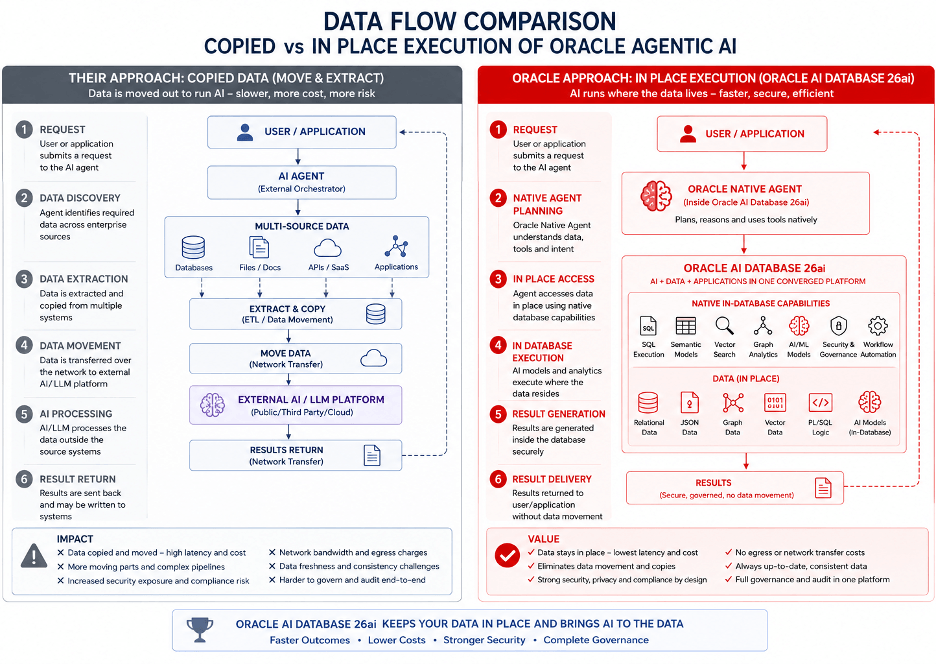
Chart 2: Copied vs. in-place Execution of Oracle Agentic AI
While all major vendors are pursuing agentic AI, their approaches differ materially. Analytics‑first platforms emphasize insight generation but lack operational depth. Data science platforms prioritize experimentation over production governance. Cloud toolkits offer flexibility at the cost of integration overhead.
Oracle differentiates itself by embedding autonomous execution into the same database systems that already run enterprise operations. The following comparisons of data flows and AI Agent control planes across multiple vendors make clear Oracle’s Agentic AI advantages.
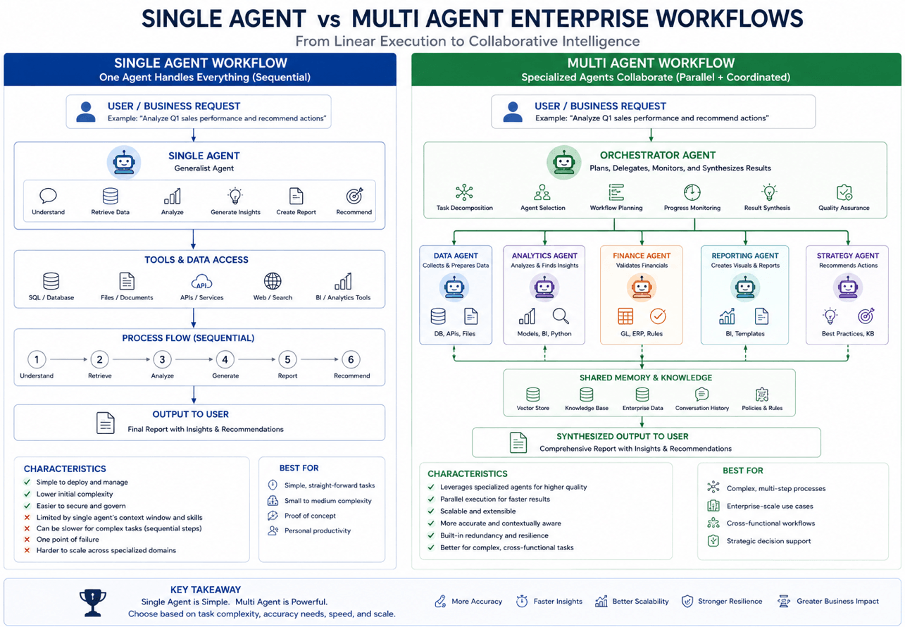
Chart 3: Single Agent vs. Multi-Agent Workflows
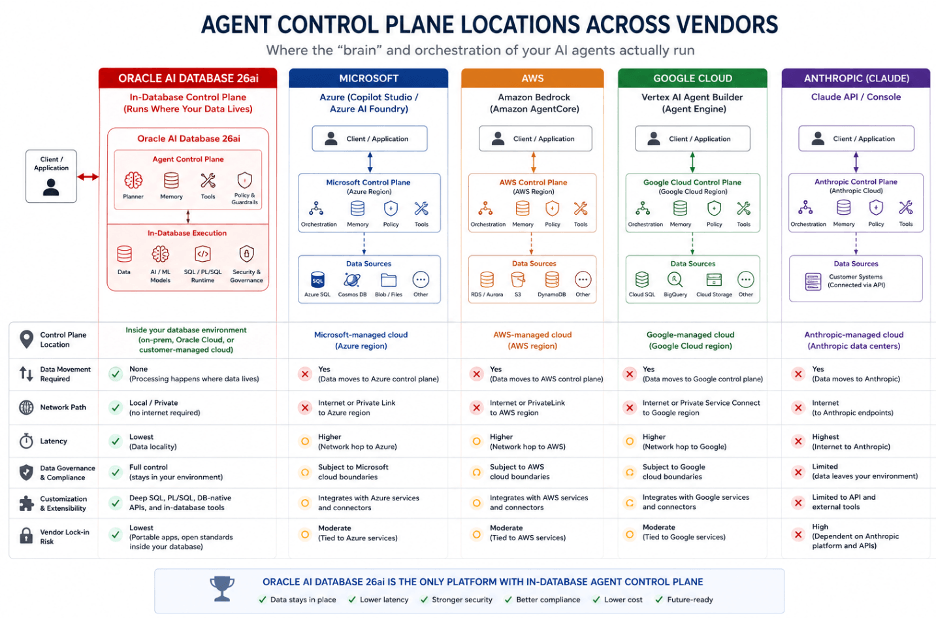
Chart 4: Agent Control Planes Locations Across Vendors
Conclusion
Oracle’s in-database Agentic AI is a smart, practical implementation. It minimizes risk, accelerates innovation, mitigates lock-in, and quickly monetizes AI investment with proprietary data. It is leaps and bounds more effective than their competitors.
Just as Oracle has changed the database game, the autonomous database game, the multi-cloud game, and the data lake game, they have now done the same for the Agentic AI game. For enterprises seeking to move beyond AI experimentation toward trusted automation, Oracle AI Database’s built-in Agentic AI capabilities represent the most integrated option currently available. Based on this detailed research, it is recommended that organizations take advantage of the self-driving Oracle Autonomous AI Database, letting it do all the work and see the difference for themselves.
For More Information on Oracle Agentic AI Agents
Go to: Oracle AI Database Delivers Mission Critical Agentic AI Built for Business Data