The AI industry is chasing the wrong prize.
For the past several years, the dominant narrative has been AGI, then superintelligence, then what we’ve called Messiah AGI. But we believe that race has moved past the point of practical enterprise relevance. The real economic prize is not generalized intelligence in the abstract. It is Enterprise AGI – intelligence that is unique to, governed by and owned by each enterprise.
Frontier model vendors have clearly pivoted toward enterprise customers because that is where the money is. But in our view, many have not pivoted architecturally. They are still trying to concentrate ever more intelligence inside generalized models. Those models are extraordinarily powerful, and they will remain foundational to enterprise AI. But generalized intelligence that is broadly available to everyone does not create durable enterprise advantage.
If every company gets access to the same built-in intelligence, the floor rises for everyone. But differentiation does not accrue at the firm level.
That is what we call “data communism.” The world’s best experts contribute reasoning traces, those traces get absorbed into frontier models, and the resulting intelligence is redistributed to the market. It is a powerful common capability layer. But common capability is not competitive advantage.
The alternative is “data capitalism.” In this model, the enterprise captures its own data, business processes, policies, operating rules, skills and tacit knowledge as governed corporate assets. Models and agents can then reason over those assets and act accordingly. The intelligence is not generic. It is particular to the enterprise.
This is the heart of Enterprise AGI.
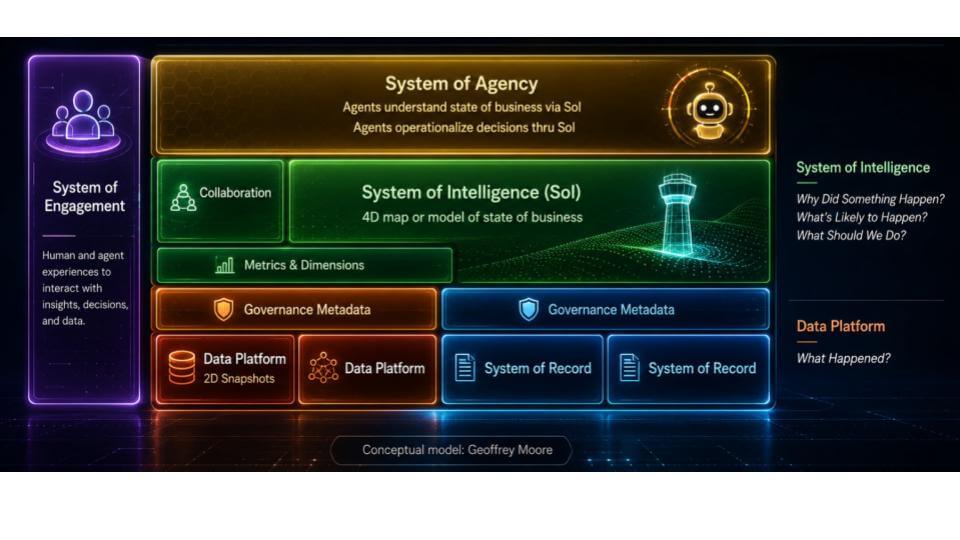
The system of intelligence becomes the new control point. Think of it as an enterprise ontology, digital twin or living business model. Data platforms and systems of record tell us what happened. The system of intelligence explains why it happened, what is likely to happen and what should be done next. The system of agency lets agents act through that intelligence. The system of engagement becomes the new work surface where people express intent, resolve ambiguity, approve actions and teach the intelligent back end.
This is why the enterprise AI stack is being reshaped as shown below:
Databricks‘ recent moves are a useful signal. The company is no longer merely positioning as data infrastructure. It is moving up the stack into engagement, intelligence and agency. Genie One is the business-user agentic client. The broader family of Genies extends data-aware coworkers to developers, data engineers, analysts, app builders and agent creators. Genie Ontology is the emerging intelligent back end. Agent Bricks, Unity Catalog, Unity AI Gateway and Omnigent begin to build, govern and connect agentic work.
The Databricks story is more than a bunch of product announcements – it’s actually architectural. The company is attempting to turn governed data into a governed model of enterprise meaning.
Genie Ontology is central to that effort. Its current strength is semantic harmonization – helping organizations agree on what their data means. It can extract knowledge snippets from tables, dashboards, queries, pipelines, metric views, documents and connected applications. It can “rank” those snippets based on provenance, authority, usage frequency, freshness and links to certified assets. In simple terms, it is trying to answer questions like: Which revenue number is the right one? What does “active user” mean? Which dashboard is trusted? How should this metric be calculated?
That sounds basic. It is not.
Most enterprises are filled with duplicated metrics, conflicting definitions and disconnected versions of truth. AI agents operating on that foundation will produce plausible jibberish. They may have access, but they will not have understanding.
The key architectural insight is that the ontology can learn from the bottom up. Users ask questions. They use company-specific language. They accept, reject and correct answers. They clarify terms. A user may ask, “Show me lost revenue from platinum customer segment.” Rather than guessing, a governed system can ask: “How do you define platinum customer?” If the user responds that platinum customers are accounts generating more than $10,000 in revenue in any given month, that answer can become reusable enterprise context.
This is why the client – or user surface – is so critical. The system of engagement is not just a front end. It is a teaching mechanism. Whoever owns the agentic work surface captures the queries, ambiguities, corrections and clarifications that make the system of intelligence smarter.
But bottom-up learning has a ceiling.
Behavior can reveal structure, vocabulary, common metrics and recurring patterns. It cannot reliably tell the system what must happen, what must not happen, which policy takes precedence or why a rule exists. That is where Enterprise AGI gets hard. The ontology must evolve from descriptive semantics into executable business logic. It must represent actions, preconditions, effects, permissions, workflows, policies and live state.
Our assessment is that Databricks Genie Ontology sits roughly around levels 5 to 6 on an ontology maturity curve – moving from predictive analytics toward an enterprise knowledge graph. That is meaningful, but the harder jump is from semantic context to agent coordination. To reach higher maturity, enterprises need a hybrid model that is bottom-up skill harvesting combined with top-down governance.
This is where user-authored skills become important. Agents are emerging first through personal productivity. People will build local prompts, automations and skills that encode how work gets done. But if those skills remain local, the enterprise gets fragmented…again. The solution is a promotion pipeline – i.e., author locally, abstract the skill, route it by risk, review it through governance and promote it into shared business logic when appropriate.
Pure bottom-up becomes a Tower of Babel. Pure top-down takes too long and becomes obsolete. The best model meets in the middle, in our view.
This is also why the broader competitive race is so intense. Frontier model vendors are entering through engagement – chat, copilots and coding agents. Data platforms such as Databricks and
@Snowflake are moving up from governed data into semantics and ontology. SaaS and process vendors such as @salesforce, @SAP, @PalantirTech, @Celonis, @BlueYonder and @RelationalAI are entering from systems of record, workflows and business processes. Hyperscalers such as @Microsoft, @Google and AWS want to own the control plane.
All are converging on the same prize – a high-value piece of real estate we call the “system of intelligence.”
A list of connectors is not enough. Connectors give agents access to applications and data. They do not give agents a map of how the business works. A connector to Salesforce does not explain how the enterprise defines a qualified lead. A connector to SharePoint does not identify the authoritative policy. A connector to Slack does not know which escalation rule applies.
Enterprise AGI requires both adaptive intelligence and deterministic intelligence. LLMs provide adaptive intelligence – reasoning, language, code, planning and flexibility. The system of intelligence provides deterministic intelligence – rules, policies, permissions, state, relationships, workflows and tacit knowledge. The enterprise needs both.
The economics will follow the architecture. Enterprise software is splitting into two categories. Below the ice sits infrastructure – data platforms, storage, compute, formats, pipelines and procedural software. These layers remain essential, but they increasingly face utility-style economics. Above the ice is where value concentrates – the modeled enterprise, the system of intelligence, the agentic applications and the engagement surfaces that learn the business and improve outcomes.
Data becomes the new hardware. The business-process model becomes the platform. Agents become the applications.
The action item for executives is clear: to stop treating AI as a model-selection exercise. Treat it as an enterprise-intelligence construction project. Pick one high-value domain. Model the critical objects. Define authoritative metrics. Harvest user-authored skills. Govern the rules. Connect agents only where the enterprise has enough context to act safely.
The companies that do this will see proprietary advantage. Those that simply plug frontier models into fragmented systems will rent generic intelligence and call it transformation.