Databricks’ most important story at Data + AI Summit was not just the number of announcements. The architecture is what got most of our attention.
We believe the company is trying to move from a data platform to an enterprise intelligence platform – and that distinction implies @alighodsi is going after a bigger prize.
For years, Databricks has been known for lakehouse architecture, open formats, data engineering, AI/ML workloads and governance. Those remain fundamental, but increasingly, they are infrastructure at lower layers of the stack. Necessary, powerful, valuable – but not necessarily where the next wave of enterprise software value will concentrate.
The strategic prize is higher up the stack.
The emerging AI stack has three critical layers on top of systems of analytics and systems of record:
- The system of engagement – where users express intent;
- The system of intelligence – where enterprise context, meaning and business logic live (governance included);
- The system of agency – where agents act through that context.
At Data + AI Summit, @databricks showed it wants to compete across all three.
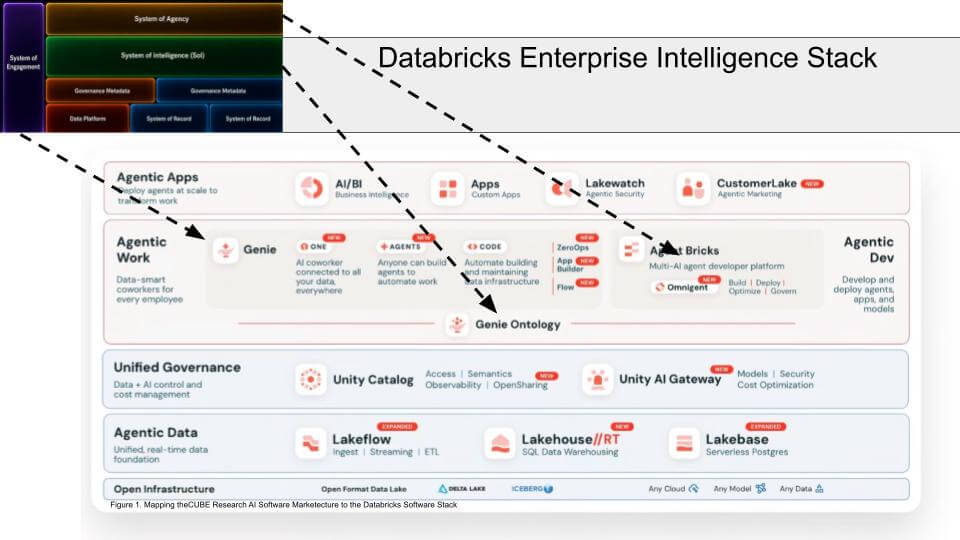
Genie is the system of engagement. Genie Ontology is the emerging system of intelligence. Agent Bricks, Unity AI Gateway and Omnigent begin to form the system of agency and governance fabric. Put together, these represent Databricks’ attempt to build a new enterprise intelligence stack.
This is the same strategic direction we see across the market.
@Snowflake is making similar moves, although our view is that Databricks’ vision currently looks more comprehensive on paper. The reason firms are going after this prize is that modern data platforms know that infrastructure alone is not enough. The higher-value play is turning governed data into business context, and then turning that context into agentic action.
Genie One is the business-user front end. It looks like an analytics workspace, but that understates its importance. Genie One is better understood as a data-aware coworker that connects users to dashboards, apps, Genie Spaces, governed tables and business metrics. Because it is anchored in business data, the user interface becomes a source of signal and intent. It captures how people ask questions, clarify ambiguity, consume answers and resolve conflicts.
This becomes highly strategic.
In the old BI world, the interface delivered dashboards and reports. In the agentic world, the interface teaches the back end. Every question, correction, clarification and accepted or rejected answer can improve the enterprise map. This is why owning the system of engagement is so important. The front end is no longer just a window into data. It is part of a “learning loop.”
Databricks is also extending the Genie pattern beyond business users. Code, ZeroOps, Agents, App Builder and Flow are role-specific coworkers tuned around the Databricks environment. A generic coding assistant can write code. A Databricks-aware coding assistant can understand Databricks assets, pipelines, governance and workflows. A generic ops assistant can summarize logs. A Databricks-aware ZeroOps assistant can diagnose and potentially remediate issues in the Databricks environment with less supervision.
That role-specific focus hints toward the broader Enterprise AGI architecture.
Just as Databricks can post-train or tune agents around its own environment, every enterprise will need agents that understand its environment. That means understanding the company’s data, entities, relationships, policies, metrics, workflows, approvals and operating constraints. In other words, the enterprise needs a map.
That is where Genie Ontology becomes strategically important.
Genie Ontology sits in the middle of the Databricks stack as the emerging system of intelligence. In our framework, the system of intelligence is the map of the enterprise. It gives agentic clients the context to navigate business meaning and gives agents the confidence to act. Today, Genie Ontology appears to be an early step toward what we call an enterprise “digital twin.” It is strongest as a semantic and contextual layer over governed data – a way to represent definitions, metrics, trusted sources and relationships. It is not yet a complete operational model of the enterprise. But in our view, it is a deliberate move in that direction.
Above the ontology sits the agency layer. Agent Bricks is becoming a platform to build, deploy, optimize and govern agents. Unity AI Gateway provides policy, routing, model governance, access control, tracing and cost controls. Omnigent connects third-party agentic clients and coding assistants back into Databricks governance. Unity Catalog remains the governance foundation that ties data and AI assets together.
This is where the stack starts to converge around the system of intelligence.
The ontology provides the map. Genie uses the map to help users work with business context. Agent Bricks builds agents that can operationalize decisions. Unity governs what is allowed. Omnigent acknowledges that enterprises will use many agentic clients, not just Databricks-native experiences.
If these layers are tightly co-designed, they reinforce one another, and Databricks moves beyond data infrastructure to become an enterprise intelligence platform.
But three big questions remain.
- First, how deeply are engagement and intelligence co-designed? The client should not merely query the ontology. It should teach it. Questions, corrections, clarifications and accepted or rejected answers should improve the enterprise map. That idea is strongest when Databricks owns the client experience. It becomes murkier when third-party clients sit in front of the Databricks back end.
- Second, how far can Genie Ontology evolve? Semantic harmonization is valuable, but Enterprise AGI requires more. It needs a governed, executable model of how the business operates – including actions, preconditions, effects, policies, workflows and live state. Databricks has important ingredients, but the full system of intelligence is still emerging.
- Third, where does the value line get drawn? Databricks and others are trying to make data formats and infrastructure less visible. Customers should not have to care whether the format is Delta or Iceberg. That is meaningful progress. But it also pushes infrastructure toward hardware-like economics – necessary, powerful and increasingly standardized. The differentiating platform becomes the ontology or digital twin. The applications on top become agents.
That is the strategic chess move Databricks is attempting.
If it works, Databricks will not merely help enterprises store, govern and analyze data. It will help them model how the business works – and let humans and agents act through that model.
Our bet: This is the real Enterprise AGI race. Not the race to put all intelligence into one frontier model. The race to turn each enterprise’s own data, processes, rules and tacit knowledge into a governed system of intelligence.
The key test for Databricks is whether Genie, Genie Ontology, Agent Bricks, Unity Catalog, Unity AI Gateway and Omnigent become a self-reinforcing system – one that learns how each enterprise operates and uses that knowledge to support coordinated action by humans and agents.
If Databricks pulls that off, it moves from leading data platform to enterprise intelligence platform.
And that is where the next major software value pool is forming.