The enterprise AI race may come down to the best frontier model. But it’s likely we’ll need more than a smart LLM and a popular copilot.
The bigger race is about who can build the most comprehensive real-time model of how an enterprise actually works – its data, entities, relationships, metrics, policies, workflows, decision rights and live operating state.
That is what we mean by a system of intelligence (SoI).
In our latest Breaking Analysis, we put Databricks’ Genie Ontology on a nine-stage ontology maturity curve. Our view is that Databricks is in a meaningful position, but not yet at the upper end of what we call “Enterprise AGI.” We place Genie Ontology roughly around levels 5 to 6 – the transition from diagnostic intelligence toward agent coordination.
That is a strong place to be relative to most enterprise data environments. But the next jump is the hard one.
The governing principle is the following:
The richer and more faithful the enterprise model, the more sophisticated the analytics – and the broader and more confident the agentic action.
At the lower levels, the enterprise is still mostly reporting on what happened. At the higher levels, humans and agents coordinate through a live model of the business.
That is the difference between disconnected analytics and organic Enterprise AGI.
The Nine Stages
The maturity curve starts with siloed reporting and ends with autonomous operations (see diagram below):
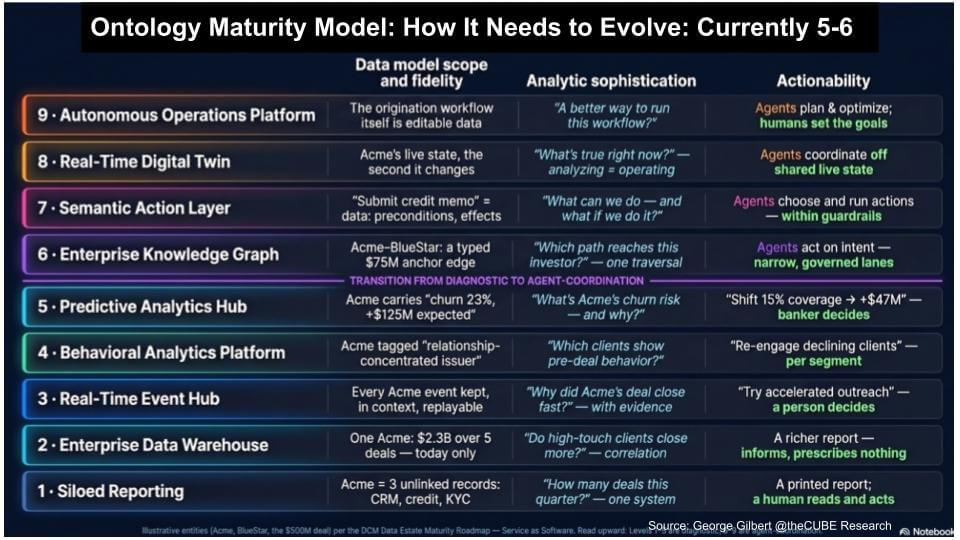
Levels 1 to 5 are mostly diagnostic.
At level 1, reporting is siloed. Customer records live in separate systems. CRM, credit, KYC, finance and support may each have their own version of the customer. A human reads a report and decides what to do.
At level 2, the enterprise data warehouse improves correlations. At level 3, the system captures events in more context. At level 4, behavioral analytics start to emerge. By level 5, predictive analytics can more accurately answer questions such as What is this customer’s churn risk, and why?
That is unquestionably useful and state of the art today. The system might recommend shifting sales coverage or prioritizing an outreach motion. But a human still decides.
This is where we think Genie Ontology is increasingly relevant.
Databricks has moved beyond a basic BI semantic layer. Genie Ontology can learn business terms, metrics, authoritative sources, entities and relationships from governed data and usage patterns. It can help the enterprise agree on what data means – which revenue number is authoritative, how a KPI is defined, which metric view should be trusted and which data source should ground a response.
That is a big step. But it is still largely descriptive.
Level 6: The Enterprise Knowledge Graph
Level 6 is where the system begins to look like an enterprise knowledge graph.
People, resources, accounts, products, transactions and relationships are connected. The system can reason over paths. For example, who can reach this investor? Which relationship matters most? Which account is connected to which opportunity? Which resource is tied to which business process?
At this level, agents can start acting on intent – but only in narrow, governed lanes.
That is why we describe Databricks as sitting around levels 5 to 6. Genie Ontology is meaningful. It is more than traditional reporting metadata. But in our view, it does not yet fully meet the strict level 6 bar, where typed relationships are first-class declarative objects across the enterprise. And it does not yet implement the higher levels where actions, policies, workflows and live state become part of the ontology itself.
Level 7: The Semantic Action Layer
The real inflection comes at level 7.
At level 7, actions become modeled data.
A command such as “submit credit memo,” “reassign sales coverage,” “approve discount,” “open fraud investigation” or “change shipment priority” is no longer just a workflow button in an application. It becomes part of the semantic action layer.
The system understands the following:
- What the action means
- When it is allowed
- What preconditions must be met
- What downstream effects it creates
- Which permissions apply
- Which policies govern it
- Which human approvals are required
- Which systems of record must be updated
This is when agents move from recommending actions to choosing and running actions within guardrails.
That requires a richer model than bottom-up semantic inference alone can provide.
Level 8: The Real-Time Digital Twin
At level 8, the ontology becomes a real-time digital twin.
The twin is not merely querying operational systems for data. It becomes the shared source of truth for the live operating state of the business.
Analysis and operation begin to converge.
The system can answer what is true right now, not just what was true in a warehouse snapshot. Agents coordinate from a shared deterministic state rather than sending messages to each other through an orchestrator that becomes a single point of failure.
This means real enterprise work is more than a set of disconnected prompts. It is multi-step, multi-agent, multi-system coordination under constraints.
Without shared state, agents become unstable.
Level 9: Autonomous Operations
At level 9, the workflow itself becomes editable data.
Agents can plan, optimize and adjust operations while humans set objectives, constraints and goals.
That is not “one person running a billion-dollar company with a swarm of bots.” That is a different idea. It is a management substrate where humans and agents coordinate around shared goals, live state, governed policies and executable workflows.
That is the upper end of Enterprise AGI.
Why the Jump From 5-6 to 7-9 Is So Hard
Bottom-up inference can take the enterprise a long way.
It can learn types, joins, vocabulary, common metrics, usage patterns, authoritative dashboards and some rule-like semantics. It can infer that users prefer a particular metric for a particular question. It can learn that “active customer” has a certain meaning in a domain. It can discover which table is most trusted for revenue.
But behavior shows what happened.
It does not reliably tell the system what is required.
A query log cannot know which remediation action is allowed. A dashboard cannot know which approval is mandatory. A chat history cannot know which policy wins when two rules conflict. Behavioral exhaust cannot fully explain why a process exists or what must never happen.
That is why the higher levels require explicit teaching, business-process modeling, governance and human-in-the-loop validation.
This is also why forward-deployed AI engineering becomes important. Moving from descriptive ontology to executable ontology takes people who can help customers capture operating logic, clarify business rules, connect processes to governed data and promote local knowledge into shared enterprise assets.
Automation will reduce the amount of manual modeling. But at the upper levels, business-process meaning still has to be taught, authored, governed and validated.
Where Databricks Goes From Here
Databricks has important ingredients.
Genie Ontology provides the semantic and contextual layer. Unity Catalog provides governance. Agent Bricks supports agent development. Unity AI Gateway supports policy, access, model governance, routing, telemetry and cost controls. MCP tools and Lakebase can help connect agents to tools and operational state.
The open question is whether these capabilities converge into one system of intelligence – or remain separate product islands.
To own the system of intelligence, Genie Ontology must evolve from a semantic knowledge layer into a governed operational model. It must move from understanding metrics and entities to understanding actions, policies, workflows, state and decision rights.
That is the leap from better analytics to Enterprise AGI.
The broader market is moving in this direction. Palantir, Microsoft FabricIQ, Celonis, RelationalAI, SAP Business Data Cloud and Salesforce Data 360 are all attacking pieces of the process and ontology problem. Some encode process context out of the box. Others rely more on explicit authoring. The common theme is that advanced ontologies cannot simply be learned from observation. They must be constructed.
Bottom Line
Databricks is at a meaningful point on the maturity curve – roughly levels 5 to 6 in our taxonomy.
That is not meant to be a dismissal. Databricks’ vision and product roadmap are strong. This is rather a recognition that Genie Ontology is already ahead of many enterprise data environments because it starts to harmonize meaning across governed data and usage.
But the next jump is harder.
To reach the higher levels of Enterprise AGI, Databricks must evolve Genie Ontology from a descriptive semantic layer into a governed, executable model of business actions, policies, workflows and live state.
That is where the enterprise AI race gets real.
Not in the chatbot.
Not in the dashboard.
Not even in the model.
In the enterprise map that tells agents what the business means, what is allowed, what should happen next and how to act safely through the systems that run the company.
What do you think? Will firms like Databricks, Palantir, Snowflake, Salesforce, ServiceNow and other existing players win this race? Or will the frontier model vendors like Anthropic and OpenAI make it so simple to adopt AI that they’ll be able to suck all the process knowledge out of existing apps and workflows – and via partnerships and M&A – dominate the emerging AI software stack?